
What is Web Development? A Beginner’s Guide to Website Building 2026-2027
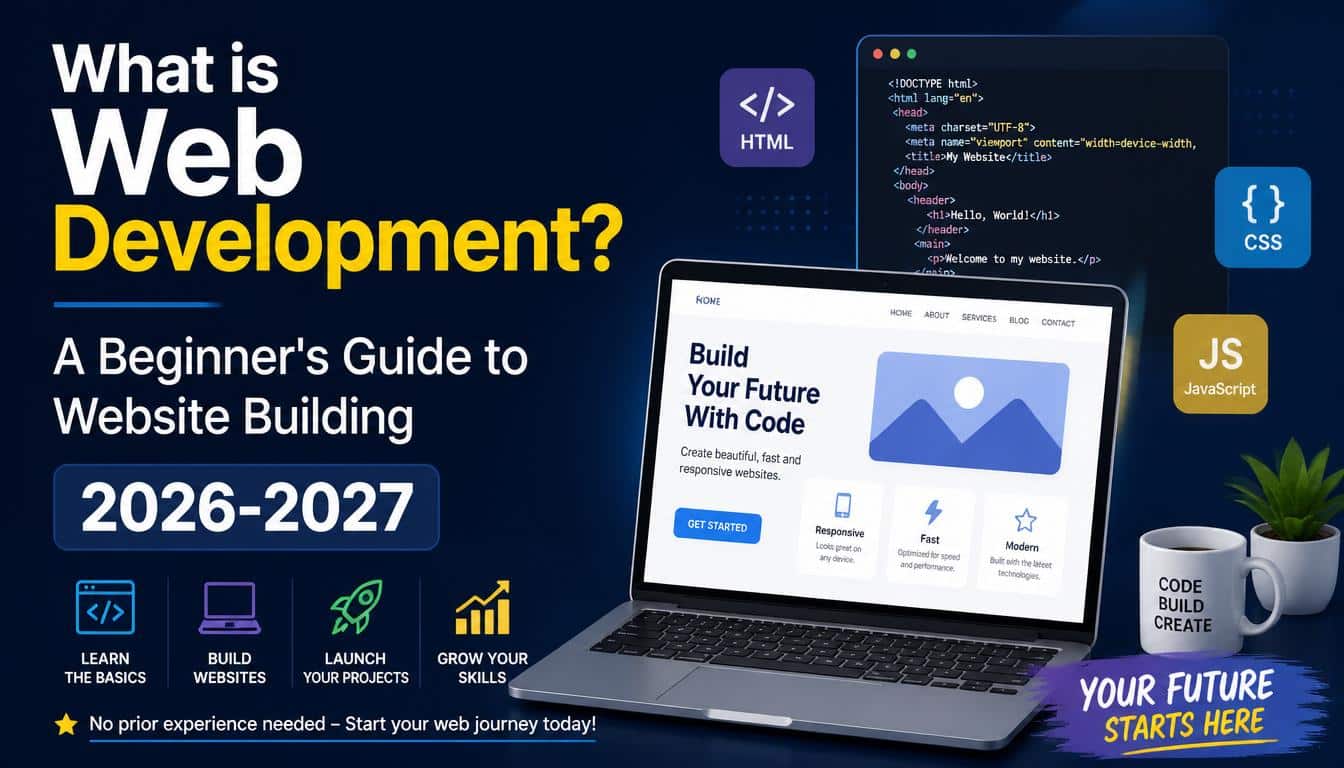
Web development is the procedure of making and updating sites with the use of tools like a content management system (CMS) and languages like HTML, PHP, as well as JavaScript.
Different from online design, web development focuses on the behind-the-scenes functioning of a website. The aesthetics of a website are a primary focus of web design. Having a working knowledge of web programming is useful.
However, content management systems (CMSs) like Wix and WordPress have made website creation accessible to consumers without technical expertise.
The procedure of designing, developing, and updating a website is known as web development, which can range from a simple text page to a complex social network program. A web development company plays a crucial role in ensuring that these sites and applications are functional, user-friendly, and high-performing.
A web developer’s job is to make reliable as well as high-performing websites, apps, and services for the World Wide Web. A web developer may specialize in one of numerous distinct areas of web development. Front-end, back-end and full-stack development are the three most common approaches to creating websites.
What types of web development are there?
Many developers focus on one particular subfield. Different developers focus on different aspects of a site, such as the user interface, the backend programming that makes the site functioning, or both. There are many distinct kinds of website developers, each specializing in another component of the development process.
Some specialists write client-side code for responsive sites, others build server-side logic and databases, and a full-stack developer handles both. Specialized paths include mobile development, e-commerce development, CMS development and game development.
Beyond these, desktop development builds locally run software, embedded development targets IoT and consumer devices, and security development relies on ethical hacking to find vulnerabilities. Website development focuses purely on sites rather than mobile apps or games. Each path calls for its own set of abilities. Various forms of web design include:
Front-end development
In order for visitors to see & interact with a website, front-end developers must first craft its user interface using markup languages like HTML, CSS, & JavaScript. Each language plays its own part in the build. HTML forms the backbone through headings, paragraphs, links and images, styling controls colors and fonts, while client-side scripting powers dropdowns, sliders, animations and real-time form validation.
Modern workflows add jQuery or Svelte for richer behavior, Bootstrap or Tailwind for faster design work, and Vite or Webpack to bundle code. Finally, Lighthouse and DevTools help audit accessibility and Core Web Vitals before launch.
Back-end development
Back-end development is the process of building the invisible parts of a website, or the server-side software. Developers who work on the website’s “back end,” or its databases, logic, APIs, architecture, & servers, are responsible for the site’s smooth operation.
To keep things reliable, developers pick a language plus a toolkit, such as PHP with Laravel or Symfony. Records usually sit in relational databases like MySQL and PostgreSQL, while NoSQL options like MongoDB and Redis handle flexible data.
That information reaches the front end through REST or GraphQL endpoints exchanging JSON. Teams then run unit testing and integration testing, deploy with containers on AWS, Azure or GCP, and add caching and load balancing.
Full-stack development
When developing a web application, full-stack developers focus on both the front as well as back ends. On the client side, they shape the UI and overall user experience; on the server side, they write server-side code, manage the database, and connect the two sides so information flows smoothly between them.
A popular route is JavaScript everywhere: React or Next.js in the browser and Node.js with Express on the server. Daily tooling often includes Git, GitHub, Docker for packaging, Postman for testing endpoints, and Vercel or Netlify for hosting.
Because they understand both halves, these developers spot performance issues early, speed up debugging, and help designers and back-end developers understand each other’s work. Even so, most still lean toward one side depending on the assignment.
Website development

Web development refers to the steps taken to plan, design, and launch a website. Work usually begins by meeting clients and stakeholders to agree on purpose, content and scope. Designers then turn those notes into mockups in Adobe XD or Sketch, so everyone can approve the look and feel before coding starts.
During the build, developers write semantic HTML, apply responsive design so the site adapts to all devices, and track every change through version control. Teams wanting speed lean on themes, templates and plugins from Drupal, Joomla or Webflow.
Before going live, developers check speed with PageSpeed Insights and add alt text, titles and metadata so search engines understand each screen. After release, monitoring traffic and regular security audits keep the site healthy and protected.
Desktop development
Developing desktop software includes its design, construction, and maintenance. Its primary goal is software creation for the three most widely used platforms: Linux, Windows, and macOS.
Unlike browser-based tools, these programs run locally on the computer, yet the know-how overlaps with web work whenever an application operates both online and offline. Common languages include C++ for raw performance and TypeScript for cross-platform interfaces.
Web technology now blurs the line. Tools built on a JavaScript runtime let developers reuse web skills and ship one codebase to all three platforms; VS Code is a well-known example of a desktop editor created this way.
Mobile development
Developing a site’s compatibility with mobile devices entails its construction, design, and upkeep. This specialty took off after the iPhone arrived in 2007 and made phones a new medium for browsing. Designers answered with responsive web design, letting one site reshape for every screen, and many teams now start with mobile-first layouts.
Developers can choose between two routes. Native Android apps demand specialized languages and a separate skill set, while progressive web apps let a normal website be installed as an independent application with offline access.
Phones often run on slower connections, so every kilobyte matters. Optimized images, SVGs and code splitting shrink downloads, while Largest Contentful Paint and Interaction to Next Paint reveal how quickly each screen loads and responds to a tap.
Game development
Crafting games for personal computers, online platforms, and handheld devices. The field spans console titles for Xbox and PlayStation, PC releases and mobile hits, so the craft overlaps heavily with mobile work. On the web, many lightweight games run directly inside Chrome, Firefox or Edge using plain JavaScript.
For richer visuals, developers reach for WebGL, which taps the graphics card, and libraries like Three.js that simplify building immersive 3D worlds. Fast engines such as Chrome’s V8 engine help game scripts run quickly during complex scenes.
Multiplayer titles add another layer. WebSocket connections push moves between players in milliseconds, supporting real-time apps such as live matches, while cloud computing lets studios scale game sessions up or down as player numbers rise and fall.
Embedded development
Embedded development is the process of making software for embedded systems like medical gadgets, drones, flight controllers, etc., utilizing languages like C and C++ to do so. Unlike typical apps, this code lives directly on hardware, often without full operating systems, so every byte of memory counts. Many devices are real-time systems that must react to sensor readings instantly, which makes attention to detail essential.
Connectivity is reshaping the field. Smart thermostats, wearables and factory sensors now exchange readings over lightweight protocol standards such as MQTT or plain HTTP, so cybersecurity and protecting data sit at the heart of each design.
If you’re looking for a Programming & Frameworks solution that can build on and integrate with Customer insights, then the Full Stack Online Training platform is the best choice.
Who is a web developer?

A web developer is someone who makes websites and other web-based software. The design, functionality and features of the website all fall under their purview. Web developers typically have a wide range of experience with several languages. Beyond languages, the role rests on soft skills. Problem-solving helps trace stubborn bugs, clear communication keeps clients aligned, and strong time management juggles deadlines, while detail orientation matters because one misplaced symbol can break an entire page.
There is no single route in. According to Zippia, 71% of these professionals hold a bachelor’s degree, and computer science is the most common major at 43%. Others rely on bootcamps, online courses and a strong portfolio instead.
The effort tends to pay off. The Bureau of Labor Statistics reports a U.S. median salary of $95,380, and the agency projects 7% growth in employment through 2034, faster than average for all occupations.
What are the five stages of website development?
Create a Design
The best thing is being a part of the creative process. The customer may have an initial discussion regarding the website’s layout, colors, functionality, unique features (like eCommerce), images, videos, and more. When meeting with the creative team, it is always a good idea for the customer to bring in some examples of websites that they find appealing. After that meeting, the design group works on a 2D illustration of the concept. In some cases, a website builder can also help turn these early mockups into functional layouts more quickly, making collaboration between designers and developers smoother.
Examine Properly
After much deliberation, the team is ready to show the client the finished site. In most cases, a live demonstration is required. More deliberation on the structure, hues, and particulars takes place at this stage. Since the client’s feedback usually leads to some sort of adjustment, it’s likely that more meetings will follow.
Creation
After getting final approval on the site’s design, it’s time to hand it over to the programmers. The developer initiates development of the site on the production server so that customers can view it online before making it publicly available. During this phase, the creative team collaborates with the copywriter as well as other departments to polish the website’s tone, content, and visuals. This is typically the most labor-intensive part of the process, yet it is also one of the most important.
Testing
Testing the new site on the test server is the next step after the developer has completed the code and the customer has finalized all content. The customer receives a link to the site that they can then distribute to other members of the decision-making team. There may be a few tweaks the customer wants to make before we launch the site.
Launching
It’s launch time for the brand-new site! Once the customer provides the go-ahead, the developer will start the launch process. Buying a domain name and signing up for web hosting fall under this category. It will take a moment for the message to spread.
What do I need to know to become a web developer?
If you’d like to work as a web developer, you need to know HTML, CSS, and JavaScript. It’s a good idea to brush up on your CSS and CSS framework skills. These fundamental web development skills equip you with the knowledge and logic required to effectively interact with programming languages.
Before writing code, newcomers benefit from general computer skills, internet basics, analytical thinking and clear goals. A machine with 8GB RAM, a stable internet connection and editors like Sublime Text or Visual Studio Code is enough to begin.
Structured lessons help next. Free options include Learn HTML, Learn CSS and Learn JavaScript, alongside freeCodeCamp, Codecademy and MDN. Finally, show you can use AI assistants while keeping code quality high, something employers increasingly notice.
How to Become a Web Developer in 6 Easy Steps
- Master the foundations of web design.
- Master your chosen field.
- Acquire some knowledge of appropriate programming languages.
- Project work is a great way to hone your abilities.
- Make a sample of your work and submit it.
- Master the fundamentals of user interface and seamlessly enhance your skills with specialized user experience training.
What are the responsibilities of a web developer?
A web developer’s potential tasks are:
- Make a model of a new software you want to develop using JavaScript or PHP.
- Create a plan for the infrastructure of the software, including testing in multiple browsers and operating systems, the use of the most appropriate technologies, and the selection of programming languages.
- Problem-solving.
- Fixing project bugs.
- Verify the functionality of new features by testing them.
- Establishing performance standards.
- Look at the code your fellow employees have written and make sure it works.
- Create data-exchanging APIs for developers to use; take advantage of and contribute to open-source
- Get updates on ongoing initiatives by consulting with the people designing and developing them.
- Ask customers and users for feedback.
- Always be learning and adapting to the latest tools, frameworks, and languages.
- Never stop learning about new techniques in web design and development.
- Production and upkeep of databases.
- Use standard coding conventions and thorough documentation to ensure that future developers can easily understand your work.
- Create the site’s or app’s data structure.
- Participate in as well as speak at web development events.
What are the advantages of learning web development?
Learning web design has several advantages.
- Jobs in web development are plentiful.
- Superb pay.
- You have the flexibility to work away from the office.
- You have the option of joining a forward-thinking tech firm like Google, Microsoft, Meta, etc.
- Freelancers can choose from a wide variety of jobs.
- Putting in time here seems like play.
On pay specifically, development pays more than design. Job-board figures put designer averages near $56,501, ranging from $31,211 to $102,285, while developer earnings start around $47,147 and climb well beyond the design ceiling over time.
The work is versatile. Developers build everything from personal sites and company sites to complex web apps, AI apps and automation tools, working in-house or freelance. Many are self-taught or bootcamp-trained, so a costly degree isn’t required.
What is the difference between a web designer and web developer?
Web developers create content for the World Wide Web. The functioning of a website is of paramount importance to a web developer. Additional areas of interest include functionality, style, language of code and art direction. Many businesses choose to work with a web design agency to ensure both aesthetics and performance are optimized.
Logos, images, and the overall look of a website are the work of a web designer. Adobe’s Illustrator and Photoshop are two of the most popular design programs used by web designers. Web designers who are also proficient in coding have an advantage when collaborating with developers.
| Aspect | Web Designer | Web Developer |
| Main focus | Look and feel, visual aesthetics and user experience | Functionality, technical performance and code |
| Key skills | Color theory, typography, layout and UX/UI principles | Programming, problem-solving, databases and server management |
| Common tools | Adobe XD, Sketch, Illustrator and Photoshop | Visual Studio Code, Git, GitHub, React and Node.js |
| Languages | Basic HTML and CSS | HTML, CSS, JavaScript, PHP and Python |
| Output | Mockups, wireframes and prototypes | Working websites, web apps and databases |
What are web development tools?
Having access to the right resources will help you learn web development more quickly. You’ll need a browser, a text editor, and a version control system to begin working on websites.
Web Browser
You may test the code in browsers. Web designers must accommodate a wide range of browsers. Firefox, Chrome, Edge, Brave, Safari, and Opera are the most popular web browsers for developers. A new user must concentrate on mastering one browser before moving on to others.
Editing Text
A text editor is where you will compose your code. There is a wide range of text editors available. Most computers come with at least one text editor; however, it’s worth investing in a better one. Web developers typically choose Atom, Sublime Text, Visual Studio Code, and Brackets as their text editor of choice.
Content Management System
Create, modify, and share your work with minimal effort with content management system software. With this system, you may manage every aspect of the site from a single interface. The CMS supplies the components (such as plugins and add-ons), and you write the code to assemble them. Many content management systems also provide aid in promoting and disseminating information. Often, they store their assortment of programs and utilities in a database (often MySQL or MariaDB). WordPress, Drupal, TYPO3, and Joomla are all examples of CMSs.
FAQs
1. What is web development?
Web development is the process of designing, building, and maintaining websites and web applications. It includes front-end development, back-end development, database management, and website optimization to ensure a fast, secure, and user-friendly experience.
2. What skills are required to become a web developer?
A web developer should understand HTML, CSS, JavaScript, responsive design, version control (Git), and at least one back-end language such as PHP, Python, or Node.js. Familiarity with frameworks and CMS platforms like WordPress is also beneficial.
3. What is the difference between front-end and back-end development?
Front-end development focuses on the visual elements users interact with, while back-end development handles server-side logic, databases, APIs, and application functionality. Full-stack developers work on both front-end and back-end technologies.
4. Which tools are commonly used in web development?
Popular web development tools include Visual Studio Code, Git, GitHub, Chrome Developer Tools, WordPress, Bootstrap, React, Node.js, and content management systems like WordPress and Drupal.
5. Is web development a good career in 2026?
Yes. Web development continues to be one of the most in-demand technology careers in 2026. Businesses of all sizes require skilled developers to build websites, web applications, and digital platforms, creating excellent opportunities for full-time employment and freelancing.
Read This Blog: https://gracethemes.com/free-rdp-server-provider/
Conclusion
Web development continues to be one of the most valuable and in-demand skills in 2026. Whether working for a digital agency, an in-house team, or as a freelance professional, web developers are responsible for creating secure, responsive, and high-performing websites that meet their clients’ goals. Their work often involves managing multiple projects, solving technical challenges, collaborating with designers and content creators, and ensuring websites deliver an excellent user experience across all devices. As technology continues to evolve, web developers must stay up to date with new programming languages, frameworks, security practices, and industry trends. Continuous learning and adaptability are essential for building modern websites that perform well and remain competitive. Whether you’re planning to become a web developer or simply want to understand how websites are built, learning the fundamentals of web development is an excellent investment that can open the door to countless career and business opportunities.
