
UX Design Firm vs Web App Interface Design: Two Different Hires
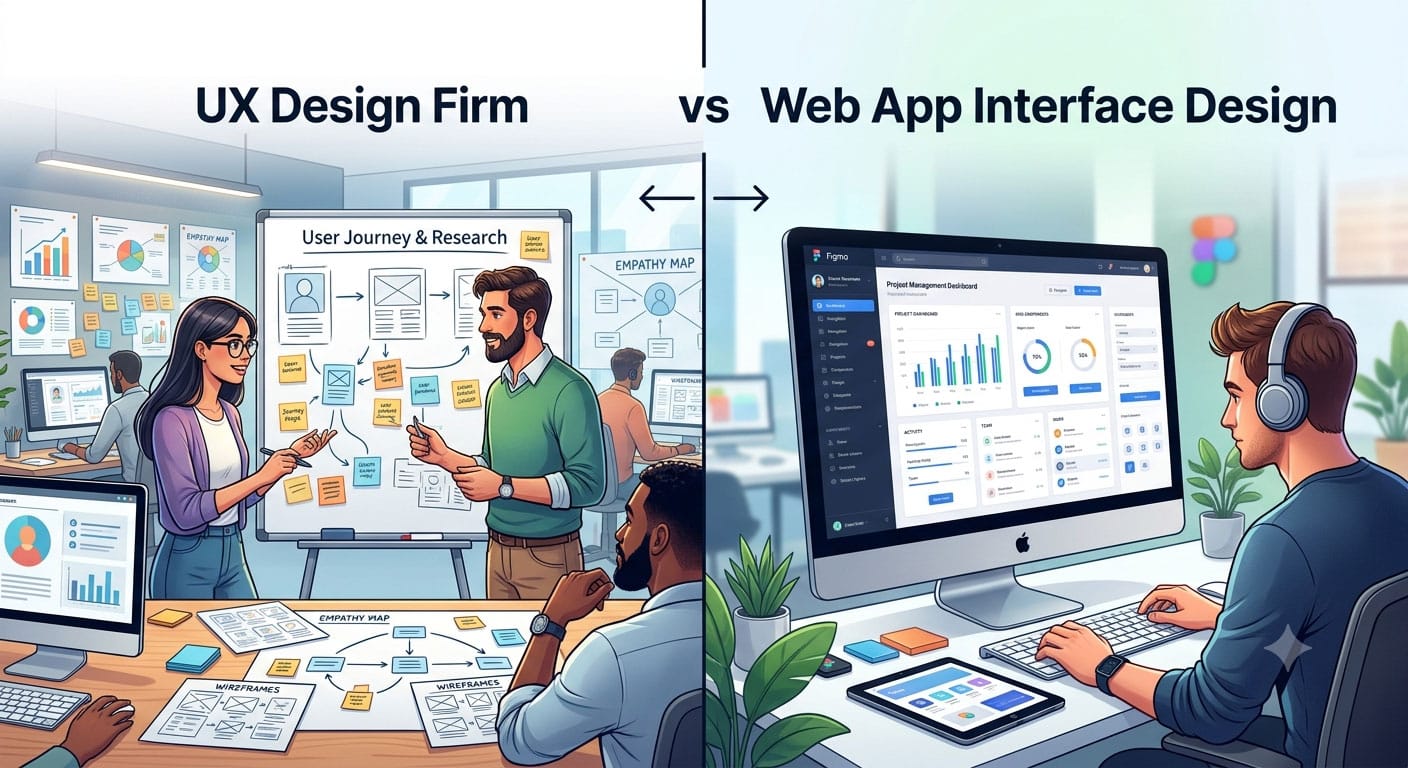
One hire studies what people need. The other decides how thousands of screen states behave. Briefing them the same way is why so many engagements disappoint.
Why it matters
- Research skills and interface systems skills sit in different people more often than buyers expect.
- A brief written for one hire produces weak work when handed to the other.
- Most products need both, and the order depends on whether the problem is known.
Two proposals arrive for the same product. One promises interviews, journey maps, and a tested prototype. The other promises a component library, documented states, and screens your engineers can build from this quarter.
Buyers often read these as competing bids for one job. In practice they describe two separate jobs. A UX design firm (https://phenomenonstudio.com/ui-ux-design-services/) answers what should exist and why, while interface work decides how the thing behaves once it exists.
This article separates the two hires by daily work, skills, briefs, and evidence, then covers the order to hire them in.
What a research-led hire does all day
A UX design firm spends most of its time outside the design tool. Recruiting participants and running sessions take more hours than drawing screens, and so does arguing about what the findings mean.
The output is a decision set. Which user group matters most, which tasks carry the business, and which features solve a problem people confirmed having.
The deliverable looks modest next to a visual design package. A prototype tested with eight people can change a roadmap more than fifty polished screens, and it rarely photographs well for a portfolio.
This hire works best when something is uncertain. New markets, new audiences, and features with weak adoption all give research something to bite on.
What interface work covers
Web app interface design starts where the direction is already agreed. The job is turning a flow into a system that survives real data and real edge cases.
Most of the work is invisible in a screenshot. Loading behavior and empty views consume more time than the layout, as do permission variations and the way a table handles five thousand rows.
The output is a component library with documented states plus the rules for combining them. Engineers should be able to build a screen nobody designed by following those rules.
Buyers underestimate how much of a research engagement is reading rather than drawing. Analytics and support transcripts feed the same picture, and a team that skips them starts from opinion.
This hire pays off when the product is growing. Every new feature inherits the system, so the tenth screen costs a fraction of the first.
How each hire behaves in week one
The opening week says more about a vendor than its proposal does.
A research team spends week one recruiting. Expect requests for customer lists, help with scheduling, and questions about which segments matter. If a vendor starts drawing screens instead, the research part of the engagement is decorative.
An interface team spends week one auditing. Expect a list of every component currently in the product, including the accidental duplicates, plus questions about your engineering stack.
A UX design firm that cannot describe its recruiting plan in week one usually subcontracts that part. Ask who runs the sessions before the contract starts.
Both weeks should end with something written. A research plan names the questions and the participants, while an audit names the inconsistencies and what they cost to fix.
Buyers can use this as a filter. Ask each vendor to describe day three of the engagement, since vague answers usually mean the first week is spent waiting for your team.
Skills that don’t transfer between them
Both roles sit under the same job titles in most listings, and the skills underneath diverge.
Research needs recruiting discipline and the patience to run a session that disproves the team’s favorite idea, all without leading the participant. Those are field skills, closer to qualitative research than to visual craft.
Interface systems need pattern discipline and naming conventions, plus an engineer’s instinct for what breaks. A designer strong here thinks in tokens and states rather than in individual pages.
Some people carry both, and they’re rarer than the market suggests. Assume a mixed team unless a portfolio shows research notes and a component library from the same project.
According to Deloitte, 83% of surveyed executives are using AI as part of their outsourced services. (Deloitte, 2024)
That shift adds a third pressure to interface work. Products now ship assistant panels and generated summaries with confidence indicators. None of those patterns existed in component libraries built three years ago.
Writing a brief each hire can use
A brief that works for research reads differently from one that works for interface design.
For a research engagement, describe the uncertainty. Name the decision you can’t make yet and the user groups involved, along with the evidence you already have. Avoid specifying screens, since that quietly turns research into decoration.
For interface work, describe the system. List the flows in scope and the roles that see them, plus the data volumes and platforms the product has to support. Name the engineering stack, because component conventions differ between frameworks.
Both briefs need one shared element. Write down the measure that should move, then let each hire explain how their work connects to it.
Buyers who send the same brief to both kinds of vendor get proposals that talk past each other, and the comparison becomes impossible.
What each hire needs from your engineers
Engineering involvement differs sharply between the two, and underestimating it delays both.
Research needs little engineering time, mostly analytics access and an occasional question about what the system can already do. One short session per week covers it.
Interface work needs engineers involved throughout. Sound web app interface design decisions depend on what the framework supports, how the data arrives, and which states the backend can produce. A designer working without that input specifies components nobody can build affordably.
Book that engineering time in the plan. An hour of engineering review per component set prevents weeks of rework, and it costs far less than finding the problem during implementation.
Watch for one clear warning sign. If a vendor never asks about your stack, its web app interface design work will arrive as pictures rather than as a system.
Evidence to request from each
The artifacts that prove competence differ, so ask for the right ones.
From a research-led vendor, ask for anonymized session notes and the finding that changed a client’s plan. A UX design firm with real practice can name a feature that got cut after testing, and the reasoning behind it.
From an interface vendor, ask for one screen in every state it ships with. Then ask how the library handles a case the client added later, since that answer shows whether the system was built to extend.
Ask both for the handover format. Editable files and documented rules decide how much your team owns after the engagement.
References answer a different question entirely. Ask what the vendor did when its recommendation was rejected, because that story reveals more than a list of launched products.
Hiring order when you need both
Most growing products need both hires within a year, and the order depends on what you don’t know.
When the problem is unclear, research goes first. Building a system around the wrong flows costs more than a research phase, and the system usually gets rebuilt.
When the problem is settled and the product looks inconsistent, interface work goes first. Users already tell you what’s wrong, and the fix is structural rather than exploratory.
A third case sits between them. Products with strong usage data and weak consistency can run a short research sprint on one flow while interface work proceeds on the rest.
Keep the two connected whichever order you choose. Research that never reaches the component library stays in a slide deck, and a library built without user evidence encodes assumptions in code.
According to Deloitte, 25% of executives report reductions in vendor service costs or service improvements from that AI adoption. (Deloitte, 2024)
A quarter is a modest share, which matches what design teams see in practice. Tools speed up production work, and the judgment calls about what to build still take the same time.
Where web app interface design work goes wrong
Interface engagements fail in ways that only show up months later.
The first failure is a library that documents the happy path. Components look complete until a user hits an empty account or a failed payment, and then engineers invent the missing views alone.
The second is naming nobody can follow. When components carry names that match a single feature, the next team builds duplicates rather than reusing what exists.
The third is a system that ignores data volume. A table designed around ten rows breaks at ten thousand, and the fix usually means redesigning the screen rather than tuning the code.
Ask about all three before signing. Vendors with real systems experience describe how they handle each one without hesitating.
Measuring whether each hire worked
The two hires prove themselves with different numbers, and mixing the measures leads to unfair reviews.
Research is judged by decisions changed. Count the features cut and the flows reordered after testing, along with the assumptions dropped. A study that confirms everything the team believed either validated a strong plan or asked weak questions.
Interface work is judged by build speed and consistency. Track how long a new screen takes to ship and how many one-off components appear each quarter. Both numbers should improve within two releases.
User-facing measures arrive a little later. Task completion and support volume respond to both hires, so attribute them to the pair rather than to one vendor.
Agree on these measures before signing. Vendors that push back on measurement usually have a reason, and it’s worth hearing what it is.
Engagement shape and budget
The two hires price differently, and comparing their quotes side by side misleads.
Research is priced by sessions and analysis time. A study covering two user groups costs less than one covering five. Participant numbers drive the schedule more than screen counts do.
Interface work is priced by components and states. A product with three roles and a dozen data views costs more than a marketing site with twenty templates, even though the second looks bigger.
Both hires carry an ongoing element. Research findings age as the market moves, and component libraries drift as features accumulate. Budget a small recurring slot for each rather than treating both as one-time purchases.
One planning habit helps with both. Ask each vendor what it would cut if the budget dropped by a third, since the answer shows what it considers essential.
Where the two hires collide
Conflicts between research and interface work follow a few predictable shapes.
Research may recommend a flow the current system can’t express without new components. That’s a real cost, and the honest response is pricing the components rather than quietly simplifying the flow.
Interface work may standardize a pattern that testing showed people misread. When that happens, the tested evidence should win, and the exception belongs in the library with a note explaining it.
Timing causes the third kind of conflict. Research runs on participant availability, while interface work runs on sprint cadence, and the two calendars rarely align without planning.
Name one person who resolves these. Without that, the team defaults to whichever discipline has the louder advocate in the room.
Phenomenon Studio runs both kinds of work inside one embedded group. These conflicts therefore get settled in a review rather than in a contract negotiation. Our researchers and interface designers sit with the client’s product team and with our own engineers. A tested flow reaches the component library with its reasoning attached. We build with clients as a long-term product partner across SaaS and HealthTech products, along with EdTech and FinTech platforms.
One habit tells Oleksandr Kostiuchenko, Marketing Manager at Phenomenon Studio, which of the two practices a vendor really staffs. He listens for what the team removed from its last product. Research-led teams name a feature that failed testing, while systems-led teams name a component variant they collapsed into an existing one. Teams that can’t name either are usually describing work someone else scoped for them.
Running both hires in the same quarter
Teams under pressure sometimes run research and interface work at once, and that can succeed with a few rules.
Split the surface area between them. Let research take the flow nobody understands while the interface team works on the settled parts of the product, such as settings and account screens.
Keep both hires on a single shared backlog. A UX design firm working from a separate board produces findings that reach the interface team weeks late, by which time components are built.
Hold one joint review each week. Fifteen minutes is usually enough to catch a finding that changes a component before it ships.
Expect at least one collision anyway. Agree in advance whether the interface team pauses when research lands mid-sprint, or finishes the current set first. Deciding that under pressure costs more than the work itself.
Sorting the labels in search results
Titles blur these two hires more than any other pair in this market.
A UX design agency may sell either job on the same page. Vendors listing UI UX design services usually mean both, though the balance varies, so ask which half the team staffs more heavily. Session counts explain most of the price gap between two UI UX design services quotes. Where UI UX design services arrive bundled with engineering, check who owns the component documentation.
Marketing-site vendors appear in the same results and do neither job. Public pages are what a web design agency builds, and web design services there stop at templates. Web design services for a product area behind a login are a different order of work. Website design services quoted per page suit brochure sites, and website design services with content planning suit larger marketing rebuilds. Campaign research shows up in some of those offers, which is a different practice from product research. Ask any web design agency whether it has designed a logged-in product, and ask what web design services cover after launch. A third web design agency may partner with a product studio for that work.
Build vendors shape what either design hire can deliver. A web development agency that has implemented a documented library will ask about tokens in the first call. Another web development agency may expect finished screens for every state. A third web development agency may offer to maintain the library itself. Ask each website development agency how it handles a state that was never designed, since the answer predicts your rework. A second website development agency may propose a design system audit first. Web development services priced without that audit assume your documentation is complete. A website development company running long engagements can keep the library current, and a website development agency on fixed scope usually cannot. Web app development estimates should separate component work from feature logic. Costs in web app development rise with roles and permissions rather than with page count. Ask whether web app development includes accessibility checks against the documented states.
App vendors extend the same system to phones. A mobile app development company should explain how it maps web components to platform conventions. Mobile app development services that skip that mapping produce an app which looks unrelated to the product. Platform accessibility settings deserve a direct question to any second mobile app development company you shortlist. Check whether mobile app development services include store releases, since mobile app development services that stop at launch leave updates to you. A mobile app development agency working alongside a web team needs the same token set. A second mobile app development agency may prefer to rebuild it from scratch.
Branding companies sit before both hires. Settle identity with branding companies first, so research findings and component work apply to a visual language that will last.
Common mistakes when choosing between these hires
- Sending a screen-by-screen brief to a research vendor, which turns discovery into an illustration exercise.
- Judging interface capability from a portfolio of marketing pages rather than dense product views.
- Running research that never reaches the component library, so findings stay in a slide deck.
- Buying a component library before the core flows have been tested with real users.
- Assuming one designer covers both practices because the job titles look the same.
Each mistake starts from the same assumption. Buyers treat design as one skill and discover the split only when the work arrives.
Your browser does not support embedded video.
Frequently asked questions
Can one designer do research and interface systems?
Some can, and they are less common than job titles suggest. Ask for one project where the same person ran user sessions and documented the component library that followed.
Which hire comes first for a new product?
Research comes first in almost every case. Building a component system around untested flows means paying twice, since the system usually changes once real users touch the product.
How many user sessions make a study useful?
Enough to see the same problem repeat across participants in one role. Ask the vendor how it decides when to stop, since a clear answer shows a real method rather than a fixed package.
What belongs in a component library handover?
Every component with its states, naming rules, and guidance for combining them. Add the reasoning behind the main patterns so the next team extends the system instead of guessing.
How do we keep research findings from being ignored?
Tie each finding to a backlog item with an owner. Findings that stay in a report get forgotten, while findings attached to tickets survive the next planning session.
Do AI features change what interface designers need to cover?
They do change the scope of the work. Generated content needs states for uncertainty, errors, and user correction, and those patterns are missing from older libraries. Ask vendors how they document them.
