
Free Church Websites (Entirely Free Forever)
When people say a church is more than a building, I always find myself nodding before I even notice it. It’s a funny thing, really.
A church can meet under a giant oak tree, inside a rented school hall, in a tiny storefront, or in a beautiful century-old sanctuary with stained glass catching the morning sun. Yet nowadays, there’s another place where people quietly gather first: a website.
Someone who’s searching for hope at 2 a.m. probably isn’t walking through your front door first. They’re opening a browser.
That tiny moment matters more than many churches realise. A visitor may simply want to know service times, while another might be looking for prayer after losing someone dear.
Another family could be moving across town and searching for a church home. They all arrive through the same little digital doorway. Kinda amazing when you think about it.
The good news? Creating Free Church Websites doesn’t have to drain a ministry budget. While there are always trade-offs between completely free services and premium solutions, many churches especially new plants,
home fellowships, mission groups, and small congregation can build a professional online presence using free tools, open-source software, and nonprofit discounts.
In this guide, we’ll explore what “free forever” really means, how to build a church website without spending unnecessary money, which tools deserve your attention, and which “free” offers should make you pause before clicking.
What Does “Free Church Websites Forever” Actually Mean?
The phrase Free Church Websites sounds almost magical. Everyone loves the idea of paying $0, but websites are built from several moving pieces.
A church website usually includes:
- A domain name
- Web Hosting
- A content management system
- A design theme
- Plugins
- Images and written content
- Regular maintenance
- Security updates
Some companies offer one or two of these free, while charging for others. Others provide generous nonprofit discounts rather than permanent free plans.
That’s why it’s important to understand the difference between “free today” and “free forever.” They’re not always the same thing, an honestly it’s easy to overlook that when you’re eager to get online.
Why Every Church Needs a Digital Presence
A church website isn’t simply an online brochure anymore.
It has quietly become the church office that’s open every hour of every day.
Whether someone wants to watch Sermons, check Church Events, request prayer, donate, or find ministry leaders, they expect those details online.
Even older generations increasingly search the internet before making their first visit. Times change in these gentle little ways.
An effective Church Website Solution helps churches:
- Welcome first-time visitors
- Share weekly messages
- Publish ministry news
- Display service schedules
- Introduce pastors and volunteers
- Highlight mission work
- Accept online giving
- Share community resources
- Improve church online presence
- Support long-term Church Website Development
The Essential Building Blocks
Before launching a website, it’s helpful to understand what each component does.
Domain Name
This is your website address.
Examples include:
- org
- church
- com
Many churches choose .org because of its nonprofit reputation. Others prefer .church because it’s memorable and clearly communicates their purpose.
Historically, services like Freenom offered free registrations for domain extensions such as .TK, .ML, .GA, .CF, and .GQ. While these domains attracted many budget-conscious users,
availability and policies have changed over time, so churches should carefully verify current options before relying on them.
If your ministry can eventually afford around $15/year or $15–30/year, purchasing a permanent domain usually provides greater stability and ownership.
Web Hosting
Think of hosting as the land your website sits on.
Without Website Hosting, your pages cannot be viewed online.
Reliable Church Website Hosting should provide:
- Good Website Uptime
- Website backups
- Security monitoring
- Technical support
- Fast loading speeds
- SSL certificates
- Regular maintenance
Free hosting exists, although many providers include storage limits, advertisements, or reduced customer support.
Why WordPress Continues to Dominate
There’s a reason millions of websites use WordPress.
Actually, there are several reasons.
It costs nothing to install.
It’s flexible.
Thousands of developers constantly improve it.
The worldwide community keeps producing tutorials, guides, themes, and plugins that make life easier for beginners.
As a CMS (Content Management System), WordPress allows churches to update pages without learning complicated programming languages.
Within the WordPress dashboard, volunteers can:
- Publish announcements
- Upload sermon videos
- Edit ministry pages
- Add photographs
- Manage events
- Update contact information
- Create prayer request forms
Even someone who’s never built a website before usually becomes comfortable after a few weekends of practice.
It feels intimidating at first, but then one day you’re updating pages without even thinking much about it.
Free Church Websites Using WordPress
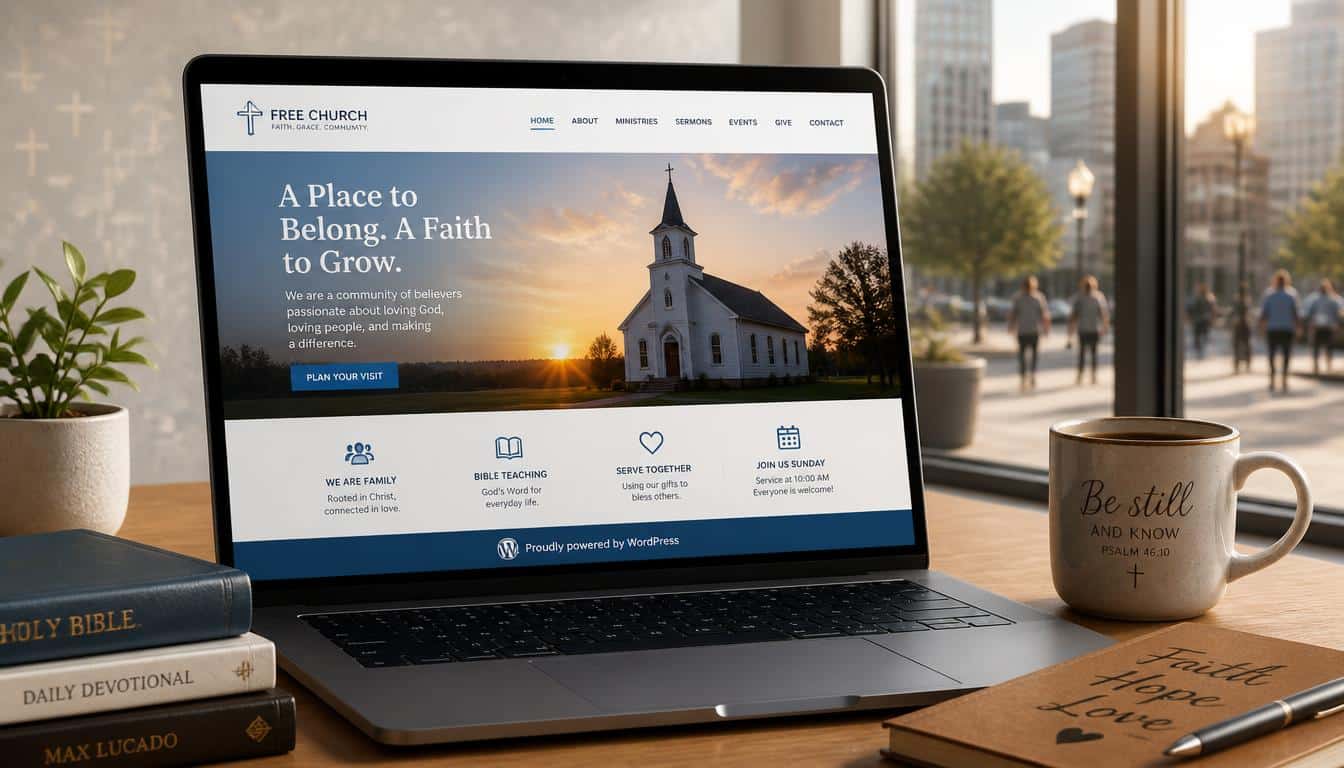
If someone asked me where to begin, I’d almost always recommend WordPress.
Creating Free Church Websites with WordPress typically involves these steps:
- Register a domain
- Choose hosting
- Complete the Automatic WordPress Installer
- Log into the WordPress admin
- Select Appearance Themes
- Install a WordPress Theme
- Visit Plugins Add New
- Install helpful WordPress Plugins
- Add pages
- Publish your first sermon
This approach keeps your church in full control instead of locking everything into a proprietary website builder.
Better still, countless volunteers already know WordPress, making future maintenance much easier.
Choosing the Right Church WordPress Theme
Not every website theme understands churches.
Some are built for restaurants.
Others focus on photographers or online stores.
A dedicated Church WordPress Theme includes layouts specifically designed for ministries.
Popular features include:
- Ministry pages
- Staff biographies
- Event calendars
- Service schedules
- Sermon archives
- Prayer request sections
- Giving pages
- Volunteer information
Many churches begin with excellent Free WordPress Themes before eventually upgrading if additional features become necessary.
One respected option discussed within church technology circles is the Restful Theme, created by Steven Gliebe and maintained with contributions from Galen Gidman.
The Restful WordPress Theme was designed specifically for churches and works especially well alongside
the Church Content Plugin, making it an attractive starting point for ministries seeking a polished appearance without unnecessary complexity.
The Church Content Plugin Makes Ministry Easier
Installing the Church Content Plugin transforms an ordinary website into something far more church-friendly.
Instead of forcing pastors to improvise, the plugin provides dedicated content types for ministry.
Features often include:
- Sermons
- Speaker profiles
- Scripture references
- Series archives
- Church Events
- Ministry pages
- Staff listings
- Campus Locations
This dramatically simplifies long-term Church Website Maintenance because everything remains organised instead of scattered across random pages.
For churches publishing weekly sermons, that’s honestly a huge relief.
Hosting Options Worth Considering
While completely free hosting exists, churches should compare reliability carefully.
Many ministries eventually choose nonprofit hosting because dependable uptime matters.
One respected provider is DreamHost, which offers DreamHost Nonprofit Hosting for eligible 501(c)(3) nonprofit organizations in the United States.
Rather than promising unrealistic “everything forever for free,” the company provides substantial nonprofit benefits that can significantly reduce costs.
Typical hosting plans elsewhere might range from $15–30/month, while more advanced managed services can reach $32/month or higher depending on storage, traffic, and support.
Some nonprofit providers even advertise a 20% discount or additional charitable pricing beyond their standard plans.
When evaluating WordPress Hosting, consider:
- Backup frequency
- Customer support
- Website Security
- Speed
- Storage
- SSL certificates
- Email accounts
- Automatic updates
- Migration assistance
Saving money is wonderful, but unexpected downtime on Easter morning? Nobody really wants that.
Free Domain Registration: Be Careful Before You Celebrate
The phrase Free Domain Registration sounds exciting.
Sometimes it truly is.
Other times, the free domain isn’t actually yours.
That’s a surprisingly important distinction.
Before choosing any provider, verify:
- Who owns the domain?
- Can you transfer it later?
- Are renewals free?
- Will pricing change?
- Is DNS fully manageable?
- Can you point it to another hosting company?
These questions prevent future headaches if your church eventually grows beyond its first hosting platform.
Many churches begin with free resources and later migrate to paid infrastructure as attendance, online ministries, and digital outreach expand.
Planning ahead makes that transition much smoother than trying to untangle ownership issues years later.
Common Risks Behind “Free Forever” Church Websites
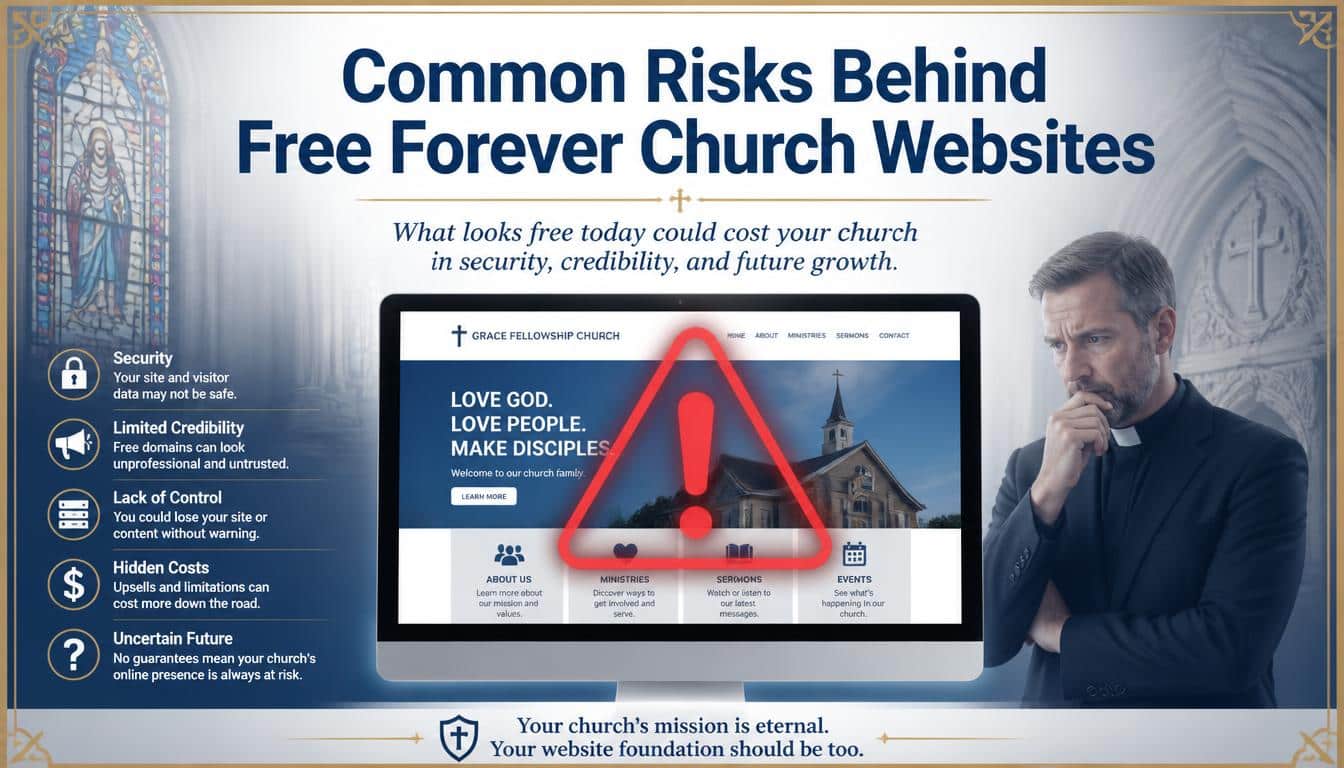
Everybody likes hearing the word “free.” I mean, who wouldn’t? Yet in website land, free can sometimes arrive carrying a tiny backpack full of compromises. Not always, but often enough that churches should pay attention before jumping in.
Some of the biggest risks include:
- Domain ownership issues
- Losing free domain access if provider policies change
- Limited Technical Support
- Slower Website Hosting
- Advertising placed on your pages
- Storage limitations
- Unexpected Future pricing changes
- Poor Hosting reliability
- Website downtime
- Unsupported software
- Weak security practices
None of these automatically mean a free platform is bad. It just means church leaders should read the small print, even if it’s a bit boring, because tomorrow’s ministry deserves today’s careful decisions.
Website Security Should Never Be an Afterthought
A church website often stores contact forms, prayer requests, volunteer information, and sometimes donation details. That makes Website Security more than just a technical checkbox.
Good security habits include:
- Strong administrator passwords
- Two-factor authentication where available
- Frequent backups
- Malware scanning
- SSL certificates
- Keeping software current
- Removing unused plugins
- Monitoring login attempts
One neglected plugin can become the tiny crack that lets bigger problems sneak in. It’s kinda like leaving one window unlocked because “it’s probably fine.”
Regular Plugin Updates and Theme Updates dramatically reduce security risks.
The Importance of Plugin Compatibility and Theme Compatibility
Installing dozens of plugins sounds exciting…until something breaks.
Every additional WordPress Plugin should serve a genuine ministry purpose.
When choosing plugins, check:
- Recent updates
- Active installations
- Compatibility with current WordPress
- Reviews from users
- Developer support
Likewise, your chosen WordPress Theme should remain actively maintained.
Good plugin compatibility and theme compatibility reduce unexpected errors and improve long-term stability.
Sometimes less really is more.
Building the Pages Every Church Needs
Every church is unique, yet visitors usually expect certain information within seconds.
Consider creating these essential Church Pages:
Home
A warm welcome, service times, recent sermon, and quick links.
About
Share your beliefs, history, mission, and leadership.
Sermons
Create an organized sermon archive with audio, video, or written notes.
Events
Display upcoming church calendar activities and special services.
Ministries
Highlight children’s ministry, youth groups, outreach, worship teams, and community programs.
Staff
Include church staff profiles with photographs and contact information.
Locations
If applicable, display campus locations using maps and directions.
Resources
Offer Bible study materials, downloadable guides, and church resources for visitors and members.
A well-organized website quietly answers questions before anyone even asks them.
Church Website SEO Without Making It Weird
Search engine optimization sometimes gets treated like mysterious magic.
Honestly, it’s mostly common sense.
Good church website SEO focuses on helping real people rather than tricking search engines.
Helpful practices include:
- Clear page titles
- Natural headings
- Fast loading pages
- Mobile-friendly design
- Descriptive image names
- Internal links
- Updated content
- Local contact information
Rather than repeating “church near me” fifty times, simply write naturally about your ministry.
Search engines have become surprisingly good at recognising genuine content.
Responsive Church Website Design Matters
Many first-time visitors discover churches using phones rather than desktop computers.
A responsive church website automatically adjusts to different screen sizes.
Benefits include:
- Easier navigation
- Faster reading
- Better accessibility
- Improved search rankings
- Lower bounce rates
A beautiful desktop website that becomes unusable on a phone isn’t really beautiful after all.
Accessibility Makes Everyone Feel Welcome
Churches spend enormous effort making physical buildings accessible.
Websites deserve the same care.
Improving website accessibility might include:
- Clear fonts
- Strong colour contrast
- Alternative text for images
- Keyboard navigation
- Readable headings
- Captioned videos
Small improvements can make a remarkable difference for visitors living with disabilities.
That’s ministry too, just in a slightly different shape.
Website Performance Is Ministry
Nobody enjoys waiting ten seconds for a page to load.
Slow websites quietly send people away before they even hear your message.
Improve website performance by:
- Compressing images
- Using caching plugins
- Selecting reliable hosting
- Minimising unnecessary plugins
- Updating software regularly
Fast websites simply feel more welcoming.
It’s funny how technology shapes first impressions without anyone noticing.
Church Website Branding Builds Trust
Your website doesn’t need flashy animations to feel professional.
Strong church branding simply communicates consistency.
Use:
- The same logo everywhere
- Consistent colours
- Readable typography
- Authentic photography
- Clear messaging
Real pictures of your congregation usually build more trust than generic stock images.
People appreciate seeing actual smiles instead of suspiciously perfect ones.
Church Website Maintenance Never Really Ends
Launching a website isn’t the finish line.
It’s more like planting a garden.
Regular Church Website Maintenance includes:
- Publishing weekly announcements
- Uploading sermons
- Updating ministry information
- Removing outdated events
- Reviewing forms
- Testing links
- Performing backups
- Checking analytics
- Installing updates
Small maintenance sessions every week prevent giant headaches later.
Website Migration Isn’t Something to Fear
Eventually, many churches outgrow their original platform.
That’s perfectly normal.
A careful website migration allows your church to move to new hosting or improved infrastructure while preserving pages, sermons, images, and search rankings.
Planning ahead makes migration much less stressful.
Churches moving beyond a basic site can hire a web development agency to build custom features and connect the new platform to their existing systems.
Choosing open platforms like WordPress CMS generally provides greater flexibility than proprietary builders.
Recommended Free WordPress Plugins for Churches
Alongside the Church Content Plugin, several general-purpose plugins improve church websites.
Useful categories include:
- Backup plugins
- SEO plugins
- Contact form plugins
- Security plugins
- Image optimization plugins
- Cache plugins
- Spam protection
- Accessibility enhancements
Always install only what you’ll actually use.
A lean website often performs better than one overflowing with unused features.
Practical Step-by-Step Church Website Setup
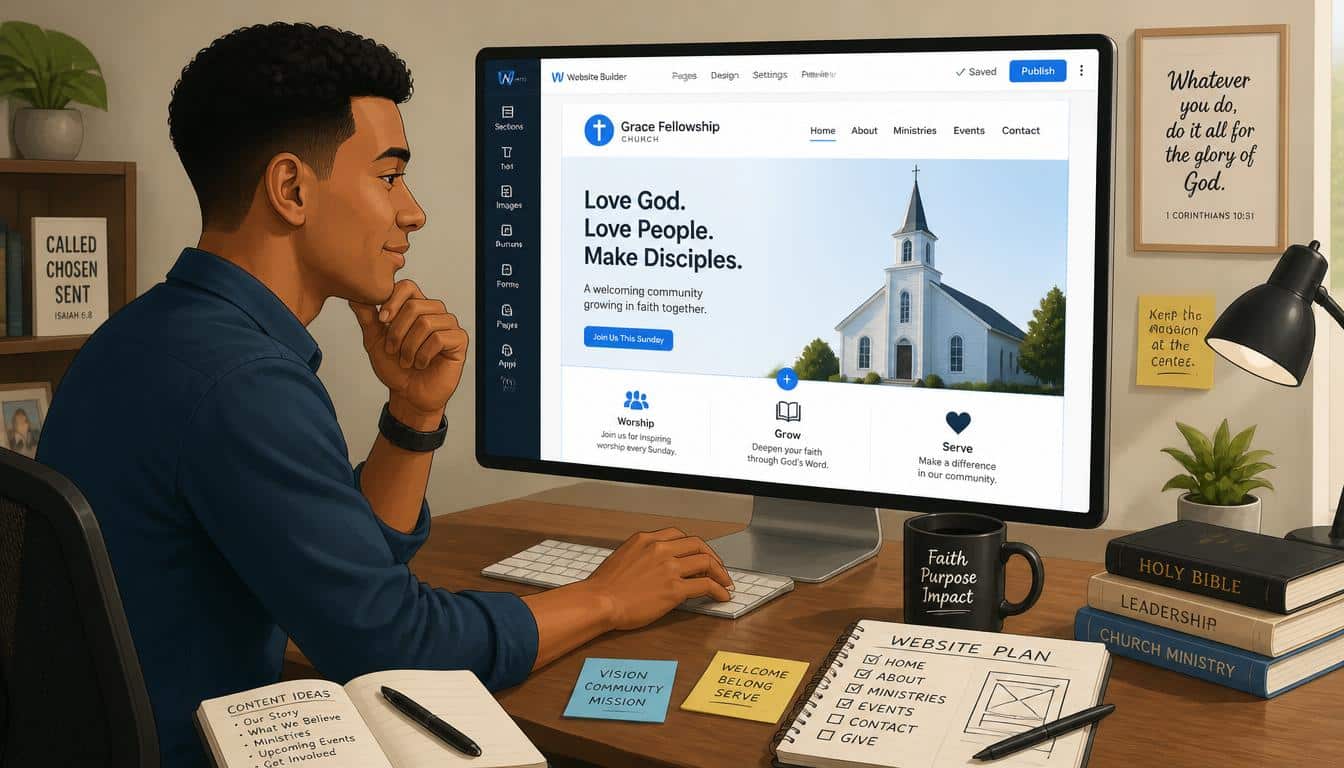
If you’re wondering how to create a free church website, here’s a realistic roadmap.
- Choose your church website platform
- Register a church domain name
- Configure DNS
- Select Website Hosting
- Complete Install WordPress
- Choose a church WordPress theme
- Install the Church Content Plugin
- Add essential pages
- Upload your first online sermons
- Publish church events
- Create ministry pages
- Test everything on mobile devices
- Launch publicly
It sounds like lots of work, and well…it is. But none of the individual steps are especially difficult.
Affordable Growth Beyond Free
Many churches begin with a zero cost website before gradually investing in improvements.
That’s a healthy approach.
You don’t need expensive software on day one.
As your congregation grows, you might later purchase:
- Premium themes
- Faster hosting
- Better backups
- Advanced security
- Professional email
- Additional storage
This gradual path creates an affordable church website without overwhelming ministry finances.
Frequently Asked questions
WordPress password protect plugin
A WordPress password protect plugin lets you secure your website, pages, posts, or specific content with a password, ensuring only authorized users can access it.
Password protect WordPress plugin
A password protect WordPress plugin is an easy way to add an extra layer of security and control who can view private content on your website.
WordPress password protection
WordPress password protection helps keep sensitive pages, posts, and files secure by restricting access to visitors with the correct password.
WordPress password protect page plugin
A WordPress password protect page plugin allows you to lock individual pages with a password, making it ideal for members-only or private content.
WordPress document management plugin
A WordPress document management plugin helps you organize, store, and securely share documents while giving you better control over file access and permissions.
Read this Blog: https://gracethemes.com/password-protect-plugin-for-wordpress/
Final Thoughts on Free Church Websites
Building Free Church Websites isn’t really about technology.
It’s about removing barriers.
Every page you publish, every sermon you upload, every event you announce, and every welcoming photograph you share gives someone another opportunity to discover your church before they ever walk through its doors.
