

Who Should Move to GPT-6.1 Sol, and Who Should Stay Put
The honest answer to “should we move to GPT-6.1 Sol” is that the question is wrong, because there is no such thing as a migration to it. It is a middle rung on a price ladder — $2 in, $10 out, with the flagship at five times that and a cheaper sibling below. The decision is not whether to adopt a model; it is which of your routes belong on which rung. OpenAI’s own documentation makes that explicit by naming it as the default for readers who are unsure where to start, which is a routing statement rather than a capability claim. The GPT-6.1 Sol benchmarks below are carried here at list rate, so the profile you build today is measurable against an invoice rather than argued about in a slide.
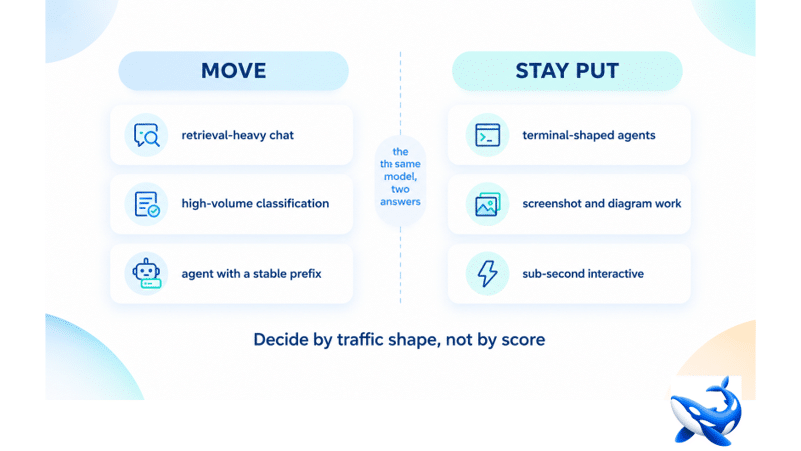
Decide by the shape of the traffic, not by the position on a leaderboard. Six profiles follow, three of each.
Move: your input dwarfs your output
This is the strongest case, and it is arithmetic rather than opinion.
If your calls carry long system prompts, retrieved documents, tool schemas or conversation history, then most of what you pay for is input, and input on this model is $2 a million against $10 for output. Add the cache-read rate of $0.10 a million for a stable prefix and the direction gets cheaper still — and the cache-read price was halved against the model this one replaces. A retrieval-heavy assistant with a fixed instruction block is close to the ideal shape for this rate card.
The test is one line of arithmetic on your own logs: total input tokens divided by total output tokens. If the ratio is above about ten to one, you are an input-heavy shop and the cheap input direction is doing the work.
Move: the work is ordinary and the volume is not
Most production traffic is not hard. Classification, extraction, summarisation, formatting, draft-then-fix loops — work where the flagship’s extra headroom is real but unused.
On the independent harness read 2026-10-07 at the Max effort setting, GPT-6.1 Sol scores 51.83 on the Intelligence Index against GPT-6 Astra’s 52.67 — under a point apart — while costing $0.7242 a task against Astra’s $3.26. A 4.5× bill for a sub-point difference is a trade that only makes sense on the genuinely hard minority of calls.
So the profile is a pipeline that currently sends everything to the expensive rung out of caution. Splitting it is the cheapest optimisation available, and it does not require changing anything about the hard route.
Move: you can measure and you are willing to
A model with a thin public record is a model you have to evaluate yourself, and that is a cost. But it is a cost paid once, in a harness you keep.
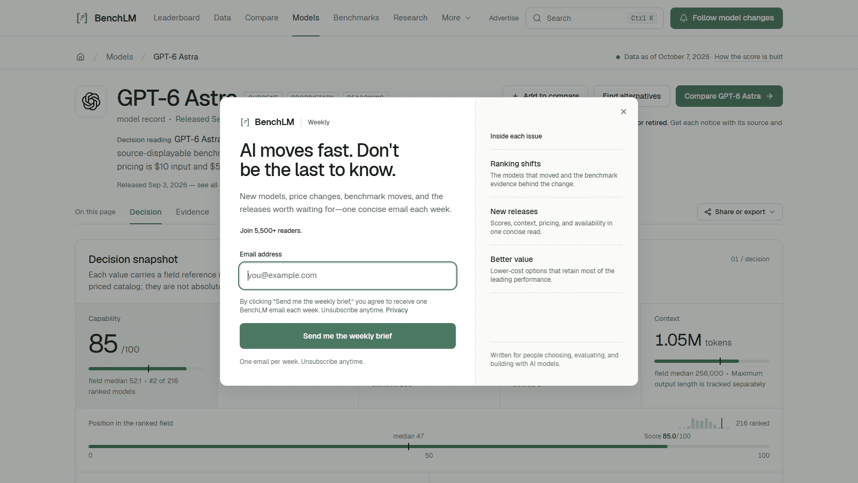
The coverage board read on 2026-10-07 publishes 14 of 31 benchmark rows for GPT-6.1 Sol across 4 of 8 categories — roughly a third the record Astra carries. That is not a reason to avoid it; it is a reason to stop treating somebody else’s average as your selection process. If you already run an evaluation set against your own traffic, the thin record costs you almost nothing and the price difference is pure margin.
Stay put: the work is terminal-shaped
This is the clearest no, and it comes from the measurement rather than from a preference.
On the independent harness, Terminal-Bench 4.0 reads 56.1% for GPT-6.1 Sol against 59.1% for GPT-6 Astra — and the coverage board has no Terminal-Bench row for Sol at all. Agentic work that lives in a shell, runs commands, reads failures and retries is the workload where the gap is largest and where the evidence is thinnest.
If that is what you are building, the flagship is the safer choice at any price, and the price is not even the deciding factor. A three-point deficit on the benchmark most representative of your work is a reason to stay, and the missing coverage row is a reason to test it yourself before believing either number.
Stay put: your calls are multimodal
GPT-6.1 Sol has no independent multimodal row on the evidence board. That does not mean it cannot see images — Artificial Analysis does carry an MMMU-Pro figure of 85.95% for it — it means the vision number you can quote comes from one evaluator rather than two that agree.
For anything reading screenshots, diagrams, PDFs or UI state, that is the difference between a decision you can defend and one you cannot. Run your own set, or stay where the record is thick.
Stay put: the latency is the product
A reasoning model generates its thinking as output tokens, and the measurement reflects it: on the same harness and the same day, GPT-6.1 Sol produces on the order of 42% more output tokens per task than Astra and takes about 48% longer to finish one.
For batch work that is invisible. For a chat interface where a person watches the answer arrive, or an agent loop that cannot start step two until step one returns, it is the whole experience. The independent per-task time read 2026-10-07 is 640 seconds for GPT-6.1 Sol against 433 for Astra — priced at about $44 for every hour of waiting you remove by moving up. Whether that is worth it depends entirely on whether a human is waiting.
The one-line version
Write your routes down, put a token count and a latency budget beside each, and let the rate card sort them. Long input, ordinary difficulty, tolerant of waiting: the middle rung. Terminal-shaped, multimodal, or human-facing and quick: somewhere else.
What makes GPT-6.1 Sol unusual is not that it wins anything. It is that the vendor names it the default and then prices it at a fifth of the flagship, which means the boring answer — put the ordinary traffic on the cheap rung — is also the explicitly recommended one. Most teams are paying flagship prices for middle-tier work and have never run the arithmetic that shows it.
OrcaRouter carries GPT-6.1 Sol at list rate on the same key as the rest of the OpenAI line, so splitting a pipeline across rungs is a model-string change per route rather than a second procurement.
Sourcing note: the $2 / $10 rates, the $0.10 cache-read price, the 1.05M context window and the routing recommendation are OpenAI’s own published claims and have not been independently reproduced. Intelligence Index figures (51.83, 52.67), the per-task costs ($0.7242, $3.2575) and the per-task times (640.46 s, 433.35 s) are from Artificial Analysis’ live model pages, read 2026-10-07, where both models are measured at the Max reasoning setting. Coverage counts (14 of 31, 4 of 8, 45 of 68, 7 of 8) are from benchlm.ai, read 2026-10-07. The implied output-token comparison is this article’s own arithmetic from the published figures, not a published measurement. All checked 2026-10-07; re-check before 2026-11-01.
