

What Was the Time 20 Hours Ago? A Quick Guide
Have you ever looked at the clock and wondered what time it was 20 hours ago? Maybe you’re checking when a message arrived, figuring out when you started a task, reviewing a travel schedule, or simply trying to remember what you were doing yesterday.
It sounds like a small calculation, but crossing midnight can make the answer a little less obvious than expected.
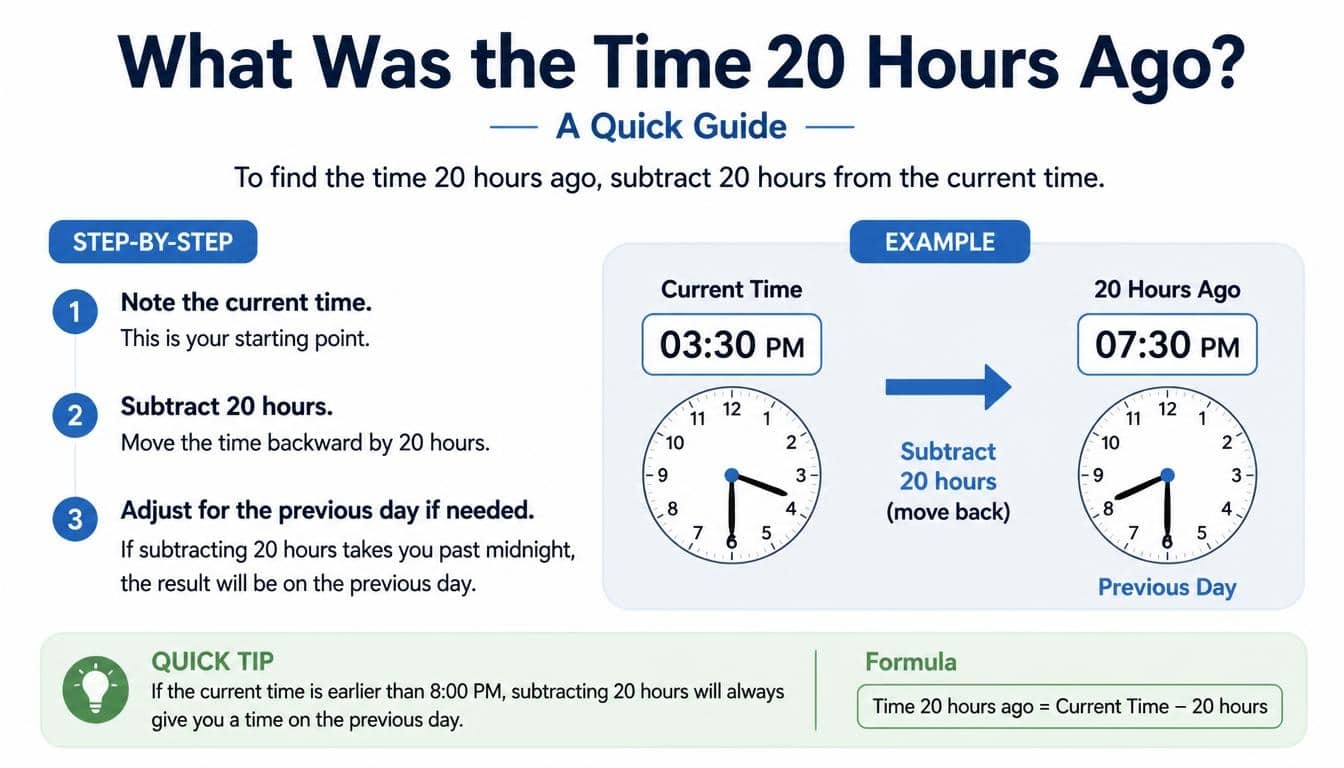
The good news is that finding the answer is easier than it looks. You only need to subtract 20 hours from the current time, while keeping an eye on the date, AM and PM, and your local time zone.
Once you understand the method, you can calculate past times without reaching for a complicated tool every time.
In this guide, we’ll explain what time was it 20 hours ago, how to calculate the previous date, how time subtraction works across midnight, and how to convert 20 hours into minutes, seconds, and milliseconds.
You’ll also find practical examples and answers to common questions, so you can get the result without making a simple calculation feel like a maths exam.
What Time Was It 20 Hours Ago?
The answer depends on your current local time. To calculate 20 hours ago from now, subtract 20 hours from the time shown on your clock. If the result crosses midnight, the answer will fall on the previous calendar day.
For example, suppose the current time is 9:42 AM on Thursday, October 29, 2026, in the GMT+5 time zone.
Subtracting 20 hours gives you:
- Current time: 9:42 AM, Thursday, October 29, 2026.
- Subtract 9 hours and 42 minutes to reach midnight? Not quite. A simpler way is to subtract 12 hours first, then another 8 hours.
- 12 hours before 9:42 AM is 9:42 PM on Wednesday, October 28.
- Another 8 hours before that is 1:42 PM on Wednesday, October 28.
Therefore, 20 hours ago was 1:42 PM on Wednesday, October 28, 2026, using this example’s current-time reference.
The important thing to remember is that the answer is not always on yesterday’s calendar date in every possible situation.
It depends on the starting time. However, because 20 hours is less than 24 hours, subtracting it from a normal clock time will generally take you into the previous calendar day when the starting time is before 8:00 PM.
How to Calculate Time 20 Hours Ago
You don’t need advanced mathematics to calculate a time in the past. The easiest approach is to break the calculation into smaller, manageable steps instead of trying to subtract everything in your head at once.
Method 1: Subtract 20 Hours Directly
Start with your current time and subtract 20 from the hour value, adjusting the date when necessary. With a 12-hour clock, it is often easier to work in 24-hour format because it avoids confusion between AM and PM.
For example, suppose it is 6:00 PM today.
- Convert 6:00 PM to 18:00.
- Subtract 20 hours: 18:00 − 20 hours.
- The result is 22:00 on the previous day, which is 10:00 PM yesterday.
So, if the current time is 6:00 PM, the time 20 hours ago was 10:00 PM yesterday. This is one of those calculations that feels awkward in your head until you switch to the 24-hour clock.
Method 2: Subtract 24 Hours, Then Add 4 Hours
This is a useful mental shortcut because 20 hours is four hours less than a full day.
Instead of subtracting 20 hours directly, subtract 24 hours and then add four hours to the result. In other words, go back one calendar day and move forward four hours.
Suppose the current time is 11:30 AM on Thursday.
- Go back 24 hours to Wednesday at 11:30 AM.
- Add four hours to reach Wednesday at 3:30 PM.
The answer is 3:30 PM on Wednesday.
This shortcut works consistently and can be easier when you’re calculating times while travelling, checking a notification, or working out when an event took place.
Method 3: Use an Hours Ago Calculator
An hours ago calculator can do the subtraction automatically when you enter a starting time and a duration. Depending on the tool, you may also be able to enter a particular date and select a time zone.
A good time calculator is especially useful when your calculation crosses midnight, the end of a month, or even the end of a year. It reduces the risk of accidentally choosing the wrong date while doing the arithmetic.
Still, understanding the calculation yourself is worthwhile. You can quickly check whether the result makes sense instead of relying entirely on a number displayed on a screen.
What Date Was It 20 Hours Ago?
When people search for what date was it 20 hours ago, they usually want more than a clock reading. They need to know the day and date too, particularly when the calculation involves messages, deadlines, work shifts, or travel arrangements.
Because 20 hours is four hours shorter than 24 hours, the answer often falls on the previous calendar day.
Here are a few examples:
- If it is 8:00 AM on Thursday, 20 hours ago was 12:00 PM on Wednesday.
- If it is 10:00 AM on Thursday, 20 hours ago was 2:00 PM on Wednesday.
- If it is 2:00 PM on Thursday, 20 hours ago was 6:00 PM on Wednesday.
- If it is 8:00 PM on Thursday, 20 hours ago was 12:00 AM on Thursday.
- If it is 11:00 PM on Thursday, 20 hours ago was 3:00 AM on Thursday.
Notice that the final two examples produce a result on the same calendar date, rather than the previous one. That’s because the starting time is late enough in the day that subtracting 20 hours does not take you back past midnight.
This is why it’s better to calculate the actual time instead of automatically assuming the answer is yesterday. A quick check of the clock can save you from getting the date wrong.
Understanding AM and PM When Subtracting 20 Hours
The 12-hour clock can be confusing when you’re subtracting a large number of hours. AM and PM switch throughout the day, and the date may change at midnight, so it’s easy to lose track of where you are.
Remember these basic distinctions:
- 12 AM means midnight, the beginning of a new calendar day.
- 12 PM means noon, the middle of the day.
- AM covers the period from midnight up to, but not including, noon.
- PM covers the period from noon up to, but not including, midnight.
Imagine it is 7:00 AM on Friday. Subtracting 12 hours takes you to 7:00 PM on Thursday. Subtracting another eight hours takes you to 11:00 AM on Thursday.
Therefore, 20 hours before 7:00 AM Friday is 11:00 AM Thursday.
A helpful trick is to subtract 12 hours first, which switches AM to PM or PM to AM, and then subtract the remaining eight hours. Be mindful of midnight, though, because moving backward across it also changes the date.
How Many Minutes, Seconds, and Milliseconds Are in 20 Hours?
Knowing the equivalent units can be useful when calculating elapsed time, reviewing computer logs, tracking work sessions, or converting time for a technical project.
Twenty hours may sound like a long stretch on the clock, but its equivalent in smaller units is straightforward.
| Time Unit | Equivalent of 20 hours |
| Days | 0.8333 days, approximately |
| Hours | 20 |
| Minutes | 1,200 |
| Seconds | 72,000 |
| Milliseconds | 72,000,000 |
The calculations are simple:
- 20 hours in minutes: 20 × 60 = 1,200 minutes.
- 20 hours in seconds: 20 × 60 × 60 = 72,000 seconds.
- 20 hours in milliseconds: 20 × 60 × 60 × 1,000 = 72,000,000 milliseconds.
These conversions describe the duration itself. They don’t tell you the exact clock time unless you also know when the calculation starts.
For instance, 72,000 seconds ago represents the same duration as 20 hours ago, provided you’re measuring ordinary elapsed time without introducing a different calendar or clock adjustment.
How to Calculate 20 Hours Ago Across Midnight
Midnight is where most time-subtraction mistakes happen. People often subtract the hours correctly but forget to move to the previous date, or they change AM to PM without considering how far back the clock needs to go.
The easiest solution is to split the calculation into two parts.
Suppose it is 4:00 AM on Friday. You want to find the time 20 hours earlier.
First, subtract four hours to reach midnight on Friday. You have now used four of the 20 hours, leaving 16 hours to subtract. Continue backward from midnight, and you’ll arrive at 8:00 AM on Thursday.
The final answer is 8:00 AM on Thursday, not Friday.
Here’s another example. If it is 1:15 AM on Monday, subtracting 20 hours takes you to 5:15 AM on Sunday. The clock moves backward, and so does the calendar date.
The main principle is simple: subtract the entire duration, not just the hour number. Whenever you cross midnight while moving backward, move the date back by one day as well.
Does the Time Zone Affect the Answer?
Yes, your time zone matters when you want the exact local time and date. A clock in Pakistan, for example, may display a different time from a clock in London or New York at the same moment.
If your current time is 9:42 AM in the GMT+5 time zone, subtracting 20 hours gives 1:42 PM on the previous day. That calculation is based on the local clock reading you supplied, rather than on a separate country’s time.
The GMT+5 designation means the local time is five hours ahead of Greenwich Mean Time. However, other locations may use different UTC offsets, and some regions change their clocks seasonally because of daylight saving time.
When using an online time conversion calculator, check that you have selected the intended time zone. Otherwise, you might calculate the correct elapsed duration but report the result using the wrong local clock.
If you’re calculating a past time for an international meeting, an online transaction, or a travel itinerary, it can help to distinguish between the local time displayed on a device and the universal timestamp recorded by a service.
What Is the Difference Between 20 Hours Ago and 20 Hours From Now?

These two phrases sound similar, but they describe opposite directions in time.
Twenty hours ago means subtracting 20 hours from a starting point. Twenty hours from now means adding 20 hours to that starting point.
For example, if the current time is 9:00 AM on Thursday:
- 20 hours ago was 1:00 PM on Wednesday.
- 20 hours from now will be 5:00 AM on Friday.
The calculation follows the same basic time arithmetic, but one moves backward and the other moves forward. In both cases, you must account for midnight and any date changes.
An hours from now calculator can be useful when planning an appointment or estimating when a task will finish. A past-time calculator is more useful when you’re checking something that has already happened.
It’s worth reading the question carefully before calculating. One small word, such as ago or from, can completely change the answer.
Common Examples of Calculating Time 20 Hours Ago
Let’s look at a few everyday situations to make the method feel more familiar.
Example: It Is 9:00 AM
If the current time is 9:00 AM, subtracting 20 hours gives 1:00 PM on the previous day.
You can check this by adding the durations: from 1:00 PM yesterday to midnight is 11 hours, and from midnight to 9:00 AM today is nine hours. Together, that makes 20 hours.
Example: It Is 3:30 PM
If the current time is 3:30 PM, the time 20 hours ago was 7:30 PM yesterday.
Subtract 24 hours first to get 3:30 PM yesterday, then add four hours. The result is 7:30 PM on the previous day.
Example: It Is 11:45 PM
If the current time is 11:45 PM, subtracting 20 hours gives 3:45 AM on the same calendar day.
For example, if it’s 11:45 PM on Thursday, the answer is 3:45 AM on Thursday. This might seem surprising at first, but counting backward 20 hours from late at night lands you in the early morning of that same date.
Example: It Is 12:15 AM
If it is 12:15 AM on Friday, 20 hours earlier was 4:15 AM on Thursday.
Going back 15 minutes takes you to midnight on Friday, and subtracting the remaining 19 hours and 45 minutes takes you into Thursday morning.
These examples show why the exact starting time matters. There isn’t one universal clock reading for 20 hours ago; the answer changes as the current time changes.
Frequently Asked Questions About What Time It Was 20 Hours Ago
How do I calculate what time it was 20 hours ago?
Subtract 20 hours from your current local time. You can also subtract 24 hours and then add four hours to the result. Remember to adjust the date if your calculation crosses midnight.
What time was it 20 hours before now?
The exact answer depends on your current time and time zone. For example, if it is 9:42 AM on October 29, 2026, then 20 hours earlier was 1:42 PM on October 28, 2026.
Is 20 hours ago always yesterday?
No. If the current time is before 8:00 PM, subtracting 20 hours will usually take you into the previous calendar day. If the current time is 8:00 PM or later, the result can fall on the same calendar day, earlier in the morning.
How many minutes ago is 20 hours?
Twenty hours equals 1,200 minutes. Multiply 20 by 60 because every hour contains 60 minutes.
How many seconds are there in 20 hours?
There are 72,000 seconds in 20 hours. The calculation is 20 × 60 × 60.
Can I use a calculator to find the previous date and time?
Yes. A date-and-time calculator can subtract 20 hours from a specified starting time and return the resulting date. For the most accurate result, check that the date, time zone, and starting time are correct.
What is the difference between a time calculator and a time difference calculator?
A time calculator can perform operations such as adding or subtracting hours. A time difference calculator usually measures the duration between two specified times or dates. Some online tools provide both functions, so the exact features depend on the calculator.
What time will it be 20 hours from now?
Add 20 hours to the current time. If the calculation passes midnight, move to the next calendar date. For example, 9:00 AM today plus 20 hours equals 5:00 AM tomorrow.
What time was it 8 hours ago?
Eight hours ago was the time you get by subtracting 8 hours from the current time. The result may fall on the previous day, depending on the current time.
What time was it 20 hours ago?
Twenty hours ago was the time you get by subtracting 20 hours from the current time. This calculation also helps determine the correct date if the time crosses midnight.
What time was it 19 hours ago?
Nineteen hours ago is calculated by subtracting 19 hours from the current time. The result shows the exact time and date from 19 hours earlier.
What was 19 hours ago?
To find what happened 19 hours ago in terms of time, subtract 19 hours from the current time. This calculation identifies the corresponding time and, if needed, the previous calendar day.
What time was 20 hours ago
The time 20 hours ago can be found by subtracting 20 hours from the current time. Depending on when you calculate it, the result may fall on the previous day.
Read More: https://gracethemes.com/what-time-was-it-20-hours-ago/
Conclusion: Finding the Time 20 Hours Ago Is Easier Than It Seems
Calculating what time was it 20 hours ago doesn’t need to be complicated. Once you know the starting time, subtract 20 hours, check whether the date changes, and make sure the AM or PM designation is correct.
For a quicker mental calculation, subtract 24 hours and add four hours. This simple shortcut works for everyday clock calculations and helps you avoid confusion when the answer falls on a different date.
Remember that 20 hours equals 1,200 minutes, 72,000 seconds, and 72,000,000 milliseconds. The duration remains the same, even though the resulting clock time and date depend on when you start and which time zone you’re using.
Whether you’re checking an old message, planning an appointment, reviewing a schedule, or satisfying a little curiosity, understanding time subtraction gives you a reliable answer without unnecessary guesswork.
And next time you catch yourself wondering what happened 20 hours earlier, you’ll know exactly where to begin: look at the clock, subtract the hours, and let the calendar follow along.
