

What Time Was It 20 Hours Ago? A Simple Guide to Calculating Past Time
Have you ever looked at the clock and wondered where the last twenty hours went? Maybe you are checking when a message arrived, figuring out how long ago a meeting happened, or simply trying to understand what time it was yesterday.
Time has a funny way of slipping through our fingers, and sometimes a simple question like “What time was it 20 hours ago?” can require a little more thinking than expected.
The good news is that calculating a past time is easier than it sounds. You only need the current time, a basic understanding of subtraction, and a small reminder that crossing midnight can change the date.
Once you know the trick, you can work out the time twenty hours ago without reaching for a calculator every single time.
In this guide, we’ll explain how to calculate twenty hours in the past, how to handle AM and PM, what happens when the date changes, and how to use an online time calculator for quick results.
We’ll also explore related calculations and answer common questions so you can find the information you need without getting lost in complicated time arithmetic.
What Time Was It 20 Hours Ago?
The answer depends on your current local time. To find out what time was it 20 hours ago, subtract twenty hours from the time shown on your clock, making sure to account for any change in the calendar date.
For example, imagine it is Thursday, October 29, 2026, at 9:30 AM in a time zone using GMT+5. Subtracting twenty hours takes you back to Wednesday, October 28, 2026, at 1:30 PM.
Here’s the calculation in a nutshell:
- Current date: Thursday, October 29, 2026.
- Current time: 9:30 AM GMT+5.
- Time to subtract: 20 hours.
- Resulting date: Wednesday, October 28, 2026.
- Resulting time: 1:30 PM GMT+5.
So, if the current time is 9:30 AM on Thursday, 20 hours ago was 1:30 PM on Wednesday. The date changes because subtracting twenty hours takes you into the previous afternoon.
Remember, this is an example based on a specific reference time. If your clock shows a different current time or you live in another time zone, your answer will be different. That’s why checking the starting time matters more than memorizing a single result.
How to Calculate 20 Hours Ago Step by Step
You don’t need advanced mathematics to figure out a past time. A little mental arithmetic will usually do the job, and after trying it a couple of times, the process becomes almost automatic.
Step 1: Check the current time
Start by looking at your phone, computer, watch, or another reliable clock. Note both the hour and whether it is AM or PM.
For instance, suppose it is 7:00 AM on a Friday. Your goal is to discover the time twenty hours before that exact moment, not twenty hours before midnight or the beginning of the day.
Step 2: Subtract 12 hours
A full twelve-hour cycle takes you to the same clock hour with the opposite AM/PM designation. If it is 7:00 AM, twelve hours earlier was 7:00 PM on the previous day.
This is a handy little shortcut because it breaks a larger calculation into two manageable pieces.
Step 3: Subtract the remaining 8 hours
Twenty hours consists of twelve hours plus another eight hours. After subtracting twelve, subtract eight more.
Starting with Friday at 7:00 AM, you reach Thursday at 7:00 PM after the first step. Eight more hours backward brings you to Thursday at 11:00 AM.
Therefore, twenty hours before Friday at 7:00 AM was Thursday at 11:00 AM.
Step 4: Check the date
The final step is to confirm whether your calculation crossed midnight. It often will when subtracting twenty hours from a morning or early-afternoon time.
If the calendar date changes, write down the previous date along with the result. This is particularly important when you’re checking appointment records, work schedules, travel plans, or timestamps in messages.
What Time Was It 20 Hours Ago in Different Examples?
Sometimes a few examples explain the idea better than a long explanation. The following calculations show how the answer changes depending on the current time.
- If it is 6:00 AM on Thursday, twenty hours ago was 10:00 AM on Wednesday.
- If it is 9:30 AM on Thursday, twenty hours ago was 1:30 PM on Wednesday.
- If it is 12:00 PM on Thursday, twenty hours ago was 4:00 PM on Wednesday.
- If it is 3:00 PM on Thursday, twenty hours ago was 7:00 PM on Wednesday.
- If it is 6:00 PM on Thursday, twenty hours ago was 10:00 PM on Wednesday.
- If it is 10:00 PM on Thursday, twenty hours ago was 2:00 AM on Thursday.
Notice something interesting? When the current time is late in the evening, subtracting twenty hours may take you to the early morning of the same calendar day. But when the current time is in the morning or afternoon, the result usually falls on the previous day.
These examples assume whole hours and no minutes to keep the arithmetic easy to follow. If the current time includes minutes, simply retain those minutes while subtracting the hours.
How to Calculate Time 20 Hours Ago When Midnight Gets in the Way
Midnight is where many people make a small mistake. They subtract the hours correctly but forget that the calendar date can move backward, which leaves them with the wrong answer.
Imagine it’s 4:00 AM on Monday morning. Going backward four hours takes you to midnight, and continuing for another sixteen hours takes you into Sunday morning.
The result is 8:00 AM on Sunday. You have gone back twenty hours, but you have also moved to the previous calendar date.
A simple way to avoid confusion is to think of time as one continuous line rather than a collection of separate days. Midnight is only a point where the date changes; it doesn’t interrupt the passing of hours.
When you calculate a past time, always ask yourself two questions: What time did I reach, and what date was it when I got there? Both parts matter.
Understanding the 12-Hour Clock: AM and PM
The twelve-hour clock divides the day into two periods, AM and PM. AM covers midnight up to, but not including, noon, while PM covers noon up to, but not including, the next midnight.
This system can make time subtraction feel a bit confusing because the clock numbers repeat twice every day. A 3:00 AM reading and a 3:00 PM reading have the same hour number, but they are twelve hours apart.
When subtracting twenty hours, remember that twenty hours is eight hours short of a complete twenty-four-hour day. Therefore, you can also think of the calculation as moving back one full day and then moving forward four hours.
For example, if it is 5:00 PM on Thursday, twenty hours earlier is 9:00 PM on Wednesday. Moving back twenty-four hours would bring you to Wednesday at 5:00 PM, and moving forward four hours gives you 9:00 PM.
This alternative method is especially useful when the AM/PM conversion starts to feel confusing. Use whichever approach feels natural, because both lead to the same answer.
What Does 20 Hours Mean in Minutes, Seconds, and Milliseconds?
Understanding the length of twenty hours in different units can be useful when working with digital records, timers, countdowns, or computer systems.
The conversions are straightforward once you know how many smaller units fit into an hour.
Here is the breakdown:
- 20 hours in minutes: 20 × 60 = 1,200 minutes.
- 20 hours in seconds: 20 × 60 × 60 = 72,000 seconds.
- 20 hours in milliseconds: 72,000 × 1,000 = 72,000,000 milliseconds.
These values describe the duration of twenty hours, not a specific time on the clock. The duration remains the same whether those hours pass during the morning, overnight, or across two calendar dates.
For example, a device recording an event that occurred twenty hours ago might store the difference as 72,000 seconds. A regular wall clock, on the other hand, would normally express the same interval through a date and a clock time.
Knowing the difference between a duration and a timestamp helps prevent common calculation errors. One tells you how long something lasted or how far apart two moments are; the other identifies a particular moment.
Using a Time Calculator to Find the Time 20 Hours Ago
If you want a quick answer without doing the arithmetic yourself, an online time calculator can help. A time calculator is designed to add or subtract hours, minutes, and sometimes seconds from a reference time.
You can generally use one by following these simple steps:
- Enter the current date and time.
- Choose the option to subtract time, if the calculator provides separate addition and subtraction modes.
- Enter 20 hours as the duration.
- Check the calculated time and date.
- Confirm that the displayed time zone matches the one you intend to use.
An hours ago calculator is particularly convenient when you’re checking several intervals in a row. Rather than calculating twenty, twenty-two, and thirty-six hours by hand, you can enter each duration and compare the results.
Some online tools also function as a time and date calculator, allowing you to work with calendar days, weeks, months, and different starting dates. Other tools focus on elapsed time between two timestamps.
If you’re using a calculator on a website such as Inch Calculator or another time-conversion service, check which inputs it expects.
Some calculators automatically use the current time, while others ask you to provide a starting time manually. Neither approach is inherently better; the important thing is knowing what reference point the result uses.
What Time Was It 20 Hours Ago in GMT+5?
A time zone matters whenever you need to connect a clock reading to a specific location or timestamp. GMT+5 means the local time is five hours ahead of Greenwich Mean Time, commonly abbreviated as GMT.
Suppose your reference time is 9:30 AM on Thursday, October 29, 2026, in GMT+5. Subtracting twenty hours gives 1:30 PM on Wednesday, October 28, 2026, in that same time zone.
The key phrase here is in that same time zone. If you’re calculating twenty hours backward from a local clock, you usually don’t need to convert to GMT first. Simply subtract twenty hours from the local time and keep the same time-zone setting.
However, things can become more complicated when the starting timestamp comes from a server in another country.
For example, an online service might display a message time in UTC while your phone shows local time. If the two clocks use different zones, convert both timestamps to the same zone before comparing them.
Also, a fixed GMT offset is not identical to every country’s local time throughout the year. Some locations observe daylight saving time, which can shift their local clocks seasonally. If your calculation involves such a location, check the applicable date and time-zone rules.
What Date Was It 20 Hours Ago?
The date twenty hours ago depends on the current time, because twenty hours is shorter than a full day but long enough to cross midnight in many situations.
If it is 9:30 AM on Thursday, October 29, 2026, then twenty hours earlier was Wednesday, October 28, 2026, at 1:30 PM. The calculation crosses into the previous calendar day.
If it is 10:00 PM on Thursday, October 29, twenty hours earlier was Thursday, October 29, at 2:00 AM. In this case, the answer is on the same calendar date because the subtraction doesn’t go back past midnight.
That may sound slightly backwards at first, but it makes sense when you picture the hours passing along a timeline.
Subtracting twenty hours from a late-evening time takes you to early morning on the same date; subtracting twenty hours from a morning time generally takes you to the previous afternoon.
For date-sensitive tasks, avoid writing only the clock time. A result such as 1:30 PM doesn’t tell the whole story unless you also know which day it belongs to.
How to Calculate 20 Hours From Now
Working out what time it will be twenty hours from now uses the same basic principle, except you add hours instead of subtracting them.
Imagine it is 9:30 AM on Thursday. Adding twelve hours takes you to 9:30 PM on Thursday, and adding another eight hours brings you to 5:30 AM on Friday.
Therefore, twenty hours from Thursday at 9:30 AM is Friday at 5:30 AM.
This method is useful for planning reminders, estimating when a waiting period will end, or determining when an activity will be completed. Just remember that the result may fall on the next calendar date.
A hours from now calculator can perform this calculation for you, especially when you’re working with unusual starting times or need to include minutes.
For recurring schedules, however, remember that adding twenty hours each time doesn’t mean the event will happen at the same clock time every day.
Twenty hours is four hours shorter than a full day. If you keep adding that duration, the clock time shifts four hours earlier on each successive calendar day.
Related Time Calculations: 21, 22, 23, 24, and 36 Hours Ago
Once you understand twenty hours, calculating nearby intervals becomes much easier. The only thing that changes is the number of hours you subtract.
Here is how to handle some common related searches:
- What time was it 21 hours ago? Subtract twenty-one hours from the current time, checking whether the date changes.
- What time was it 22 hours ago? Subtract twenty-two hours, or think of it as subtracting one full day and adding two hours.
- What time was it 23 hours ago? Subtract twenty-three hours, which is equivalent to moving back one day and forward one hour.
- What time was it 24 hours ago? Move back exactly one day. The clock time generally stays the same.
- What time was it 36 hours ago? Subtract one full day and another twelve hours.
These are general methods rather than fixed clock-time answers. To calculate a specific result, you must know the starting time, date, and relevant time zone.
The twenty-four-hour calculation is particularly useful because it offers a quick reference point. Once you know the time twenty-four hours ago, you can move forward four hours to find the time twenty hours ago.
For example, if it is 9:30 AM Thursday, then twenty-four hours ago was 9:30 AM Wednesday. Moving forward four hours gives you 1:30 PM Wednesday.
Why Accurate Past-Time Calculations Matter in Everyday Life
A question about twenty hours ago might seem small, but accurate time calculations can help with more than simple curiosity. In everyday situations, knowing the exact time can prevent misunderstandings and make planning a little easier.
Consider a message that says it was sent twenty hours ago. If you want to determine when the sender sent it, you need to subtract that duration from the relevant current timestamp.
If the message was sent on the previous day, recording only the clock time might lead you to misunderstand the sequence of events.
The same principle applies to work shifts, travel itineraries, medication schedules, online transactions, and project deadlines. In each case, the exact reference time matters, and so does the date.
There is one small catch with digital timestamps: a label reading “20 hours ago” may be rounded or updated periodically.
A platform might display an approximate elapsed time rather than the exact second an event occurred.
If precision is important, look for the original timestamp instead of relying only on a relative-time label.
For ordinary planning, a quick subtraction is usually sufficient. For official records, financial transactions, or time-sensitive documentation, use the precise recorded time and confirm the relevant time zone.
Common Mistakes When Calculating Time 20 Hours Ago
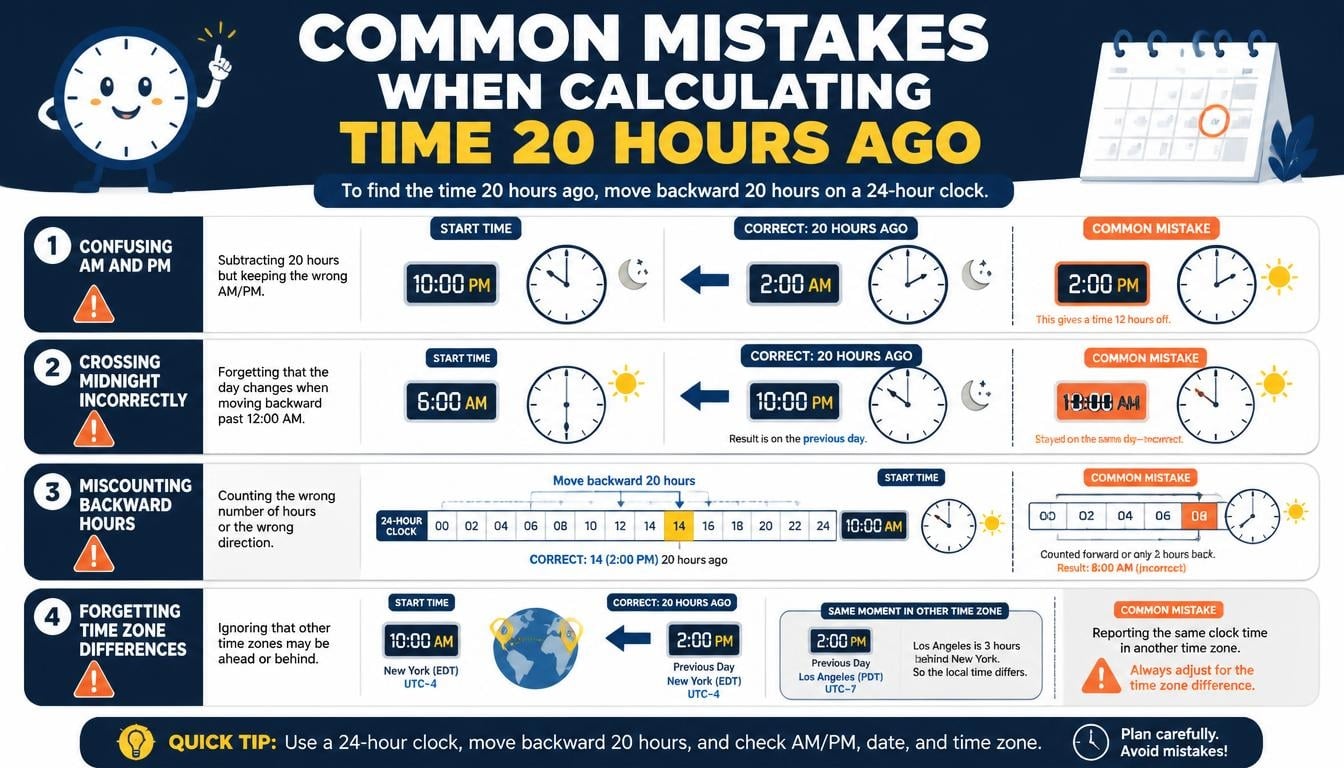
Even a simple calculation can go wrong if you rush through it. Fortunately, the most common mistakes are easy to avoid.
Forgetting the date change: Subtracting twenty hours can take you to the previous calendar day. Always check the date after finding the clock time.
Mixing up AM and PM: Going backward twelve hours changes AM to PM or PM to AM, with special attention needed around midnight and noon.
Treating twenty hours as twenty-four hours: Twenty hours is four hours less than a full day. If you subtract an entire day and forget to add those four hours back, the result will be wrong.
Ignoring time zones: A timestamp in UTC may not match the local time displayed on your device. Convert the reference time before calculating when the timestamps use different zones.
Assuming every “hours ago” label is exact: Some websites and apps show approximate elapsed times. If you need an exact answer, use the original event timestamp.
A good habit is to check your result in reverse. If subtracting twenty hours gives you Wednesday at 1:30 PM, adding twenty hours should return you to Thursday at 9:30 AM. When both calculations agree, you’ve probably got it right.
How to Make Time Calculations Easier
You don’t have to memorize every possible hour interval. Instead, learn a few useful shortcuts and keep them in mind whenever you need to calculate time backward.
- Remember that 12 hours switches between AM and PM.
- Remember that 24 hours takes you back one calendar day at the same clock time.
- Remember that 20 hours equals 24 hours minus 4 hours.
- Convert hours into minutes by multiplying by 60.
- Convert hours into seconds by multiplying by 3,600.
- Check the date and time zone whenever precision matters.
These small habits make time arithmetic more reliable, whether you’re calculating when a message arrived or planning an event for the following morning.
For complicated schedules, an online time calculator is a sensible option. For simple questions, mental arithmetic is often quicker than opening another app. The best method is the one that gives you a clear, verifiable result without unnecessary fuss.
Frequently Asked Questions About What Time It Was 20 Hours Ago
What time was it 20 hours ago?
Subtract twenty hours from your current local time. For example, if it is 9:30 AM on Thursday, October 29, 2026, in GMT+5, then twenty hours ago was 1:30 PM on Wednesday, October 28, 2026.
How do you calculate 20 hours ago without a calculator?
Subtract twelve hours first, then subtract another eight hours. Keep track of AM and PM, and check whether the subtraction crosses midnight. You can also subtract twenty-four hours and then add four hours to the result.
What date was it 20 hours ago?
It depends on the current time. If the calculation crosses midnight, the result may fall on the previous date. If you subtract twenty hours from a late-evening time, the result may remain on the same calendar date.
How many minutes are there in 20 hours?
There are 1,200 minutes in twenty hours. Multiply twenty by sixty because each hour contains sixty minutes.
How many seconds are there in 20 hours?
Twenty hours contains 72,000 seconds. The calculation is 20 × 60 × 60.
How many milliseconds are there in 20 hours?
There are 72,000,000 milliseconds in twenty hours. Since one second contains 1,000 milliseconds, multiply 72,000 by 1,000.
Does subtracting 20 hours always change the date?
No. The date changes only if the subtraction crosses midnight. For instance, subtracting twenty hours from 10:00 PM takes you to 2:00 AM on the same calendar day, whereas subtracting twenty hours from 9:00 AM takes you to 1:00 PM on the previous day.
What is the difference between hours ago and hours from now?
“Hours ago” refers to a time in the past, so you subtract the duration. “Hours from now” refers to a future time, so you add the duration. Both calculations need a starting time and may cross a calendar date.
Can I use a time difference calculator for this?
Yes. A time difference calculator can help determine the interval between two timestamps, while a date-and-time calculator can add or subtract a specified duration. Make sure the calculator uses the correct starting time and time zone.
How do I verify an online time calculation?
Check the arithmetic manually or calculate in reverse by adding twenty hours to the result. If the starting and ending timestamps use different time zones, convert them to a common time zone before comparing them.
What time was it 8 hours ago
Eight hours ago was the time you get by subtracting 8 hours from the current time. The exact result depends on your current local time and date.
What time was it 20 hours ago
Twenty hours ago was the time calculated by subtracting 20 hours from the current time. Depending on the current time, the result may fall on the previous calendar day.
What time was it 19 hours ago
To find the time 19 hours ago, subtract 19 hours from the current local time. This calculation also helps determine the corresponding date.
What was 19 hours ago
Nineteen hours ago refers to the time and date 19 hours before now. You can calculate it by subtracting 19 hours from the current time.
What time was 20 hours ago
The time 20 hours ago is found by counting back 20 hours from the present time. If the calculation crosses midnight, the result will be on the previous day.
Read More: https://gracethemes.com/24-hours-ago-time-and-date/
Final Thoughts: Finding the Right Time 20 Hours Ago
So, what time was it twenty hours ago? The answer is found by subtracting twenty hours from the current time and checking whether the calendar date changes along the way.
If your reference time is 9:30 AM on Thursday, October 29, 2026, in GMT+5, the result is 1:30 PM on Wednesday, October 28, 2026.
The calculation itself is simple, but paying attention to dates, AM and PM, and time zones helps you avoid the little mistakes that can cause confusion later.
Once you understand the relationship between twenty hours and a full twenty-four-hour day, even seemingly tricky time questions become much easier.
Whether you prefer a quick mental calculation or an online hours-ago calculator, you now have the tools to work out past times with confidence.
And the next time somebody asks you what happened twenty hours ago, you won’t need to stare at the clock wondering where to begin.
If this guide helped you, share your favorite time-calculation shortcut or a question you’ve struggled with in the comments.
Sometimes the simplest tricks are the ones we remember longest, and sharing them can make everyday tasks easier for someone else, too.
