

What Time Was It 16 Hours Ago?

There are some questions that look almost too simple to ask, until you actually need the answer: what time was it 16 hours ago?
You glance at the clock, count backward in your head, get halfway through the calculation, and suddenly you’re wondering whether you crossed midnight somewhere along the way. It happens more often than people admit, honestly.
If the current time is 12:04 PM on September 17, 2026, in GMT+5, then going back 16 hours takes us to 8:04 PM on Wednesday, September 16, 2026.
The date changes because 16 hours is longer than the remaining time between noon and midnight, so the answer belongs to the previous day.
That tiny date change is the part that trips people up. Subtracting hours is not only about moving the clock hand backward; sometimes you also have to move backward on the calendar.
Once that idea clicks, questions such as what was the time 16 hours ago become much easier.
| Current Time | 16 Hours Ago |
| 12:00 AM | 8:00 AM (previous day) |
| 2:00 AM | 10:00 AM (previous day) |
| 4:00 AM | 12:00 PM (previous day) |
| 6:00 AM | 2:00 PM (previous day) |
| 8:00 AM | 4:00 PM (previous day) |
| 10:00 AM | 6:00 PM (previous day) |
| 12:00 PM | 8:00 PM (previous day) |
| 2:00 PM | 10:00 PM (previous day) |
| 4:00 PM | 12:00 AM |
| 6:00 PM | 2:00 AM |
| 8:00 PM | 4:00 AM |
| 10:00 PM | 6:00 AM |
What Time Was It 16 Hours Ago?
Let’s start with the direct answer, because nobody should have to wander through a maze of calculations just to find a clock time.
At 12:04 PM on September 17, 2026, subtracting 16 hours gives:
- Time 16 hours ago: 8:04 PM
- Date: Wednesday, September 16, 2026
- Time format: 8:04 PM
- Time zone: GMT+5
- Day: Wednesday
- Difference: 16 hours
So, if someone asks what time was it 16 hours ago, the answer from this reference point is 8:04 PM on September 16, 2026.
A useful little trick is to split the subtraction into two comfortable pieces. From 12:04 PM, go back 12 hours and you reach 12:04 AM. Then go back another four hours, landing at 8:04 PM on the previous day. Much less mental gymnastics, and your brain gets to keep its coffee.
How to Calculate 16 Hours Ago
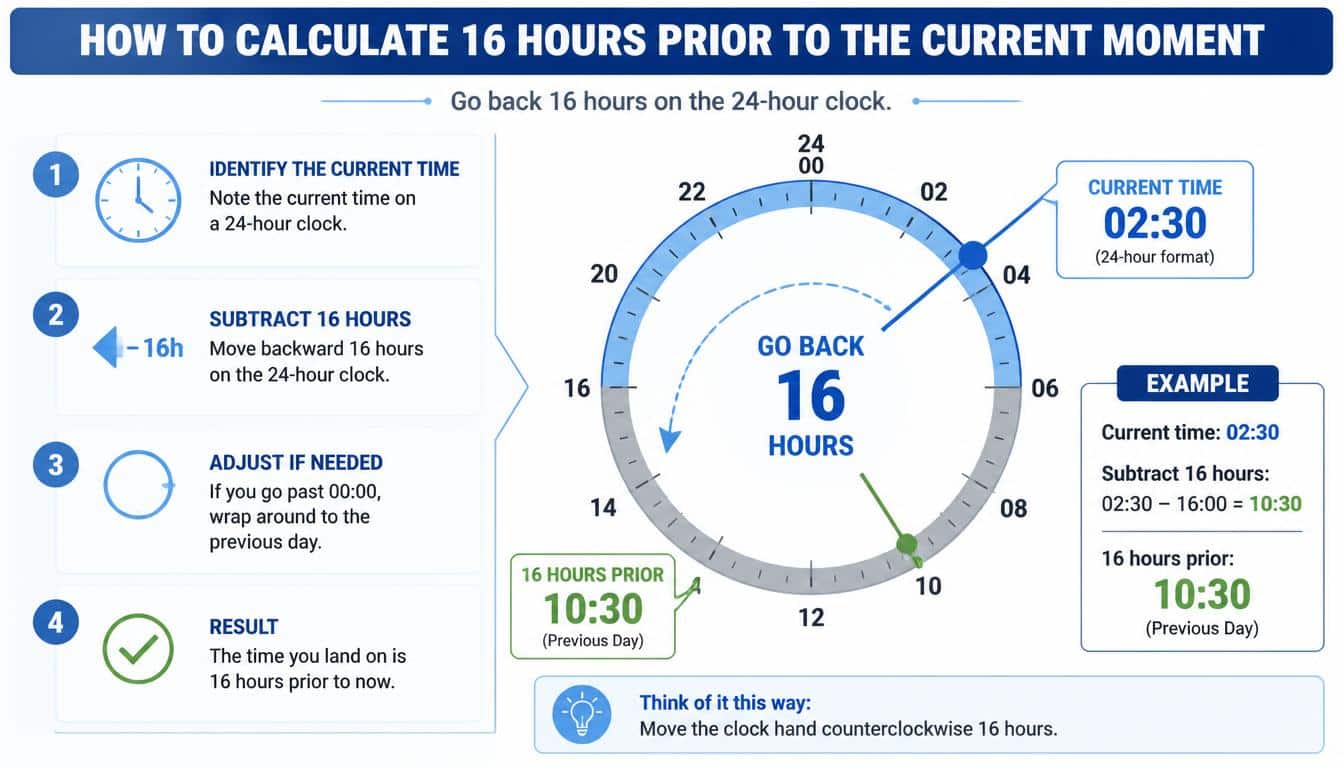
The easiest method for calculate 16 hours ago questions is ordinary time subtraction. Start with the current clock time and remove 16 hours. If the result crosses midnight, change the date as well.
For our example:
12:04 PM − 16 hours = 8:04 PM the previous day.
Another way is to subtract 24 hours first and then add eight hours back. Since 16 hours is eight hours less than a full day, the answer must be eight hours earlier on the previous calendar date.
That gives:
12:04 PM − 24 hours = 12:04 PM on September 16
Then:
12:04 PM + 8 hours = 8:04 PM on September 16
This method can be surprisingly handy when the starting time is close to midnight. It reduces the chance of accidentally writing the correct clock time with the wrong date, which is a very common little error.
What Was the Time 16 Hours Ago in Simple Terms?
Think of a normal day as a circle rather than a straight line. The clock keeps moving, but when you pass midnight, the calendar quietly flips to another date. That is why 16 hours earlier can mean the previous evening rather than simply “yesterday morning.”
Starting at 12:04 PM, there are 12 hours until midnight. Because we need to go back 16 hours, we pass midnight by four hours.
So the path looks like this:
- 12:04 PM, September 17
- 8:04 AM, September 17 4 hours earlier
- 12:04 AM, September 17 12 hours earlier
- 8:04 PM, September 16 16 hours earlier
Notice the calendar changes only after reaching midnight. This is the bit that makes time subtraction slightly different from ordinary subtraction on paper.
What Time Was It 16 Hours Ago If It Is Noon?
When the current time is exactly noon, the calculation becomes beautifully simple.
12:00 PM − 16 hours = 8:00 PM on the previous day.
So if it is noon on Thursday, 16 hours ago it was 8:00 PM on Wednesday. If it is noon on September 17, 2026, then 16 hours earlier was 8:00 PM on September 16, 2026.
For times just after noon, the minutes stay the same when you subtract a whole number of hours. For example, 12:37 PM minus 16 hours is 8:37 PM the previous day. The clock minutes don’t magically disappear, thankfully.
Why the Previous Day Matters
A previous day calculation becomes necessary whenever subtracting the required number of hours takes you across midnight. This is particularly important for records, messages, appointments, work logs, online activity, and anything else where the date matters as much as the hour.
Suppose an email says it was sent “16 hours ago.” If you only calculate the clock time, you might write 8:04 PM without mentioning September 16. That could be confusing if someone assumes the message happened on September 17.
Date and time work together. A clock time without its date can sometimes be incomplete, especially around midnight, and thats where small mistakes turn into surprisingly annoying ones.
16 Hours Ago in Minutes, Seconds, and Milliseconds
Sometimes a time calculator needs more than hours and minutes. Fortunately, converting 16 hours into smaller units is straightforward.
16 hours in minutes:
16 × 60 = 960 minutes
16 hours in seconds:
16 × 60 × 60 = 57,600 seconds
16 hours in milliseconds:
16 × 60 × 60 × 1,000 = 57,600,000 milliseconds
So:
- 16 hours = 960 minutes
- 16 hours = 57,600 seconds
- 16 hours = 57,600,000 milliseconds
These conversions are useful when software, spreadsheets, databases, or technical systems measure elapsed time using smaller units. For ordinary people checking yesterday’s dinner time, though, seconds and milliseconds are probably more drama than necessary.
What Time Was 16 Hours Ago in AM/PM Format?
The 12-hour clock uses AM and PM to divide the day into two sections. This makes time subtraction slightly more interesting when you cross noon or midnight.
For the example here, the starting point is 12:04 PM. Subtracting 16 hours moves backward through:
PM → AM → PM
That sounds odd at first, but it is perfectly normal because we cross midnight. After reaching 12:04 AM, another four hours takes us back into the previous evening, producing 8:04 PM.
This is also why blindly changing PM to AM isn’t a reliable way to calculate a past time. You need to count the hours, not merely flip the letters beside the clock.
How to Find the Time 16 Hours Before Now
If you want to find the time 16 hours before now, use a three-step process that works on nearly any ordinary clock.
First, write down your current time as accurately as possible, including minutes. Seconds can be included if you need precision.
Second, subtract 16 hours. If the subtraction crosses midnight, move the date backward by one day.
Third, check whether the AM/PM designation makes sense. This final glance catches many mistakes, especially when you’re doing the calculation quickly.
For example:
Current: 12:04 PM, September 17
Subtract: 16 hours
Result: 8:04 PM, September 16
And there it is. No mysterious formula, no complicated machinery, just a clock behaving like a clock.
Using a Time 16 Hours Ago Calculator
An hours ago calculator or time 16 hours ago calculator can be useful when you want an instant result without manually doing the arithmetic. You enter a starting date and time, select the number of hours to subtract, and the calculator handles the calendar change.
A good time calculator should account for the date as well as the clock. This matters because subtracting 16 hours from an afternoon time will often land on the previous evening.
Some online time calculators also handle seconds, minutes, future calculations, and time-zone differences. They can be especially useful when you are working with timestamps rather than casual clock times.
Still, knowing the manual method is worthwhile. A calculator can give you an answer, but understanding why the answer is correct makes it easier to spot an incorrect setting or timezone.
16 Hours Ago vs. 16 Hours From Now
The phrases 16 hours ago and 16 hours from now sound almost like mirror images, and mathematically they are.
“16 hours ago” means move backward 16 hours.
“16 hours from now” means move forward 16 hours.
From 12:04 PM on September 17, 2026, going backward gives:
8:04 PM on September 16, 2026.
Going forward gives:
4:04 AM on September 18, 2026.
So the two results are on opposite sides of the current moment, with the calendar potentially changing in either direction. The important thing is to identify whether you’re moving into the past or the future before starting your calculation.
What Happens With 17, 18, 19, 20, or 21 Hours Ago?
Once you understand the 16-hour calculation, nearby questions become much easier. Starting from 12:04 PM on September 17, 2026, the results are:
- 17 hours ago: 7:04 PM on September 16
- 18 hours ago: 6:04 PM on September 16
- 19 hours ago: 5:04 PM on September 16
- 20 hours ago: 4:04 PM on September 16
- 21 hours ago: 3:04 PM on September 16
The minutes remain 04 because we’re subtracting whole hours. If the starting time included seconds, those seconds would remain too, unless the calculation included seconds.
This is one reason keeping the original timestamp intact is useful. Don’t round the current time unless you actually want an approximate answer.
Does GMT+5 Change the Calculation?
A GMT+5 time zone does not change the mathematical meaning of “16 hours ago.” It changes the local clock representation you start with.
If your local time is 12:04 PM in GMT+5, then 16 hours earlier in that same local time zone is 8:04 PM on the previous day. The duration remains exactly 16 hours.
Time-zone calculations become more complicated when the starting point and ending point are in different zones. In that situation, you first need to establish which local time you’re using. A time difference calculator can help, but the timezone labels still matter.
For a simple same-zone calculation, there is no need to make it harder than it is. Start with the local clock, subtract 16 hours, and check the date.
Common Mistakes When Calculating 16 Hours Ago
One frequent mistake is forgetting the date change. Someone correctly calculates 8:04 PM but writes September 17 instead of September 16. The clock is right, but the complete timestamp is wrong.
Another mistake is confusing 12 AM and 12 PM. Noon is 12 PM, while midnight is 12 AM. Those two labels have caused an almost unreasonable amount of confusion over the years, really.
A third mistake is subtracting 16 from the hour number without considering the 12-hour clock. For example, trying to turn 12 PM directly into “-4 PM” doesn’t work. The clock wraps around instead.
Finally, people sometimes forget the time zone. “8:04 PM” means different things in different locations, so a precise timestamp should include the relevant timezone when accuracy matters.
A Quick Formula for Time Subtraction
There isn’t one fancy formula required for ordinary hour subtraction. The basic idea is:
Past time = current time − elapsed hours
For this example:
12:04 PM − 16 hours = 8:04 PM, previous day
For duration conversions:
Hours × 60 = minutes
Hours × 3,600 = seconds
Hours × 3,600,000 = milliseconds
These simple relationships are enough for most everyday calculations. If dates, time zones, daylight-saving transitions, or timestamps with seconds are involved, a dedicated calculator can reduce the chance of a human error.
Why Exact Time Matters
There is a difference between saying “about 16 hours ago” and identifying an exact timestamp. If you’re remembering when something happened casually, approximate time may be completely fine.
But for an appointment, transaction, message, work record, travel event, or digital log, the exact hours, minutes, seconds, and date can matter. Even a few minutes can change the order of events.
That’s why a good answer to what time was 16 hours ago should ideally include both the clock time and the calendar date. “8:04 PM” is useful. “8:04 PM on September 16, 2026, GMT+5” is much clearer.
A Simple Mental Shortcut
Here is a shortcut worth remembering: because a full day contains 24 hours, subtracting 16 hours is the same as moving forward 8 hours from the same clock time while moving back one calendar day.
So:
12:04 PM today − 16 hours
is equivalent to:
12:04 PM yesterday + 8 hours
which gives:
8:04 PM yesterday.
This little trick works because 16 is eight less than 24. It can make mental calculations faster, particularly when the starting time is somewhere around the afternoon or evening.
Frequently Asked Questions
16 hours ago
16 hours ago refers to a point in time that occurred exactly 16 hours before the current time. The exact date and time depend on when you are checking.
What time was it 16 hours ago
To find the time 16 hours ago, subtract 16 hours from the current time. This may take you back to the previous day, depending on the current hour.
How long ago was 16 hours ago
16 hours ago means exactly 16 hours have passed between that earlier time and now. It is equivalent to 960 minutes or 57,600 seconds.
When was 16 hours ago
16 hours ago was the same clock time on the previous day in many cases. The exact date depends on the current date and time.
What was 16 hours ago from now
To determine what was 16 hours ago from now, simply count backward 16 hours from the current time. If necessary, the calculation will cross into the previous calendar day.
Read this blog: https://gracethemes.com/what-time-is-12-hours-from-now/
Final Answer: What Time Was It 16 Hours Ago?
Using the stated reference time of 12:04 PM on September 17, 2026, GMT+5, the answer is:
It was 8:04 PM on Wednesday, September 16, 2026.
In other words, 16 hours ago was the previous evening. The calculation is simply a matter of subtracting 16 hours, recognizing that the calculation crosses midnight, and moving the date back by one day.
