

What Time Is 12 Hours From Now?
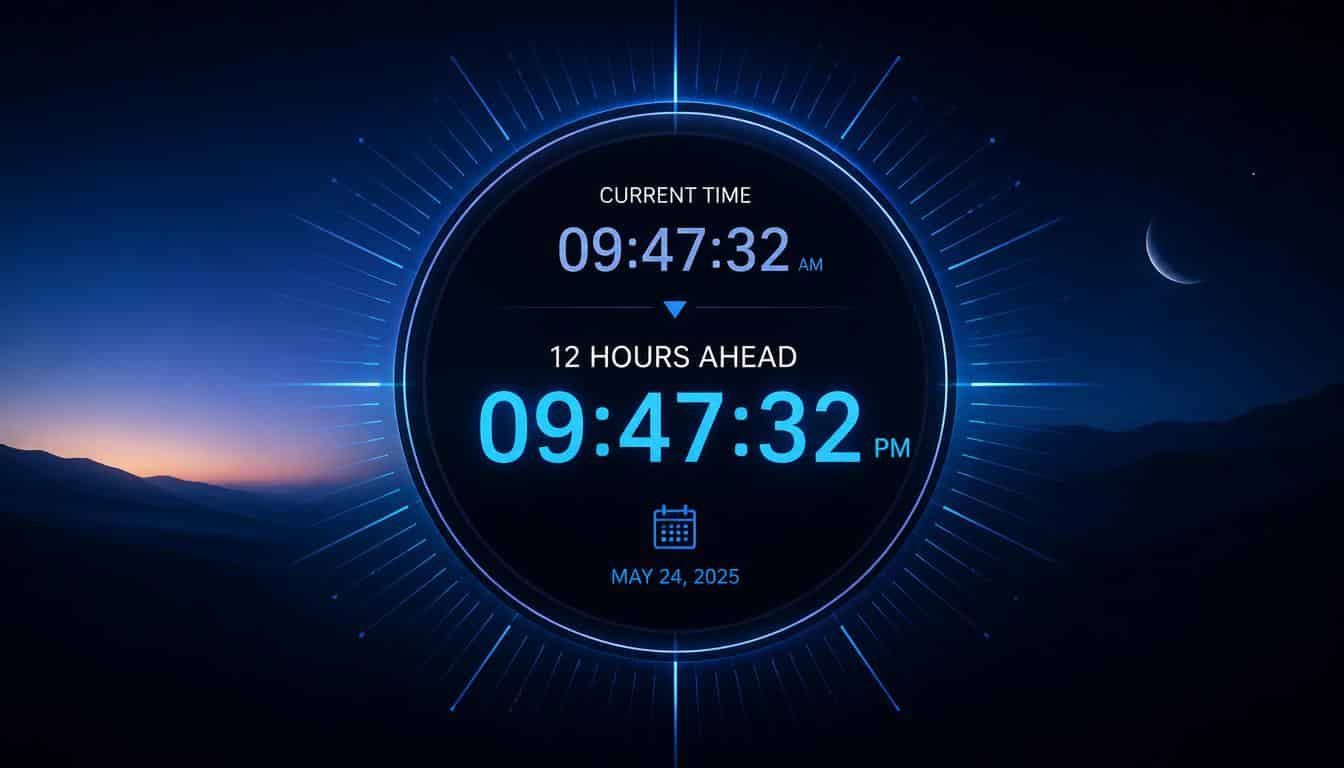
There is something oddly satisfying about asking, “what time is 12 hours from now?” It sounds like a tiny question, almost too small to need calculating, yet it can become surprisingly confusing when AM, PM, midnight, dates, and time zones all enter the picture.
A quick bit of time arithmetic can suddenly turn into a miniature puzzle, especially when you’re doing it half-awake.
The good news is that the answer is usually very simple. If you know the current time, you can add exactly 12 hours to find the future time. The only thing you need to watch carefully is whether the calculation crosses midnight and therefore changes the date and time.
For the current example, the local time being used here is 1:27 PM on Tuesday, September 15, 2026, in GMT+5. Adding 12 hours takes us past midnight, so the answer becomes 1:27 AM on Wednesday, September 16, 2026.
Thats the whole calculation, although understanding why it works makes similar questions much easier.
| Current Time | 12 Hours From Now | Date Change |
| 12:00 AM | 12:00 PM | Same day |
| 1:00 AM | 1:00 PM | Same day |
| 3:30 AM | 3:30 PM | Same day |
| 6:00 AM | 6:00 PM | Same day |
| 9:15 AM | 9:15 PM | Same day |
| 12:00 PM (Noon) | 12:00 AM (Midnight) | Next day |
| 1:27 PM | 1:27 AM | Next day |
| 3:45 PM | 3:45 AM | Next day |
| 6:30 PM | 6:30 AM | Next day |
| 9:00 PM | 9:00 AM | Next day |
| 11:30 PM | 11:30 AM | Next day |
What Time Is 12 Hours From Now?
If the current time is 1:27 PM, then adding 12 hours produces 1:27 AM on the following day. The minutes stay exactly the same because we are adding a whole number of hours, not minutes.
So, in this example:
- Current time: 1:27 PM
- Add: 12 hours
- Future time: 1:27 AM
- Future date: Wednesday, September 16, 2026
- Time zone: GMT+5
This is a classic 12-hour time calculation. The hour moves forward by twelve, but on a 12-hour clock, adding twelve hours brings the clock face back to the same displayed hour. The AM/PM label changes, which is the little detail that trips people up.
If you were wondering, “What time will it be 12 hours from now?”, the practical answer is therefore 1:27 AM on Wednesday, September 16, 2026, based on the current time used in this article. If your own clock shows a different current time, your answer will naturally be different too.
How Do You Calculate 12 Hours From Now?
The easiest method is simply to add twelve to the hour while keeping the minutes unchanged. With a 24-hour clock, the calculation is even cleaner because there is no AM/PM label to juggle around.
For example, suppose the current time is 8:15 AM. Add twelve hours and you get 8:15 PM. If the current time is 8:15 PM, twelve hours later is 8:15 AM the next day.
The basic time calculation formula is:
Current time + 12 hours = future time
For a 24-hour clock, you can represent the same idea as:
Current hour + 12, adjusted to the next day when necessary.
It sounds technical, but really it is just moving the clock hands around once. Twelve hours is half of a full 24-hour day, so the AM/PM state always flips when exactly twelve hours are added.
What Happens to AM and PM After 12 Hours?
The relationship between AM / PM and twelve hours is one of the most useful things to remember. Adding twelve hours changes AM to PM or PM to AM, while the displayed clock hour remains the same.
For instance:
- 2:00 AM → 2:00 PM
- 5:30 AM → 5:30 PM
- 9:45 AM → 9:45 PM
- 2:00 PM → 2:00 AM
- 5:30 PM → 5:30 AM
- 9:45 PM → 9:45 AM
Notice the pattern, its almost wonderfully boring once you see it. The minutes don’t change, and the hour shown on a 12-hour time format clock comes back to the same number.
This is why twelve hours can be easier to calculate mentally than thirteen or fourteen hours. With thirteen hours, you need to move one additional hour; with twelve, you simply flip the AM/PM designation and check whether the date changes.
12 Hours From Now in 12-Hour and 24-Hour Time
The 12-hour time format uses numbers from 1 through 12 together with AM or PM. The 24-hour system, sometimes called military time, runs from 00:00 through 23:59.
Take the example of 1:27 PM.
In 12-hour format, it is:
1:27 PM
In 24-hour format, it is:
13:27
Now add twelve hours:
13:27 + 12:00 = 01:27 on the next day.
Converted back to the familiar clock, that becomes:
1:27 AM
This is a useful little piece of time conversion, because 24-hour notation makes crossing midnight much more obvious. You dont have to wonder whether the answer belongs to today or tomorrow; the number itself gives you a clue.
What Date Is 12 Hours From Now?
The date matters whenever the calculation crosses midnight. Twelve hours is exactly half a day, so whether you remain on today’s date depends entirely on the starting time.
If it is 7:00 AM, twelve hours later is 7:00 PM on the same date. If it is 7:00 PM, twelve hours later is 7:00 AM on the next date.
Using the current example:
Tuesday, September 15, 2026, 1:27 PM
plus
12 hours
equals
Wednesday, September 16, 2026, 1:27 AM
The date changes because the calculation passes through midnight. This is where a simple current date and time check becomes important, particularly when scheduling reminders, deadlines, appointments, travel, or online events.
12 Hours From Now: A Simple Examples List
These examples give you a quick mental reference. They are not complicated formulas, just ordinary clock movements that make the pattern easier to notice.
- 12 hours from 1:00 AM → 1:00 PM
- 12 hours from 3:15 AM → 3:15 PM
- 12 hours from 6:30 AM → 6:30 PM
- 12 hours from 9:45 AM → 9:45 PM
- 12 hours from 12:00 noon → 12:00 AM the next day
- 12 hours from 2:00 PM → 2:00 AM the next day
- 12 hours from 5:20 PM → 5:20 AM the next day
- 12 hours from 8:40 PM → 8:40 AM the next day
- 12 hours from 11:10 PM → 11:10 AM the next day
The interesting one here is noon. Twelve hours after noon is midnight, while twelve hours after midnight is noon. The two sit opposite each other on the daily clock, which makes them handy anchors when doing mental calculations.
How to Add 12 Hours to the Current Time
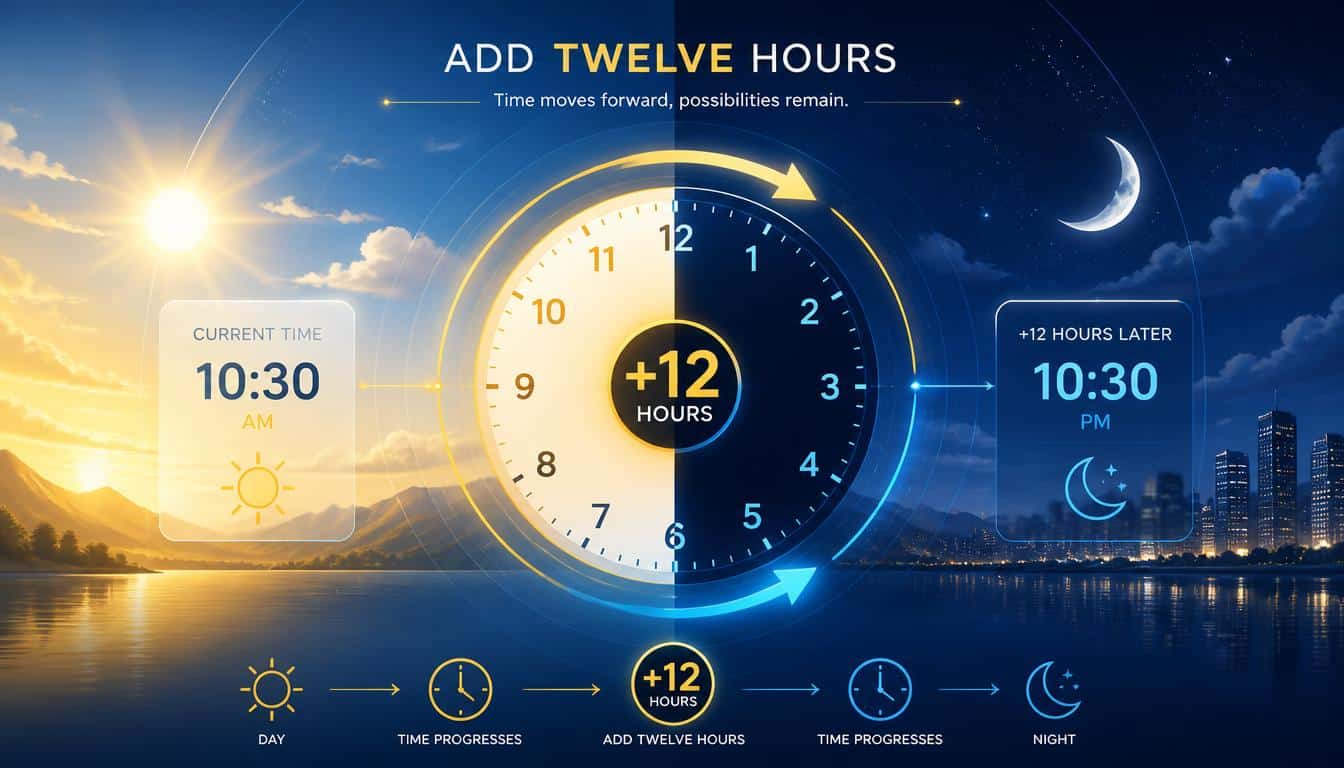
When you need to calculate 12 hours, use a three-step approach. It takes only a moment and works regardless of whether the time is in the morning or evening.
Step one: Look at the current hour and minutes.
Step two: Keep the minutes exactly as they are and move twelve hours forward.
Step three: Switch AM to PM or PM to AM, then check whether the calculation crosses midnight.
For example, if the clock says 10:35 AM, twelve hours later is 10:35 PM. If the clock says 10:35 PM, twelve hours later is 10:35 AM tomorrow.
Thats basically the entire time arithmetic trick. Once the AM/PM switch becomes automatic, these calculations become almost instant.
12 Hours Ago vs. 12 Hours From Now
There is a useful mirror image between 12 hours ago and 12 hours from now. Adding twelve hours moves forward by half a day, while subtracting twelve hours moves backward by half a day.
Suppose the current time is 4:25 PM.
Twelve hours from now is:
4:25 AM tomorrow
Twelve hours ago was:
4:25 AM today
The displayed hour is identical in both cases, but the date changes depending on the direction of movement. This distinction matters when someone says, “What time was it twelve hours ago?” because the answer may belong to yesterday rather than today.
You can also use the same approach for 13 hours ago, 14 hours ago, 15 hours ago, 16 hours ago, or 17 hours ago. Simply subtract the requested number of hours and adjust the date when the clock crosses midnight.
What Time Is 13–17 Hours From Now?
Sometimes a person starts with the twelve-hour question and then realizes they actually need a slightly longer interval. The calculation is still straightforward, and 13–17 hours can be understood as twelve hours plus a little extra.
For example:
- 13 hours from now = twelve hours + one hour
- 14 hours from now = twelve hours + two hours
- 15 hours from now = twelve hours + three hours
- 16 hours from now = twelve hours + four hours
- 17 hours from now = twelve hours + five hours
If the starting time is 1:27 PM, then twelve hours later is 1:27 AM. From there, the additional hours give:
- 13 hours → 2:27 AM
- 14 hours → 3:27 AM
- 15 hours → 4:27 AM
- 16 hours → 5:27 AM
- 17 hours → 6:27 AM
This approach is often easier than trying to perform a large calculation in one jump. Break it into a twelve-hour block and the remaining hours, and the answer feels much less slippery.
How Many Minutes Are in 12 Hours?
For unit-based time conversion, twelve hours can be converted into several smaller measurements.
One hour contains 60 minutes, so:
12 hours = 720 minutes
That means twelve hours from now is also 720 minutes from now. If you are working with a timer, spreadsheet, scheduling system, or programming task, minutes can sometimes be more convenient than clock notation.
The calculation is simple:
12 × 60 = 720 minutes
So the answer to “How many minutes are in 12 hours?” is 720 minutes. Nothing fancy hiding in there, thankfully.
How Many Seconds Are in 12 Hours?
The same principle works for seconds. There are 60 seconds in one minute and 60 minutes in one hour.
Therefore:
12 hours = 43,200 seconds
The calculation is:
12 × 60 × 60 = 43,200 seconds
So if a system asks for a twelve-hour duration in seconds, use 43,200 seconds. This is particularly useful when setting technical timers or understanding duration values, where a clock time such as 1:27 PM isn’t the format the system expects.
How Many Milliseconds Are in 12 Hours?

For even finer measurements, one second contains 1,000 milliseconds.
Since twelve hours contains 43,200 seconds:
43,200 × 1,000 = 43,200,000 milliseconds
So:
12 hours = 43,200,000 milliseconds
It looks like a ridiculously large number compared with twelve hours, but thats simply because milliseconds are very small units. The duration hasn’t become longer; we have just measured the same duration with a much smaller ruler.
Using GMT+5 for a 12-Hour Calculation
A time zone can change the displayed answer because different places have different local clocks. The duration itself does not change, though: twelve hours is twelve hours everywhere.
For this example, the reference is GMT+5, meaning the local clock is five hours ahead of Greenwich Mean Time. The important thing is to calculate from the actual local/current time rather than assuming another country’s clock applies.
If your current time is 1:27 PM in GMT+5, twelve hours later is 1:27 AM in the same time zone, on the next day.
The UTC offset becomes especially important when an event is being arranged between people in different regions. A calculation that is correct in one local time can appear to have a different clock reading somewhere else, even though the underlying moment is identical.
Why Midnight and Noon Cause Confusion
Midnight and noon are the two moments that tend to make ordinary clock calculations feel slightly mischievous. Midnight marks the beginning of a new calendar day, while noon sits halfway through it.
Twelve hours after noon is midnight, and twelve hours after midnight is noon. This is why a calculation involving either one should always include the date when accuracy matters.
For example, 12:00 PM plus twelve hours is 12:00 AM on the following day. Meanwhile, 12:00 AM plus twelve hours is 12:00 PM on the same calendar day.
People sometimes accidentally treat 12 AM as afternoon or 12 PM as midnight, which causes the whole calculation to wander off in the wrong direction. A quick date check usually catches the mistake.
Can an Hours From Now Calculator Do This Automatically?
Yes. An Hours from now calculator or time calculator can perform the calculation automatically once you provide the starting time and the number of hours.
For a basic question such as 12 hours from now, however, manual calculation is often quicker. You simply identify the current hour, keep the minutes unchanged, switch AM/PM, and check the date.
A calculator becomes more useful when you are adding unusual intervals, working with several dates, comparing time zones, or calculating something like 37 hours from a particular timestamp. For ordinary twelve-hour questions, your own brain is already a pretty decent little calculator.
Common Mistakes When Calculating 12 Hours Later
One frequent mistake is changing the minutes. If the current time is 6:42, twelve hours later is still 6:42. The minutes have no reason to move.
Another mistake is forgetting the AM/PM change. Twelve hours after 6:42 AM is 6:42 PM, while twelve hours after 6:42 PM is 6:42 AM the next day.
A third mistake is ignoring the date. Saying “6:42 AM” may technically be incomplete if someone needs to know whether you mean today or tomorrow. For scheduling, the complete date and time is much safer.
Finally, people sometimes confuse 12 hours with 12 hours ago. One moves forward and the other moves backward, so direction matters more than it first appears.
A Quick Reference for 12-Hour Time Calculation
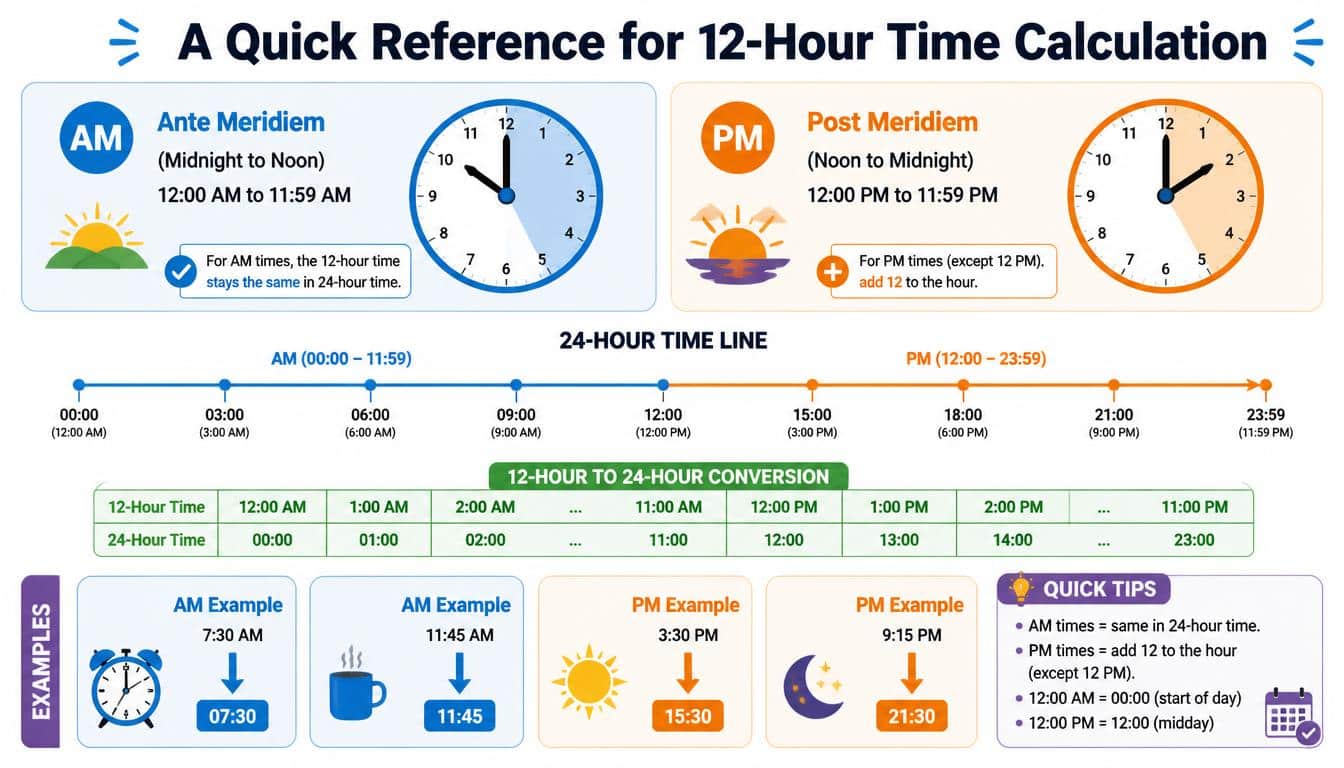
Here is a compact reference you can keep in mind whenever you need to add hours to time:
- AM + 12 hours → same clock hour, PM
- PM + 12 hours → same clock hour, AM
- PM + 12 hours → usually the next calendar day
- Minutes remain unchanged when adding exactly 12 whole hours
- 12 hours = 720 minutes
- 12 hours = 43,200 seconds
- 12 hours = 43,200,000 milliseconds
- Midnight and noon deserve extra attention
- Always check the time zone when comparing locations
- Include the date whenever midnight is crossed
It really is a small collection of rules, and once they are familiar, most twelve-hour calculations stop feeling like calculations at all.
Frequently asked Questions
12 hours from now is what time
To find the time 12 hours from now, add 12 hours to the current time. The result will be the same clock time but switch from AM to PM or PM to AM.
What is 12 hours from now
12 hours from now means exactly half a day after the current time. For example, if it is 2:00 PM now, 12 hours from now will be 2:00 AM the next day.
What time was it 12 hours from now
If you mean 12 hours ago, subtract 12 hours from the current time. This gives you the same clock time on the previous or current day, depending on the starting time.
12hrs from now
12hrs from now is simply the current time plus 12 hours. Since 12 hours equals half a day, the AM/PM designation will switch.
Time in 12 hours
The time in 12 hours can be calculated by adding 12 hours to the current time. For example, 8:30 AM becomes 8:30 PM, while 8:30 PM becomes 8:30 AM the next day.
Read More: https://gracethemes.com/weeks-calculator-add-weeks-to-date/
Final Answer: What Time Is 12 Hours From Now?
Using the current reference time for this article—1:27 PM on Tuesday, September 15, 2026, GMT+5—the answer is:
12 hours from now = 1:27 AM on Wednesday, September 16, 2026.
The calculation can be written simply as:
1:27 PM + 12 hours = 1:27 AM the following morning
The key idea is that twelve hours is half a day. On a 12-hour clock, the displayed hour and minutes return to the same position, while AM changes to PM or PM changes to AM. If the starting point is in the afternoon or evening, the future date may move into tomorrow.
So when someone asks, “What is 12 hours from the current time?”, don’t overcomplicate it. Look at the clock, move forward twelve hours, flip AM/PM, and check the calendar. Thats usually all there is to it.
If your own clock shows a different current time, simply repeat the same method. The exact answer always depends on the starting local/current time and, when relevant, the applicable time zone.
And if you’re using an online time calculator or hours from now calculator, the same basic logic is happening behind the screen only much faster and without the human tendency to accidentally call midnight noon.
A tiny calculation, yes, but one that becomes wonderfully clear once you know what to watch for.
