

What Time Was It 15 Minutes Ago? A Simple Guide to Time Calculation
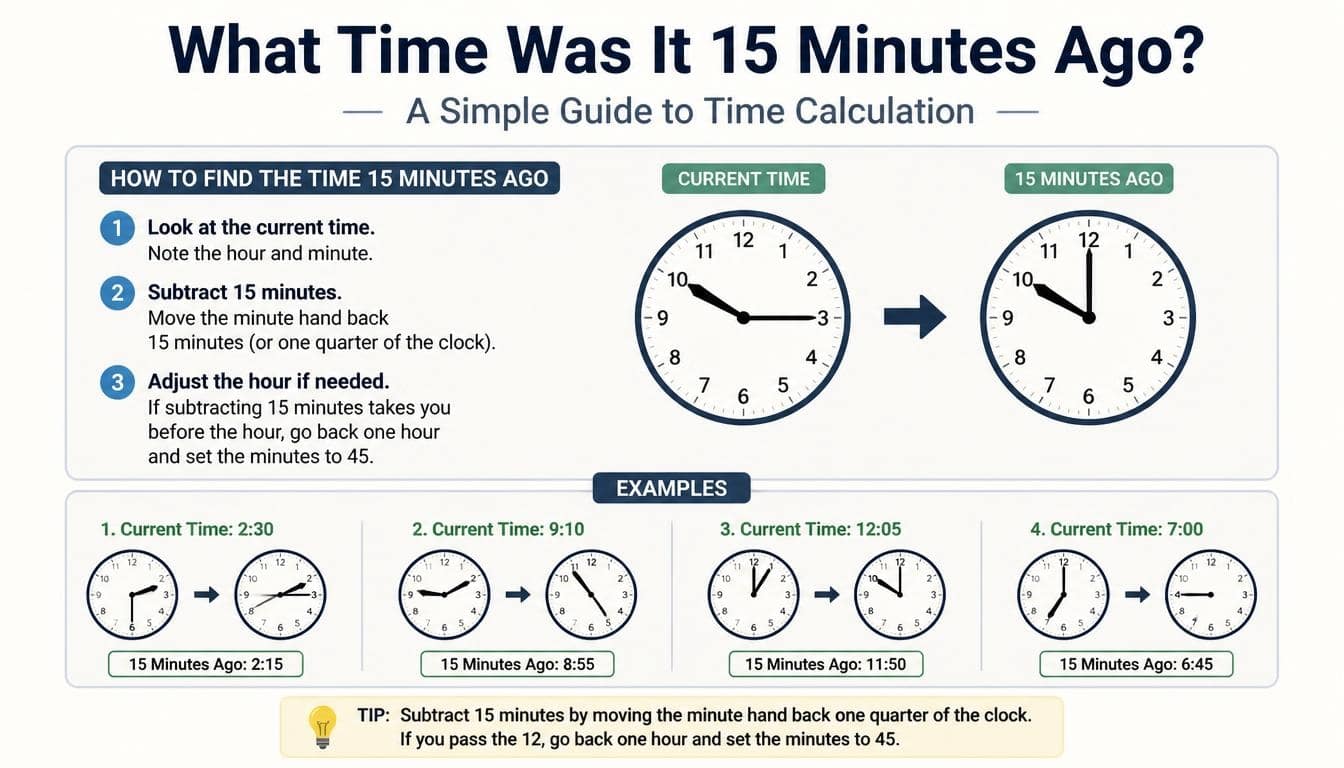
Have you ever glanced at your phone, wondered what time it was fifteen minutes earlier, and then found yourself doing little calculations in your head?
It happens more often than we might think. Maybe you are checking when a meeting started, figuring out how long you’ve been waiting for a friend, or trying to remember the exact time you sent an important message.
Whatever the reason, knowing What time was it 15 minutes ago can be surprisingly useful in everyday life.
The good news is that the calculation is simple. If the Current time is 10:00 AM, then 15 minutes ago it was 9:45 AM. You simply move the clock backward by fifteen minutes, keeping an eye on the hour, the AM/PM designation, and the date if the calculation crosses midnight.
In this guide, we’ll explore how to calculate the earlier time, understand time zones, convert minutes into other units, and avoid common mistakes.
Whether you need a quick answer or want to understand the calculation properly, you’ll find everything here without needing to be a maths expert.
What Time Was It 15 Minutes Ago?
The answer depends on the exact time on your clock right now. To find the earlier time, take the current hours and minutes and subtract fifteen minutes. That’s all there is to it in most situations, although crossing an hour or midnight needs a little extra attention.
For example, if the clock reads 10:00 AM, subtracting fifteen minutes gives you 9:45 AM. If the clock reads 3:30 PM, the answer is 3:15 PM. Easy enough, right?
Here are some quick examples to make the idea clearer.
- If the Current time is 10:00 AM, the time fifteen minutes earlier was 9:45 AM.
- If the current time is 11:20 AM, the earlier time was 11:05 AM.
- If the current time is 2:15 PM, the earlier time was 2:00 PM.
- If the current time is 6:40 PM, the earlier time was 6:25 PM.
- If the current time is 12:10 PM, the earlier time was 11:55 AM.
- If the current time is 8:05 AM, the earlier time was 7:50 AM.
- If the current time is 12:05 AM, the earlier time was 11:50 PM on the previous day.
Notice how the answer changes depending on where the current time falls. Sometimes you only subtract the minutes, and sometimes you also need to adjust the hour or calendar date.
The key is to remember that a clock does not stop at the end of an hour. It moves into the previous hour, and eventually into the previous day when midnight is involved.
What Was the Time Fifteen Minutes Ago at 10:00 AM?
Let’s use a specific example because it makes the calculation easier to understand. Imagine your digital clock displays 10:00 AM on Thursday, October 29, 2026, in the GMT+5 time zone.
To determine What was the time fifteen minutes ago, subtract fifteen minutes from 10:00 AM.
The result is 9:45 AM on Thursday, October 29, 2026, assuming 10:00 AM is the reference time in that time zone.
This example also shows why the date and time zone matter. A calculation can be mathematically correct, but its exact calendar date depends on when and where the reference time was recorded.
Here is the calculation in a simple format:
- Reference time: 10:00 AM
- Time interval: 15 minutes
- Calculation: 10:00 AM − 15 minutes
- Result: 9:45 AM
- Date: Thursday, October 29, 2026
- Time zone: GMT+5
The same method works for any other clock time. Just start with the actual time you want to use and move backward by fifteen minutes.
How to Calculate Time 15 Minutes Ago Without a Calculator
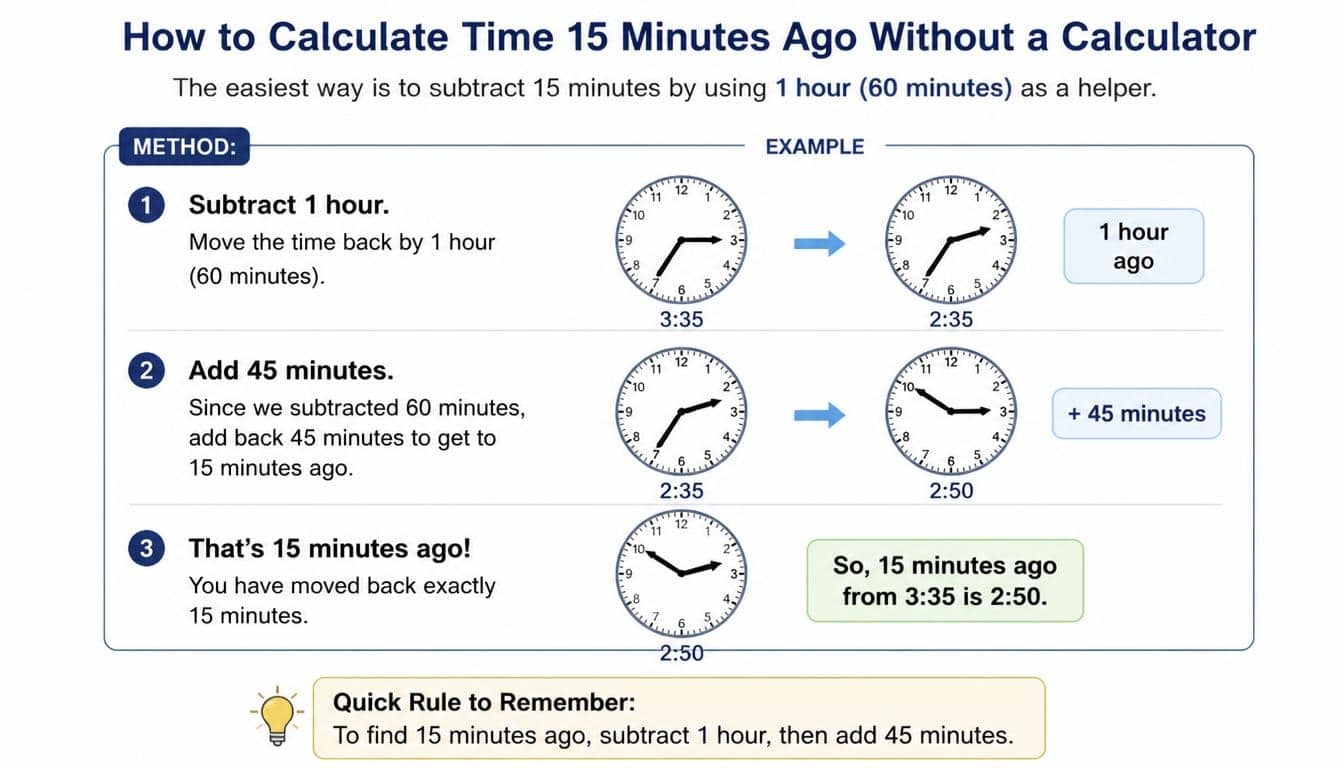
You don’t always need an online tool to work out an earlier time. In fact, learning a few simple rules can make everyday Time calculation much easier, especially when you’re checking appointment times or working out when an event began.
Start with the current minutes
Look at the minutes displayed on your clock. If the number is fifteen or greater, subtract fifteen directly.
For instance, 4:35 PM becomes 4:20 PM. The hour stays the same because the subtraction does not cross into the previous hour. This is probably the easiest situation you’ll encounter.
Adjust the hour when necessary
What happens if the clock says 4:10 PM? You cannot simply subtract fifteen from ten and keep the same hour, because that would produce a negative number of minutes.
Instead, borrow one hour, which is equal to sixty minutes. Subtract fifteen from seventy minutes, giving you fifty-five minutes, and move the hour backward by one.
So, 4:10 PM becomes 3:55 PM.
Check the AM or PM designation
The AM/PM label may also change when the calculation crosses noon or midnight. For example, 12:05 PM minus fifteen minutes becomes 11:50 AM.
Similarly, 12:05 AM minus fifteen minutes becomes 11:50 PM on the previous calendar day. These little changes are easy to miss when you’re in a hurry, so it’s worth checking the final result.
Confirm the date if needed
Most calculations remain on the same date. However, if the reference time is shortly after midnight, subtracting fifteen minutes may take you into the previous day.
For example, 12:08 AM on Friday becomes 11:53 PM on Thursday. The time calculation is straightforward, but the date needs to move backward as well.
A Quick Time Subtraction Table
When you only need a fast answer, a table can save you from repeating the calculation every time. The examples below show how fifteen minutes changes different reference times.
| Current time | Time 15 minutes ago |
| 6:00 AM | 5:45 AM |
| 7:15 AM | 7:00 AM |
| 8:20 AM | 8:05 AM |
| 9:45 AM | 9:30 AM |
| 10:00 AM | 9:45 AM |
| 11:10 AM | 10:55 AM |
| 12:05 PM | 11:50 AM |
| 1:30 PM | 1:15 PM |
| 3:00 PM | 2:45 PM |
| 5:10 PM | 4:55 PM |
| 8:25 PM | 8:10 PM |
| 12:05 AM | 11:50 PM on the previous day |
These are examples rather than a live clock reading. For an exact answer at any other moment, use your local clock as the starting point.
Understanding the Time Difference: What Does 15 Minutes Mean?
Fifteen minutes might feel like a short interval, but it can make a real difference in how we organise our day. It is enough time to walk to a nearby shop, prepare a cup of tea, review a few notes, or finish a small task that has been sitting on your list.
From a mathematical perspective, fifteen minutes is one quarter of an hour. That’s why it is often called a quarter of an hour, a phrase that appears in everyday conversations about schedules and appointments.
Here are the most useful conversions:
- 15 minutes in hours: 0.25 hours.
- 15 minutes in seconds: 900 seconds.
- 15 minutes in milliseconds: 900,000 milliseconds.
- 15 minutes as a fraction of an hour: One-quarter, or 1/4.
- 15 minutes as part of a 60-minute hour: 25% of the hour.
The conversions are useful when you need to compare different measurements of time. For example, a computer system might record an interval in milliseconds, while a calendar displays the same interval in hours and minutes.
The duration stays the same, even though the number used to describe it changes.
What Time Was It 15 Minutes Ago in GMT+5?
Time zones can make an otherwise simple calculation a little confusing. GMT+5 means a time offset of five hours ahead of Greenwich Mean Time, or UTC+5 when expressed using the corresponding UTC offset.
If your clock shows 10:00 AM in GMT+5, then fifteen minutes earlier it was 9:45 AM in the same time zone. You don’t need to convert to another time zone before subtracting the minutes, unless your task specifically requires a different reference zone.
For clarity, consider these examples:
- Current time in GMT+5: 10:00 AM; earlier time: 9:45 AM.
- Current time in GMT+5: 4:30 PM; earlier time: 4:15 PM.
- Current time in GMT+5: 12:10 AM; earlier time: 11:55 PM on the previous day.
The Current time GMT+5 is only meaningful when the reference time is known. A time zone identifies the offset, but it doesn’t independently tell you the exact current hour and minute.
If you’re comparing timestamps from two countries, make sure both are expressed in a consistent time zone before calculating the difference. Otherwise, an apparent discrepancy might come from the time-zone conversion rather than an error in the clock.
How to Use a Time Difference Calculator
An online Time difference calculator can be helpful when you need more than a quick subtraction. These tools are especially useful for calculating elapsed time between appointments, comparing timestamps, or checking intervals that span several hours or dates.
A basic Time calculator generally follows a simple process.
- Enter the reference time, such as 10:00 AM.
- Choose the operation to perform, which in this case is subtraction.
- Enter the duration of fifteen minutes.
- Check the resulting time and, where relevant, the date.
- Confirm the time zone if the result will be used for a different location.
Some websites, including Inch Calculator, provide time and unit calculation resources that can help users understand measurements and conversions. When choosing any online calculator, make sure you understand whether it expects a duration, a clock time, or two timestamps.
A Time subtraction calculator is particularly useful when the calculation crosses midnight or involves a longer interval. It can reduce manual errors, though you should still verify the time zone and input values before relying on the result.
For quick everyday calculations, a phone’s clock or calculator app may be enough. You don’t need a specialised website for every fifteen-minute question.
How to Calculate Time Across Midnight
Crossing midnight is where people often make small time-calculation mistakes. The difficulty isn’t the subtraction itself; it is remembering that the calendar date changes when you move backward past 12:00 AM.
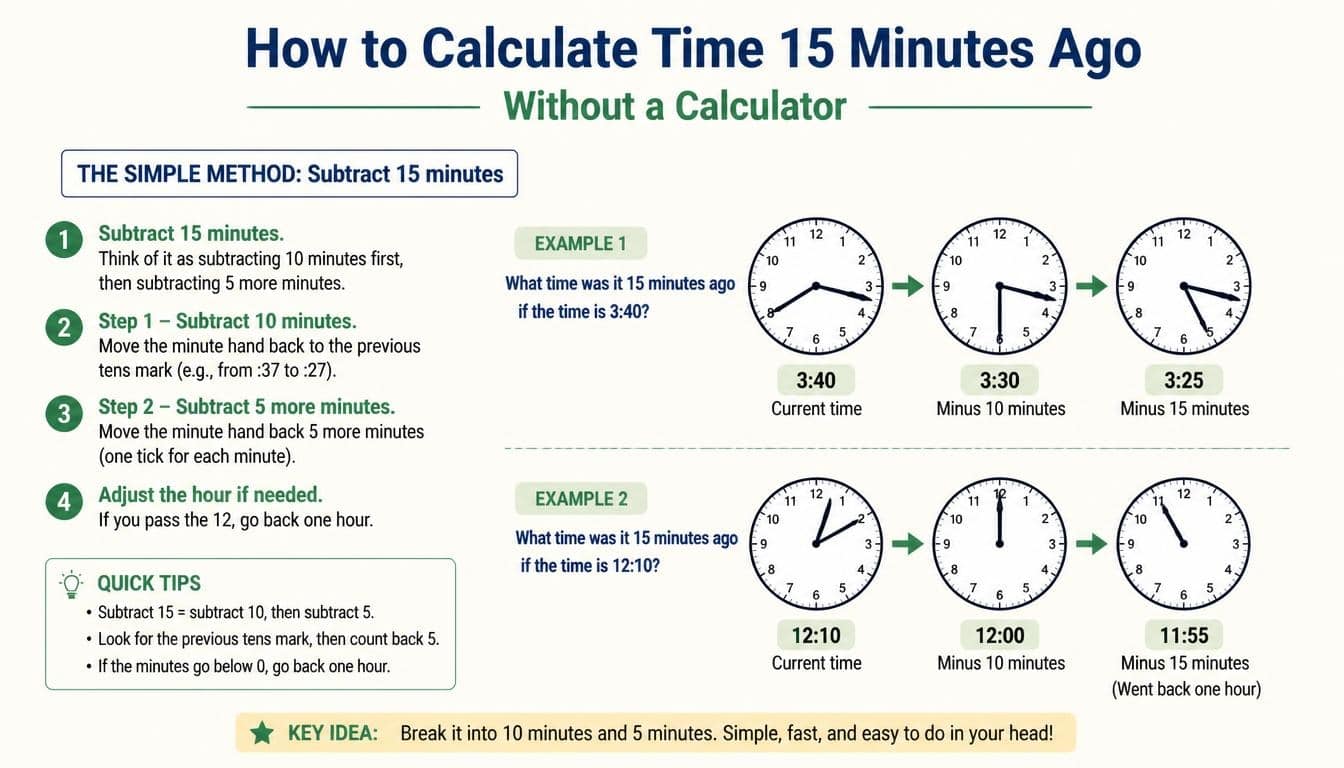
Suppose it is 12:10 AM on Friday. Fifteen minutes earlier, the clock would have shown 11:55 PM on Thursday.
Here’s the reasoning:
- Begin with 12:10 AM on Friday.
- Move backward ten minutes to reach midnight.
- Subtract the remaining five minutes.
- The final time is 11:55 PM on Thursday.
The same principle applies to dates at the end of a month or year. If you subtract fifteen minutes from 12:05 AM on January 1, the answer is 11:50 PM on December 31 of the previous year.
A Time and date calculator can be useful when a calculation crosses a day, month, or year boundary. For ordinary clock arithmetic, though, remembering the midnight rule is usually enough.
One important detail: subtracting fifteen minutes from a local clock time near a daylight-saving transition can be more complicated in regions that observe those changes. When exact timestamps matter, use a date-aware calculation with the correct time zone.
What Time Is It 15 Minutes From Now?
Although the main question concerns the past, the same method can help you calculate a future time. Instead of subtracting fifteen minutes, you add them to the reference time.
For example, if the current time is 10:00 AM, then fifteen minutes later it will be 10:15 AM. If the time is 11:50 AM, the answer will be 12:05 PM.
Here are some other examples:
- 2:20 PM plus fifteen minutes equals 2:35 PM.
- 4:55 PM plus fifteen minutes equals 5:10 PM.
- 11:55 PM plus fifteen minutes equals 12:10 AM on the following day.
- 12:50 AM plus fifteen minutes equals 1:05 AM.
A Minutes from now calculator performs this kind of addition automatically. It is handy for reminders, short breaks, cooking timers, and deciding when to leave for an appointment.
The rule is simple: subtract minutes to find a past time and add minutes to find a future time. Both operations use the same sixty-minute hour and the same need to check date changes.
Time Conversion: From Minutes to Hours, Seconds, and Milliseconds
Time is measured in different units depending on the situation. A wall clock usually shows hours and minutes, a stopwatch may display seconds, and digital systems often measure extremely short intervals in milliseconds.
Understanding these units makes Time conversion much easier.
| Unit | Equivalent to 15 minutes |
| Hours | 0.25 hours |
| Minutes | 15 minutes |
| Seconds | 900 seconds |
| Milliseconds | 900,000 milliseconds |
To convert minutes into hours, divide by sixty. Fifteen divided by sixty equals 0.25 hours.
To convert minutes into seconds, multiply by sixty. Fifteen multiplied by sixty equals 900 seconds. To convert seconds into milliseconds, multiply by another thousand, producing 900,000 milliseconds.
These conversions describe the duration of fifteen minutes, not the actual clock time fifteen minutes ago. For instance, 900 seconds is always equivalent to fifteen minutes, whether the clock shows morning, afternoon, or evening.
That distinction matters when using a Time conversion calculator. A duration converter and a clock-time calculator may look similar, but they solve different problems.
Understanding AM and PM in Time Calculations
The twelve-hour clock divides a day into two periods, AM and PM. AM is traditionally expanded as ante meridiem, meaning before noon, while PM means post meridiem, or after noon.
Noon is 12:00 PM, and midnight is 12:00 AM. These two labels are easy to mix up, especially when calculating an earlier or later time around either boundary.
Imagine that it is 12:10 PM. Subtracting fifteen minutes gives 11:55 AM because the calculation crosses noon in the backward direction.
Now imagine it is 12:10 AM. The result is 11:55 PM on the previous day. The hour and AM/PM label both change, and the calendar date moves backward.
When working with a 12-hour clock calculation, always check three things: the hour, the minutes, and the AM/PM designation. If the result crosses midnight, check the date too.
For international work, a 24-hour clock can reduce some confusion. For example, 10:00 AM is written as 10:00, while 10:00 PM is written as 22:00. Fifteen minutes before 22:00 is 21:45, which corresponds to 9:45 PM.
Common Mistakes When Calculating 15 Minutes Ago
Even a simple subtraction can go wrong when someone is rushing. Most mistakes happen because people focus only on the minutes and forget about the hour or date.
One common error is subtracting fifteen from the minute number without adjusting the hour. If the time is 3:05 PM, the answer isn’t 3:-10 PM. You need to borrow an hour, making the correct result 2:50 PM.
Another mistake is overlooking the AM/PM change. Fifteen minutes before 12:05 PM is 11:50 AM, not 11:50 PM. Similarly, fifteen minutes before 12:05 AM is 11:50 PM on the previous day.
People also sometimes confuse elapsed time with clock time. If a meeting started fifteen minutes ago, its starting time depends on the exact time the meeting began relative to the current clock. A duration alone doesn’t identify a particular hour or date.
To avoid these errors, use a consistent Time calculation formula:
Earlier time = reference time − elapsed duration.
Then verify whether the calculation crosses an hour, noon, midnight, or a calendar boundary. This small final check can save a surprising amount of confusion.
Past Time and Future Time: Knowing the Difference
A Time in the past refers to a moment that occurred before the reference time. A Time in the future refers to a moment that will occur after it.
If the current time is 10:00 AM, 9:45 AM is fifteen minutes in the past, while 10:15 AM is fifteen minutes in the future. Both are separated from the reference time by the same duration, but they fall on opposite sides of it.
This distinction is useful when setting alarms, planning reminders, reviewing call records, and checking the timing of online events. It is also important when reading logs that include a timestamp and a duration.
For example, if a system reports that a task finished fifteen minutes ago, you can estimate its completion time by subtracting fifteen minutes from the recorded current time. If it says the task will finish in fifteen minutes, you add that interval instead.
A Time duration calculator helps when the interval is longer than a few minutes, while a basic clock calculation is often enough for a short period. Choose the tool according to the precision your situation needs.
Choosing the Right Online Time Calculator
Not every time tool does the same thing, and choosing the correct one can make the result much easier to interpret. A Time calculator online may handle clock arithmetic, elapsed durations, future times, or date differences, depending on its design.
Here are the main types to look for:
- Time subtraction calculator: Useful for finding an earlier clock time.
- Minutes from now calculator: Useful for estimating a future time.
- Time difference calculator: Useful for comparing two clock readings or timestamps.
- Time and date calculator: Useful for calculations involving dates and longer intervals.
- Time conversion tool: Useful for changing minutes into hours, seconds, or milliseconds.
If you need to know what time it was fifteen minutes before 10:00 AM, a simple subtraction tool is sufficient. If you’re comparing timestamps from different locations, a time-zone-aware calculator is a better choice.
Always enter the reference date when the date matters. An answer that gives the correct hour and minute but the wrong day may still be unsuitable for work records, travel plans, or event scheduling.
Practical Examples From Everyday Life
Time calculations aren’t only for people who enjoy numbers. They’re part of ordinary routines, and knowing how to work them out can be genuinely useful.
Imagine you’ve received a message at 9:45 AM and check your phone at 10:00 AM. You can see that fifteen minutes have passed since the message arrived, assuming both timestamps use the same time zone and clock reference.
Or perhaps a friend tells you they left home fifteen minutes ago. If they left at 5:20 PM, the reference time would be approximately 5:35 PM. You can use that estimate to decide whether to call them or wait a little longer.
Cooking is another simple example. If you put something in the oven at 6:15 PM and need to check it after fifteen minutes, the target time is 6:30 PM. A timer can handle the reminder, but understanding the calculation makes the schedule easy to verify.
These examples also show why accuracy matters. When the interval is short, a small mistake can feel insignificant, but in transport, appointments, or timed tasks, even a few minutes can make a difference.
Frequently Asked Questions About What Time Was It 15 Minutes Ago?
How do I calculate what time it was 15 minutes ago?
Start with the current clock time and subtract fifteen minutes. If the minutes are less than fifteen, move back one hour and add sixty to the minute value before subtracting. Then check the AM/PM label and date.
What was the time 15 minutes before 10 AM?
Fifteen minutes before 10:00 AM was 9:45 AM on the same day, assuming the reference clock and time zone remain unchanged.
What time was it 15 minutes ago today?
The exact answer depends on the current time and the applicable time zone. Check your clock, subtract fifteen minutes, and adjust the date if the calculation crosses midnight.
How do I calculate 15 minutes ago in GMT+5?
Use the current local time in GMT+5 and subtract fifteen minutes. For example, if the reference time is 10:00 AM GMT+5, the result is 9:45 AM GMT+5.
Is fifteen minutes equal to 0.25 hours?
Yes. One hour contains sixty minutes, so fifteen divided by sixty equals 0.25 hours.
How many seconds are in fifteen minutes?
Fifteen minutes equals 900 seconds because each minute contains sixty seconds.
What happens when the calculation crosses midnight?
The clock moves into the previous calendar day when subtracting minutes from a time shortly after midnight. For example, fifteen minutes before 12:10 AM on Friday is 11:55 PM on Thursday.
Can I use an online calculator instead of doing the maths myself?
Absolutely. A time calculator can quickly subtract minutes, add future intervals, and handle date changes. Just make sure you enter the correct reference time and time zone.
What time was it 15 minutes ago
15 minutes ago was 9:45 AM on Thursday, October 29, 2026, assuming the current time is 10:00 AM GMT+5.
15 minutes ago from now
To find the time 15 minutes ago, subtract 15 minutes from the current time. For example, if it is 10:00 AM now, the time 15 minutes ago was 9:45 AM.
What time was 15 minutes ago
The time 15 minutes ago depends on your current local time. Simply subtract 15 minutes from the current time to determine the exact result.
Time 15 minutes ago
To calculate the time 15 minutes ago, subtract 15 minutes from the current clock time. Fifteen minutes is also equal to 0.25 hours or 900 seconds.
Read More: https://gracethemes.com/what-was-the-time-20-hours-ago/
Final Thoughts: A Small Calculation That Makes Time Easier to Understand
So, What time was it 15 minutes ago? The answer comes down to one simple idea: subtract fifteen minutes from the reference time. If the clock reads 10:00 AM, the result is 9:45 AM. If the calculation crosses an hour or midnight, adjust the hour, AM/PM designation, and date accordingly.
Understanding this little calculation can make daily planning feel more organised. It helps when checking messages, tracking appointments, setting reminders, reviewing timestamps, or simply satisfying your curiosity about how much time has passed.
You don’t need complicated maths to get an accurate result. A clear reference time, a basic understanding of clock arithmetic, and a quick check of the date are usually all you need. And when the calculation gets a little more complicated, an appropriate online time calculator can do the heavy lifting.
Next time you wonder what happened fifteen minutes earlier, you’ll know exactly where to begin. Time keeps moving, minute by minute, but with a little practice, keeping track of it becomes one less thing to worry about.
