

What Time Was It 11 Hours Ago?
There is something oddly satisfying about figuring out a past time. Maybe you saw a message timestamp, noticed a missed call, or simply wondered, “What was happening 11 hours ago?”
It sounds like a tiny question, almost too small to bother calculating, yet crossing from afternoon into the previous day can make the answer surprisingly easy to get wrong.
One minute you’re thinking morning, the next you’re accidentally placing an event in the wrong date, and clocks suddenly feel like tiny puzzles.
For the timestamp associated with this request, the local reference time is 3:53 PM GMT+5 on Friday, August 21, 2026. Subtracting 11 hours gives 4:53 AM GMT+5 on the same date.
So, if your question is what time was it 11 hours ago, the answer from that exact reference is 4:53 AM.
It is worth pointing out that 4:57 AM would be the answer only if the starting time were 3:57 PM, so those four minutes matter in a precise time calculation.
That little distinction is actually the whole lesson: the result depends on the exact current time, timezone, and date you begin with.
A clock does not know that you meant “roughly eleven hours”; it just keeps marching along, annoyingly precise as clocks tend to be.
| Current Time | 11 Hours Ago |
| 3:53 PM | 4:53 AM |
| 4:00 PM | 5:00 AM |
| 5:00 PM | 6:00 AM |
| 6:00 PM | 7:00 AM |
| 7:00 PM | 8:00 AM |
| 8:00 PM | 9:00 AM |
What Time Was It 11 Hours Ago? Explane
Let’s start with the straightforward calculation. If the current time is 3:53 PM and we want to know the time 11 hours ago, we subtract eleven hours from 3:53 PM.
One useful way is to subtract the hours in two pieces. From 3:53 PM, going back three hours takes us to 12:53 PM.
Then going back another eight hours takes us to 4:53 AM. In total, we’ve moved backward 11 hours, or 660 minutes, and landed at 4:53 AM.
So the calculation looks like this:
- Current time: 3:53 PM
- Time to subtract: 11 hours
- Equivalent duration: 660 minutes
- Resulting time: 4:53 AM
- Resulting date: Friday, August 21, 2026
This also answers several versions of the same search, including what time was 11 hours ago, what time was it 11 hours before now, and 11 hours ago time.
The wording changes, but the arithmetic doesn’t. And yes, time arithmetic is wonderfully stubborn like that.
There is another way to see it. Since 12 hours would move 3:53 PM back to 3:53 AM, subtracting only 11 hours leaves us one hour later: 4:53 AM. This shortcut can be handy when the starting time is close to noon or midnight.
Why 11 Hours Ago Can Feel Confusing
The biggest source of confusion isn’t actually subtraction. It’s the AM/PM switch. If you subtract a few hours from an afternoon time, you stay in the afternoon.
But once the subtraction crosses midnight, you’re suddenly talking about the previous day. That date change is where many otherwise sensible calculations wander off the road a little.
For example, imagine the starting time is 8:00 AM. Eleven hours earlier is 9:00 PM on the previous day. The clock says 9:00, but the date has changed.
If someone writes only “9 PM” without mentioning the date, a reader could reasonably assume it means the same day. Thats why timestamps are more useful when they include the date too.
The same issue appears when someone asks what time was it 12 hours ago. At 3:53 PM, twelve hours earlier is 3:53 AM on the same day.
But at 5:30 AM, twelve hours earlier is 5:30 PM on the previous day. Same number of hours, different calendar outcome.
This is why a reliable time calculator should ideally handle both the clock time and the calendar date. Otherwise, it can give you a technically correct clock reading while leaving out an important piece of the answer.
The Exact Meaning of 11 Hours
An hour is not a vague little chunk of “some time.” In ordinary clock arithmetic, 11 hours equals 660 minutes, 39,600 seconds, and 39,600,000 milliseconds.
Those conversions are simple:
- 11 hours in minutes = 11 × 60 = 660 minutes
- 11 hours in seconds = 11 × 60 × 60 = 39,600 seconds
- 11 hours in milliseconds = 11 × 60 × 60 × 1,000 = 39,600,000 milliseconds
Why bother with all those numbers when nobody is usually sitting around thinking in milliseconds? Because they show that subtracting hours is just a unit conversion problem wearing a clock-shaped hat.
A computer can work with milliseconds, while a person might prefer hours and minutes, but the elapsed duration is still exactly the same.
For practical everyday questions, however, hours and minutes are usually enough. Nobody needs to know that a forgotten meeting occurred 39,600,000 milliseconds ago unless they are debugging something and having a rather unusual Friday.
How to Calculate 11 Hours Ago Without a Calculator
You don’t need an hours ago calculator for a simple eleven-hour subtraction. A mental method works quite nicely.
Suppose the starting point is 3:53 PM. First, remember that twelve hours earlier is 3:53 AM. Because we only want eleven hours earlier, move forward one hour from 3:53 AM. The result is 4:53 AM.
Another method is to convert the time into a 24-hour clock. 3:53 PM becomes 15:53. Subtract 11:
15:53 − 11:00 = 04:53
This approach is particularly helpful because it removes some of the AM/PM confusion. There is no question whether 04:53 is in the morning; the 24-hour format has already settled the argument.
You can also subtract one hour at a time if your brain is feeling less cooperative:
3:53 PM → 2:53 PM → 1:53 PM → 12:53 PM → 11:53 AM → 10:53 AM → 9:53 AM → 8:53 AM → 7:53 AM → 6:53 AM → 5:53 AM → 4:53 AM.
Eleven steps, one hour each. It is not glamorous, but it works.
What Time Was It 11 Hours Ago on a Different Starting Time?
The answer to what time was it 11 hours ago is never a universal clock time. It changes with the starting point.
That’s an important thing to understand if you’re comparing timestamps from different devices or locations.
If the starting time is 10:00 AM, eleven hours earlier is 11:00 PM on the previous day. If the starting time is 11:00 AM, the answer is midnight.
If the starting time is 12:00 PM, it becomes 1:00 AM. And if the starting time is 11:00 PM, eleven hours earlier is noon on the same day.
A quick set of examples makes the pattern clearer:
- 8:00 AM minus 11 hours = 9:00 PM previous day
- 10:00 AM minus 11 hours = 11:00 PM previous day
- 12:00 PM minus 11 hours = 1:00 AM same day
- 3:00 PM minus 11 hours = 4:00 AM same day
- 6:00 PM minus 11 hours = 7:00 AM same day
- 11:00 PM minus 11 hours = 12:00 PM same day
Notice the interesting middle point. Around midday, subtracting eleven hours generally keeps the result on the same calendar date.
Earlier morning times are more likely to push the result into yesterday. This is a tiny pattern, but once you notice it, these questions become much less mysterious.
What Time Was It 11 Hours Ago If the Starting Time Is 4:57 PM?
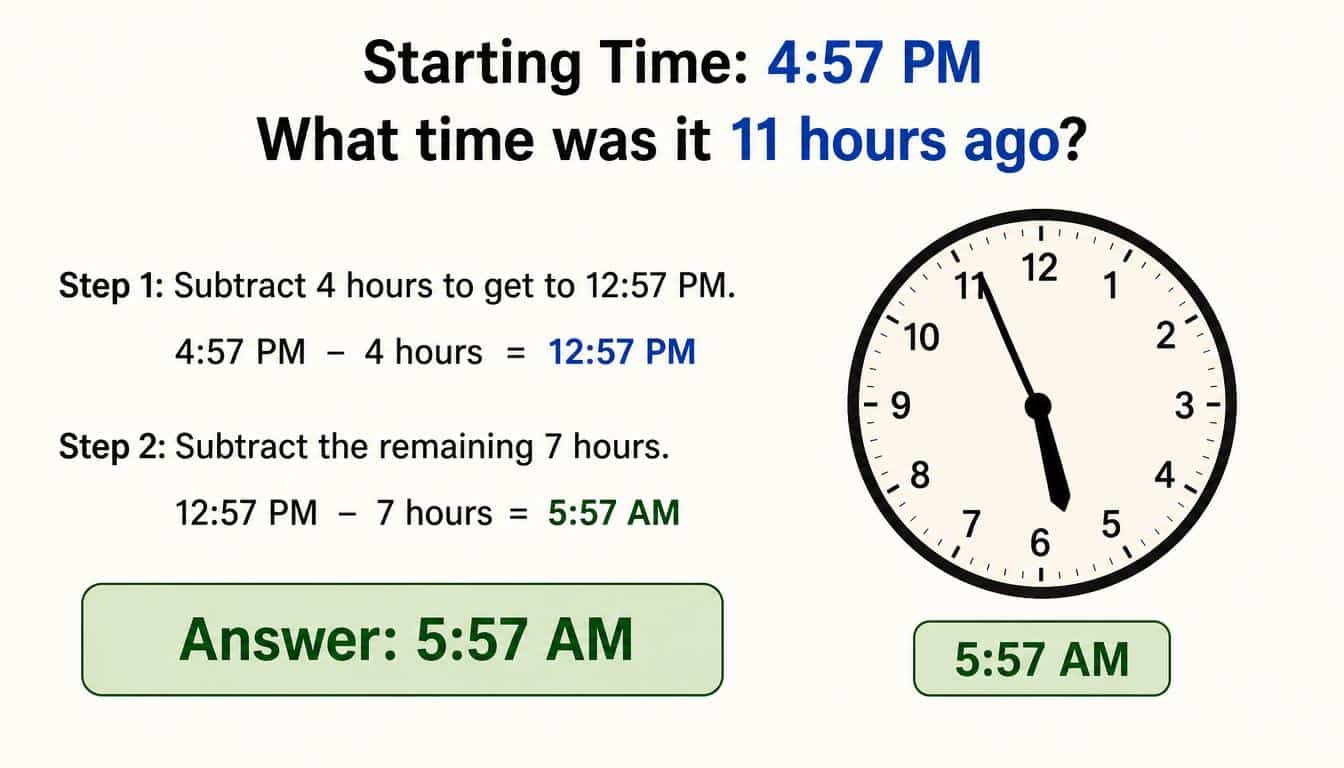
This particular example is useful because 4:57 AM appears frequently in time-related searches and can be confused with a result from a nearby starting time.
If the starting time is 4:57 PM, subtracting 11 hours produces 5:57 AM. It does not produce 4:57 AM.
To get 4:57 AM exactly, the starting time would need to be 3:57 PM. In other words:
3:57 PM − 11 hours = 4:57 AM
That distinction matters when you are trying to validate the result of a timestamp calculation. A four-minute difference isn’t a rounding issue; it indicates that the starting timestamp itself was different.
So if you encounter a statement such as “11 hours ago was 4:57 AM,” ask one very boring but very useful question: “What was the exact starting time?” Boring questions are sometimes the ones that rescue calculations.
What Time Was It 11 Hours Ago Across Time Zones?
Time zones make an already simple calculation a little more interesting. If one person is in GMT+5 and another is in a different timezone, their local clock readings can be different even though the underlying moment is identical.
For the reference used here, 3:53 PM GMT+5 minus eleven hours equals 4:53 AM GMT+5. If you convert that same moment to another timezone, the displayed clock time changes according to the timezone offset.
This is why a time difference calculator can be more useful than ordinary subtraction when you’re comparing people in different countries.
You first determine the instant, then apply each location’s offset. It is less about “subtract eleven from this number” and more about understanding which clock you’re looking at.
For international work, travel, online meetings, gaming sessions, and remote friendships, always pay attention to the timezone label. “4:53 AM” on its own is incomplete information if the people involved live several time zones apart.
11 Hours Ago Versus 12, 13, 14, 15, and 16 Hours Ago
Once you know how to calculate eleven hours backward, the nearby questions become almost automatic. From 3:53 PM, here’s what happens:
- 11 hours ago = 4:53 AM
- 12 hours ago = 3:53 AM
- 13 hours ago = 2:53 AM
- 14 hours ago = 1:53 AM
- 15 hours ago = 12:53 AM
- 16 hours ago = 11:53 PM on the previous day
That last result is especially important. At sixteen hours, the calculation crosses midnight. So the clock reading becomes 11:53 PM, but the date is now the previous day.
This same pattern answers future-time questions too. From 3:53 PM:
- 12 hours from now = 3:53 AM on August 22
- 13 hours from now = 4:53 AM on August 22
- 14 hours from now = 5:53 AM on August 22
- 15 hours from now = 6:53 AM on August 22
- 16 hours from now = 7:53 AM on August 22
It can feel slightly strange that adding hours moves into tomorrow while subtracting enough hours moves into yesterday.
But that is simply the calendar doing what calendars do, without asking our permission first.
What Time Was It 11 Hours Ago in Everyday Situations?
There are plenty of ordinary reasons someone might need to calculate hours ago. Perhaps a social-media post says it was published eleven hours ago and you want to know roughly when it appeared. Maybe a delivery notification has an old timestamp.
Or you’re trying to remember when you sent a message and the app gives you only an elapsed-time label.
For example, if you check a notification at 3:53 PM and it says “11 hours ago,” the corresponding time is 4:53 AM, assuming the app’s timestamp uses the same timezone and there are no unusual rounding rules.
That could mean the notification was sent during the morning, while you were presumably asleep or doing something much more sensible than checking notifications.
The same reasoning works for work logs. If a task says it was completed eleven hours ago, subtract eleven hours from the reference time.
If the answer crosses midnight, remember to change the date too. A calendar date is part of the answer, not decorative furniture.
When Online Time Calculators Are Helpful

A simple calculation is easy by hand, but online tools become useful when you need to compare multiple locations, dates, or intervals.
An hours from now calculator, time subtraction tool, or similar time calculator can save effort when you’re working with complicated schedules.
For example, a tool such as Inch Calculator may be useful when you want a calculator-based result rather than doing the arithmetic manually.
The important thing is to check what timezone the calculator assumes and whether it interprets the entered time as AM or PM.
When using similar time calculators, don’t just look at the final number. Validate the result by checking the starting time, timezone, date, and direction of the calculation. If you asked for hours ago, you should be subtracting.
If you asked for hours from now, you should be adding. It sounds obvious, yet little interface details can make people click the wrong option.
A good calculator is an assistant, not a replacement for understanding the question. If the result looks strange, don’t immediately assume the calculator is wrong. First inspect the inputs. Time has a talent for exposing tiny mistakes.
Common Mistakes When Calculating Hours Ago
One of the most common mistakes is forgetting the AM/PM change. Someone may subtract eleven from 3 PM and write 8 PM, treating the clock as though it were an ordinary number. But clocks don’t work that way. You cannot simply perform 15 − 11 and stop thinking.
Another mistake is forgetting midnight. If the answer lands at 12:30 AM, it may technically belong to the next calendar day when adding time, or to the previous calendar day when subtracting time. The clock face alone won’t tell you the date.
Timezone confusion is another big one. A timestamp generated in GMT+5 won’t necessarily display the same local hour in GMT, CET, or another timezone.
During daylight-saving changes, the situation can become even more interesting, especially around the dates when clocks move.
Finally, people sometimes confuse elapsed time with a rounded display. An app might show “11 hours ago”
even though the exact timestamp is 10 hours and 45 minutes old, depending on how that app rounds its labels. So “11 hours ago” does not always guarantee eleven complete hours have passed.
11 Hours Ago: A Quick Formula
If you want a compact method, think of the calculation this way:
Past time = current time − elapsed hours
For the example in this article:
3:53 PM − 11 hours = 4:53 AM
Or in 24-hour notation:
15:53 − 11:00 = 04:53
The equivalent duration is 660 minutes, so you could also calculate the result by subtracting 660 minutes from the current timestamp.
This is more useful for software and spreadsheets than for casual mental arithmetic, but the underlying idea is exactly the same.
For future calculations, reverse the operation:
Future time = current time + elapsed hours
So 12 hours from now, 13 hours from now, or 16 hours from now are all solved by adding rather than subtracting. Once the direction is clear, most of the puzzle disappears.
How to Figure Out the Time Quickly
When you need to figure out the time without an online tool, start by writing the exact current time. Don’t begin with “around three.” Write 3:53 PM, for example. Precision at the beginning creates precision at the end.
Next, decide whether you’re moving backward or forward. For “hours ago,” subtract. For “hours from now,” add. Then check whether you crossed midnight. If you did, update the date.
A final check can be surprisingly effective: reverse the calculation. If you believe 4:53 AM was eleven hours before 3:53 PM, add eleven hours to 4:53 AM.
You return to 3:53 PM. That’s a quick way to validate the result without using another calculator.
If the arithmetic works in both directions, you’re probably done. And if it doesn’t, well, the clock has politely informed you that something went sideways.
Why Exact Time Matters More Than People Think
A question like what time was it 11 hours ago can look trivial, but exact time matters in plenty of real situations.
It can affect whether a deadline was met, when a message was sent, whether an appointment was missed, or how long someone has been waiting.
In legal, financial, technical, and workplace records, timestamps can carry much more weight than ordinary conversational time estimates. “Sometime yesterday morning” is very different from “4:53 AM on August 21, 2026.” The first is approximate; the second identifies a specific point in time.
Even casual situations benefit from precision. If a friend says, “I texted you eleven hours ago,” you might be trying to remember whether you were awake at the time.
Knowing the exact time 11 hours earlier can turn a vague memory into something much easier to place.
That’s perhaps why these little time questions keep appearing online. We don’t just want arithmetic. We want to locate ourselves inside the day.
A Practical Way to Remember the Calculation
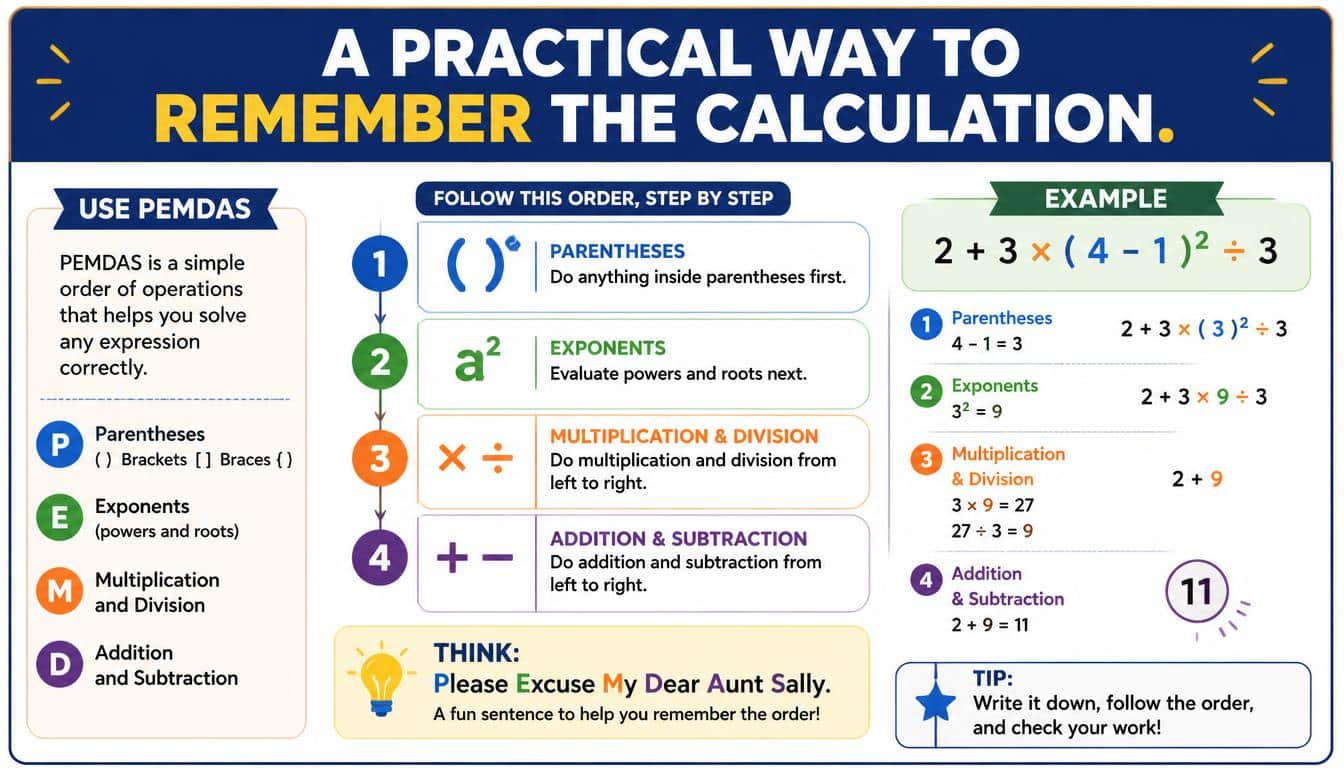
If you regularly need to calculate past or future times, think in terms of a 24-hour clock. It makes time conversion much easier because there is no AM/PM ambiguity.
For instance, 3:53 PM becomes 15:53. Subtract eleven hours and you get 04:53. If the subtraction goes below 00:00, add 24 hours and move the date backward one day.
If you’re adding hours and go beyond 24:00, subtract 24 hours and move the date forward one day.
That method sounds a little technical, but after a few tries it becomes second nature. Your brain starts treating 23:00 and 04:00 as neighboring points on a loop rather than unrelated numbers.
And there is something pleasing about that loop. Midnight isn’t really an ending. It’s simply the place where one date hands the baton to another.
Frequently Asked Questions
11 hours ago
11 hours ago means the time exactly 11 hours before the current time. To find it, subtract 11 hours from the current time.
What time was it 11 hours ago
The time 11 hours ago is calculated by subtracting 11 hours from the current time. The exact result depends on your current time and time zone.
11 hours ago from now
11 hours ago from now refers to the time that occurred 11 hours before the present moment. Simply subtract 11 hours from the current clock time.
What was 11 hours ago from now
To find what happened 11 hours ago from now, calculate the time by moving the clock back 11 hours from the current time.
What time was 11 hours ago
The time 11 hours ago is the current time minus 11 hours. If the calculation crosses midnight, the result will fall on the previous day.
Read This Blog: https://gracethemes.com/what-time-was-it-15-hours-ago/
Final Thoughts: What Time Was It 11 Hours Ago?
For the exact reference time used here, 3:53 PM GMT+5 on Friday, August 21, 2026, the answer is 4:53 AM GMT+5 on Friday, August 21, 2026.
The calculation is straightforward: subtract 11 hours, which equals 660 minutes, from the starting time.
If you encountered 4:57 AM as an answer elsewhere, check the starting timestamp. 3:57 PM minus 11 hours equals 4:57 AM, while 3:53 PM minus 11 hours equals 4:53 AM.
Four minutes can look insignificant, but in a precise timestamp calculation, they tell you the input times were different.
The broader trick is simple: write down the exact current time, identify the timezone, subtract or add the required number of hours, and check whether the calendar date changes.
Once you’ve got those four pieces, questions such as what time was it 12 hours ago, what time was it 13 hours ago, or what time is 16 hours from now stop being little traps and become ordinary arithmetic.
Time is strange that way. Eleven hours can turn an afternoon into a quiet morning, or a late-night calculation into the previous day.
It can connect a message you just read with a moment when you were asleep, eating lunch, commuting, or staring out a window without any idea that the future version of you would later be asking about it.
So next time you need to find the time, don’t guess at the clock. Start with the exact timestamp, do the subtraction, check the date, and give the answer with its timezone when it matters.
A small bit of care makes the resulting time much more trustworthy and saves you from confidently telling someone that yesterday happened four minutes earlier than it actually did.
