

What Time Was It 15 Hours Ago?
There are questions that arrive wearing a very ordinary shirt, but somehow carry a little story underneath.
What time was it 15 hours ago is one of those questions. Maybe you are checking when a message was sent, trying to remember when you woke up, figuring out whether something happened yesterday or today, or simply wondering where
the clock has wandered while you weren’t looking. Time is funny like that; it keeps moving even when our attention has gone somewhere else.
If the reference time is 3:19 PM on Friday, August 21, 2026, in GMT+5, then subtracting fifteen hours takes us back to 12:19 AM on the same calendar date.
In other words, the answer to “what was the time 15 hours ago” is 12:19 AM, Friday, August 21, 2026. The calculation sounds slightly more complicated than it is, mostly because crossing midnight makes the brain do a tiny double-take.
There is also a useful lesson hiding inside this simple time calculation. When you subtract hours, you are not merely changing the numbers on a clock.
Sometimes you cross midnight, which means the date and time change together. A person who forgets that little detail can arrive at an answer that looks perfectly reasonable and is completely wrong. Clocks are polite little liars in that way.
| Reference Time | 15 Hours Ago | Date |
| 3:19 PM | 12:19 AM | Friday, August 21, 2026 |
What Time Was It 15 Hours Ago? The Simple Answer
Let us begin with the cleanest example. Suppose the current time is 3:19 PM. To find the time fifteen hours earlier, we can subtract fifteen hours in two comfortable pieces.
Take away three hours from 3:19 PM, and you reach 12:19 PM. Then take away the remaining twelve hours, and you land at 12:19 AM. So the result is 12:19 AM. Nothing mysterious happened; we simply moved the clock backwards fifteen hours.
The important part is recognizing that 12:19 AM comes after midnight, not before it. Because the calculation crosses the midnight boundary, the result belongs to the early morning of the relevant calendar date.
This is why knowing only the clock time isn’t always enough when you need an exact date as well.
- Current reference: 3:19 PM
- Elapsed duration: 15 hours
- Past time: 12:19 AM
- Calendar date: Friday, August 21, 2026
- Time zone: GMT+5
- 15 hours in minutes: 900 minutes
- 15 hours in seconds: 54,000 seconds
So, if somebody asks, “what time was it fifteen hours ago?”, the short answer in this example is 12:19 AM.
If they need the full answer, give them the date and time zone too, because those details stop a simple calculation from becoming a confusing one.
How to Calculate 15 Hours Ago Without Getting Lost
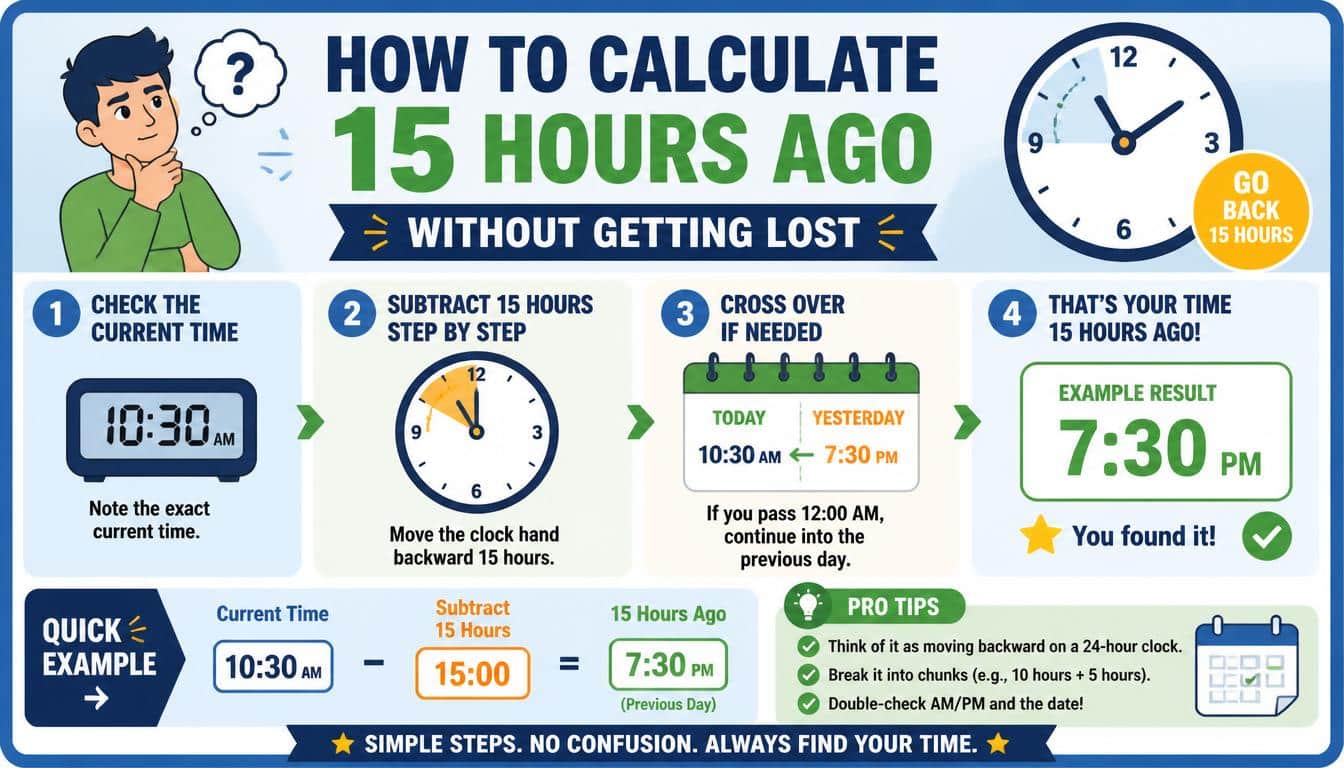
A good way to calculate 15 hours ago is to treat the problem as ordinary hour subtraction rather than trying to mentally spin a clock around in one giant leap.
Start with the reference time and subtract enough hours to reach midnight or noon, then subtract whatever remains.
For 3:19 PM, subtract three hours first. You get 12:19 PM. Now you have twelve hours left to subtract. Twelve hours from 12:19 PM takes you to 12:19 AM. The minutes stay at 19 because we are changing only the hour component.
Another method is to convert the time into a 24-hour clock. 3:19 PM becomes 15:19. Subtract 15 hours, and you get 00:19.
The expression 00:19 is simply another way of writing 12:19 AM. This approach is especially handy when working with schedules, software, travel plans, or a busy household where AM and PM seem to swap places whenever nobody is looking.
If you are doing this regularly, an hours ago calculator or time difference calculator can save a few mental gymnastics.
Still, understanding the calculation yourself is worthwhile. A calculator can give the answer, but knowing why the answer is correct gives you something better than a number.
What Does 15 Hours Ago Mean in Real Life?
The phrase 15 hours ago describes an elapsed period rather than a particular clock reading. It means exactly fifteen hours have passed between the reference moment and the earlier moment.
That distinction matters because “fifteen hours ago” will produce different clock times depending on when you begin.
For example, fifteen hours before 3:19 PM is 12:19 AM. But fifteen hours before 10:00 AM is 7:00 PM on the previous day. Same duration, completely different clock reading. Time calculation is really about relationships between moments, not about memorizing a single answer.
Imagine someone saying, “The parcel was delivered 15 hours ago.” If you hear that at 3:19 PM, the delivery happened around 12:19 AM.
Suddenly the sentence has a different feeling. Maybe the courier arrived very late, or perhaps the delivery happened while everyone was asleep. A tiny calculation can add a surprisingly large piece of context.
15 Hours Ago and the Previous Day
One of the easiest mistakes in time subtraction is forgetting that a result may fall on a previous date. If the current time is shortly after midnight, subtracting fifteen hours sends you back into the afternoon or evening of the day before.
For instance, imagine it is 2:00 AM on Friday. Fifteen hours earlier was 11:00 AM on Thursday. The clock has moved backward fifteen hours, but the calendar has moved backward one day.
This is why questions such as what was the date 15 hours ago cannot always be answered by looking at the hour alone.
In the 3:19 PM example, however, the calculation reaches 12:19 AM on Friday. We are still within the same named calendar date because fifteen hours is less than
the seventeen hours separating midnight from 5:00 PM, roughly speaking. The date boundary is still important, even when we don’t end up crossing it.
15 Hours Ago in Minutes, Seconds, and Milliseconds
Sometimes hours aren’t the most convenient unit. If you are comparing timestamps or working with a digital system, smaller units can make the calculation clearer.
Fifteen hours contains 900 minutes because 15 × 60 = 900. It contains 54,000 seconds, because 900 × 60 = 54,000. And it contains 54,000,000 milliseconds, because
one second contains 1,000 milliseconds. Suddenly that harmless-looking fifteen hours has become a rather enormous pile of tiny ticks.
So the useful conversions are:
- 15 hours = 900 minutes
- 15 hours = 54,000 seconds
- 15 hours = 54,000,000 milliseconds
These conversions are helpful for anyone learning time unit conversion, building a schedule, checking timestamps, or simply satisfying that strange human urge to know exactly how many seconds have disappeared since breakfast.
Understanding AM, PM, Midnight, and Noon
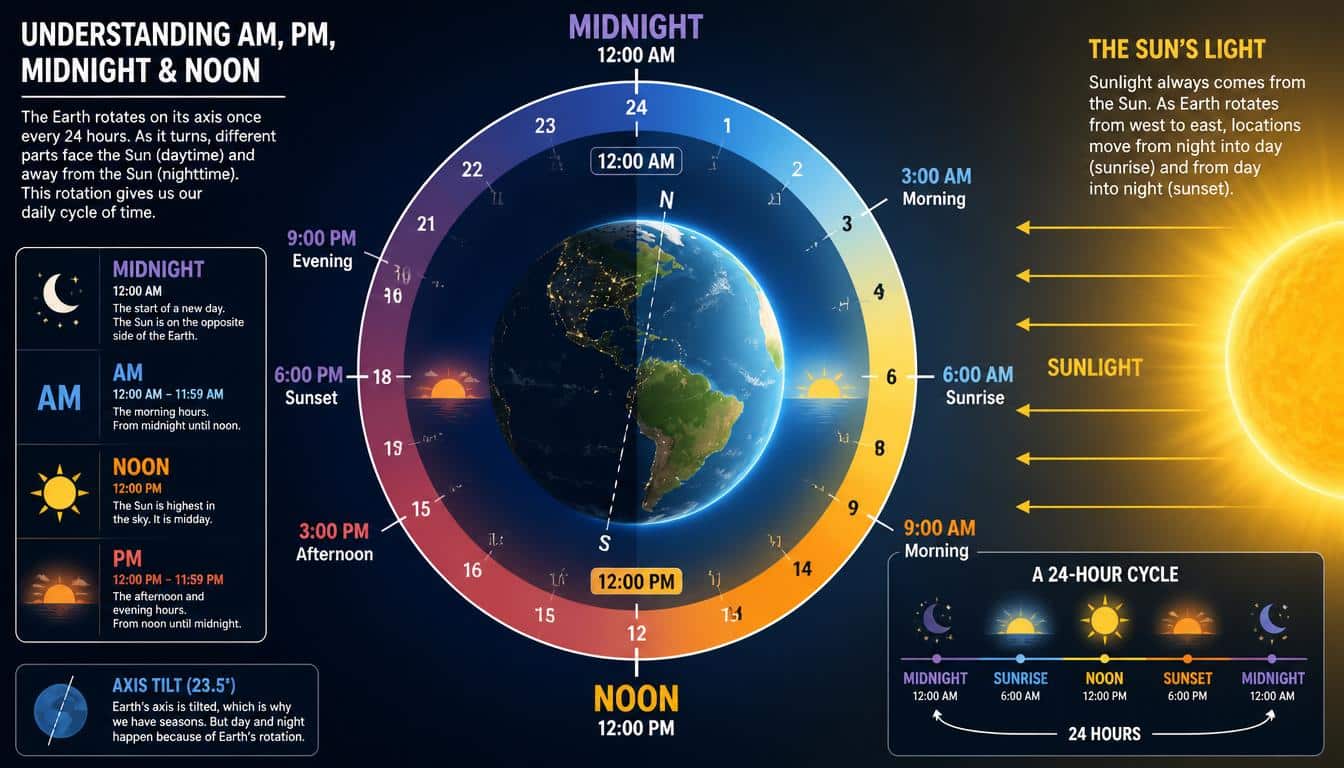
The AM/PM system creates many of the mistakes people make when they subtract hours from time. The letters divide the day into two twelve-hour periods, but midnight and noon sit at the places where people most often hesitate.
12:00 AM means midnight, the beginning of a new day. 12:00 PM means noon, the middle of the daytime period. So 12:19 AM is nineteen minutes after midnight, while 12:19 PM is nineteen minutes after noon. Those two times are twelve hours apart, despite looking almost identical.
This is why writing the full answer as 12:19 AM on Friday, August 21, 2026 is safer than writing only “12:19.” When a message, appointment, birthday plan, or important memory depends on timing, a missing AM or PM can turn clarity into guesswork rather quickly.
What Time Was It 16, 17, 18, 19, or 20 Hours Ago?
Once you understand the fifteen-hour calculation, nearby values become much easier. Starting with 3:19 PM, each additional hour simply moves the result one hour farther into the past.
- 16 hours ago: 11:19 PM on Thursday, August 20, 2026
- 17 hours ago: 10:19 PM on Thursday, August 20, 2026
- 18 hours ago: 9:19 PM on Thursday, August 20, 2026
- 19 hours ago: 8:19 PM on Thursday, August 20, 2026
- 20 hours ago: 7:19 PM on Thursday, August 20, 2026
Notice the interesting little shift. At fifteen hours ago, the result is just after midnight on Friday. At sixteen hours ago, it has crossed into Thursday evening. One extra hour changes the previous date, which is why date-aware calculations are so useful.
The same logic works in the opposite direction. If you ask what time will it be 15 hours from now, you add rather than subtract.
Fifteen hours after 3:19 PM is 6:19 AM on Saturday, August 22, 2026. The clock keeps marching, apparently with no concern whatsoever for our attempts to keep up.
What Time Is 16, 17, 18, 19, or 20 Hours From Now?
Future calculations follow exactly the same principle. You simply perform hour addition instead of hour subtraction.
Starting from 3:19 PM on Friday:
- 16 hours from now: 7:19 AM on Saturday
- 17 hours from now: 8:19 AM on Saturday
- 18 hours from now: 9:19 AM on Saturday
- 19 hours from now: 10:19 AM on Saturday
- 20 hours from now: 11:19 AM on Saturday
This is useful when planning travel, work shifts, medication reminders, online events, or a late-night conversation that somehow became a morning conversation. A phrase like “see you in eighteen hours” sounds vague until you actually put it on a clock.
Why Time Zones Matter More Than They First Appear
A time calculation is only as reliable as its reference point. GMT+5, UTC+5, and other time zone descriptions tell us how local time relates to UTC, the international reference standard used for coordinating clocks around the world.
Suppose two friends discuss an event and one says it happened at 12:19 AM. Without a time zone, that statement may be incomplete.
Twelve nineteen in London and twelve nineteen in a location five hours ahead of GMT are not the same instant. The clock displays the same numbers, but the world around those numbers is different.
For this reason, a dependable time calculator should ideally accept the date, local time, and time zone. This becomes particularly important when working across countries, especially around daylight-saving changes. Time, it turns out, has paperwork.
When a Time Calculator Is Better Than Mental Math
There is nothing wrong with calculating fifteen hours by hand. In fact, it is a useful little exercise.
But there are situations where a dedicated calculator is the wiser choice, particularly when seconds, dates, time zones, or several timestamps are involved.
A tool such as an Inch Calculator time resource can be useful when you need more than a quick subtraction.
An hours from now calculator can also make future planning easier, while a past time calculator can help determine an earlier timestamp without forcing you to count backward across several midnight boundaries.
Still, tools should support understanding, not replace it completely. If a calculator says the answer is 12:19 AM, you should be able to glance at the calculation and think, “Yes, that makes sense.” That little moment of confidence is useful, especially when the numbers matter.
Common Mistakes When Finding 15 Hours Ago
The first common mistake is confusing AM and PM. Someone may see 3:19 PM and subtract fifteen from the number three, producing an impossible negative-looking hour.
The fix is simple: think in terms of a 24-hour clock or split the subtraction into manageable pieces.
Another mistake is forgetting the date. If the calculation crosses midnight, the earlier time belongs to a different calendar date.
This matters enormously for travel reservations, deadlines, work records, medical appointments, and messages where timestamps are being used as evidence of when something happened.
A third mistake is ignoring the time zone. If an event occurred in GMT+5, converting it to another local time without accounting for the UTC offset can create an apparent
discrepancy that isn’t really a discrepancy at all. Two clocks can disagree and both be correct, which is one of time’s more annoying talents.
A Quick Formula for Finding the Earlier Time
For everyday calculations, there is no need to make things unnecessarily fancy. You can use this simple idea:
Earlier time = current time − elapsed hours
So, if the current reference is 3:19 PM:
3:19 PM − 15 hours = 12:19 AM
For digital calculations, use 24-hour notation:
15:19 − 15:00 = 00:19
Then convert 00:19 back into the familiar 12-hour format:
00:19 = 12:19 AM
The same formula works for sixteen, seventeen, eighteen, nineteen, or twenty hours ago. If the result becomes negative, you simply move into the previous calendar day.
It sounds a bit mathematical, but really it’s just the clock asking you to remember where midnight lives.
Why Knowing the Exact Time Can Matter
People often search what time was it 15 hours ago for surprisingly practical reasons. A forgotten notification, a bank transaction, an online post, a delivery confirmation, a work event, or a conversation can all depend on knowing when something occurred.
Parents may use timestamps when remembering a baby’s feeding or sleeping schedule. Friends might check the time difference before calling someone overseas.
Someone preparing a birthday message may discover that their carefully planned midnight greeting was actually sent at 11:59 PM because the phone was operating
under another time zone. These are small things, but small things become memorable very quickly.
There is also an emotional side to time. Looking back fifteen hours can feel almost like opening a tiny window into the previous part of your day.
What were you doing then? Who were you speaking with? Had you already gone to sleep? Was something important just beginning? The clock can answer the numerical question, while memory answers the human one.
A Handy Reference for Related Time Questions
Once people learn one calculation, they often want the neighboring answers too. Here is a compact reference based on the same 3:19 PM starting point:
- What time was it 15 hours ago? 12:19 AM.
- What time was it 16 hours ago? 11:19 PM the previous day.
- What time was it 17 hours ago? 10:19 PM the previous day.
- What time was it 18 hours ago? 9:19 PM the previous day.
- What time was it 19 hours ago? 8:19 PM the previous day.
- What time was it 20 hours ago? 7:19 PM the previous day.
- What time is 15 hours from now? 6:19 AM the following day.
- What time is 16 hours from now? 7:19 AM the following day.
- What time is 17 hours from now? 8:19 AM the following day.
- What time is 18 hours from now? 9:19 AM the following day.
- What time is 19 hours from now? 10:19 AM the following day.
- What time is 20 hours from now? 11:19 AM the following day.
The point isn’t really to memorize these numbers. It is to notice the pattern. Once the reference time is known, every hour backward or forward moves the clock by exactly one hour, while the date changes whenever midnight is crossed.
How to Find the Time 15 Hours Ago Yourself
If you want to find time 15 hours ago without using a website, begin by writing down the exact reference date and time. Include AM or PM. If the location matters, include the time zone too.
Next, subtract fifteen hours. If you’re near midnight, separate the calculation into smaller pieces. For example, subtract enough hours to reach midnight and then continue into the previous day. This makes the time subtraction much less error-prone.
Finally, check the result against common sense. If it is afternoon now, fifteen hours earlier should normally be somewhere around midnight or the previous evening. If your answer suddenly says tomorrow morning, something has probably gone sideways.
The Bigger Lesson Hidden Inside a Small Calculation
A question about 15 hours ago seems almost too simple to deserve an article, yet it demonstrates several important ideas about how humans organize time.
We use clock time to describe moments, dates to locate those moments on a calendar, and time zones to connect local clocks to the wider world.
The calculation also reminds us that time is continuous even though our clocks divide it into neat boxes.
Midnight is a boundary we invented for convenience; the actual passing of one second into another doesn’t stop and announce itself. We simply label the moment differently once the calendar rolls over.
That is perhaps why these little questions are so useful. They make an invisible thing visible. Fifteen hours becomes 900 minutes, then 54,000 seconds, and suddenly
a vague phrase like “earlier today” has a precise shape. Not bad for a question that can be answered with subtraction.
Frequently Asked Questions
What Time Was It 15 Hours Ago?
15 hours ago was approximately 12:47 AM today in Pakistan.
How Long Ago Was 15 Hours Ago?
15 hours ago means exactly 15 hours before the current time.
What Was 15 Hours Ago?
15 hours ago was approximately 12:47 AM on August 21, 2026, in Pakistan.
When Was 15 Hours Ago From Now?
15 hours before now was approximately 12:47 AM on August 21, 2026, in Pakistan.
15 Hours Ago From Now
If the current time is around 3:47 PM, going back 15 hours takes you to approximately 12:47 AM.
Read This Blog: https://gracethemes.com/what-date-is-12-weeks-from-today/
Final Thoughts: Fifteen Hours Is a Small Distance Through Time
So, what time was it 15 hours ago? Using the stated example of 3:19 PM on Friday, August 21, 2026, in GMT+5, the answer is 12:19 AM on Friday, August 21, 2026.
The calculation is simply fifteen hours of subtraction, but because the path passes through midnight, it deserves a little attention to the date and AM/PM notation.
Remember the essential pieces: fifteen hours equals 900 minutes, 54,000 seconds, and 54,000,000 milliseconds. To move backward, subtract the duration; to move forward, add it.
When midnight gets involved, check the date. When different locations are involved, check the time zone.
And when the calculation really matters, use a reliable time difference calculator rather than trusting a sleepy brain at 2 AM.
Time doesn’t usually announce where it has been. We have to ask. Sometimes the answer is useful for a schedule, sometimes for a timestamp, and sometimes it simply satisfies that peculiar human curiosity about where we were fifteen hours before this very moment.
Either way, once you understand the pattern, questions about the past and future become much easier to untangle.
And perhaps that’s the nicest thing about learning a simple calculation: the clock may keep rushing ahead, but for a moment, you can turn around and know exactly where it was.
