

What Time Is 15 Hours From Now?
There is something oddly satisfying about knowing exactly where the clock will land after a certain stretch of time.
Maybe you’re planning a late-night study session, waiting for a flight, setting a reminder, or simply wondering what the clock will say tomorrow.
Whatever the reason, the question “what time is 15 hours from now?” sounds simple, but the answer depends on the precise time you start with, your time zone, and whether those fifteen hours carry you into the next calendar day.
At the moment, if the starting time is 3:33 PM on Tuesday, September 8, 2026, in GMT+5, adding 15 hours takes you to 6:33 AM on Wednesday, September 9, 2026.
That little date change is the part people sometimes miss, because 15 hours is long enough to push the calculation right through midnight.
So, in plain language: 15 hours from 3:33 PM is 6:33 AM the following morning. It sounds almost like a tomorrow problem, and really, thats exactly what it is.
| Current Time | 15 Hours From Now | Date |
| 3:33 PM | 6:33 AM | September 9, 2026 |
| 3:38 PM | 6:38 AM | September 9, 2026 |
What Time Is 15 Hours From Now Right Now?
If “now” means 3:33 PM on September 8, 2026, the calculation is quite straightforward once you split it into smaller pieces. You can first count from 3:33 PM to midnight, then add the remaining hours after midnight.
From 3:33 PM to 12:00 AM is 8 hours and 27 minutes. Since the total target is 15 hours, you still have 6 hours and 33 minutes left after midnight. Add that to the beginning of September 9, and you arrive at 6:33 AM on September 9.
That means the direct answer is:
- Starting time: 3:33 PM, Tuesday, September 8, 2026
- Time added: 15 hours
- Result: 6:33 AM, Wednesday, September 9, 2026
- Time zone: GMT+5
The interesting bit is that the clock doesn’t merely move forward; the date moves forward too. Thats why a complete answer should usually mention both the time and the date when calculating many hours from now.
What Time Will It Be in 15 Hours?
To find what time will it be in 15 hours, the easiest method is to add the hours directly while keeping an eye on the 24-hour clock. This avoids some of the confusion caused by AM and PM.
For example, 3:33 PM can be written as 15:33 in 24-hour notation. Add 15 hours:
15:33 + 15 hours = 30:33
A clock does not go to 30:33, of course. After 24:00, you begin counting from midnight again. Subtract 24 hours:
30:33 − 24:00 = 06:33
So the result is 06:33, or 6:33 AM.
This method is especially useful when your calculation crosses midnight. It feels a little more mechanical, but thats actually the good part. You don’t have to keep asking yourself whether the result is AM or PM while doing the calculation.
What Time Is 15 Hours From Now If It Is 3:38 PM?
A slightly different starting minute gives a slightly different answer, which is why online examples can sometimes appear inconsistent.
If the current time is 3:38 PM on September 8, 2026, then adding 15 hours gives:
- 3:38 PM to midnight = 8 hours 22 minutes
- Remaining time = 6 hours 38 minutes
- Midnight plus 6 hours 38 minutes = 6:38 AM
Therefore, 15 hours from 3:38 PM is 6:38 AM the next day.
The date would be Wednesday, September 9, 2026, assuming the starting date is Tuesday, September 8. A five-minute difference at the beginning naturally produces a five-minute difference at the end. The clock is annoyingly consistent like that.
How to Calculate 15 Hours From Now
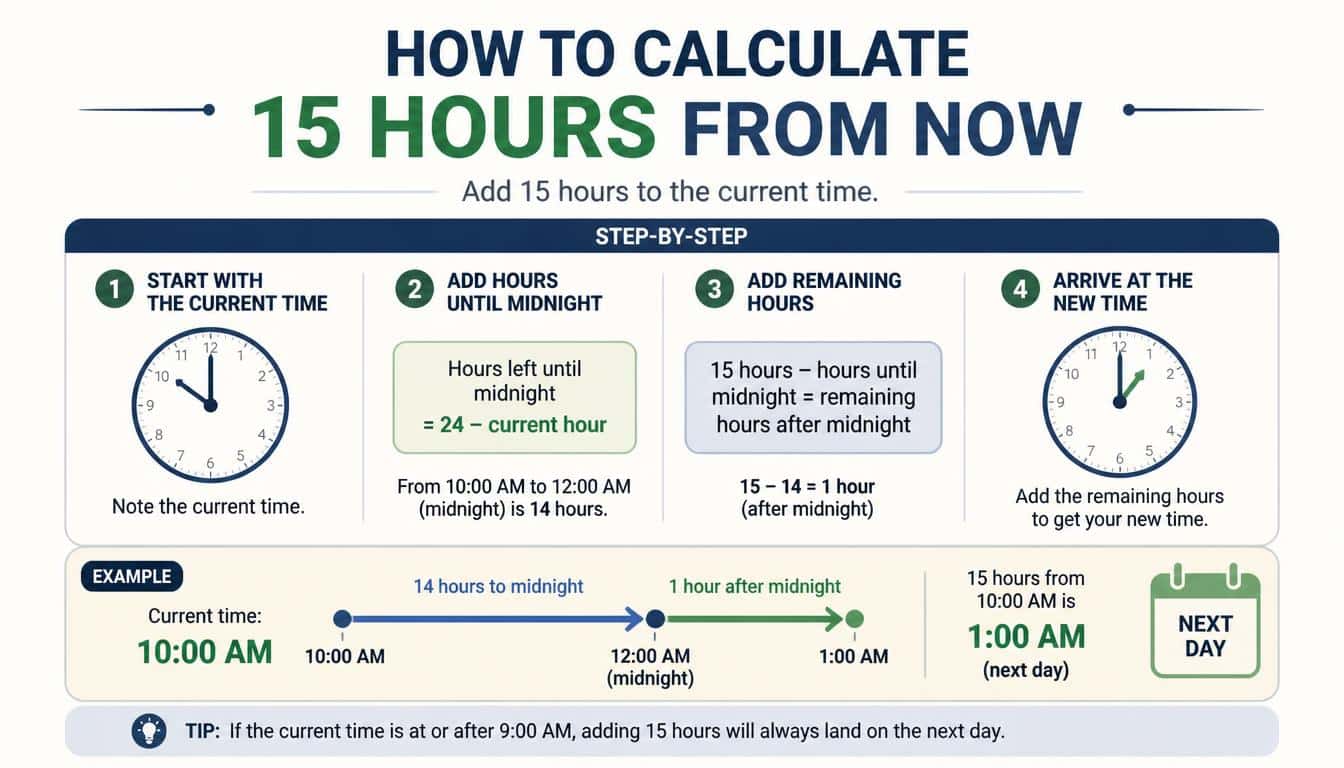
You don’t need a special calculator to work out a 15-hour time difference. A few simple approaches can do the job.
The first method is to add the hours in chunks. Suppose it is 4:00 PM. Adding 8 hours takes you to midnight. You have 7 hours remaining, so adding those takes you to 7:00 AM the next day.
The second method uses the 24-hour clock. Convert the starting time into 24-hour notation, add 15, and subtract 24 if the result is 24 or greater. For example, 16:00 + 15 = 31:00, and 31:00 − 24:00 = 07:00.
The third method is simply to move the clock forward one hour at a time, though nobody really wants to count fifteen individual hours unless they enjoy making life difficult for themselves.
A Quick 15-Hour Calculation Formula
A useful formula is:
Future time = Current time + 15 hours
If the resulting hour is 24 or higher, subtract 24 and move the calendar date ahead by one day.
For instance:
10:00 AM + 15 hours = 25:00
Then:
25:00 − 24:00 = 1:00 AM
So 15 hours after 10:00 AM is 1:00 AM the following day.
The same idea works for practically any starting time, including times with minutes. You just need to preserve the minutes while adding the hours. It’s not fancy, but it works reliably.
Examples of 15 Hours From Different Starting Times
Looking at several examples makes the pattern much easier to understand. Here are some common starting points and where 15 hours later would land.
- 12:00 AM + 15 hours = 3:00 PM the same day.
- 1:00 AM + 15 hours = 4:00 PM the same day.
- 2:00 AM + 15 hours = 5:00 PM the same day.
- 3:00 AM + 15 hours = 6:00 PM the same day.
- 6:00 AM + 15 hours = 9:00 PM the same day.
- 8:00 AM + 15 hours = 11:00 PM the same day.
- 9:00 AM + 15 hours = 12:00 AM the next day.
- 10:00 AM + 15 hours = 1:00 AM the next day.
- 12:00 PM + 15 hours = 3:00 AM the next day.
- 3:00 PM + 15 hours = 6:00 AM the next day.
- 6:00 PM + 15 hours = 9:00 AM the next day.
- 9:00 PM + 15 hours = 12:00 PM the next day.
Notice the turning point around the morning hours. If you start at 9:00 AM or later, adding 15 hours generally carries you into the following calendar day. Thats the date-rollover detail worth remembering.
15 Hours From Now in 12-Hour and 24-Hour Time
Time can be displayed using either the 12-hour clock or the 24-hour clock. Both represent the same moment, but they can make calculations feel very different.
In the 12-hour format, you might see:
3:33 PM → 6:33 AM
In the 24-hour format, the same calculation is:
15:33 → 06:33
The 24-hour clock is often easier for arithmetic because there is no AM/PM switch to mentally manage. Midnight is represented as 00:00, noon is 12:00, and the afternoon continues with 13:00, 14:00, 15:00, and so on.
If you’re calculating time manually, switching to 24-hour notation can save you from those little “wait, is that tomorrow?” moments.
Does 15 Hours From Now Change the Date?
Yes, it can. Whether the date changes depends entirely on your starting time.
If you start early in the day, fifteen hours may still end on the same date. For example, 6:00 AM plus 15 hours equals 9:00 PM, so no date change occurs.
But if you begin later, the calculation crosses midnight. For example, 3:00 PM plus 15 hours equals 6:00 AM the following day.
For the current example:
Tuesday, September 8, 2026, at 3:33 PM
plus
15 hours
equals
Wednesday, September 9, 2026, at 6:33 AM.
This is known as a date rollover. The time calculation itself doesn’t become harder; you simply need to remember that midnight is the boundary between two calendar dates.
How Many Minutes Are in 15 Hours?

Sometimes the easiest way to understand a duration is to convert it into minutes.
There are 60 minutes in one hour. Therefore:
15 × 60 = 900 minutes
So:
15 hours = 900 minutes
That means when you ask what time is 15 hours from now, you are really asking where the clock will be after 900 minutes have passed.
For example, if it is 3:33 PM now, adding 900 minutes eventually lands at 6:33 AM the next morning. Breaking a long duration into minutes can be helpful when you’re working with timers, schedules, transportation, or software that uses minute-based durations.
How Many Seconds Are in 15 Hours?
There are 60 seconds in every minute, so we can continue the conversion.
First:
15 hours = 900 minutes
Then:
900 × 60 = 54,000 seconds
Therefore:
15 hours = 54,000 seconds
It may sound like a giant number when written out, but the conversion is really just two small multiplications. Fifteen hours contains fifty-four thousand individual seconds, ticking away whether we’re paying attention or not.
For technical applications, countdowns, programming, and time-based measurements, knowing this conversion can be surprisingly handy.
How Many Milliseconds Are in 15 Hours?
A millisecond is one-thousandth of a second. There are 1,000 milliseconds in one second.
Since 15 hours contains 54,000 seconds:
54,000 × 1,000 = 54,000,000 milliseconds
So:
15 hours = 54,000,000 milliseconds
That’s 54 million milliseconds, which looks much more dramatic than fifteen hours sitting quietly on a clock. The duration hasn’t changed at all, of course; we’ve just chosen a much smaller unit for measuring it.
This conversion is particularly relevant in computing, software systems, digital timers, and technical measurements where milliseconds are used instead of ordinary clock hours.
What Time Was It 15 Hours Ago?
The same calculation works in reverse. Instead of adding 15 hours, you subtract 15 hours from the current time.
If it is 3:33 PM on September 8, 2026, go backward 15 hours. Subtracting 3 hours takes you to noon, and subtracting another 12 hours takes you to midnight.
The result is:
12:33 AM on September 8, 2026
So, assuming the starting point is 3:33 PM on September 8, 15 hours ago was 12:33 AM on the same date.
This is a useful reminder that “15 hours from now” and “15 hours ago” aren’t necessarily on different calendar dates. It depends on where your starting time sits relative to midnight.
15 Hours From Now Across Midnight
Midnight is where most mistakes happen. People often add the hours normally and forget that the calendar needs to advance.
Suppose the starting time is 8:00 PM. You have four hours until midnight. That leaves eleven hours.
Now count those eleven hours from midnight:
12:00 AM + 11 hours = 11:00 AM
Therefore:
8:00 PM + 15 hours = 11:00 AM the next day.
A good mental trick is to stop thinking of midnight as “the end.” Think of it as a doorway. Once you pass through it, the clock starts again at 12:00 AM and the date has changed. Slightly poetic for a clock calculation, perhaps, but it does help.
Why Time Zones Matter for “15 Hours From Now”
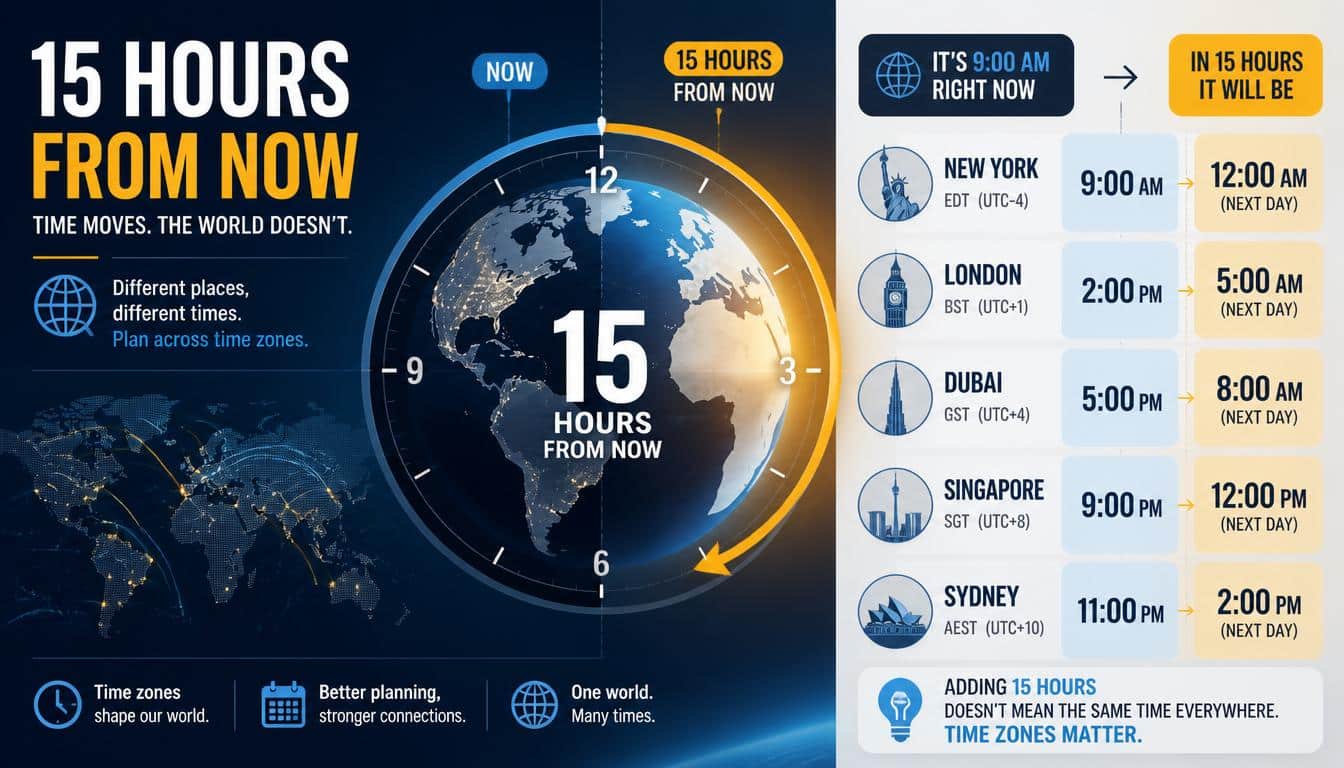
The phrase “now” is local to a time zone. There isn’t one universal clock time that represents now for everyone on Earth.
For someone in GMT+5, 3:33 PM is a different moment on the clock than 3:33 PM in another time zone. The duration of fifteen hours itself never changes, but the displayed local time can be different.
This becomes particularly important when planning international meetings, flights, online events, or deadlines. If someone says an event happens fifteen hours from now without specifying their time zone, there can be room for confusion.
For ordinary personal calculations, the safest approach is simple: use the current local time on the device you’re actually using, then add the required duration.
A Simple Table for 15 Hours From Now
The following examples give a quick reference for common starting times.
| Starting Time | 15 Hours Later |
| 12:00 AM | 3:00 PM |
| 1:00 AM | 4:00 PM |
| 3:00 AM | 6:00 PM |
| 6:00 AM | 9:00 PM |
| 8:00 AM | 11:00 PM |
| 9:00 AM | 12:00 AM next day |
| 10:00 AM | 1:00 AM next day |
| 12:00 PM | 3:00 AM next day |
| 3:00 PM | 6:00 AM next day |
| 6:00 PM | 9:00 AM next day |
| 9:00 PM | 12:00 PM next day |
| 11:00 PM | 2:00 PM next day |
The table is useful because you can spot the general pattern almost instantly. Once you know the starting hour, the fifteen-hour result is mostly just a matter of checking whether midnight gets crossed.
15 Hours From Now vs. 16, 17, 18, 19, and 20 Hours
If you’re comparing nearby durations, each additional hour simply moves the result one hour later.
Starting at 3:33 PM, the approximate results are:
- 15 hours from now: 6:33 AM the next day
- 16 hours from now: 7:33 AM the next day
- 17 hours from now: 8:33 AM the next day
- 18 hours from now: 9:33 AM the next day
- 19 hours from now: 10:33 AM the next day
- 20 hours from now: 11:33 AM the next day
This pattern is reassuringly simple. Once you’ve calculated one result correctly, the following calculations don’t require starting from scratch. Just move the answer forward by one hour for every additional hour in the duration.
Common Mistakes When Calculating 15 Hours
One common mistake is forgetting the date change. A person may correctly calculate the clock time as 6:33 AM but write September 8 instead of September 9. The time is right, but the answer is still incomplete.
Another mistake is confusing noon and midnight. 12:00 PM is noon, while 12:00 AM is midnight. Mixing those two up can throw an entire calculation off by twelve hours, which is rather a lot when you’re only trying to add fifteen.
A third mistake is treating “15 hours from now” as if it means “tomorrow at the same time.” It doesn’t. A full day is 24 hours, so fifteen hours is nine hours shorter than one complete day.
Finally, people sometimes forget minutes. If it’s 3:38 PM, the answer isn’t 6:33 AM just because the hour happens to be three. The 38 minutes stay with the calculation, giving you 6:38 AM.
When an Online 15 Hours From Now Calculator Helps
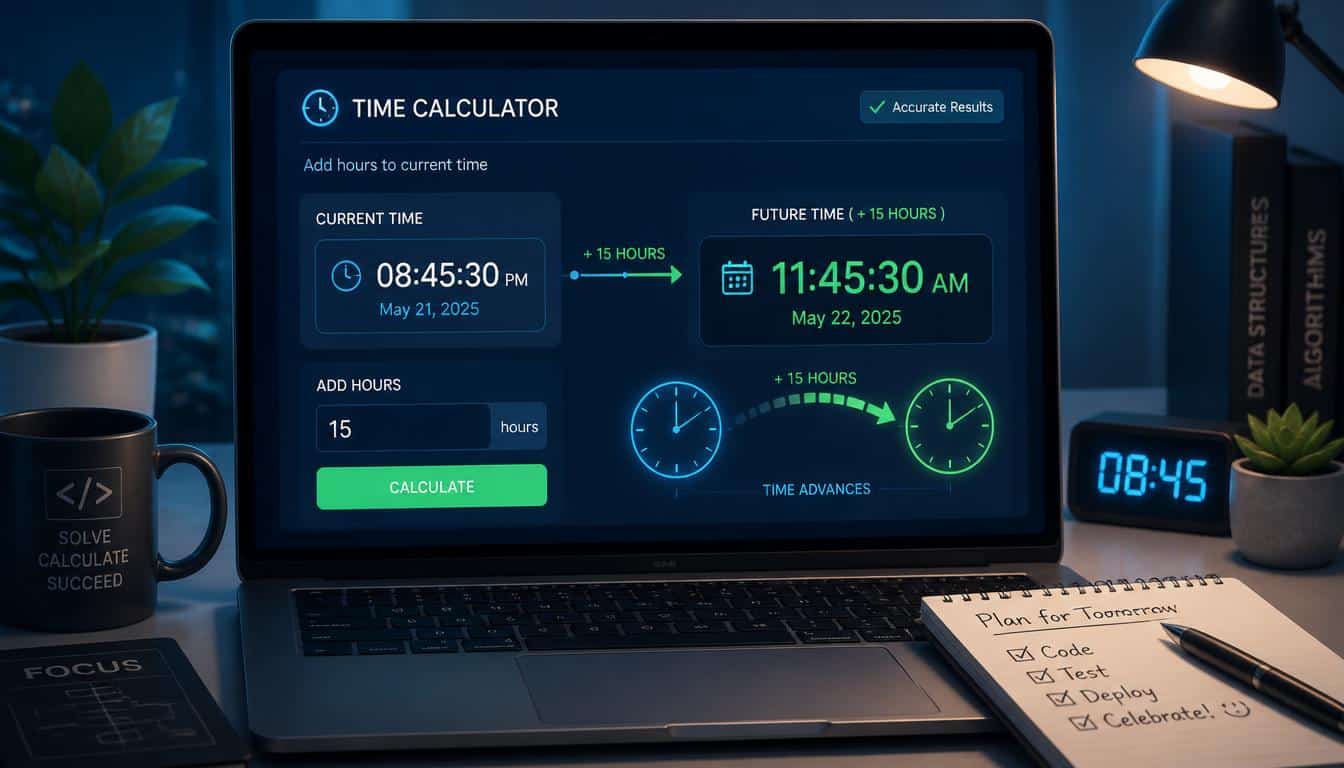
For a basic calculation, mental math is enough. But an online 15 hours from now calculator can be useful when the starting time includes unusual minutes, a different time zone, or a complicated date.
A calculator is also convenient when you need to calculate several durations quickly. Instead of manually checking fifteen, sixteen, seventeen, eighteen, nineteen, and twenty hours, you can enter each duration and compare the results.
Still, understanding the underlying calculation is worthwhile. A calculator gives you an answer, but knowing how the answer works helps you catch mistakes when a result looks suspicious.
A Fast Mental Method for Busy Moments
If you only need a quick answer, use this three-step trick:
- Find how many hours remain until midnight.
- Subtract that number from 15.
- Add the remaining hours to midnight on the next date.
For 3:33 PM, there are 8 hours and 27 minutes until midnight. Fifteen hours minus 8 hours 27 minutes leaves 6 hours 33 minutes.
So the answer is 6:33 AM the following day.
It takes a few seconds once you’ve practiced it, and there’s no need to reach for a calculator every time the question pops into your head.
Frequently Asked Questions
15 hours from now is what time
15 hours from now, the time will be 6:38 AM on Wednesday, September 9, 2026, based on the current time of 3:38 PM.
What is 15 hours from now
15 hours from now will be 6:38 AM the next day. The exact result depends on your current local time.
Time in 15 hours
The time in 15 hours will be 6:38 AM on September 9, 2026, when starting from 3:38 PM on September 8.
What time is 15 hours from now
If the current time is 3:38 PM, adding 15 hours gives 6:38 AM the following morning.
What time is it in 15 hours
In 15 hours, it will be 6:38 AM on Wednesday, September 9, 2026, based on a current time of 3:38 PM.
Read More: https://gracethemes.com/what-time-is-9-hours-from-now/
Final Answer: What Time Is 15 Hours From Now?
Using the current reference time of 3:33 PM on Tuesday, September 8, 2026, in GMT+5, the answer is:
15 hours from now = 6:33 AM on Wednesday, September 9, 2026.
In duration terms, fifteen hours equals:
- 900 minutes
- 54,000 seconds
- 54,000,000 milliseconds
The most important thing to remember is that the phrase “from now” depends on the exact starting time and time zone.
Change the starting time by five minutes, and the final answer changes by five minutes too. Change the time zone, and the displayed local clock time changes as well.
For a quick calculation, convert the starting time to the 24-hour clock, add 15, and subtract 24 if necessary. If the calculation passes midnight, move the calendar date forward by one day. Thats really all there is to it.
Time calculations can look strangely complicated until you see the pattern. After that, fifteen hours is just fifteen hours 900 minutes patiently marching forward, one minute at a time, until the clock quietly arrives at the next morning.
