

What Time Is 9 Hours From Now?
There is something oddly satisfying about asking, “What time is 9 hours from now?” It sounds like a tiny piece of time calculation, but the answer can decide when you
call someone, take medicine, start a trip, finish work, check a delivery, or finally crawl into bed after a very long day. Time keeps moving while we are thinking about it, which is probably the most annoying thing about clocks.
If the current time is 3:04 PM GMT+5, adding 9 hours gives 12:04 AM on Wednesday, September 9, 2026.
In other words, the answer crosses midnight and lands on the following day. If you are checking the calculation at a slightly different moment, the result will naturally shift by those same minutes, so “now” matters quite a lot here.
The simple idea is this: take the current time, add the requested duration, and adjust the date whenever the clock passes midnight.
It sounds almost too easy, yet midnight has a sneaky habit of making ordinary time arithmetic look more complicated than it really is.
| Calculation | Result |
| Current time | 3:04 PM GMT+5 |
| Add | 9 hours |
| Time after 9 hours | 12:04 AM |
| Date | Wednesday, September 9, 2026 |
| Total minutes | 540 minutes |
| Total seconds | 32,400 seconds |
What Time Is 9 Hours From Now?
Using 3:04 PM GMT+5 as the starting point, the answer to what time is 9 hours from now is 12:04 AM on Wednesday, September 9, 2026.
The calculation is straightforward, although the date changes because nine hours carries the clock beyond midnight.
You can think of it in two smaller jumps, which makes the time calculation method easier to see. From 3:04 PM to midnight is 8 hours and 56 minutes.
That leaves 4 minutes, taking us to 12:04 AM. Simple enough, but easy to miss if you’re staring only at the hour hand.
So, in this example:
- Current time: 3:04 PM GMT+5
- Duration: 9 hours
- Future time: 12:04 AM
- Date: Wednesday, September 9, 2026
- Time difference: 9 hours
- Result: midnight-plus-four-minutes on the next day, basically
The important detail is the time zone. GMT+5 means Greenwich Mean Time offset +5, so the same instant can appear as a different clock time somewhere else.
A person in another time zone may therefore see a different local answer, even though the actual duration is still exactly nine hours.
How to Calculate 9 Hours From Now
To calculate time 9 hours from now, start with the clock time you have at this very moment. Then add nine hours while remembering that a 12-hour clock repeats itself after 12, and a calendar date changes at midnight. This sounds like school arithmetic wearing a wristwatch, but it works beautifully.
For example, suppose your current time is 3:04 PM. Add six hours first and you reach 9:04 PM. Add the remaining three hours and you reach 12:04 AM. Because the clock passed midnight, the date moves forward one day.
This is the basic future time calculation:
3:04 PM + 9 hours = 12:04 AM the next day.
With a 24-hour clock, the same calculation is even cleaner. 3:04 PM becomes 15:04. Add nine hours and you get 24:04, which is represented as 00:04 on the following date.
The 24:04 notation is useful during the calculation, but ordinary clocks would simply call it 12:04 AM.
This is why AM/PM calculation can occasionally feel confusing. The mathematics hasn’t changed; only the way the clock displays the number has changed.
Once you remember that 12:00 AM means midnight and 12:00 PM means noon, the whole thing gets much less mysterious.
9 Hours From Now: Understanding Midnight
The phrase 9 hours from now becomes particularly interesting when the starting point is in the afternoon. You don’t just add nine to the displayed hour and stop. If that pushes the clock beyond midnight, you need to perform a next day calculation.
At 3:04 PM, adding one hour gives 4:04 PM. Adding three more gives 7:04 PM. Six hours after the starting point is 9:04 PM. Eight hours after it is 11:04 PM. Then one final hour brings us to 12:04 AM.
That final step changes both the clock period and the date, which is why the answer isn’t “12:04 PM.” The first hour of a new day belongs to AM, even though it follows an entire evening of PM hours. Clocks really do enjoy making simple things look suspicious.
If you are doing the calculation without a calculator, a useful trick is to split the duration around midnight. First calculate how long remains until midnight, then add whatever time is left.
For this example:
- 3:04 PM → 12:00 AM = 8 hours 56 minutes
- Remaining duration = 4 minutes
- Midnight + 4 minutes = 12:04 AM
- New date = Wednesday, September 9, 2026
That’s the whole time conversion in a few lines, and there isn’t any hidden clock magic involved.
9 Hours From Now Calculator: Why It Helps
An Hours From Now Calculator can be useful when you don’t want to perform mental hours calculation, especially when the starting time includes unusual minutes or when the calculation crosses several dates. A calculator can handle the clock arithmetic while you simply enter the starting point and duration.
The idea behind an hours from now calculator is generally the same as manual calculation.
It takes a starting date and time, adds the specified duration, and returns the corresponding future time. Some calculators also allow negative values so you can investigate past times as well.
For example, a tool such as Inch Calculator may provide time-related calculation resources, including an Hours From Now Calculator.
Depending on the interface, you may also encounter related tools, latest videos, a video, feedback controls, a name, email, comment,
or links to similar time calculators. Interfaces can change, so the calculation itself is more important than any particular button or logo.
The Inch Calculator logo is simply branding; it doesn’t alter the mathematics. What matters is entering the correct starting time, choosing the appropriate time zone when the tool requires it, and checking whether the result falls on the same date or the next one.
9 Hours From Now in Minutes, Seconds, and Milliseconds
Nine hours may look like a large block of time on a clock, but it becomes surprisingly tidy when converted into smaller units. For anyone searching for 9 hours in minutes, the answer is 540 minutes.
The calculation is:
9 × 60 = 540 minutes.
For 9 hours in seconds, multiply 540 minutes by 60. That produces 32,400 seconds. It is the same duration, merely expressed with a much fussier number, as numbers sometimes like to do.
For milliseconds, multiply the seconds by 1,000. Therefore, 9 hours in milliseconds equals 32,400,000 milliseconds.
Here is the complete duration conversion:
- 9 hours = 540 minutes
- 9 hours = 32,400 seconds
- 9 hours = 32,400,000 milliseconds
These conversions can be useful in programming, scheduling systems, technical documentation, timers, and other situations where a clock display isn’t the preferred format. For an ordinary appointment, though, saying “I’ll see you in 32,400 seconds” may get you a very confused look from your friend.
What Time Will It Be in 10, 11, 12, 13, or 14 Hours?
People often ask a follow-up question immediately after finding the answer to what time will it be in 9 hours. If nine hours takes you to 12:04 AM, then each additional hour simply moves the clock forward.
Starting from 3:04 PM GMT+5, the sequence looks like this:
- 9 hours from now: 12:04 AM, Wednesday
- 10 hours from now: 1:04 AM, Wednesday
- 11 hours from now: 2:04 AM, Wednesday
- 12 hours from now: 3:04 AM, Wednesday
- 13 hours from now: 4:04 AM, Wednesday
- 14 hours from now: 5:04 AM, Wednesday
So if someone searches what time is 10 hours from now, the answer in this example is 1:04 AM. For what time is 11 hours from now, it is 2:04 AM. Likewise, what time is 12 hours from now gives 3:04 AM.
The pattern becomes quite obvious once you see it. The minutes stay at :04 because we’re adding whole hours, while the hour itself keeps moving.
There is no need to restart the calculation each time, which saves a little brainpower for more important things, like remembering where you left your phone.
What Time Was It 9 Hours Ago?

Time calculations can also travel backward. Instead of adding hours, you subtract them. So the question what time was it 9 hours ago is simply the reverse of the forward calculation.
If the current time is 3:04 PM, subtract nine hours. Going backward six hours takes you to 9:04 AM. Subtract the remaining three hours and you arrive at 6:04 AM.
Therefore:
3:04 PM − 9 hours = 6:04 AM.
This is sometimes called a past time calculator problem. The same principles apply: preserve the minutes, move backward through the clock, and change the date if necessary.
The reverse method is especially handy when someone says, “That happened nine hours ago,” and you’re trying to work out when it occurred. Just remember that “ago” points backward, while “from now” points forward. Tiny words, surprisingly bossy.
Comparing 9 Hours With Other Durations
Looking at 9 hours alongside 10 hours, 11 hours, and 12 hours can make duration planning easier. Nine hours is long enough to stretch across an evening and into the following morning, particularly when the starting point is in the afternoon.
If you begin before noon, the same nine-hour duration can land in the afternoon or evening rather than after midnight. For instance, starting at 6:00 AM and adding nine hours gives 3:00 PM. Starting at 6:00 PM and adding nine hours gives 3:00 AM the next day.
That contrast is worth remembering because a duration doesn’t have a single clock-time answer. The result depends on the current time used as the starting point. Nine hours is always nine hours, but the clock face it lands on changes depending on where you begin.
A useful mental shortcut is to ask yourself three things: What time is it now? How many hours am I adding? Will the calculation pass midnight? Those three questions handle most ordinary clock calculations without much drama.
Why the Time Zone Matters
The phrase GMT+5 identifies a time offset rather than a universal clock reading. When someone says the current time is 3:04 PM GMT+5, they’re giving you both the clock time and the geographic offset needed to interpret it correctly.
If you simply copy 3:04 PM into a calculator while ignoring the time zone, the numerical result may still be 12:04 AM locally, but you could misunderstand what that moment represents somewhere else.
This matters when coordinating international meetings, flights, remote work, online events, or calls with family overseas.
A nine-hour time difference is also not necessarily the same thing as a time-zone difference. The first describes a duration between two moments; the second describes the relationship between clocks in different locations. They sound alike, but they’re doing different jobs.
That’s why good time calculation starts with a clearly identified starting time and, when relevant, a clearly identified time zone. Otherwise, you may get a perfectly correct answer to a slightly wrong question, which is the most irritating kind of correct.
A Simple Time Calculation Method Anyone Can Use
If you don’t have an online time calculator, use this four-part method. It works for adding hours to current time, subtracting hours, and checking a future appointment.
- Write down the exact clock time you’re starting with.
- Add the hours gradually rather than trying to jump instantly.
- Watch for midnight and noon, where AM and PM change.
- Change the calendar date whenever the clock passes midnight.
For example, starting at 3:04 PM and adding 9 hours can be broken into 6 + 3. Six hours gives 9:04 PM, and three more gives 12:04 AM. Because midnight has been crossed, the answer belongs to the next calendar day.
This method is often easier than relying on memory, particularly when you’re tired. And yes, tired brains are terrible at clocks. A person can calculate complicated things at work all day and still stare at 11:00 PM plus two hours as if the universe has personally betrayed them.
When 9 Hours From Now Falls Before Noon or After Noon
Whether the answer occurs before noon or after noon depends entirely on the starting point. This is one reason searches such as time 9 hours from now need an actual current time to produce a meaningful answer.
Starting at 3:04 PM places the result at 12:04 AM, comfortably after midnight but before noon. Starting at 7:00 AM, however, nine hours later is 4:00 PM, which is clearly after noon.
Starting at 12:04 AM and adding nine hours gives 9:04 AM. Starting at 12:04 PM and adding nine hours gives 9:04 PM. Same duration, radically different-looking results, because clocks are sensitive little creatures.
The key isn’t memorizing answers. It is learning the relationship between the starting point and the future time. Once that clicks, you can calculate almost any ordinary hour-based question without needing a special tool.
Common Mistakes When Adding 9 Hours
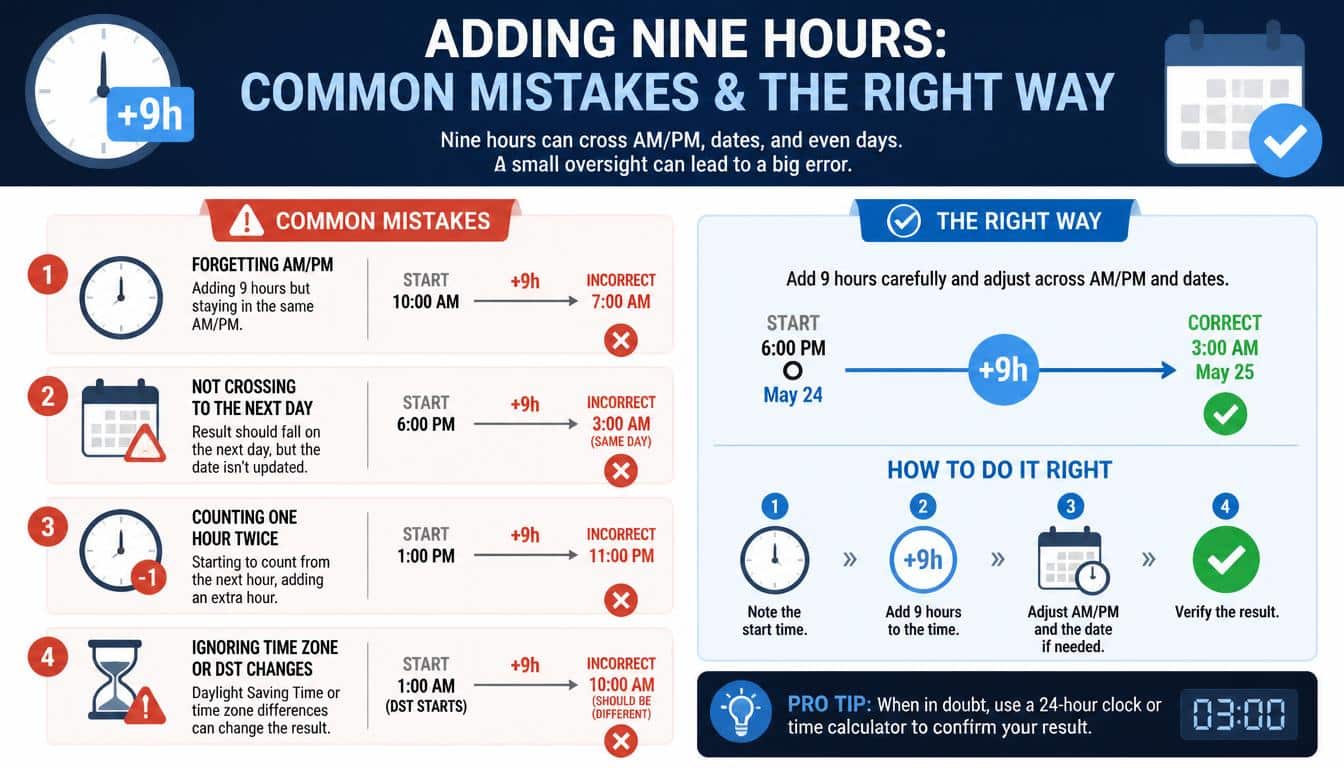
One common mistake is adding nine directly to the hour number on a 12-hour clock. If the starting time is 8:00 PM, adding nine to 8 produces 17, which isn’t a normal 12-hour clock display. You then need to convert that result correctly rather than simply writing “17 PM,” which is where the clock starts filing complaints.
Another mistake is forgetting the date. If you calculate 3:04 PM + 9 hours and write 12:04 AM without mentioning Wednesday, September 9, 2026, the answer is technically incomplete for scheduling purposes.
People also sometimes confuse 12:00 AM and 12:00 PM. Midnight is 12:00 AM; noon is 12:00 PM. This little distinction causes an impressive amount of scheduling chaos for something involving only two letters.
Finally, don’t confuse 9 hours ago with nine hours from now. One moves backward and one moves forward. If you remember that “ago” means subtract and “from now” means add, you’re already halfway out of the woods.
Frequently Asked Questions About 9 Hours From Now
What time is 9 hours from now?
Using 3:04 PM GMT+5 as the starting time, 9 hours from now is 12:04 AM on Wednesday, September 9, 2026. The calculation crosses midnight, so the calendar date changes.
How many minutes are in 9 hours?
There are 540 minutes in 9 hours. Multiply nine by 60, because each hour contains 60 minutes.
How many seconds are in 9 hours?
There are 32,400 seconds in nine hours. That’s 540 minutes multiplied by 60 seconds per minute.
How many milliseconds are in 9 hours?
There are 32,400,000 milliseconds in nine hours. One second contains 1,000 milliseconds, so the conversion is pleasantly mechanical.
What time was it 9 hours ago?
If the starting time is 3:04 PM, then 9 hours ago was 6:04 AM on the same calendar day. This is the reverse of adding nine hours.
Does adding 9 hours always change the date?
No. It depends on the starting time. If you start early in the morning, the result may remain on the same date. If you start late enough in the day, nine hours can cross midnight and move into the following day.
Is 12:04 AM morning or night?
12:04 AM is just after midnight, so it is technically the very beginning of the new day. In everyday conversation, people may call it nighttime, while calendars treat it as the new morning. Both descriptions make sense depending on context.
9 hours from now is what time
Find out the exact time that will occur nine hours after the current time. This is useful for quickly planning events or checking future schedules.
What time was it 9 hours ago
Calculate the exact time from nine hours earlier. Simply subtract nine hours from the current time to find the corresponding past time.
What is 9 hours from now
Learn what the clock time will be nine hours from the present moment. The result may fall on the same day or the following day, depending on the current time.
What time is it in 9 hours
Determine the time you can expect after nine hours have passed. This calculation helps you easily work out a future time without manual counting.
What time was 9 hours ago
Check the time that occurred nine hours before now. Subtracting nine hours from the current time gives you the exact past time.
Read More: https://gracethemes.com/what-date-will-it-be-2-weeks-from-today/
Final Thoughts on Calculating 9 Hours From Now
The answer to what time is 9 hours from now is not really about memorizing a particular clock reading.
It is about understanding duration, recognizing the starting point, and knowing when the clock crosses midnight. Using 3:04 PM GMT+5, the result is 12:04 AM on Wednesday, September 9, 2026.
The calculation is simple: start at 3:04 PM, move forward eight hours and 56 minutes to midnight, then use the remaining four minutes. There you are, standing at 12:04 AM on the next day. No complicated formula needed, just a little patient clock-watching.
For everyday situations, an hours from now calculator can save time, especially when you’re dealing with several dates, unusual starting times, or international schedules.
But understanding the underlying time calculation method is still useful because it lets you check whether a calculator’s answer makes sense.
And that is probably the nicest thing about learning time arithmetic: once you understand it, the clock stops looking like a puzzle.
Nine hours becomes 540 minutes, 32,400 seconds, or 32,400,000 milliseconds. Different numbers, same stretch of life. The clock merely tells the story in another language.
So whether you’re planning something nine hours ahead, checking 9 hours ago, comparing 10–14 hours, or simply wondering where the day disappeared to, the rule remains pleasantly steady: know your starting time, add or subtract the duration, watch for midnight, and check the date.
Time keeps moving, of course. It doesn’t wait around while we finish the calculation. Maybe that’s exactly why these small questions matter: they turn an invisible passing thing into a moment we can actually understand.
