
What Is the Metaverse? A Complete Guide to Virtual Worlds, Technology, and the Future of Digital Life
Imagine putting on a headset, stepping into a room that exists only in the digital world, and finding your friends already waiting there.
Someone is showing off a new digital painting, another person is preparing for a virtual concert, and a third is discussing a business idea while sitting beside a beautiful ocean that doesn’t exist anywhere on Earth.
Strange? Perhaps a little. But this is the kind of experience that helps explain why the metaverse has captured so much attention.
The internet has already changed how we communicate, work, learn, shop, and entertain ourselves. Yet, most of our online experiences still involve looking at screens and clicking on buttons.
The Metaverse introduces a different possibility: digital spaces where people can feel present, interact through avatars, and participate in experiences that resemble parts of real life. It isn’t simply about escaping reality; it’s about discovering new ways to connect with it.
So, what is the metaverse, how does it work, and why are companies, developers, gamers, and everyday internet users interested in it?
The answers are more interesting than the futuristic images often associated with this technology. And no, you don’t necessarily need an expensive headset or a futuristic home to begin understanding it.
What Is the Metaverse? Understanding the Basic Meaning
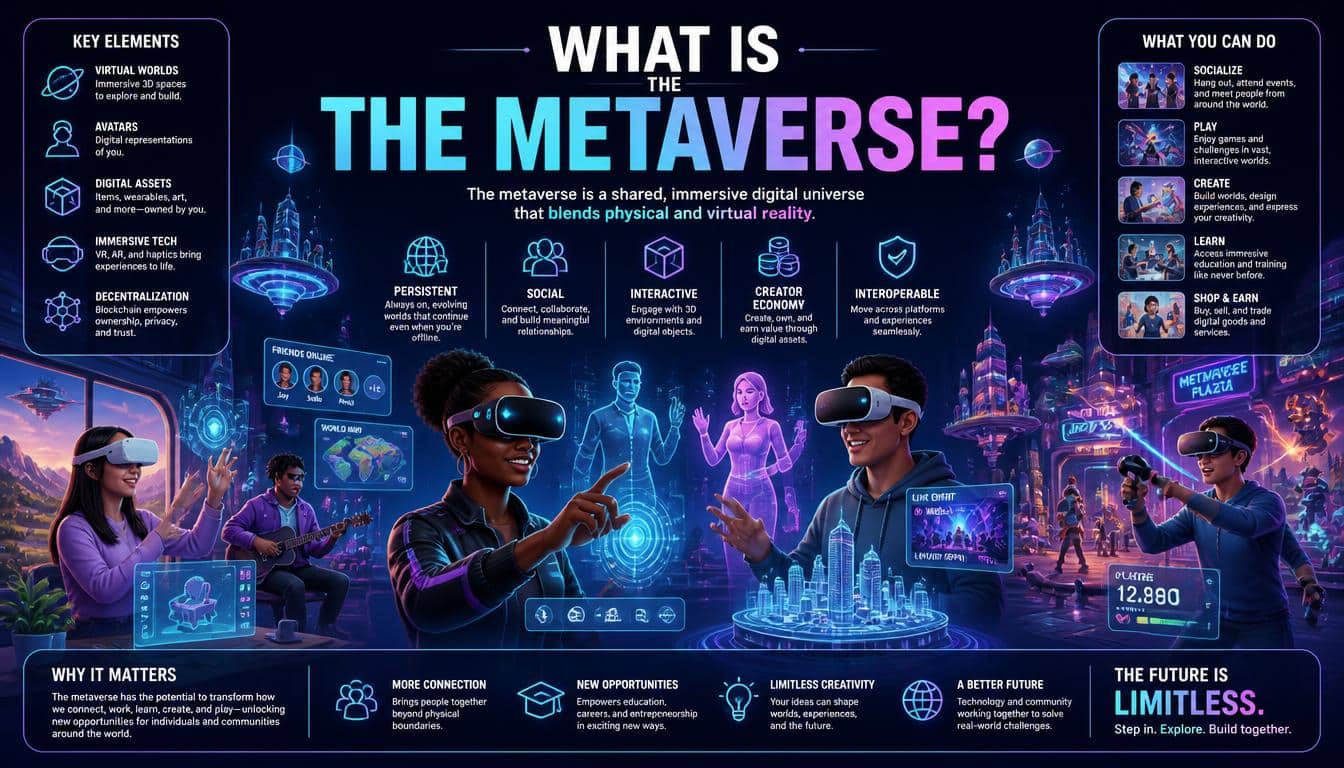
The metaverse is a broad concept describing interconnected or persistent digital environments where people can interact with other users, explore virtual spaces, create content, play games, attend events, and sometimes participate in digital economies.
These environments may use virtual reality (VR), augmented reality (AR), three-dimensional graphics, and other immersive technologies to make online experiences feel more natural.
Think of the difference between watching a football match on your phone and entering a virtual stadium with friends. In the first situation, you’re observing an event through a screen.
In the second, you might control an avatar, move around the stadium, talk to other spectators, and feel as though you’re part of the crowd. That sense of participation is central to the metaverse meaning.
However, there is no single, universally accepted technical definition of the metaverse.
Some people use the term for social virtual worlds, while others imagine a much broader digital environment connecting work, entertainment, education, commerce, and physical spaces.
The important point is that the metaverse isn’t one particular app or website. It is a vision of how digital experiences might become more immersive, interactive, and connected over time.
How Does the Metaverse Work?
The metaverse combines several technologies that already exist, although they are developing at different speeds. These technologies help create digital environments, represent users inside them, and allow people to communicate or interact with virtual objects in real time.
At its simplest, the process works like this: a platform creates a digital environment, your device displays that environment, and your actions control your avatar or influence the world around you.
Other participants can see and respond to those actions, making the experience social rather than purely individual.
Here are the main components that make these experiences possible.
Virtual Reality and Augmented Reality
Virtual reality (VR) places users inside a computer-generated environment, usually through a headset with motion tracking and interactive controllers.
You might use VR to explore a virtual museum, practise a professional skill, attend a meeting, or play a game that surrounds you with a three-dimensional world.
Augmented reality (AR) works differently. Instead of replacing your surroundings entirely, it adds digital elements to the physical world.
For example, an AR application could display a virtual piece of furniture in your living room so you can see how it might look before buying it.
Both technologies contribute to immersive digital experiences, but neither is compulsory for every metaverse platform. Many virtual environments can be accessed using an ordinary computer, smartphone, or gaming console.
Three-Dimensional Graphics and Spatial Computing
Three-dimensional technology helps developers build spaces that users can explore rather than simply view. Digital rooms, landscapes, buildings, objects, and characters are created using 3D modelling and rendering tools.
Spatial computing takes this concept further by allowing digital content to respond to positions, movements, and relationships in physical or virtual space. A person could reach towards a digital object, walk around a virtual sculpture, or manipulate a model as if it were sitting on a table.
The result can feel surprisingly intuitive. Instead of navigating every experience through menus and flat screens, users may interact with digital environments using gestures, movement, voice, or controllers.
Digital Avatars and Virtual Identity
An avatar is a digital representation of a person. It might look like the user, resemble a cartoon character, or be a completely imaginative creation with colourful hair, unusual clothing, and features that would be impossible in the physical world.
These avatars help people communicate, express themselves, and participate in shared environments.
Someone attending a virtual business meeting might choose a realistic professional avatar, while the same person could select a playful character for a gaming session later that evening.
Still, an avatar is not the whole of a person’s identity. Privacy, account security, impersonation, and control over personal information remain important concerns as virtual identity becomes more significant.
Real-Time Interaction and Persistent Worlds
Many metaverse experiences allow users to interact simultaneously. One person can move an object, another can respond to a message, and a third can join the conversation without restarting the entire environment.
A persistent virtual world continues to exist when individual participants leave. For example, a user-created shop might remain available after its creator logs out, depending on the platform’s design. Other visitors may continue exploring, shopping, or attending an event.
Persistence and real-time interaction help create the feeling of a shared digital place. Yet, persistence does not automatically mean that a world is permanent, decentralized, or available without interruption.
Platforms still depend on servers, software, business decisions, and technical infrastructure.
A Brief History of the Metaverse
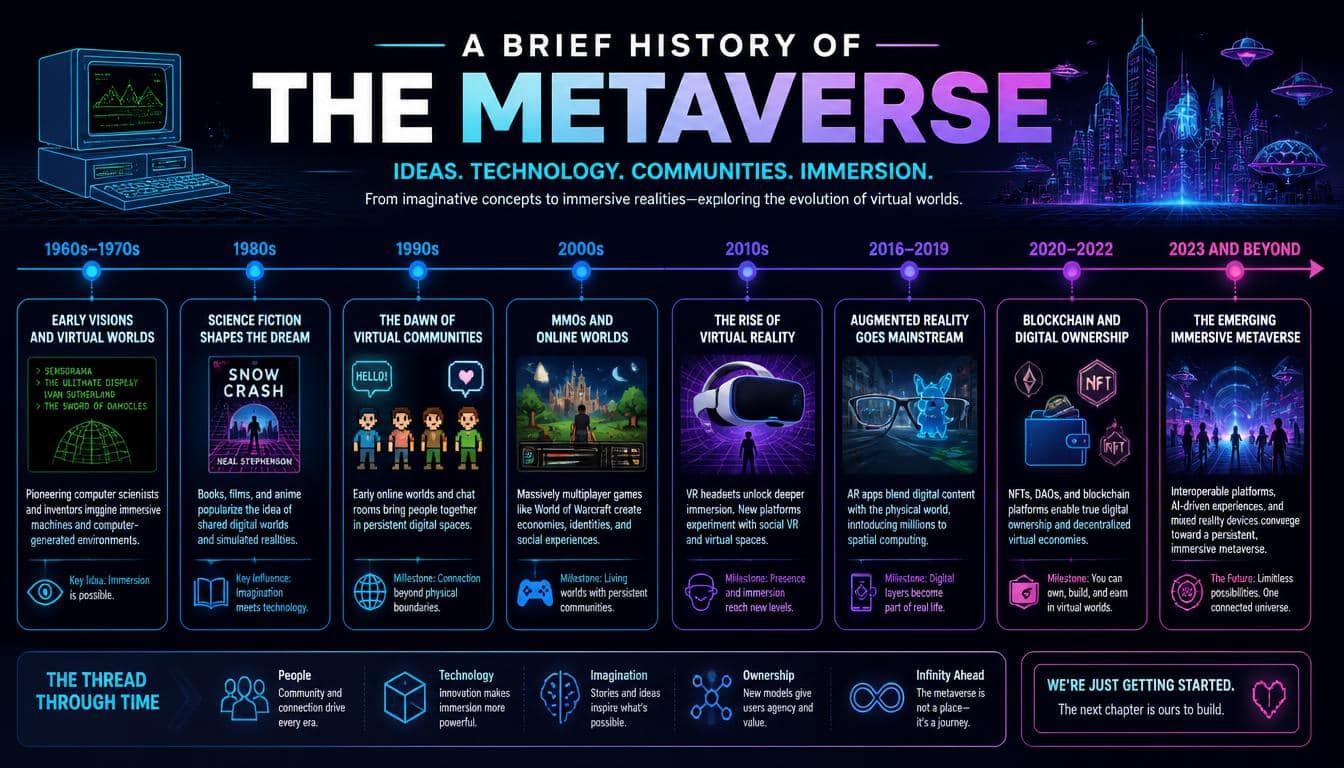
Although the metaverse may sound like a recent invention, its ideas have been developing for decades. Science-fiction writers imagined immersive digital realities long before modern headsets and powerful graphics processors became widely available.
Neal Stephenson’s 1992 novel Snow Crash helped popularize the term “metaverse.” The book imagined a shared virtual environment in which people interacted through digital representations of themselves. The idea was fictional, but it offered a memorable way to think about life inside a computer-generated world.
Later, Ernest Cline’s novel Ready Player One, published in 2011, explored a future in which people spent considerable time in an expansive virtual universe. Its popularity introduced even more readers to the possibility of immersive digital life.
Meanwhile, actual technology was moving forward. Second Life, launched by Linden Lab in 2003, allowed users to create avatars, build virtual spaces, socialize, and participate in a digital economy.
Multiplayer games and online communities were also developing features that would later be associated with metaverse experiences.
In 2021, Facebook changed its corporate name to Meta, placing greater public attention on virtual reality and the company’s vision for the metaverse.
The announcement helped turn an established technological idea into a mainstream business conversation.
The journey is still unfolding. Some early expectations proved overly ambitious, while useful technologies and communities continued to develop.
The metaverse is better understood as an evolving collection of ideas and platforms than as a finished product that suddenly appeared one day.
Popular Metaverse Platforms and Examples
There is no single platform that represents every aspect of the metaverse. Different environments focus on gaming, social interaction, creativity, digital ownership, professional collaboration, or virtual reality.
The following examples illustrate how the broader concept is being explored.
Roblox
Roblox is an online platform where users can explore experiences and games created by developers and community members. Its user-generated content, customizable avatars, and social features make it a useful example of a metaverse-like environment.
A child might spend an afternoon playing an obstacle course, while a developer creates a virtual shop or designs an entirely new game. The platform demonstrates how users can become creators rather than simply consumers of digital entertainment.
However, safety, moderation, privacy, and age-appropriate communication are especially important considerations on platforms used by younger audiences.
Fortnite
Fortnite is widely known for its multiplayer gameplay, but its creative and social experiences extend beyond traditional matches. Players can participate in virtual events, explore custom environments, and interact with others through digital characters.
These features show how a gaming platform can become a social destination as well as a place to play. A concert or community event inside a game can bring together people who may live thousands of kilometres apart.
Although Fortnite has metaverse-like characteristics, it is not the entire metaverse. It is one example of how entertainment platforms can blend gaming, communication, and shared digital experiences.
Minecraft
Minecraft offers an open-ended world where players build structures, explore landscapes, collaborate on projects, and create their own rules or challenges. Its block-based appearance might seem simple, but the creative possibilities are enormous.
Teachers can use Minecraft-based environments for collaborative learning, while friends can build elaborate cities together. Some communities use private servers to develop persistent worlds with their own social systems and activities.
Minecraft illustrates an important principle: immersive digital participation doesn’t always require realistic graphics or expensive virtual reality equipment.
Second Life
Second Life is one of the earlier examples of a user-created virtual world. Participants can customize avatars, establish businesses, build environments, and attend social events.
Its history is particularly useful when discussing the metaverse economy because users have long experimented with virtual services, digital products, and community-based commerce within the platform.
Second Life also reminds us that virtual worlds did not begin with the latest technology boom. People have been finding ways to build meaningful digital communities for many years.
Decentraland and The Sandbox
Decentraland and The Sandbox are associated with blockchain-based virtual environments and digital assets. Depending on the platform and its rules, users may explore spaces, create experiences, and interact with assets connected to blockchain systems.
These platforms are often discussed in conversations about Web3, virtual property, and digital ownership. Their approach differs from platforms where the company controls most account systems, transactions, and virtual items.
Still, blockchain involvement doesn’t guarantee financial success, complete decentralization, or universal ownership rights. Users should examine the technical arrangements, platform terms, and risks before spending money.
VRChat and Horizon Worlds
VRChat focuses on social interaction through customizable avatars and user-created virtual environments. It offers an example of how people can gather in spaces that range from imaginative fantasy settings to informal meeting rooms.
Horizon Worlds, associated with Meta, has also explored social virtual environments and creator-built experiences. Such platforms demonstrate the appeal of spending time with others inside a shared digital setting.
Their success depends on more than graphics alone. Good communities, accessible controls, useful features, and reasons to return are what make a digital space feel alive.
The Role of Gaming in the Metaverse
Gaming has become one of the most visible pathways into metaverse-style experiences.
Games already bring together digital identities, shared environments, interactive objects, and social communication, so the transition toward more immersive experiences feels fairly natural.
In a traditional single-player game, the world may exist primarily for one person’s adventure. In a social virtual environment, players might construct buildings together, attend an event, create an activity for other visitors, or develop a community with its own traditions.
The metaverse gaming concept therefore goes beyond realistic graphics. It emphasizes participation, creativity, social presence, and sometimes user-generated economies.
Games can also provide relatively accessible entry points. Someone may already understand avatars, online multiplayer sessions, and virtual spaces without having any experience with a VR headset.
However, not every online game is a metaverse, and not every metaverse experience needs to be a game. Education, design, collaboration, shopping, and cultural events can all benefit from similar technologies.
The Metaverse Economy: How Do People Make Money?
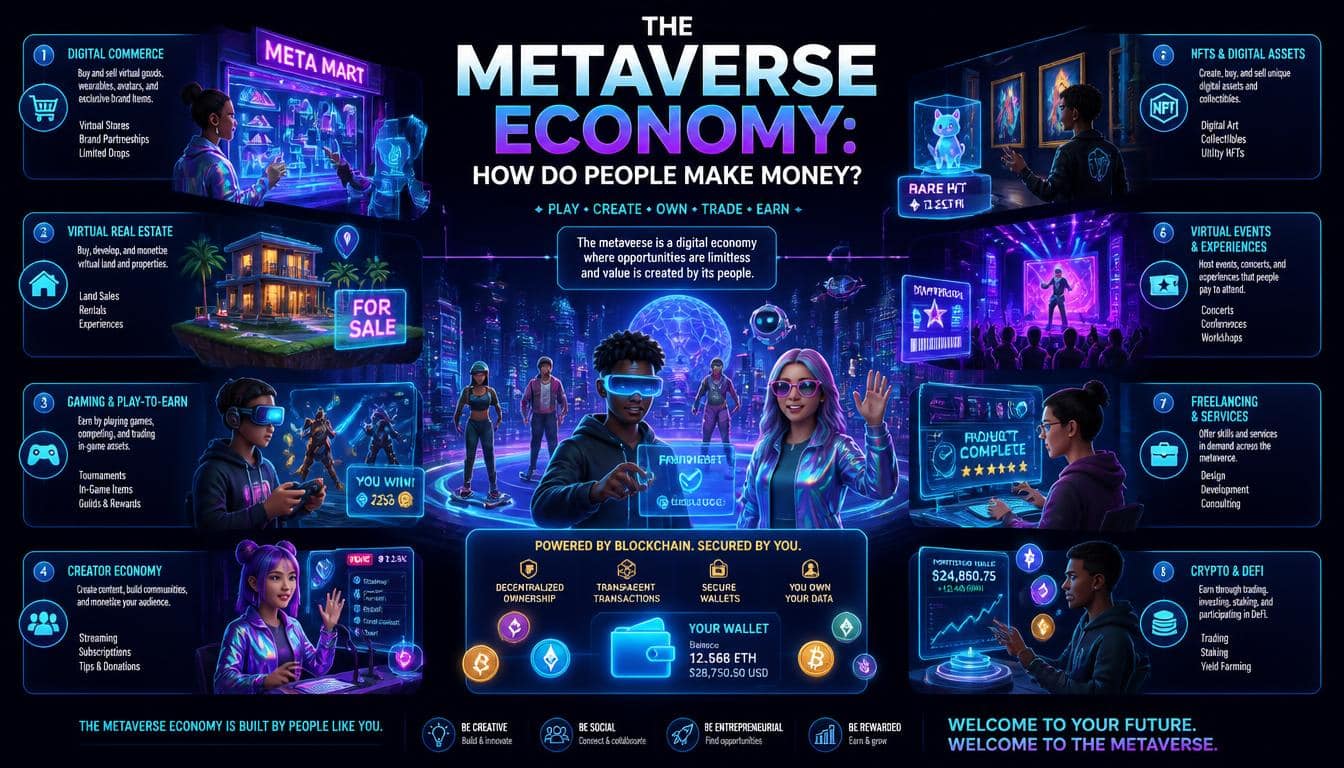
One of the most discussed aspects of the metaverse is its potential economy. Digital environments can support the creation, exchange, and sale of virtual goods and services, although the opportunities vary considerably by platform.
Imagine a designer who creates fashionable clothing for avatars. Another person develops a virtual exhibition space, while a musician performs at an online event.
These creators may be able to earn money when users purchase their work or pay to participate in certain experiences.
Possible economic activities include:
- Virtual goods: Clothing, accessories, decorative objects, digital furniture, and other items used in online environments.
- Creator services: Designing avatars, building virtual spaces, producing 3D models, or developing interactive experiences.
- Virtual events: Hosting concerts, workshops, exhibitions, conferences, and other ticketed activities.
- Digital commerce: Displaying products, demonstrating designs, or creating immersive shopping experiences.
- Digital collectibles: Offering blockchain-linked tokens or other digital items, where supported by the platform.
- Professional services: Providing training, architectural visualizations, simulations, and collaboration tools for organizations.
These possibilities are sometimes described as the metaverse economy or virtual economy. The underlying principle is simple: people may be willing to pay for useful, entertaining, distinctive, or meaningful digital experiences.
But earning money is not guaranteed. A virtual shop can attract no customers, an asset can lose demand, and platform rules may change. Cryptocurrency-linked projects introduce additional risks, including price volatility, scams, technical failures, and uncertain resale value.
The sensible approach is to view virtual commerce as a developing business area, not a shortcut to effortless income.
Digital Ownership, Blockchain, and Web3
Discussions about the metaverse often overlap with blockchain and Web3, but these terms describe different concepts.
Blockchain is a type of distributed ledger technology that records information across a network. Some virtual platforms use it to track digital assets or transactions. Non-fungible tokens (NFTs), for example, can represent distinct digital tokens associated with artwork, collectibles, or virtual items.
Web3 is a broad term commonly associated with decentralized internet services, blockchain-based applications, and systems that give users different ways to participate in digital networks.
The metaverse, by comparison, focuses on shared digital environments and experiences. A virtual world can use blockchain technology, but it doesn’t have to. Similarly, a Web3 application doesn’t need to provide a three-dimensional environment.
This distinction matters because a platform can offer immersive interaction without decentralized ownership, or decentralized asset systems without immersive virtual reality.
Digital ownership also needs careful interpretation. Owning a token does not necessarily mean owning the underlying artwork, intellectual property, or permanent access to a virtual world. Those rights depend on the relevant contracts, licenses, and platform arrangements.
The long-term goal of greater interoperability would allow users to move more easily between environments, potentially carrying selected identity details, assets, or preferences with them.
Achieving that goal requires technical standards, compatible systems, clear rights, and cooperation among platform developers. It remains an important challenge rather than a universal feature of today’s virtual worlds.
Real-World Uses of the Metaverse Beyond Gaming
The metaverse is often associated with entertainment, but its practical applications could reach far beyond games. Organizations are exploring immersive environments for activities where seeing, practising, or collaborating can be more effective than reading instructions alone.
Education and Virtual Learning
Students can explore historical environments, examine three-dimensional scientific models, or practise complex procedures in simulated settings. Instead of merely reading about the solar system, a learner could move between planets in a carefully designed virtual lesson.
Virtual environments may also help students collaborate across geographical boundaries. A classroom in one country could work on a shared project with learners elsewhere, provided they have reliable access and suitable teaching support.
These experiences work best when they support clear educational goals. Immersion alone doesn’t guarantee better learning, and effective teaching still matters more than flashy technology.
Healthcare and Professional Training
Simulations can give medical students and other professionals opportunities to practise selected procedures in controlled environments.
Virtual scenarios may help people repeat tasks, explore unusual situations, and receive feedback without exposing real patients or equipment to unnecessary risk.
Immersive tools may also support certain forms of rehabilitation, visualization, and professional education. However, medical applications require appropriate clinical evidence, accessibility considerations, and professional oversight.
The technology is a tool, not a replacement for qualified healthcare professionals or real-world training where hands-on competence is necessary.
Business Meetings and Remote Collaboration
Remote work has made digital collaboration a normal part of professional life. Metaverse-style environments could add shared 3D models, virtual workspaces, and interactive demonstrations to existing online meetings.
An engineering team, for instance, might inspect a digital prototype together before manufacturing a physical version. Architects could guide clients through a building design, while employees could rehearse tasks in a simulated workplace.
These tools are most valuable when they solve a specific problem. If a simple video call is easier and more comfortable, forcing everyone into a virtual meeting room may not be an improvement.
Shopping, Architecture, and Design
Immersive shopping could let customers examine virtual product displays, test furniture arrangements, or view digital versions of clothing before making a purchase.
Designers might use the same technology to show clients how a room or building could look at different stages of development.
This can make abstract ideas easier to understand. A customer doesn’t need to imagine every dimension from a flat image if they can inspect a model from several angles.
Even so, product accuracy, clear pricing, privacy, and honest descriptions remain essential. A beautiful virtual showroom is no substitute for a product that meets expectations when it arrives.
Benefits of the Metaverse
The metaverse offers several potential advantages, especially when immersive technology provides something that conventional digital tools cannot easily deliver.
- More engaging communication: Shared virtual spaces can make conversations and group activities feel more interactive.
- Creative freedom: Users can design places, characters, objects, and experiences without the physical limitations of the real world.
- Learning through practice: Simulations can help people rehearse tasks and explore complex ideas.
- Global participation: Communities can connect across borders without everyone travelling to the same physical location.
- New creative opportunities: Artists, developers, educators, and designers may find audiences for digital work.
- Improved visualization: Three-dimensional models can help people understand products, buildings, machinery, and scientific concepts.
- Alternative social experiences: Some people may appreciate virtual communities built around shared interests, hobbies, or creative projects.
The real value, however, depends on the purpose of the experience. Technology becomes meaningful when it makes something easier, more useful, more enjoyable, or more accessible.
Challenges and Risks of the Metaverse
For all its possibilities, the metaverse also raises serious questions. A realistic digital environment can create genuine excitement, but it can also introduce problems that users, families, businesses, and regulators need to consider.
Privacy and Data Security
VR and AR systems may collect information about movements, gestures, surroundings, and interactions, depending on their hardware and software. Such data can reveal more about a person than an ordinary username or profile picture.
Users should understand what information a platform collects, how long it retains that information, and whether it shares data with other organizations. Strong passwords, secure account settings, and careful permission management are practical starting points.
Cyberbullying and Personal Safety
Digital environments can create new opportunities for harassment, unwanted contact, impersonation, and abusive behaviour. Because immersive experiences may feel socially intense, negative interactions can be particularly upsetting.
Useful protections include moderation, blocking and reporting features, privacy controls, age-appropriate safeguards, and clear community standards. Platforms should make these protections easy to find rather than hiding them in complicated menus.
Accessibility and Cost
VR headsets, capable computers, fast internet connections, and suitable physical spaces can be expensive or unavailable to many people. Some users may also experience motion discomfort or have disabilities that make certain interfaces difficult to use.
Affordable hardware, mobile access, adjustable controls, captions, and alternative interaction methods can help more people participate. A future digital world that excludes large parts of the population would miss much of its promise.
Misinformation and Financial Scams
Virtual environments can make misleading promotions and fraudulent schemes feel convincing. Fake investment opportunities, imitation projects, phishing links, and promises of guaranteed profits can put users at financial risk.
Be cautious about anyone demanding urgent payments, promising extraordinary returns, or insisting that a digital asset must increase in value. Verify the platform, examine its terms, and never assume that a virtual item will retain its price.
Environmental and Technical Concerns
Immersive digital services require hardware, computing resources, networks, and electricity. The environmental impact varies by device, infrastructure, usage, and product lifespan.
Technical challenges also include latency, server reliability, compatibility, and the ability to support many simultaneous participants. These issues may sound less exciting than virtual concerts, but they determine whether those concerts work smoothly in practice.
How to Access the Metaverse as a Beginner
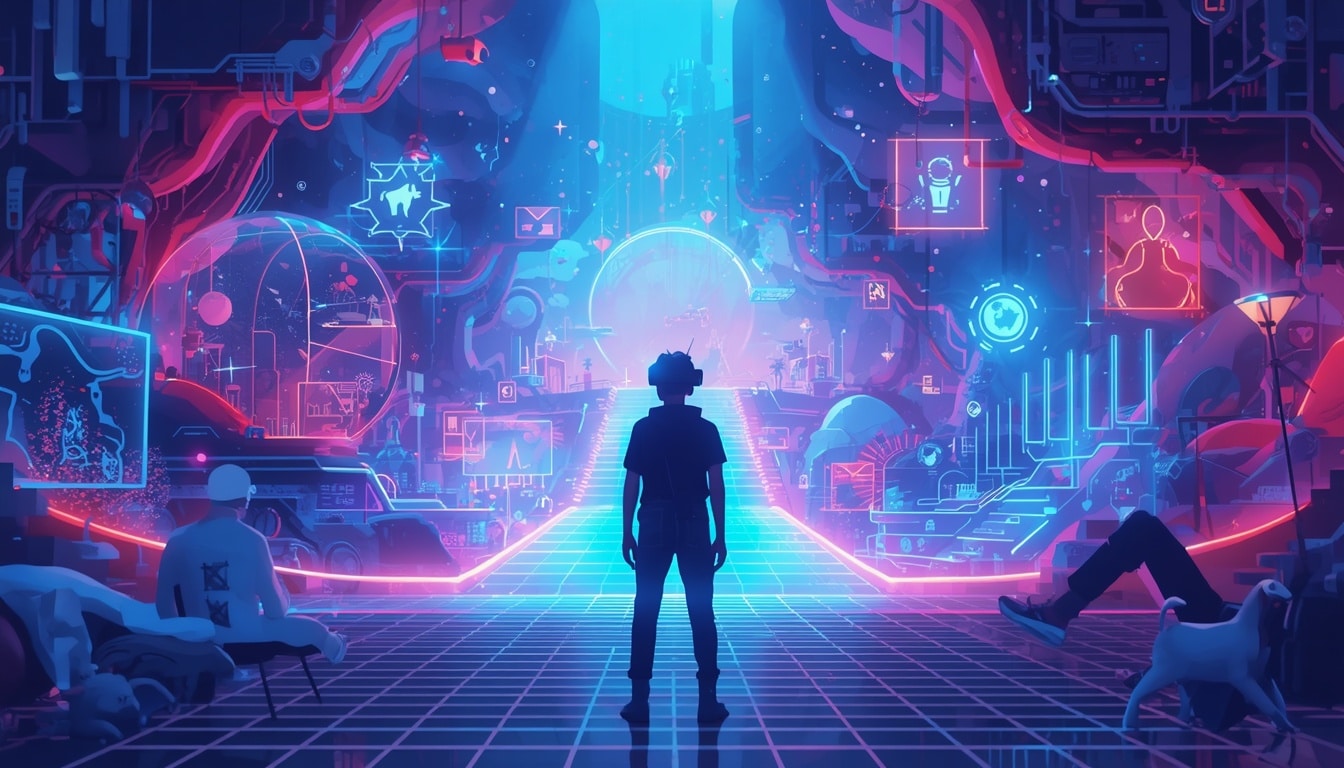
Getting started does not need to involve a large purchase or a complicated technical setup. The easiest approach is to explore a platform that matches your interests and offers a suitable level of access.
- Choose a device: Start with a smartphone, computer, gaming console, or VR headset, depending on the experience you want to try.
- Select a platform: Explore an accessible option such as Roblox, Minecraft, or a social virtual world that fits your interests.
- Create an avatar: Choose a digital identity and review the platform’s privacy settings before sharing personal information.
- Learn the controls: Spend a little time understanding movement, communication, navigation, and safety tools.
- Explore with a purpose: Visit a creative environment, join a community activity, attend a virtual event, or try a learning experience.
- Protect your account: Use a strong, unique password and enable additional security measures when available.
- Set spending limits: Enjoy free experiences first, and avoid buying digital assets simply because someone claims they will become valuable.
You can enter some metaverse-style environments without a VR headset. A regular screen may provide a less immersive experience, but it can still support social interaction, exploration, and creativity.
For beginners, curiosity is more useful than expensive equipment. Start small, learn what you enjoy, and decide later whether more advanced hardware would genuinely improve your experience.
What Is the Difference Between the Metaverse and the Traditional Internet?
The traditional internet already supports social networks, video calls, online games, digital shopping, and countless other services. The metaverse builds on some of those capabilities by emphasizing spatial interaction and a stronger sense of presence.
Consider an ordinary online meeting. Participants appear in separate video windows, share documents, and speak to one another.
In a virtual environment, they might instead appear as avatars around a shared table, manipulate a 3D model, or move to different areas of a virtual workspace.
The underlying purpose is similar: helping people communicate and accomplish tasks. The difference lies in the interface and the kind of participation it enables.
Not every activity benefits from becoming immersive. Reading a short message or checking a bank balance may remain easier on a conventional screen. The metaverse is likely to complement many internet services rather than replace everything people already use.
Who Owns the Metaverse?
There is no single owner of the entire metaverse because it is not one unified platform. Individual companies operate their own services, control their infrastructure, and establish the rules governing their environments.
Meta, Roblox Corporation, Epic Games, Microsoft, and other organizations have contributed technologies, platforms, or services relevant to immersive digital experiences. Independent developers and open-source communities also play important roles.
Some blockchain-based environments aim to distribute certain forms of control among users or token holders.
However, decentralized governance does not eliminate every form of central control, and it doesn’t automatically make a platform independent of infrastructure providers.
The broader vision of an interoperable metaverse would require different services to work together more effectively.
Organizations such as the Khronos Group have developed open standards relevant to graphics and immersive technologies, while the Metaverse Standards Forum has provided a venue for discussing interoperability across the industry.
Whether these efforts lead to genuinely connected virtual environments will depend on technical progress, business incentives, user demand, and agreement about shared standards.
What Is the Future of the Metaverse?
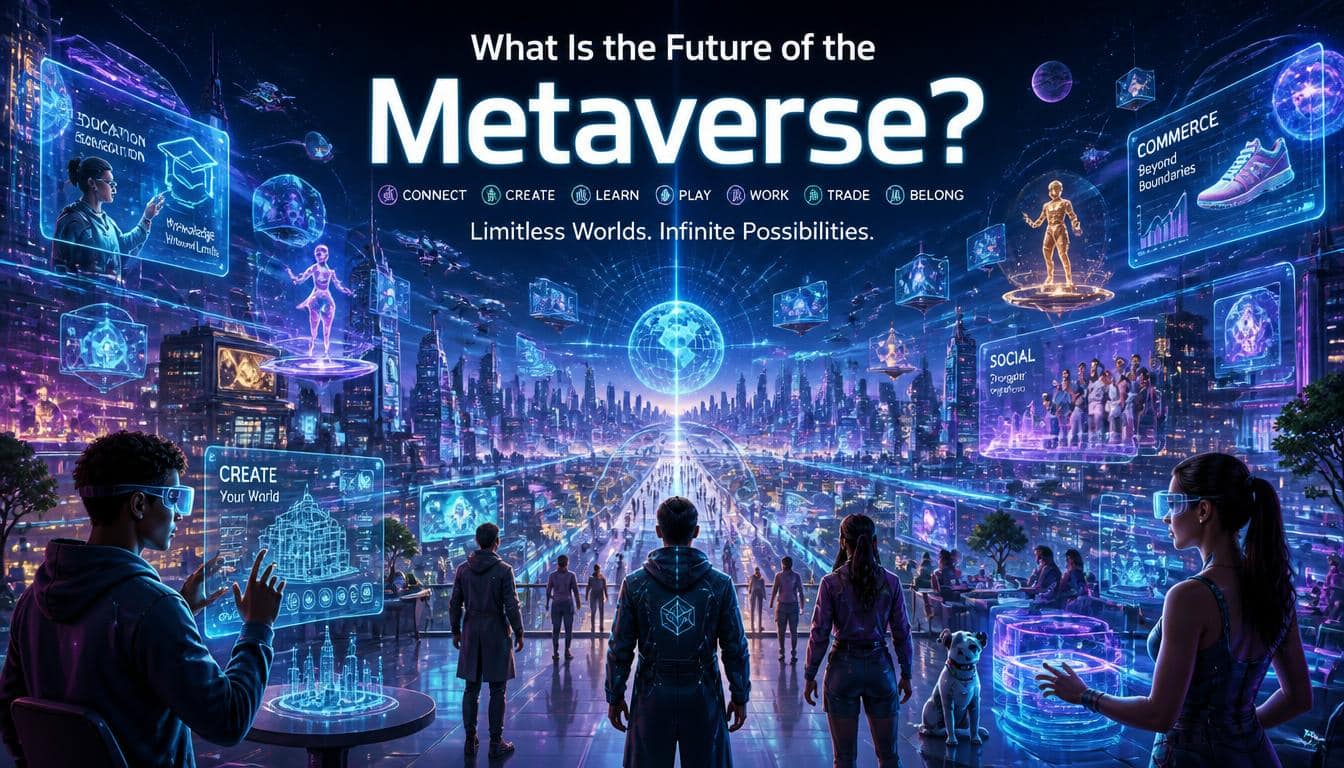
The future of the metaverse is uncertain, and that uncertainty is worth acknowledging. Some early predictions suggested that immersive digital environments would rapidly transform nearly every aspect of life.
Actual adoption has been more uneven, with some experiences finding dedicated communities while others struggle to attract regular users.
Progress will depend on several factors. Hardware needs to become comfortable and affordable, software needs to offer genuine value, and digital environments must become safer and easier to use.
Better accessibility, useful content, reliable infrastructure, and clearer rules around digital rights will also matter.
Artificial intelligence may help developers create responsive virtual characters, generate environments, translate conversations, and personalize learning experiences.
Improvements in spatial computing could make digital objects interact more naturally with physical surroundings.
At the same time, the future may not look like a single enormous virtual universe. It could consist of many specialized environments connected by selected services and standards, with people moving between ordinary screens, augmented reality, and immersive spaces as needed.
The most promising outcome isn’t necessarily a world where everyone spends every waking hour wearing a headset. It may be a digital ecosystem that helps people collaborate, learn, create, and connect when immersive experiences offer a clear advantage.
Frequently Asked Questions About the Metaverse
Is the metaverse real or just a concept?
The metaverse is both an existing collection of digital experiences and a broader vision for the future.
Platforms already offer virtual environments, avatars, social activities, and creator tools, but the fully connected, interoperable metaverse often imagined in popular discussions does not yet exist as one unified system.
Do I need a VR headset to enter the metaverse?
No. Many platforms can be accessed through computers, smartphones, and gaming consoles. A VR headset can provide a stronger sense of immersion in compatible experiences, but it isn’t essential for every virtual world.
Is Roblox part of the metaverse?
Roblox has several metaverse-like characteristics, including avatars, social interaction, user-generated experiences, and virtual economies. Whether someone calls it a metaverse platform depends on how broadly they define the term.
Is Fortnite a metaverse?
Fortnite offers social experiences, creative environments, and virtual events alongside its core gameplay.
These features make it a common example in discussions about the metaverse, although it remains one platform rather than a complete, interconnected digital universe.
Can people make money in the metaverse?
Yes, some creators and businesses earn money by developing virtual experiences, selling digital products, offering design services, or hosting events. However, income is not guaranteed, and digital assets or virtual businesses can lose value.
What is the difference between the metaverse and Web3?
The metaverse concerns immersive or shared digital environments, while Web3 generally refers to ideas about decentralized internet services and blockchain-based applications. They can overlap, but neither requires the other.
Is the metaverse safe for children?
Safety depends on the platform, its moderation systems, privacy settings, and the child’s age and circumstances.
Parents and guardians should review communication controls, spending permissions, age ratings, and reporting features, and discuss appropriate online behaviour with children.
Will the metaverse replace the internet?
There is no reliable basis for assuming that it will replace the internet entirely. More likely, immersive environments will become another way to use digital services, alongside websites, mobile apps, messaging, and video calls.
Read More: https://gracethemes.com/unpair-and-erase-your-apple-watch/
How to Make the Most of the Metaverse
The best way to understand the metaverse is to connect its technology to an actual human need.
Are you interested in creative expression, gaming, learning, remote collaboration, or simply seeing what a virtual world feels like? Starting with a clear purpose makes it easier to choose useful experiences without getting distracted by hype.
It also helps to separate practical possibilities from marketing promises. An environment that allows friends to create something together may offer genuine value, while an expensive digital asset marketed as a guaranteed investment deserves considerable scepticism.
Keep your privacy in mind, respect other participants, and remember that time spent online should support rather than overwhelm your everyday life. The technology is most useful when it expands your options, not when it becomes an obligation.
Conclusion: A New Way to Imagine Our Digital Lives
So, what is the metaverse? At its heart, it is a developing vision of digital life in which people can do more than look at information through a screen.
They can enter shared environments, meet through avatars, create interactive experiences, explore new forms of learning, and experiment with ways of working and communicating that were once difficult to imagine.
Its future will depend on more than advanced graphics or expensive headsets. Trust, accessibility, meaningful content, privacy, and genuine human connection will determine whether these virtual environments become useful parts of everyday life.
Perhaps the most exciting possibility is not that digital worlds will become indistinguishable from the physical world, but that they will offer experiences the physical world cannot easily provide.
A student may explore an imaginary planet, a designer may walk a client through an unbuilt home, and friends separated by oceans may gather in a place created entirely from imagination.
The metaverse is still evolving, and its final shape remains open. That leaves room for questions, experimentation, and better ideas.
Approach it with curiosity, a practical mindset, and a healthy dose of caution, and you may discover that the real story isn’t about escaping the world we know. It’s about finding thoughtful new ways to participate in it.
