

What Is CRC Networking? Understanding the Cyclic Redundancy Check
Imagine sending a photograph to a friend, joining a video call with your family, or downloading an important document just before a deadline.
You probably don’t stop to think about the thousands or millions of bits travelling between devices. You simply expect the information to arrive in the same condition it left.
Yet, the journey of digital data isn’t always perfectly smooth, and even a tiny change in a stream of bits can cause trouble. This is where CRC networking comes into the picture, working quietly behind the scenes to help computers recognize damaged data.
The term CRC stands for Cyclic Redundancy Check (CRC), a mathematical technique used to identify accidental changes in digital information.
It adds a calculated value to a block of data, allowing the receiving device to check whether the information appears to have been altered during transmission or storage. The idea sounds simple, but the mathematics behind it is surprisingly clever.
Understanding what CRC is in networking gives us a clearer picture of how digital communication systems maintain reliability.
From Ethernet cables to wireless communication, this error-detection technique helps devices decide whether a received frame or data block deserves to be trusted or should be rejected.
CRC doesn’t magically repair damaged information, nor can it promise that every possible error will be detected.
What it does is provide a powerful, efficient way of spotting many common transmission errors, which is rather important in a world where almost everything depends on digital communication.
What Is CRC Networking?
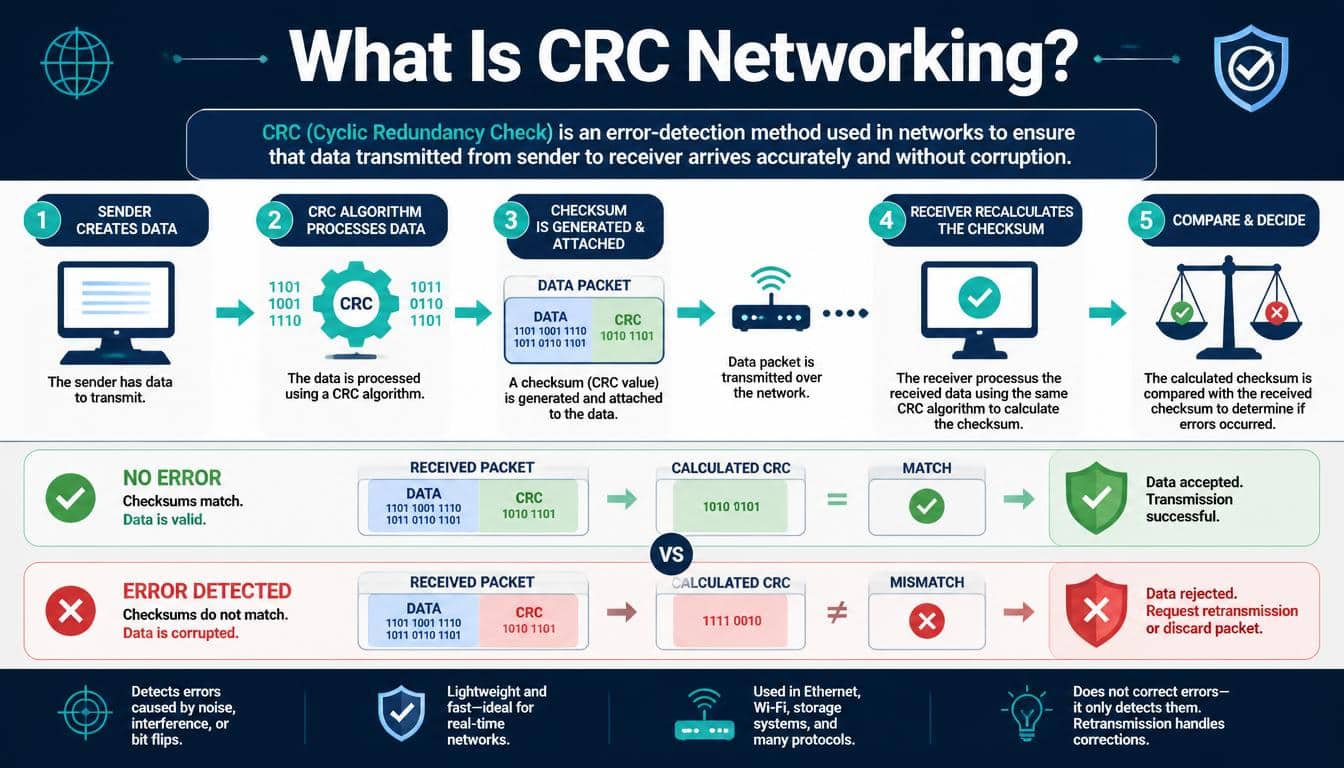
CRC networking refers to the use of a Cyclic Redundancy Check to detect errors in data exchanged between connected devices.
A sender calculates a special value from the data and attaches it to the transmitted frame or block. The receiving device then performs a corresponding calculation to verify whether the data passes the integrity check.
This calculated value is commonly called a CRC checksum, although technically it is a polynomial remainder rather than an ordinary arithmetic checksum.
That small distinction matters because CRC uses binary polynomial operations instead of simply adding numbers together.
Suppose a computer sends a file across an Ethernet network. Electrical interference, hardware problems, or other disturbances might change one or more bits while the information is travelling.
The receiving device can recalculate the CRC and compare the result with the expected value. If the check fails, the data is identified as corrupted.
The receiver can then discard the affected frame or rely on another mechanism to request retransmission, depending on the protocol and system design.
In everyday terms, CRC acts like a tamper-evident seal for digital information: it can reveal signs of trouble without necessarily telling you how to fix them.
Why Is CRC Important in Computer Networks?
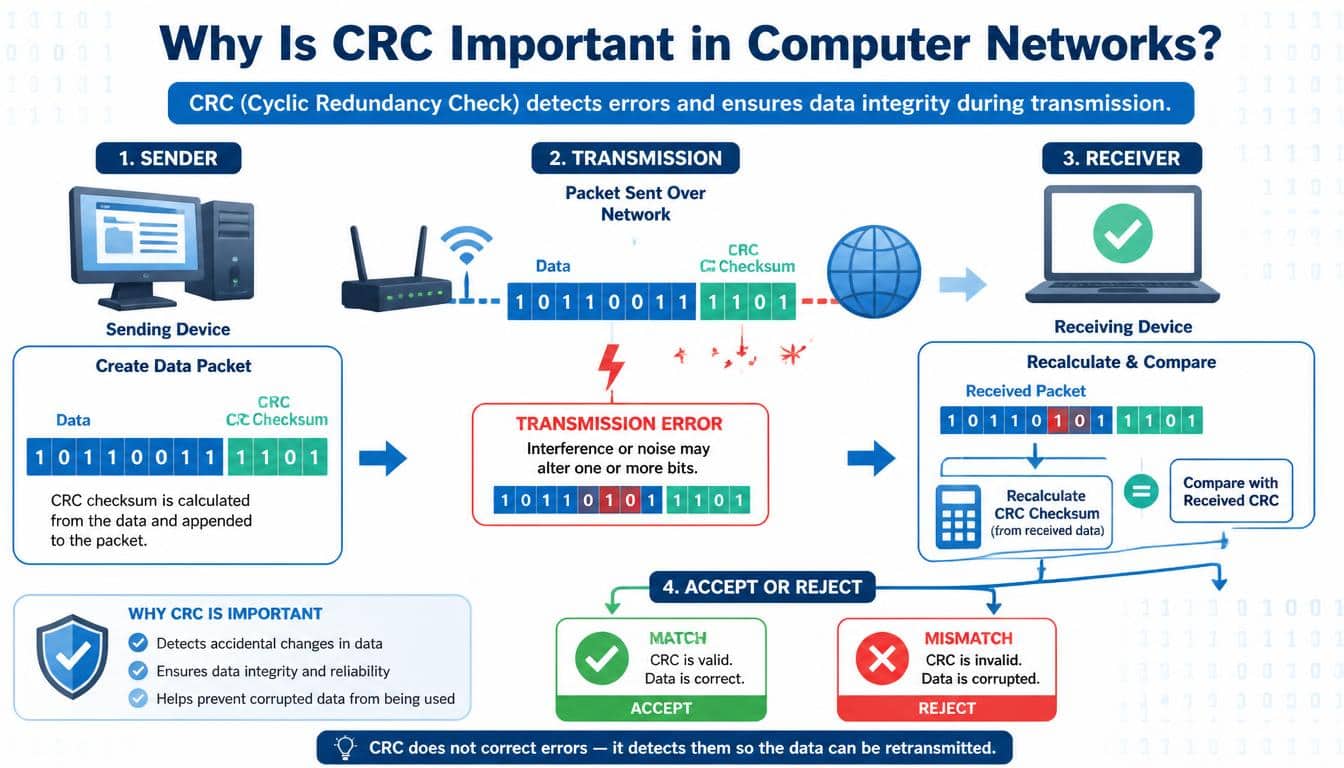
Digital networks carry information in the form of bits, and those bits must survive their journey through cables, switches, radios, and other communication equipment. Unfortunately, real-world transmission channels are not immune to interference or faults. A single corrupted bit might affect a file, a network packet, or a message in ways that are difficult to notice immediately.
CRC error detection helps identify such problems before corrupted data is treated as valid. This makes it an important component of network reliability, especially where devices exchange enormous quantities of information every second.
Consider a busy office where dozens of computers exchange files through an Ethernet switch. Without suitable error-detection mechanisms, damaged frames might pass unnoticed at the link layer.
CRC provides a practical check that helps the receiving hardware reject frames that fail the expected integrity test.
Its value extends beyond office networks. Wireless devices, embedded controllers, storage systems, industrial equipment, and communication hardware can all benefit from error detection.
CRC is popular because it offers strong detection capabilities for many common error patterns without requiring a huge amount of additional data or complicated processing.
How Does CRC Work? A Step-by-Step Explanation
The central idea behind how CRC works is to perform a calculation on a message using a predefined binary polynomial.
The sender and receiver must agree on the same CRC rules, including the polynomial and relevant calculation parameters. Otherwise, two perfectly functioning devices may produce different results, which is a compatibility problem nobody wants.
The process generally follows these steps.
- Prepare the data: The sender begins with the message, frame, or data block that needs protection.
- Calculate the CRC: A defined algorithm processes the bits using XOR operations and polynomial division.
- Attach the result: The calculated CRC value is placed in a designated field, such as the Frame Check Sequence in an Ethernet frame.
- Transmit the data: The message and its associated CRC travel through the communication channel.
- Verify the received information: The receiving device recalculates or checks the CRC using the protocol’s prescribed method.
- Accept or reject the frame: If the check succeeds, the frame passes this particular integrity test. If it fails, the frame is treated as corrupted.
Imagine mailing a parcel with a uniquely calculated seal number that can be verified at the destination. The number doesn’t stop the parcel from being damaged, but it gives the recipient a way to detect certain kinds of unwanted changes. CRC performs a similar role, only with binary mathematics instead of physical seals.
One important detail is that a successful CRC check does not prove that the information is authentic or completely error-free. It indicates that the data passed a particular error-detection test.
The Mathematics Behind the CRC Algorithm
The CRC algorithm may look intimidating at first because it involves polynomial arithmetic, binary division, and bitwise operations. Fortunately, the fundamental idea is easier to understand than the terminology suggests.
In ordinary decimal arithmetic, dividing one number by another produces a quotient and a remainder. CRC also uses division, but it operates on binary polynomials, where the coefficients are either zero or one.
For example, the binary sequence 1101 can represent the polynomial:
x³ + x² + 1
Each bit corresponds to a polynomial coefficient. A one indicates that a particular power of x is present, while a zero means it is absent.
CRC uses modulo 2 arithmetic, in which addition and subtraction are performed without carrying or borrowing. The key operation is XOR (Exclusive OR). When two bits differ, XOR produces 1; when they are the same, it produces 0.
| First bit | Second bit | XOR result |
| 0 | 0 | 0 |
| 0 | 1 | 1 |
| 1 | 0 | 1 |
| 1 | 1 | 0 |
This carry-free arithmetic makes binary polynomial division particularly convenient for digital hardware. A CRC calculation repeatedly applies XOR operations according to the chosen generator polynomial until it obtains the required remainder.
The remainder becomes the basis of the CRC value. Although the calculation is mathematical, the actual implementation can be very fast, especially when supported by dedicated processor instructions or networking hardware.
What Is a CRC Generator Polynomial?
A CRC polynomial, also known as a generator polynomial, defines the mathematical rules used to calculate the CRC remainder. Its degree determines the nominal width of the CRC, while its particular coefficients influence which error patterns the algorithm can detect.
For instance, a degree-16 generator polynomial produces a 16-bit CRC, while a degree-32 polynomial produces a 32-bit CRC. The choice isn’t simply about making the number longer; the polynomial itself also matters.
Different protocols and applications use different CRC definitions because they have different requirements. A polynomial that performs well for one message-length range or communication system may not be the best choice for another.
Researchers, including Philip Koopman and his collaborators, have studied CRC polynomial selection and error-detection performance. Such work helps engineers choose polynomials with useful detection properties for particular data lengths and error models.
A well-selected polynomial can detect all single-bit errors and many multiple-bit error patterns, along with specified classes of burst errors.
However, the exact guarantees depend on the polynomial, message length, and CRC configuration. Choosing a suitable polynomial is therefore an engineering decision rather than a matter of picking whichever number looks impressive.
CRC Calculation Example: Understanding the Remainder
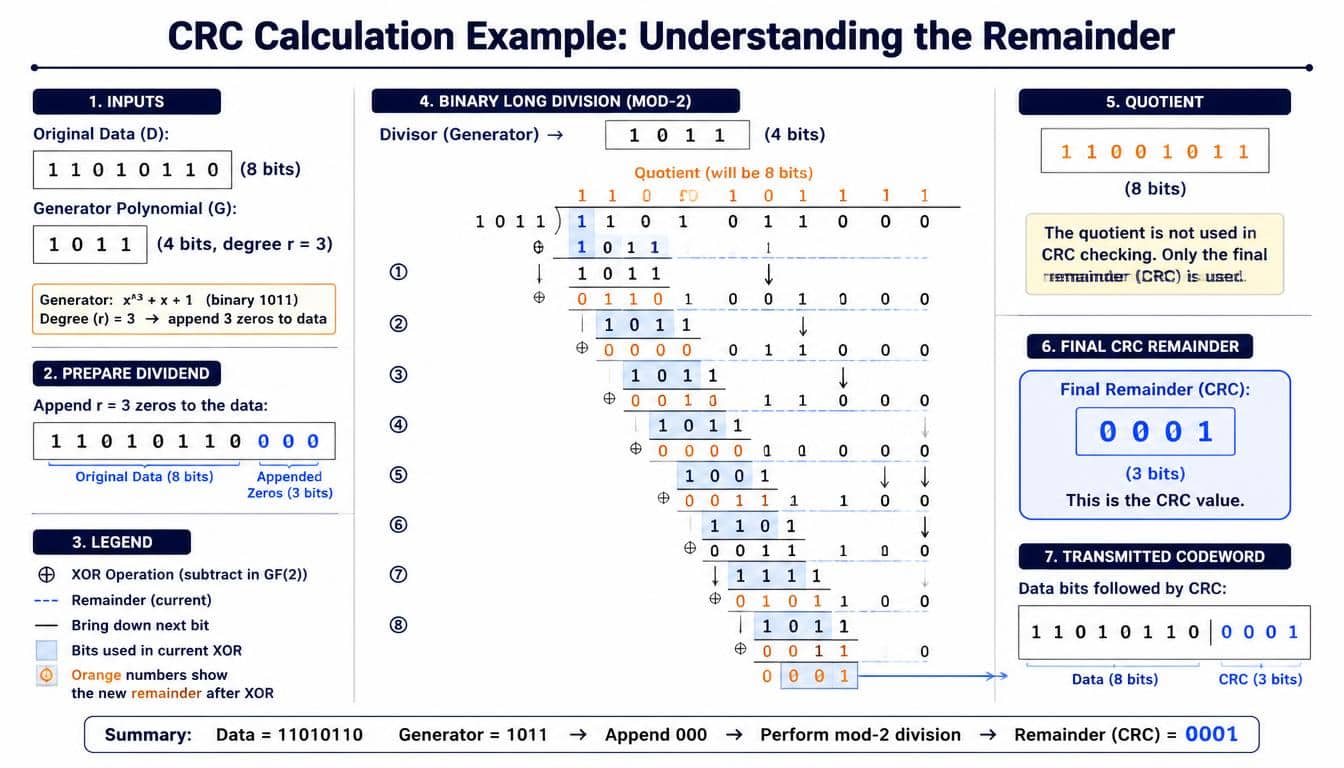
A small binary example can make CRC calculation less mysterious. Suppose the message bits are 1101 and the generator polynomial is represented by the bit sequence 1011, which has degree three.
For a simplified CRC example, the sender appends three zeros to the message because the generator has degree three. The resulting dividend is:
1101000
The sender then performs modulo 2 binary division using 1011. Whenever the leading bit of the current segment is 1, the generator is aligned with that segment and XORed against it. Unlike ordinary division, this process doesn’t involve borrowing or carrying.
Continuing the XOR-based division until no further operation is possible produces the remainder:
001
The three-bit remainder is appended to the original message, giving the codeword:
1101001
This example demonstrates the basic mathematical principle rather than every detail of a production CRC implementation. Real protocols may specify an initial register value, reflected input or output bits, a final XOR value, and particular transmission conventions.
Those parameters are essential. Two algorithms may use the same generator polynomial but still calculate different CRC values because their initialization, reflection, or finalization rules differ.
CRC in Networking: Ethernet, Wi-Fi, and TCP/IP
The practical value of CRC in networking becomes clearer when we look at the communication technologies that use it.
Ethernet and Frame Validation
Ethernet uses a CRC-based Frame Check Sequence to detect corruption in transmitted frames. In commonly used Ethernet formats, the FCS is 32 bits long and is calculated using a standardized CRC-32 algorithm.
When a frame arrives, receiving hardware checks its integrity. Frames that fail the FCS check are generally discarded rather than passed onward as valid Ethernet frames.
This process is especially useful in busy local area networks, where many devices exchange data continuously. The CRC check is typically handled by network interface hardware, so users don’t need to perform the calculation themselves.
Wi-Fi and Wireless Communication
Wireless communication faces challenges that wired networks may avoid, including radio interference, fading signals, and collisions. Wi-Fi frame formats use CRC-based integrity checking to help identify corrupted frames.
When a frame fails the applicable integrity check, the receiver can reject it. Depending on the Wi-Fi exchange and protocol conditions, retransmission mechanisms may help recover the lost information.
CRC doesn’t eliminate wireless interference. Instead, it helps the system distinguish frames that pass the integrity check from those that appear damaged, which is an essential part of dependable wireless communication.
TCP/IP and Network Reliability
It is useful to distinguish CRC from the checksums used by other networking protocols. IPv4 includes a checksum for its header, while TCP uses a checksum covering its header, data, and a pseudo-header derived from relevant IP-layer information.
These checksums use one’s-complement arithmetic, not the same polynomial-division process used by CRC. The TCP checksum and an Ethernet CRC therefore serve related but different roles.
TCP also includes mechanisms such as acknowledgments, sequence numbers, and retransmissions to support reliable delivery. CRC at the link layer and checksums at other layers complement one another, creating several opportunities to detect transmission problems.
The result is a layered approach to network error detection, with each mechanism designed for a particular part of the communication process.
CRC-16, CRC-32, and Other CRC Types
CRC algorithms are available in several widths, each designed around a particular polynomial and set of parameters. The number in the name generally indicates the width of the resulting CRC value.
- CRC-8: Produces an 8-bit result and is often suitable for short messages, small embedded systems, and applications with modest integrity-checking needs.
- CRC-16: Produces a 16-bit result and is used in various communication protocols and industrial systems. CCITT-16 is a familiar historical name associated with certain 16-bit CRC definitions, although exact variants must be distinguished by their parameters.
- CRC-32: Produces a 32-bit result and is widely associated with Ethernet frame checking and various file formats and data-processing applications.
A wider CRC doesn’t automatically make every implementation superior. The best option depends on the message length, expected error patterns, performance requirements, and protocol compatibility.
Engineers should also remember that CRC names can be ambiguous. A complete definition may need the polynomial, initial value, input and output reflection settings,
final XOR value, and check value for a standard test message. Without these details, two implementations labelled CRC-16 may not agree.
CRC vs Checksum: What Is the Difference?
CRC and checksum methods both help detect accidental changes in data, but their calculations differ.
A traditional checksum often adds groups of data values together and stores a result derived from that sum. Some protocols use one’s-complement arithmetic, while others use different methods. A CRC instead computes a polynomial remainder using binary operations.
| Feature | CRC | Traditional checksum |
| Basic calculation | Polynomial division over binary coefficients | Often addition or another arithmetic operation |
| Main operations | XOR and bitwise processing | Commonly addition and complement operations |
| Error detection | Strong for many structured bit-error patterns | Depends on the checksum algorithm |
| Common examples | Ethernet FCS, CRC-protected data blocks | IPv4 header checksum, TCP checksum |
| Error correction | Does not normally correct errors | Does not normally correct errors |
Neither approach should be confused with a cryptographic hash or message authentication code. CRC is designed primarily for accidental corruption, not for resisting deliberate manipulation.
For example, an attacker who can alter a message may also be able to calculate a matching CRC. A cryptographic integrity mechanism is more appropriate when protection against malicious changes is required.
CRC vs Parity Checking and Error-Correcting Codes
Parity checking is a simpler error-detection technique that adds a bit chosen to make the number of ones even or odd. It can detect any odd number of bit flips within the protected group, but it misses errors that change an even number of bits.
CRC generally provides stronger detection capabilities for structured error patterns, including many burst errors. This makes it particularly useful for network frames and longer data blocks.
An error-correcting code (ECC) has a different purpose. Depending on its design, an ECC can detect errors and correct some of them without requiring the sender to retransmit the entire data block.
CRC usually detects corruption but doesn’t identify the original message with enough information to repair it. If a CRC-protected network frame is damaged, recovery may depend on retransmission, redundancy elsewhere in the system, or another error-recovery method.
The distinction is important: error detection and error correction are not the same thing. CRC helps identify a problem; a separate mechanism must decide what to do next.
How Does CRC Detect Burst Errors?
A burst error occurs when several bits within a region of transmitted data are affected. The bits don’t all have to change from zero to one; some may flip in the opposite direction, and other bits between the changed positions may remain untouched.
Burst errors can arise from temporary interference, electrical disturbances, or problems affecting a portion of a communication signal. CRC algorithms are particularly useful because suitable generator polynomials provide defined guarantees for detecting bursts of particular lengths.
For example, a properly selected degree-32 CRC detects every burst error of length 32 bits or less, provided the burst is defined by the usual span from its first corrupted bit to its last corrupted bit.
Longer burst errors can also be detected, but there is no universal guarantee that every such pattern will be caught.
For a well-designed CRC, an undetected random error is often described using a probability near 2−n, where n is the CRC width, under suitable assumptions about error patterns. For a 32-bit CRC, this is approximately one in 4.3 billion.
That figure isn’t a promise for every real-world failure scenario. Error patterns may not be uniformly random, and CRC performance depends on the polynomial and message length. Still, it illustrates why CRC is valuable for detecting accidental data corruption.
CRC Implementation in Software and Hardware
A CRC can be calculated in software, in dedicated hardware, or through a combination of both. The appropriate method depends on how much data must be processed, the available computing resources, and the speed required.
Bitwise CRC Implementation
A straightforward CRC implementation processes the message one bit at a time. The algorithm updates a register using shifts and XOR operations, following the chosen polynomial and processing convention.
This approach is relatively easy to understand and can be useful for educational examples, small embedded systems, and reference implementations.
Its main drawback is that processing each bit individually may be slower than alternatives when handling large data streams.
Table-Driven CRC Calculation
A CRC lookup table can make computation much faster by storing the result of common byte-level operations. Rather than repeatedly performing every bitwise step, the program uses a byte of input data to select a precomputed value and update the CRC register.
A table-driven implementation can process a byte at a time, and more advanced methods can handle multiple bytes or machine words per iteration. These techniques are common when high throughput matters.
The trade-off is that lookup tables require additional memory. A smaller table may suit an embedded controller with limited resources, while a larger table can be useful on a general-purpose computer.
Hardware CRC Processing
Dedicated CRC circuitry and processor instructions can accelerate calculation without requiring the CPU to execute every operation separately.
Network interface controllers commonly perform Ethernet FCS processing in hardware, allowing the computer to exchange frames efficiently.
Digital signal processors and embedded controllers may also offer hardware support for CRC calculations. However, the supported polynomial or instruction behavior must match the intended algorithm, or additional processing may be necessary.
The goal is not simply to make the calculation fast. A correct, interoperable implementation is more important than an impressive benchmark, because a fast CRC that disagrees with the receiving device is of little practical use.
Common CRC Implementation Mistakes
Even though CRC is mathematically well defined, software implementations can fail when developers overlook small configuration details. The problem often isn’t the fundamental polynomial arithmetic but the way an algorithm interprets and processes the data.
Common mistakes include:
- Using the wrong polynomial: Both devices must use compatible CRC definitions.
- Ignoring initialization values: The starting register value can change the final result.
- Mixing up bit reflection: MSB-first and LSB-first processing conventions must be handled correctly.
- Confusing bit order with byte order: Bit reflection within a byte and the order in which bytes are transmitted are separate issues.
- Applying the final XOR incorrectly: Some CRC definitions complement or otherwise transform the final register value.
- Including the wrong bytes: The protocol specifies which parts of a frame are covered by the calculation.
- Testing only one message: A single successful example doesn’t prove that an implementation is correct.
Developers can avoid many of these problems by using a well-documented CRC parameter set, checking standard test vectors, and testing messages containing zero bytes, long sequences, and varied bit patterns.
For protocol development, interoperability testing is just as important as mathematical correctness. Two implementations should produce the expected result for the same input under the same parameter settings.
Does CRC Prevent Data Corruption?
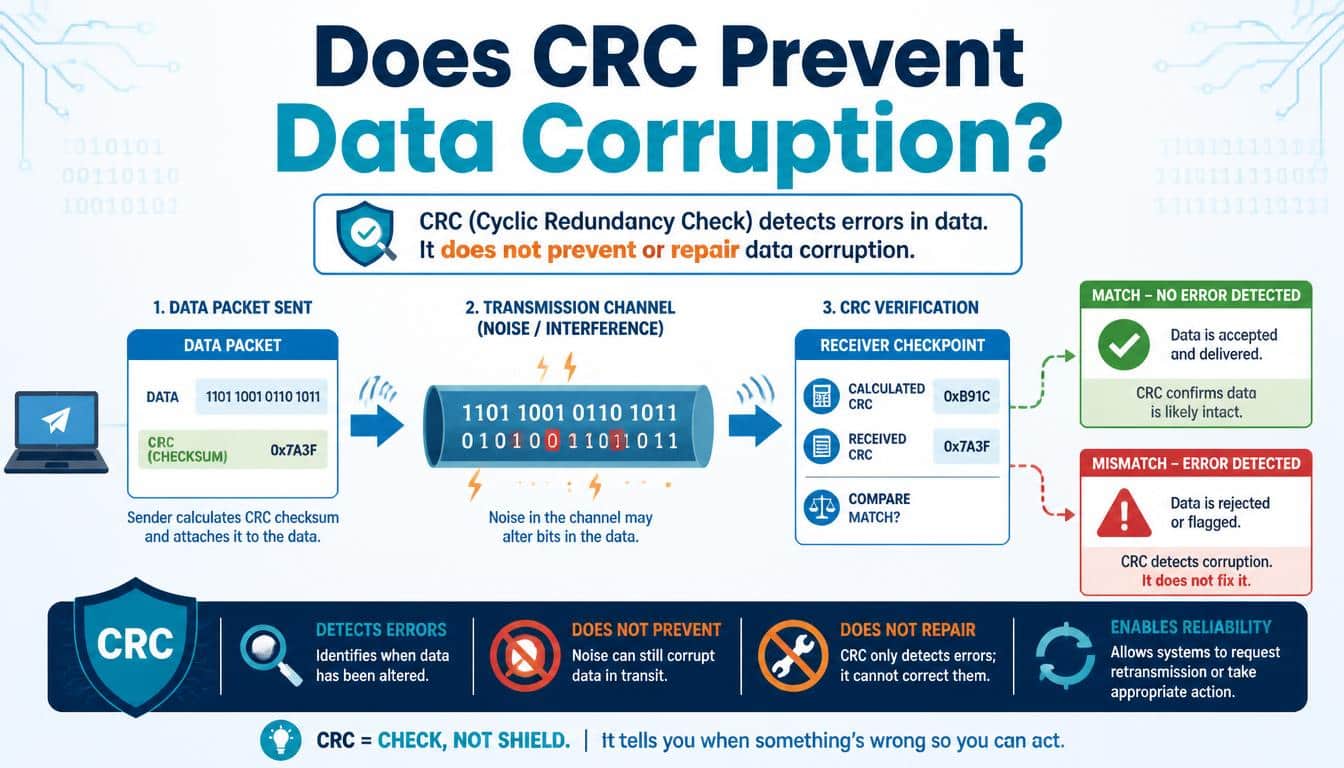
A common misconception is that CRC prevents information from being damaged. In reality, CRC is primarily an error-detecting code, not a preventive shield.
A communication channel can still corrupt bits, and a CRC cannot physically stop interference or repair the affected data. Its job is to identify many cases where the received information does not match the expected integrity calculation.
Other mechanisms may help prevent errors from reaching an application. For instance, a network interface can discard a frame with a failed FCS, while a higher-level protocol may arrange for the missing data to be retransmitted.
Data integrity is therefore a combined effort involving suitable transmission hardware, error detection, protocol design, and recovery procedures. CRC is one important component of that system, rather than a complete solution by itself.
It also offers no meaningful guarantee of authenticity. If the goal is to prevent unauthorized modification, the system needs appropriate cryptographic protection in addition to ordinary error detection.
Frequently Asked Questions About CRC Networking
What does CRC stand for in networking?
CRC stands for Cyclic Redundancy Check. It is an error-detection technique that calculates a binary remainder from data so the receiving system can check for many types of accidental corruption.
Why is CRC used in Ethernet?
Ethernet uses a CRC-based Frame Check Sequence to detect damaged frames. Receiving hardware checks the frame’s integrity and typically discards frames that fail the check.
Is CRC better than a checksum?
CRC generally detects many structured bit errors more effectively than simple additive checksums, particularly in communication frames. However, the best method depends on the protocol and the types of errors it needs to detect.
Can CRC detect every transmission error?
No. CRC detects many error patterns, but some changes can produce the same CRC value. The chance of an undetected error depends on the polynomial, message length, and error pattern.
What is the difference between CRC-16 and CRC-32?
CRC-16 produces a 16-bit result, whereas CRC-32 produces a 32-bit result. Their detection performance also depends on the specific generator polynomial and parameters, not just the width.
Why does CRC use XOR operations?
XOR implements addition and subtraction modulo 2, the basic arithmetic used in CRC polynomial division. It allows efficient calculation using ordinary digital logic and bitwise instructions.
Is CRC used in TCP?
TCP uses a checksum based on one’s-complement arithmetic rather than a CRC. CRC may be used at lower network layers, such as Ethernet, while TCP performs its own end-to-end transport-layer integrity check.
Can CRC correct damaged data?
CRC normally identifies corruption rather than correcting it. Recovery requires another method, such as retransmission or an appropriate error-correcting code.
What happens when a CRC check fails?
The receiving system generally marks the data as invalid and may discard it. Depending on the protocol, the sender might retransmit the data or a higher-level mechanism may recover the missing information.
What is a crc error
A CRC error occurs when the Cyclic Redundancy Check detects that data has been corrupted or changed during transmission or storage. It indicates a data integrity problem, but it does not identify or repair the error.
Read More: https://gracethemes.com/how-certificate-chains-work/
How to Choose the Right CRC for a Project
Selecting a CRC begins with understanding the system’s requirements. A developer working with an established network protocol should use the CRC definition specified by that protocol instead of inventing a new one.
For a new design, consider the maximum message length, expected error patterns, acceptable residual error risk, processing speed, memory constraints, and hardware support. The polynomial should be selected according to its documented error-detection properties for the intended message sizes.
It is also wise to consult established engineering references. Ross Williams’s work on CRC algorithm parameterization and implementation is a useful resource for understanding the details that distinguish CRC variants. Polynomial-selection research by Koopman and Chakravarty can also help explain why the choice of generator polynomial matters.
Before deployment, verify the implementation against known test vectors and confirm that the sender and receiver agree on all relevant parameters. This practical step saves time, particularly when integrating devices from different manufacturers or combining software with dedicated hardware.
Conclusion: A Small Calculation With an Important Job
CRC networking is a good example of how an elegant mathematical idea can solve a very practical problem.
By calculating a remainder from a stream of bits, communication systems gain a reliable way to identify many accidental changes that might otherwise go unnoticed.
From Ethernet frame validation and Wi-Fi integrity checks to embedded devices and data-storage applications, the Cyclic Redundancy Check helps keep digital information dependable.
Its strength comes from the careful combination of polynomial mathematics, XOR operations, efficient implementation, and well-defined protocol rules.
Still, CRC works best when understood for what it truly is. It detects many errors but does not normally correct them, and it cannot replace cryptographic protection when security and authenticity are required.
Combined with suitable transmission protocols and recovery mechanisms, however, it provides a powerful foundation for dependable digital communication.
The next time you send a message, transfer a file, or connect to a wireless network, remember that reliability often depends on small operations happening quietly in the background.
CRC may never appear on your screen, but its contribution to keeping data intact is worth understanding.
A few carefully calculated bits can make a surprisingly big difference in the way our connected world communicates.
