

What Is an Algorithm?
Imagine giving someone a recipe without explaining what ingredients to use, when to add them, or how long to cook everything.
They might understand what you want, but getting the same delicious result every time would be pretty difficult. Computers face a similar challenge.
They can perform millions of operations in seconds, but they need clear instructions to know what to do and how to do it.
This is where an algorithm enters the picture. Behind almost every digital activity, from searching for information on Google to watching recommended videos, there is an algorithm quietly working in the background.
It takes information, follows a defined process, and produces a result. Sometimes the result is a simple calculation, while in other situations it can be a complicated prediction based on enormous amounts of data.
Understanding algorithms is not just for programmers or computer scientists. They influence business decisions, social media experiences, banking systems, online shopping, healthcare technology, and even the way artificial intelligence understands information.
So, what is an algorithm, how does it work, and why has it become such an important part of modern technology? Let’s explore the concept in a simple, practical, and meaningful way.
What Is an Algorithm? A Simple and Practical Definition
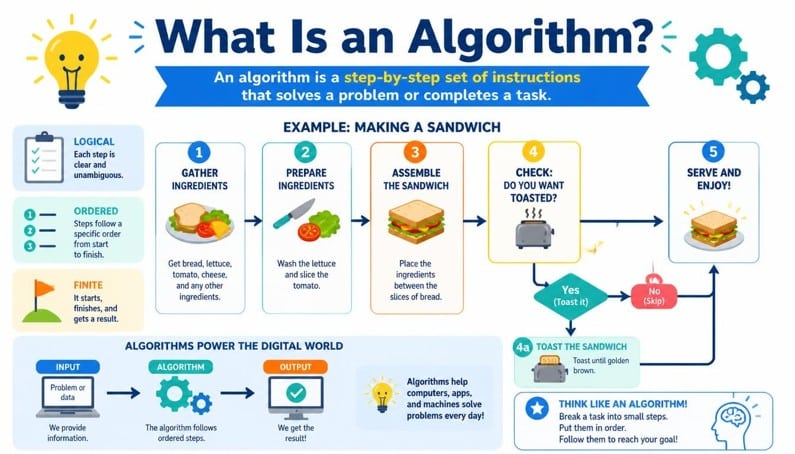
An algorithm is a clearly defined sequence of step-by-step instructions designed to solve a particular problem or complete a specific task. These instructions explain what needs to happen, in what order, and under which conditions.
In simple words, an algorithm is a plan that tells a person or computer how to reach a desired result.
Think about finding a particular name in a telephone directory. You could start reading every entry from the first page, but that would take quite a while. Alternatively, you could open the directory somewhere in the middle, check whether the name comes before or after the displayed entry, and continue narrowing your search.
That organised approach is an algorithmic way of solving a problem.
In computing, algorithms provide the logical foundation for software applications. A computer follows instructions written in a programming language and performs the operations needed to achieve the intended outcome.
However, an algorithm is not necessarily a piece of computer code. It can exist as a written procedure, a mathematical formula, a flowchart, or even a series of instructions followed by a person.
For example, making a cup of tea involves a simple algorithm:
- Gather water, tea leaves, milk, and sugar.
- Heat the water until it boils.
- Add tea leaves and allow them to brew.
- Add milk and sugar according to preference.
- Strain the tea and serve it.
Each action follows a logical sequence. Changing the order could change the result, which is exactly why instructions matter.
Why Are Algorithms Important in Everyday Computing?
Algorithms are everywhere, although most people rarely notice them. Whenever you open an application, search for something online, or transfer money through a banking service, different algorithms may be handling the work behind the screen.
Their importance comes from their ability to turn complicated tasks into manageable operations.
Consider a few everyday examples.
- Search engines: Algorithms examine billions of web pages and organise relevant results according to a search query.
- Social media: Recommendation algorithms analyse activity and help determine which posts, videos, or accounts appear in a feed.
- Online shopping: Shopping platforms use algorithms to recommend products based on browsing behaviour, preferences, and previous purchases.
- Navigation applications: Route-finding algorithms evaluate available roads and help identify suitable journeys.
- Banking systems: Algorithms help process transactions, detect unusual activity, and identify potentially fraudulent behaviour.
- Healthcare technology: Certain algorithms assist medical professionals by analysing images, organising information, and supporting clinical decisions.
What makes these examples interesting is that they solve very different problems using the same fundamental idea: follow a logical process to transform information into a useful result.
Without algorithms, modern computer processing would be far less organised, and many digital services would struggle to operate efficiently.
How Do Algorithms Work? Understanding the Basic Process
An algorithm works by accepting information, processing it according to predefined instructions, and producing an outcome. This relationship is often explained through three basic elements: input, processing, and output.
Although the actual operations can become extremely complicated, this basic structure remains important.
1. Input: Providing the Necessary Information
The first stage involves collecting or receiving the information needed to solve a problem.
An input can be a number, a word, an image, a location, a customer record, or an entire collection of information.
For example, imagine a calculator application. When someone enters 15 and 25 and selects addition, these numbers become the input data.
Different algorithms require different kinds of input. A weather forecasting algorithm may receive temperature readings, atmospheric pressure, wind speed, and historical weather information.
The quality of the input matters too. Incorrect, incomplete, or poorly organised information can lead to unreliable results. It is a small detail that makes a surprisingly big difference.
2. Processing: Following the Instructions
Once the input is available, the algorithm begins performing its defined operations.
This stage involves applying logical rules, mathematical calculations, comparisons, or other procedures to the supplied information.
For example, a calculator algorithm receiving 15 and 25 for addition performs the required mathematical operation:
15 + 25 = 40
More advanced algorithms might compare thousands of records, identify relationships, remove unnecessary information, or perform multiple calculations before reaching a result.
The computer executes these instructions through its processor, following the logical sequence provided by the software.
3. Output: Producing the Final Result
The final stage produces an output, which represents the result of the algorithm’s operations.
In the calculator example, the output is 40.
However, an output does not always have to be a number. It could be:
- A sorted list of names.
- A decision to approve or reject a transaction.
- A recommended product.
- A predicted weather condition.
- A route displayed on a digital map.
- A warning about suspicious account activity.
The output depends on the original problem and the instructions used to solve it.
A Simple Example of Input, Processing, and Output
Imagine an algorithm designed to determine whether a student has passed an examination.
| Stage | Description |
| Input | Student’s examination marks |
| Processing | Compare marks with the passing score |
| Decision | Determine whether marks are at least 50 |
| Output | Pass or fail |
The algorithm follows a straightforward decision-making process. If the student receives 65 marks, the output is Pass. If the student receives 42 marks, the output is Fail.
This is a simple example of input and output processing, but the same underlying structure appears in much more advanced computer systems.
Different Types of Algorithms and Their Uses
Not every algorithm solves a problem in the same way. Some are designed to arrange information, others search for particular records, and some help computers make decisions based on complex data.
Understanding the major types of algorithms makes it easier to recognise how computational problem-solving works.
1. Sorting Algorithms
Sorting algorithms organise information according to a particular order.
For example, an application might arrange a list of names alphabetically, display products from lowest to highest price, or organise examination marks from highest to lowest.
Popular sorting algorithms include:
- Bubble Sort.
- Selection Sort.
- Insertion Sort.
- Merge Sort.
- Quick Sort.
Consider the following unsorted numbers:
18, 5, 30, 12, 2
A sorting algorithm can rearrange them into:
2, 5, 12, 18, 30
The result is a sorted list that is easier to understand, search, and manage.
Different sorting techniques have different performance characteristics. Some are useful for small collections, while others are better suited to larger datasets.
2. Searching Algorithms
Searching algorithms help locate specific information within a collection of data.
Imagine looking for a particular book in a library. Instead of examining every book randomly, you could follow an organised procedure to narrow down the possibilities.
Two common examples are:
- Linear Search: Examines items one after another until the desired item is found.
- Binary Search: Repeatedly divides a sorted collection into smaller sections to locate an item more efficiently.
Binary Search is particularly useful when working with sorted data because it can eliminate large portions of the search area at each step.
3. Recursive Algorithms
A recursive algorithm solves a problem by calling itself to handle smaller versions of the same problem.
This may sound a little unusual at first, but the concept is quite practical.
For example, calculating a factorial involves multiplying a number by the factorial of the number immediately below it.
The factorial of 5 is:
5 × 4 × 3 × 2 × 1 = 120
A recursive approach expresses this calculation using a smaller version of the original problem until it reaches a simple stopping condition.
Recursive algorithms are commonly used in tree structures, mathematical calculations, and certain searching procedures.
4. Greedy Algorithms
Greedy algorithms make a choice that appears best at the current stage of a problem.
They do not necessarily examine every possible combination before making a decision. Instead, they repeatedly select the most promising available option according to a defined rule.
For example, a route-planning problem might use a greedy strategy to select the closest available next location.
These methods can produce excellent results for certain problems, although a locally attractive decision does not always produce the best overall solution.
5. Dynamic Programming Algorithms
Dynamic programming solves complicated problems by breaking them into smaller overlapping problems and storing previously calculated results.
This avoids repeating the same calculations again and again.
A classic example is calculating Fibonacci numbers. Instead of repeatedly calculating earlier values, an algorithm can store them and reuse them whenever necessary.
Dynamic programming is useful in scheduling, resource allocation, optimisation, and many mathematical problems.
What Is the Difference Between an Algorithm and a Program?
People sometimes use the words algorithm and program as if they mean exactly the same thing. They are related, but there is an important difference.
An algorithm describes the logical procedure for solving a problem, whereas a program is an implementation of instructions that a computer can execute.
Think of building a house.
The architectural plan explains how the house should be constructed. The builders then use materials, equipment, and practical techniques to turn that plan into a real structure.
In a similar way, an algorithm represents the solution strategy, while a computer program translates that strategy into executable instructions.
Here are some important differences:
| Algorithm | Program |
| Describes a solution method | Implements instructions in code |
| Can be written in plain language | Written using programming languages |
| Focuses on logic and sequence | Focuses on executable operations |
| Does not require a specific language | Requires an appropriate programming environment |
| Can be represented through flowcharts or pseudocode | Can be compiled or interpreted for execution |
For example, an algorithm for calculating the average of three numbers might say:
- Accept three numbers.
- Add all three numbers.
- Divide the total by three.
- Display the answer.
A programmer can implement this procedure using Python, Java, C++, or another programming language.
The underlying algorithm remains essentially the same, even when the programming language changes.
How Algorithms Help Solve Real-World Problems
The real value of algorithms becomes clearer when we move beyond simple mathematical examples.
In practical situations, they help organisations process information, automate repetitive activities, improve efficiency, and make informed decisions.
Business Applications
Businesses handle enormous amounts of information every day. Managing customer records, inventory, payments, and sales manually can become expensive and time-consuming.
Algorithms help simplify these activities.
For instance, an online retailer can use algorithms to analyse customer purchases, estimate product demand, and organise stock levels.
Similarly, financial institutions use algorithmic systems to evaluate transaction patterns and identify unusual activities that may require further investigation.
These business applications of AI and traditional computing can improve operational efficiency, although important decisions still require appropriate oversight.
Education
Educational platforms can use algorithms to identify learning patterns and suggest suitable learning materials.
If a student repeatedly struggles with a particular topic, an application might recommend additional exercises or explanations.
This can make digital learning more responsive to individual needs, rather than presenting exactly the same material to everyone.
Transportation
Navigation systems use sophisticated algorithms to evaluate road networks, traffic conditions, and possible routes.
A route-planning algorithm may compare different paths and recommend one based on travel time, distance, or other selected criteria.
These systems are especially valuable in busy cities where traffic conditions can change unexpectedly.
Healthcare
Healthcare organisations use computational algorithms for tasks such as analysing medical images, managing patient information, and supporting certain diagnostic processes.
Some advanced systems can identify patterns in medical data that might be difficult to notice through manual examination alone.
However, algorithmic recommendations should be treated carefully. Healthcare decisions involve individual circumstances, professional judgement, and patient safety.
What Is the Role of Algorithms in Machine Learning?
Algorithms become particularly interesting when we explore machine learning, a field of artificial intelligence that allows computer systems to learn patterns from data.
Traditional algorithms usually follow instructions explicitly defined by programmers. Machine learning algorithms, however, use data and mathematical procedures to develop models that can perform tasks or make predictions.
Imagine teaching a computer to recognise pictures of cats.
Instead of writing individual instructions describing every possible cat, a machine learning system can be trained using a collection of labelled images.
The learning algorithm examines these examples and identifies recurring characteristics, such as shapes, textures, and visual patterns.
Over time, the system develops a model that can estimate whether a new image contains a cat.
This is an example of pattern recognition in machine learning.
How Machine Learning Algorithms Learn Patterns
The learning process generally involves several important stages.
- Data collection: Relevant information is gathered from different sources.
- Data preparation: The information is cleaned, organised, and prepared for training.
- Model training: A learning algorithm examines the training data and adjusts its internal parameters.
- Evaluation: The trained model is tested using information it has not previously encountered.
- Improvement: The system may be adjusted to improve its performance.
The objective is to develop a model that can recognise useful relationships and perform reliably on new information.
Machine learning is used in spam detection, product recommendations, speech recognition, image classification, and many other applications.
What Is the Difference Between an Algorithm and a Machine Learning Model?
This distinction is worth understanding because the two concepts are closely connected but not interchangeable.
A machine learning algorithm is the procedure used to learn patterns from data.
A model is the result of applying that learning process to training data. It contains the learned parameters and relationships used to generate predictions or classifications.
For example, a learning algorithm may examine thousands of house sales and learn how property size, location, and age relate to selling prices.
The resulting model can then estimate the likely price of another property using its available characteristics.
In simple terms, the algorithm describes how learning happens, while the model represents what has been learned.
Understanding Loss Functions and Optimization Algorithms
Machine learning systems do not automatically produce perfect predictions. During training, their results may differ from the correct answers.
This is where two important concepts become useful: loss functions and optimization algorithms.
What Is a Loss Function?
A loss function measures how far a machine learning model’s predictions are from the expected results.
Suppose a model predicts that a house will sell for $200,000, while its actual selling price is $220,000.
The difference represents a prediction error. A loss function converts this error into a numerical value according to a particular mathematical rule.
Different machine learning tasks use different loss functions.
Common examples include:
- Mean Squared Error: Measures the average squared difference between predicted and actual numerical values.
- Mean Absolute Error: Measures the average absolute difference between predictions and actual values.
- Cross-Entropy Loss: Commonly used in classification problems to evaluate predicted probabilities.
A smaller loss often indicates that the model’s predictions are closer to the expected results, although the correct evaluation method depends on the problem.
What Is an Optimization Algorithm?
An optimization algorithm adjusts the parameters of a machine learning model to reduce its loss function.
Imagine trying to find the lowest point in a hilly landscape while being unable to see the entire landscape. You might examine the slope beneath your feet and take steps in a direction that moves you downhill.
Optimization algorithms follow a somewhat similar mathematical idea.
One popular method is Gradient Descent.
It calculates how the loss changes when model parameters change and uses that information to update those parameters.
The process repeats during training, helping the model find parameter values that produce better predictions.
However, reducing training loss alone does not guarantee a useful model. A system must also perform well on new data, not just the examples it has already studied.
Artificial Intelligence and the Growing Importance of Algorithms
Artificial intelligence relies heavily on algorithms to perform tasks that traditionally require human intelligence.
These tasks may include recognising speech, understanding language, identifying images, making recommendations, and generating predictions.
Modern AI systems can involve several layers of algorithms working together.
For example, an AI-powered language application may use algorithms to process text, identify relationships between words, estimate likely responses, and generate meaningful sentences.
Similarly, image recognition systems use computational methods to identify patterns within visual information.
It is important to remember that AI is not a single algorithm. It is a broad technological field containing many different approaches, models, and computational techniques.
Human-Centered AI: Technology That Considers People
As artificial intelligence becomes more widely used, technical performance is no longer the only important consideration.
Human-centered AI focuses on designing systems that support people, respect human needs, and account for the broader effects of automated decisions.
For example, an algorithm used in recruitment might help organise applications, but it should not unfairly disadvantage candidates because of biased historical data.
Similarly, recommendation systems should consider user privacy and avoid encouraging harmful patterns of behaviour.
Human-centered AI encourages developers and organisations to think about several important questions:
- Is the system fair to different groups of people?
- Can users understand how important decisions are made?
- Is personal information being handled responsibly?
- Can a person challenge or review an automated decision?
- What happens when the algorithm makes a mistake?
These questions connect technical AI fundamentals with real-world business implications and societal considerations.
A powerful algorithm is not automatically a responsible algorithm. Its design, purpose, data, and consequences all matter.
What Makes an Algorithm Good?
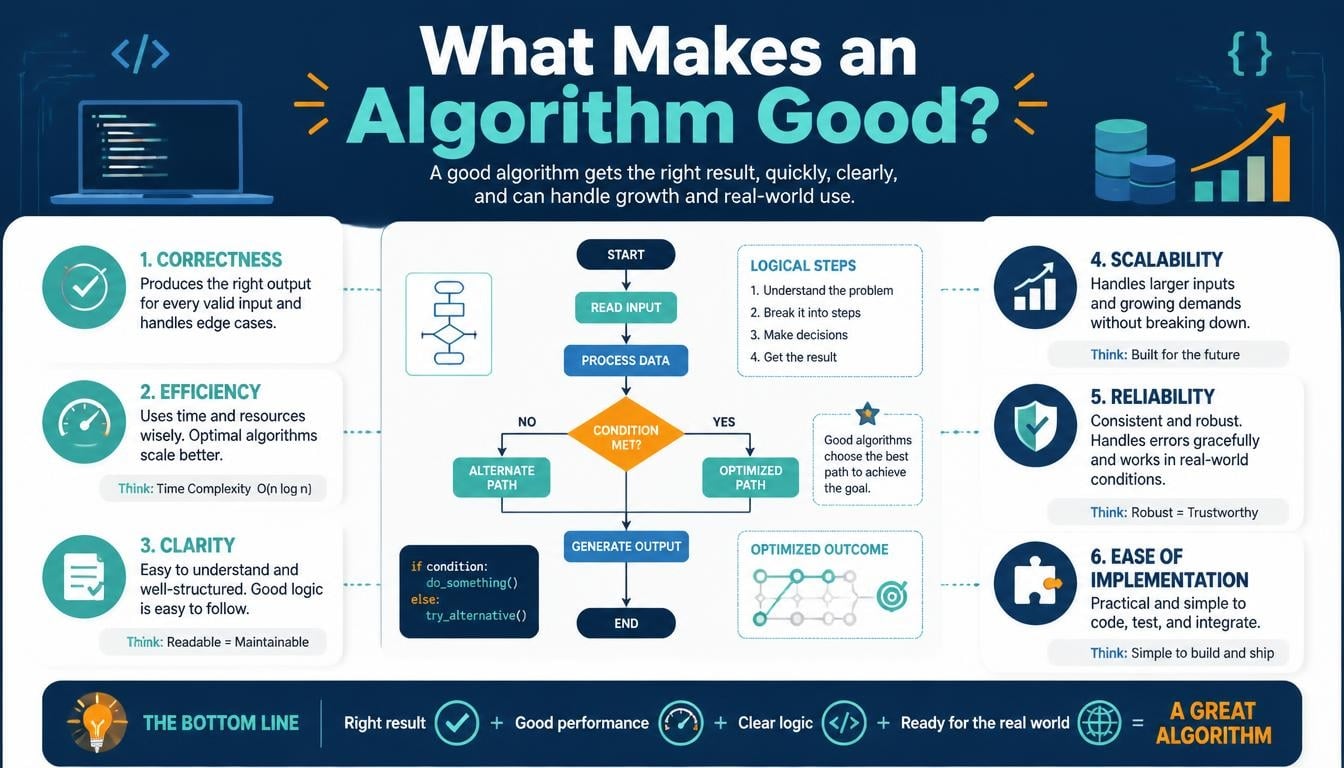
Not every algorithm is equally useful. Some solve problems quickly, while others consume excessive computing resources or produce unreliable results.
A well-designed algorithm should have several important characteristics.
Correctness
An algorithm should produce the expected result when given valid input.
If it is designed to calculate an average, it should perform the mathematical operations accurately rather than returning an unrelated number.
Efficiency
An algorithm should use computing resources sensibly.
Efficiency generally involves considering how much time and memory an algorithm needs as the amount of input data increases.
Clarity
Its instructions should be understandable and logically organised.
Clear instructions make algorithms easier to develop, test, maintain, and improve.
Finiteness
An algorithm should eventually finish its work.
An instruction sequence that continues indefinitely without reaching a meaningful stopping condition is generally not a useful solution to a task.
Scalability
A good algorithm should ideally continue performing reasonably well when the amount of data or the size of the problem increases.
An approach that works beautifully for ten records may become impractical when handling ten million records.
How Is Algorithm Efficiency Measured?
Computer scientists often analyse algorithm efficiency using a concept called Big O notation.
Big O notation describes how an algorithm’s resource requirements grow as its input size increases.
It is not simply a measurement of how many seconds an operation takes on one particular computer. Instead, it helps compare the general growth of computational work.
Some common complexity categories include:
| Complexity | General meaning |
| O(1) | Constant time |
| O(log n) | Logarithmic growth |
| O(n) | Linear growth |
| O(n log n) | Linearithmic growth |
| O(n²) | Quadratic growth |
For example, accessing an element directly from an array can often take O(1) time.
A linear search through an unsorted list may require examining every element, resulting in O(n) time complexity in the worst case.
An algorithm with O(n²) complexity may become significantly slower as the input grows, particularly when dealing with large collections.
This analysis helps developers choose suitable solutions instead of simply writing code that works for a small example.
Common Misunderstandings About Algorithms
Algorithms are widely discussed, especially in conversations about artificial intelligence and social media. Unfortunately, some common misunderstandings make the subject seem more complicated than it really is.
Misunderstanding 1: Every algorithm is extremely complicated.
Not at all. Adding two numbers, finding the largest value in a list, and checking whether someone is eligible for a discount are all examples of algorithmic problem-solving.
Misunderstanding 2: Algorithms only exist inside computers.
Algorithms can be followed by people too. Recipes, mathematical procedures, and organised instructions all demonstrate algorithmic thinking.
Misunderstanding 3: Algorithms always produce correct answers.
An algorithm can produce incorrect results because of flawed instructions, poor-quality input data, programming errors, or unsuitable assumptions.
Misunderstanding 4: Artificial intelligence and algorithms are the same thing.
They are related but different. Algorithms are general procedures for solving problems, while artificial intelligence is a broader field that uses algorithms and other techniques to build intelligent systems.
Misunderstanding 5: A faster algorithm is always better.
Speed matters, but accuracy, memory consumption, reliability, fairness, and maintainability can be equally important depending on the application.
Understanding these distinctions makes it easier to evaluate technology without believing every claim made about it.
How to Start Learning Algorithmic Problem-Solving
You do not need an advanced mathematics degree to begin understanding algorithms. In fact, starting with ordinary everyday problems can make the subject much easier.
The most useful approach is to develop logical thinking before worrying too much about programming syntax.
Here are some practical ways to begin.
Start With Simple Everyday Problems
Choose a familiar task, such as arranging books, calculating a shopping bill, or finding the largest number in a list.
Write down the instructions needed to complete it.
Try to make every step clear enough that someone else could follow the same process without asking you what you meant.
Learn Pseudocode
Pseudocode describes an algorithm using simple language that resembles programming logic without following the strict rules of a particular programming language.
For example:
text
START
INPUT first_number
INPUT second_number
total = first_number + second_number
DISPLAY total
END
This describes a basic addition algorithm.
Pseudocode is helpful because it allows you to concentrate on the solution rather than worrying about syntax errors.
Practise With Flowcharts
Flowcharts use visual symbols to represent the steps and decisions within an algorithm.
A basic flowchart might contain:
- An oval representing the start or end.
- A rectangle representing an operation.
- A diamond representing a decision.
- Arrows showing the direction of the process.
These diagrams are especially useful when an algorithm includes multiple conditions or possible outcomes.
Explore a Programming Language
Once you understand the logical process, learning a programming language becomes much easier.
Python is often a comfortable starting point because its syntax is relatively readable.
You can begin with simple programs involving calculations, conditions, loops, and lists before exploring more advanced algorithmic techniques.
Practise Different Types of Problems
Try solving problems involving searching, sorting, counting, comparisons, and mathematical calculations.
After solving a problem, ask yourself whether there is another approach that uses less time or memory.
This habit gradually develops stronger algorithmic thinking.
The Future of Algorithms in an Increasingly Digital World

Algorithms will continue to influence how people interact with technology. As computing systems become more capable, algorithmic techniques are likely to play an even larger role in scientific research, education, business, healthcare, transportation, and communication.
Machine learning systems are becoming increasingly sophisticated at identifying patterns and producing predictions from large datasets.
At the same time, organisations are paying greater attention to transparency, privacy, security, and fairness when developing automated systems.
The future is not simply about creating algorithms that perform more calculations in less time. It is also about creating systems that solve meaningful problems without ignoring the people affected by their decisions.
This is where technical innovation and responsible design need to work together.
A useful algorithm should not merely produce an impressive result. It should produce a result that makes sense, serves a genuine purpose, and can be trusted within its intended environment.
Frequently Asked Questions
What is an algorithm in simple words?
An algorithm is a set of step-by-step instructions used to solve a problem or complete a specific task. It takes input, processes information, and produces an output.
How do algorithms work?
Algorithms work by following predefined instructions to process input data and generate a result. They may perform calculations, comparisons, or decisions depending on the task.
What are the main types of algorithms?
Common types include sorting algorithms, searching algorithms, recursive algorithms, greedy algorithms, and dynamic programming algorithms. Each type is designed to solve particular problems.
What is the difference between an algorithm and a program?
An algorithm describes the logical steps needed to solve a problem, while a program implements those steps using a programming language that a computer can execute.
What is the role of algorithms in machine learning?
Machine learning algorithms help computers identify patterns in data and learn from examples. They use this learning process to build models that can make predictions or decisions.
Read More: https://gracethemes.com/how-to-screenshot-on-windows/
Conclusion: Algorithms Are the Invisible Instructions Behind Modern Technology
So, what is an algorithm? At its heart, an algorithm is a logical sequence of instructions designed to solve a problem or complete a task. It accepts input, processes information, follows defined rules, and produces an output.
From simple calculations and sorted lists to machine learning models and artificial intelligence, algorithms provide the foundation for countless computational activities.
Understanding how algorithms work helps us appreciate not only the technology we use every day but also the reasoning behind it.
It explains how computers make decisions, how machine learning systems recognise patterns, and how digital services transform enormous amounts of information into useful results.
Perhaps the most interesting thing about algorithms is that their basic idea is surprisingly human. We have always followed organised steps to accomplish tasks, solve problems, and reach our goals.
Computers simply take this familiar approach and perform it at a scale and speed that would be difficult for people to manage alone.
As technology continues to evolve, learning about algorithms will remain a valuable skill for students, professionals, business owners, and anyone curious about the digital world.
The next time a search engine finds exactly what you need or an application recommends something unexpectedly useful, remember that there is probably an algorithm working quietly behind the scenes, turning instructions and information into something meaningful.
