

What Is a Chief Technical Officer? (And How To Become One)
Imagine a software company preparing to launch a product that could change how thousands of people work.
The developers are writing code, the designers are polishing the user experience, and the business team is thinking about customers.
Somewhere in the middle of all this activity, one person must connect the technical pieces with the company’s bigger dreams. That person might be the Chief Technical Officer (CTO).
A CTO is more than the person who understands complicated software or knows which technology will be useful next year.
They are a technology leader who helps an organization make smart technical decisions, build reliable products, manage risks, and prepare for a future that doesn’t always follow the plan.
It is a role where technical knowledge meets business thinking, and honestly, neither side can do the job properly without the other.
If you’ve ever wondered what a chief technical officer does, which qualifications are needed, how much a CTO earns, or how to move from an IT position into executive leadership, this guide will help you understand the journey.
You don’t need to have every answer today. What matters is knowing which skills to build and how to turn your experience into something bigger.
What Is a Chief Technical Officer?
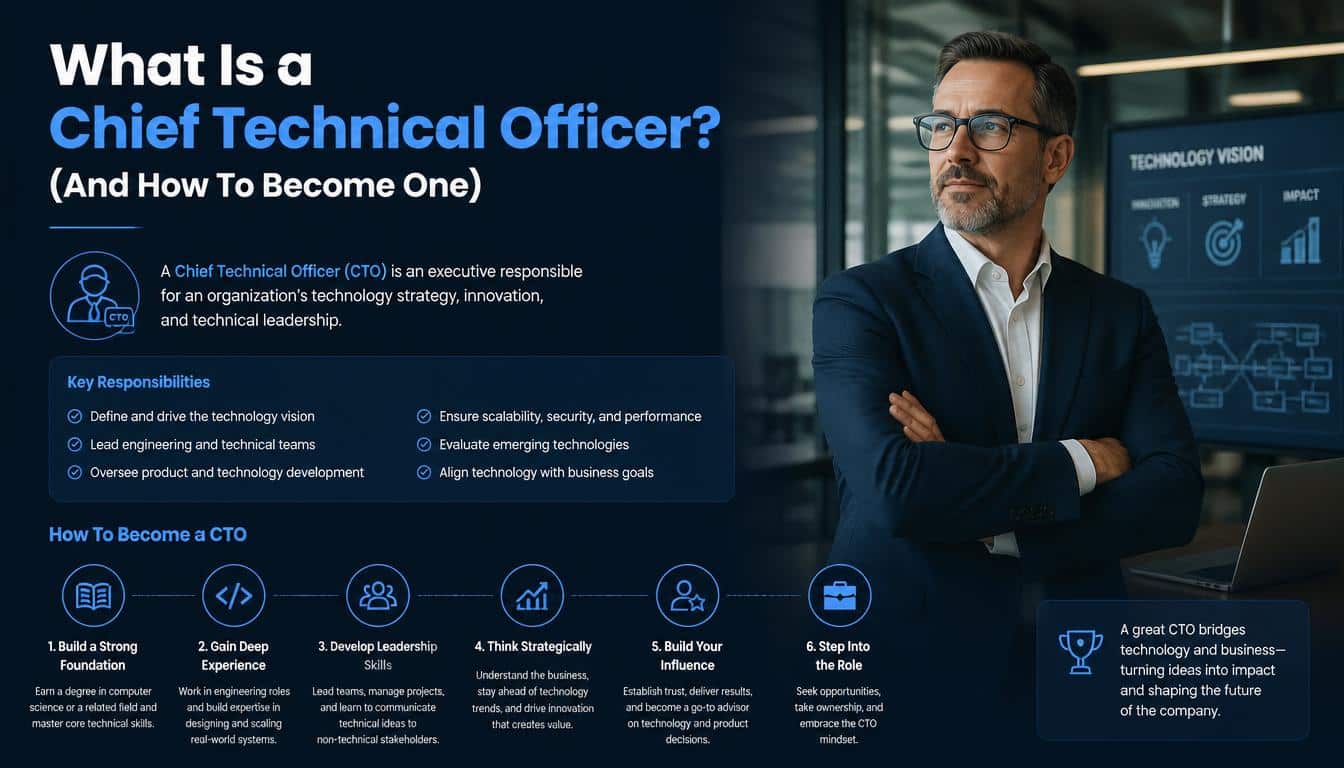
A Chief Technical Officer, commonly called a CTO, is a senior executive responsible for guiding an organization’s technical direction.
Depending on the company, this can include software development, technology infrastructure, cybersecurity, product engineering, research and development (R&D), and the adoption of emerging technologies.
The title is also commonly written as Chief Technology Officer. Although some organizations use the two titles interchangeably, a company’s exact responsibilities depend on its structure, industry, and business needs.
The job title alone doesn’t tell the whole story, so reading the actual job description is always worthwhile.
Think of a CTO as the person who helps answer three important questions: What technology should the business build or use? How can the organization make that technology reliable and secure? And how will today’s decisions support tomorrow’s growth?
A good CTO doesn’t necessarily write the most code in the company. Instead, they create the conditions in which talented people can build the right things, solve difficult problems, and deliver useful results without wasting time on technology that doesn’t serve a clear purpose.
What Does a Chief Technical Officer Do?
The daily work of a CTO can look quite different from one organization to another. A startup CTO might review software architecture in the morning, speak with investors at lunchtime, and help a developer solve a production issue before the day ends.
At a large enterprise, the same title may involve technology budgets, executive meetings, governance, and long-term planning.
Despite these differences, several responsibilities appear in many CTO roles.
Developing Technology Strategy
One of the most important CTO responsibilities is creating a technology strategy that supports business goals.
A company may want to expand into a new market, improve its digital products, or automate a slow internal process. The CTO evaluates which technical investments can realistically support those ambitions.
This involves understanding business priorities, identifying opportunities, assessing risks, and creating a technology roadmap. The roadmap explains where the organization is heading and what it needs to accomplish along the way.
Technology decisions can become expensive when they’re made without a clear purpose. A thoughtful CTO helps the company avoid chasing every new trend simply because competitors are talking about it.
Managing Technology Teams
Technology leadership is not about giving instructions and waiting for results. It means hiring capable people, developing their strengths, resolving disagreements, and helping teams work toward shared objectives.
A CTO may oversee software developers, architects, security specialists, infrastructure engineers, product engineering managers, and other technical professionals. In smaller companies, they may work directly with nearly everyone on the engineering team.
Strong team management also involves creating a healthy working environment. People should feel comfortable reporting problems, questioning assumptions, and suggesting better approaches. After all, a team that hides mistakes can turn a small technical issue into a very expensive surprise.
Overseeing Product Development and Innovation
For organizations that sell technology products, the CTO often plays a central role in product development. They help determine how products should be designed, developed, tested, deployed, and maintained.
Their work may include digital product development, software architecture, database design, systems integration, performance optimization, and decisions about programming languages or cloud platforms.
Innovation is another important part of the job, but it doesn’t always mean inventing something completely new. Sometimes, the smartest innovation is simplifying an existing system so customers can use it more easily or employees can complete their work in half the time.
Protecting Information and Managing Risk
Cybersecurity is no longer a concern that belongs exclusively to the security department. A serious data breach can damage customer trust, interrupt operations, and create legal or financial consequences.
Depending on the organization’s structure, the CTO may oversee security engineering, data protection, access controls, system reliability, and technical risk management. They also work with security teams to establish appropriate standards and incident-response procedures.
A CTO doesn’t have to personally perform every security task. Their responsibility is to ensure that security receives proper attention, suitable resources, and a meaningful place in technical decision-making.
Managing Budgets and Technology Investments
Every organization has limited resources. The CTO must decide which projects deserve investment, which tools provide genuine value, and when replacing an outdated system makes more sense than maintaining it.
This is where IT budget management, vendor management, and technology performance evaluation become important. A solution with an impressive list of features may still be a poor investment if it is too costly to maintain or doesn’t solve a real business problem.
A practical CTO understands that the most expensive technology isn’t automatically the best technology. Sometimes, a modest and dependable solution is exactly what the business needs.
What Are the Different Types of CTOs?
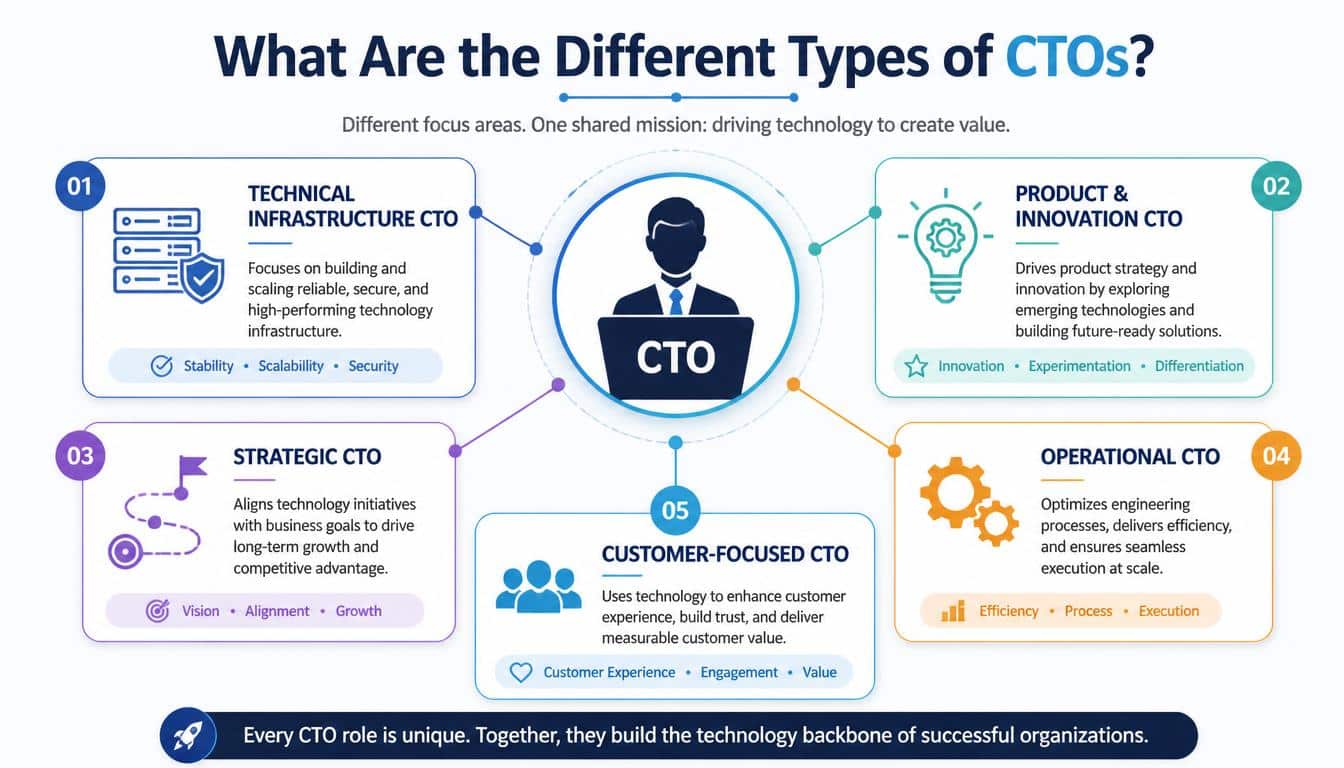
There isn’t one universal model for the CTO role. Some executives concentrate on internal systems, while others focus on products, innovation, or future business opportunities. These categories can overlap, especially in smaller companies.
The Infrastructure-Focused CTO
An infrastructure-focused CTO concentrates on the systems that keep an organization running. Their responsibilities may include cloud computing, networks, data management, IT infrastructure, system availability, and security.
They pay attention to reliability, scalability, technical operations, and the cost of maintaining essential services. In a large organization, they may work closely with infrastructure and operations leaders to ensure that systems can handle growing demand.
The Customer-Focused CTO
A customer-focused CTO is concerned with how technology serves users and supports the company’s products or services. Their decisions are shaped by customer feedback, market expectations, product performance, and the overall customer experience.
They may collaborate closely with product managers, designers, sales teams, and customer support. Their job is to make sure the technology solves meaningful customer problems instead of becoming complicated for the sake of being complicated.
The Long-Term Vision CTO
A long-term vision CTO focuses on the organization’s future technical direction. They evaluate emerging technologies, identify opportunities, and help leaders understand what technical capabilities the business may need in the coming years.
Their work can involve research and development, architecture planning, technology roadmaps, and preparing systems for future growth. They must balance ambition with practical considerations, because a brilliant idea isn’t very useful if the organization cannot implement or maintain it.
The Innovation-Focused CTO
An innovation-focused CTO explores new ways to use technology to create value or strengthen a company’s competitive position. This might involve artificial intelligence, automation, advanced analytics, or entirely new digital products.
They often work with research teams, engineers, business strategists, and external technology partners. Good innovation leadership requires experimentation, but it also requires discipline: not every promising experiment deserves to become a full-scale product.
CTO vs. CIO: What Is the Difference?
The Chief Technology Officer (CTO) and Chief Information Officer (CIO) are both senior technology executives, but their focus often differs.
A CTO commonly concentrates on the technology behind products, services, engineering, and external innovation. A CIO often focuses on the information systems and technology services that help the organization operate internally.
For example, a software company might rely on its CTO to guide product architecture and engineering strategy, while its CIO manages internal business applications, employee systems, and enterprise IT services.
However, these boundaries aren’t fixed. Some companies combine the responsibilities, while others divide them differently. The organization’s size, industry, and reporting structure all influence how the positions work together.
The Chief Executive Officer (CEO) is different again. The CEO leads the overall business, while the CTO contributes specialized technology leadership to the company’s wider strategy.
A CTO must therefore understand more than engineering; they also need to explain technical decisions in terms of business value, customer needs, and organizational priorities.
How to Become a Chief Technical Officer
Becoming a CTO is usually a gradual process rather than a single promotion. Most people develop their technical expertise first, learn how organizations operate, take responsibility for larger projects, and eventually demonstrate that they can lead people and make decisions beyond their individual technical work.
There is no single career path that guarantees the title. Still, the following steps provide a useful framework for building the experience employers commonly look for.
Build a Strong Technical Foundation
Start by learning how technology works at a practical level. Depending on your interests, this might mean software development, computer science, information systems, cybersecurity, database management, cloud infrastructure, or network architecture.
You don’t need to master every technical specialty. However, you should understand the fundamentals well enough to evaluate trade-offs, ask useful questions, and communicate with specialists across different teams.
For aspiring software-focused CTOs, programming, system design, testing, and software architecture are particularly valuable. For infrastructure-oriented roles, operating systems, networks, cloud services, and information security may deserve more attention.
The goal is not to collect technical buzzwords. It is to build the kind of knowledge that helps you solve real problems and make sound decisions.
Earn a Relevant Degree or Equivalent Experience
Many CTOs have a bachelor’s degree in computer science, information technology, software engineering, cybersecurity, or information systems. These programs can provide a structured understanding of computing, software, data, and technical problem-solving.
A master’s degree in a relevant field may be helpful for certain industries or executive positions. An MBA can also be useful if you want to strengthen your knowledge of finance, organizational leadership, operations, and business strategy.
However, CTO qualifications vary considerably between employers. Some organizations place significant weight on formal education, while others prioritize demonstrated technical ability, leadership experience, and a record of delivering successful products.
A degree can open doors, but it doesn’t automatically prepare someone to lead an engineering organization. Practical experience is where much of the deeper learning happens.
Gain Hands-On Industry Experience
Most aspiring CTOs spend several years developing their careers before reaching executive leadership. The exact timeline depends on the industry, organization, and individual’s opportunities.
You might begin as a software developer, IT professional, systems engineer, security engineer, data engineer, or another technical specialist. From there, you can progress into senior engineering roles, architecture, technical project leadership, and management.
During this stage, focus on learning how systems behave outside the classroom. Work on real deployments, investigate production problems, improve software quality, and understand how technical decisions affect customers and colleagues.
Hands-on experience is especially important because a CTO must distinguish between a solution that looks good in a presentation and one that will actually work under real operating conditions.
Develop Leadership and Management Skills
Technical excellence alone rarely prepares someone for executive responsibility. At some point, you must learn to help other people succeed rather than measuring your contribution only by the tasks you complete yourself.
Volunteer to lead projects, mentor junior colleagues, coordinate releases, or improve a process that affects several teams. Learn to handle disagreements respectfully and give feedback that helps people grow.
You should also develop communication skills, decision-making, time management, active listening, and conflict resolution. These abilities become more important as your responsibilities expand.
A future CTO needs to explain a complex technical risk to a nontechnical executive without turning the meeting into a lecture. That is a skill worth practising early in your career.
Move Into Senior Technical or Management Roles
Before becoming a CTO, many professionals work as senior engineers, engineering managers, software architects, directors of engineering, heads of technology, or vice presidents of engineering.
These roles help you understand how to manage projects, allocate resources, plan hiring, evaluate performance, and coordinate teams. They also provide opportunities to make decisions that affect more than one technical component or department.
Try to gain experience with both technical delivery and business planning. If you’ve only worked on individual features, volunteer to participate in architecture reviews or budgeting discussions. If you’ve primarily managed people, keep your technical knowledge current.
This balance makes it easier to transition from a specialist or manager into an executive technology leader.
Learn to Think Like a Business Leader
A CTO must understand why the business exists, who its customers are, how it earns revenue, and what makes it competitive. Technical decisions should support these goals rather than operate separately from them.
Learn the basics of budgets, operating costs, return on investment, customer acquisition, product performance, and financial planning. You don’t need to become an accountant, but you should be able to explain the business consequences of a technical choice.
For instance, investing in a new platform may improve scalability but require substantial migration work. An effective CTO evaluates both the long-term benefits and the immediate costs before recommending a decision.
This is where business acumen and strategic thinking separate a strong technical manager from a capable executive.
Build a Record of Meaningful Results
As you progress, keep track of the projects and improvements you have contributed to. Useful achievements might include reducing system downtime, improving deployment speed, strengthening security, lowering infrastructure costs, or helping launch a successful product.
Whenever possible, describe results using measurable evidence. Instead of saying you improved performance, explain how you identified the bottleneck, what you changed, and what difference the change made.
You should also learn to discuss setbacks honestly. Executives need people who can explain what went wrong, what they learned, and how they will reduce the chance of similar problems in future.
A consistent record of thoughtful decisions and successful collaboration can help demonstrate that you’re ready for greater responsibility.
What Skills Are Required to Become a CTO?
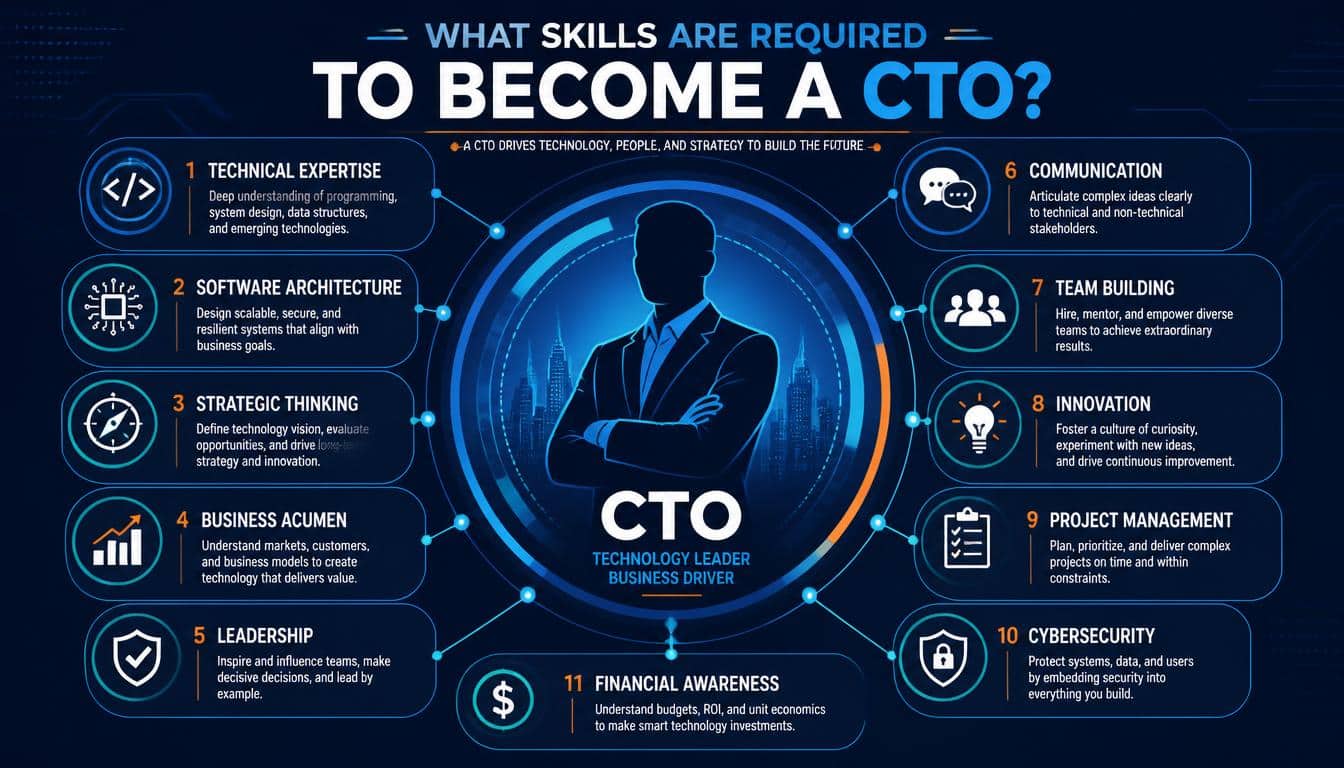
The strongest CTOs combine technical understanding with leadership, business awareness, and the ability to make decisions under uncertainty. The exact mix varies, but several competencies are useful in almost every environment.
Technical Knowledge
A CTO should understand the major technologies relevant to their organization. This might include software architecture, cloud platforms, databases, APIs, cybersecurity, infrastructure, data engineering, or emerging technology.
They don’t need to be the most knowledgeable person in every specialty. Instead, they must know enough to evaluate proposals, identify risks, recognize weak assumptions, and bring the right experts into important decisions.
Strategic Thinking
Technology leaders must look beyond immediate tasks and consider how decisions will affect the organization over time. A quick fix might solve today’s problem while creating maintenance difficulties for years.
Strategic thinking involves evaluating alternatives, considering future needs, and understanding the relationship between technical choices and business objectives. It also requires knowing when a company should wait rather than invest in an immature technology.
Communication and Collaboration
A CTO works with engineers, executives, customers, vendors, and other departments. Each group may care about different things, so clear communication is essential.
Engineers might need architectural details, while senior business leaders need a concise explanation of costs, risks, and expected results. Being able to adjust your explanation without losing accuracy is a genuine leadership advantage.
Problem-Solving and Decision-Making
Complex technical problems rarely arrive with a complete set of instructions. A CTO must evaluate evidence, compare options, decide what matters most, and remain calm when the outcome is uncertain.
Good decision-making also involves recognizing when you don’t have enough information. Sometimes the right move is to run a small experiment, consult a specialist, or postpone a decision until the risks are better understood.
People Management and Adaptability
Technology changes quickly, and teams need leaders who can adapt without creating unnecessary confusion. A CTO should understand how to support professional development, encourage accountability, and help people respond to organizational change.
Leadership also means admitting when an earlier decision was wrong. Employees are more likely to raise concerns when leaders treat honest mistakes as opportunities to learn rather than reasons to blame someone.
What Education and Certifications Help Aspiring CTOs?
There is no universal certificate that qualifies someone to become a CTO. Education and professional development should support the type of leadership role you want, not become a collection of credentials without practical value.
A computer science degree may provide a useful foundation for product engineering. An information technology or information systems degree may suit professionals interested in enterprise technology. Cybersecurity education can be valuable in organizations where risk, compliance, and data protection are central concerns.
Several certifications may also support specific career goals:
- Project Management Professional (PMP): Can help demonstrate structured project management knowledge and practices.
- Certified in the Governance of Enterprise IT (CGEIT): Focuses on enterprise IT governance and related organizational responsibilities.
- Certified ScrumMaster (CSM): Provides training in Scrum practices and collaborative agile team environments.
- Industry-specific technical certifications: Cloud, cybersecurity, networking, and architecture credentials can be useful when they match your responsibilities.
Certification requirements and recognition vary, so check the issuing organization’s current criteria before enrolling.
An MBA is not mandatory for most CTO positions. It can help you understand finance, organizational strategy, and executive decision-making, but relevant experience and the ability to deliver results remain important.
The best approach is to choose education that fills a genuine gap in your knowledge. Continuous learning matters far more than collecting certificates simply to make a résumé look impressive.
What Is the CTO Salary?
The Chief Technology Officer salary can vary significantly according to location, industry, company size, responsibilities, and experience.
A CTO at an early-stage startup may receive a relatively modest salary with potential equity, while an executive at a large established enterprise may have a much larger compensation package.
It would be misleading to suggest that every CTO earns a particular amount. Compensation changes across countries and markets, and salary surveys may use different definitions of the role. For a reliable estimate, compare current job advertisements and compensation data for your specific location and industry.
Several factors influence CTO earnings:
- Industry: Financial technology, enterprise software, healthcare technology, and other specialized sectors may have different compensation structures.
- Company size: Larger organizations may offer higher base salaries, although smaller companies can sometimes provide meaningful equity opportunities.
- Experience: Executives with a strong record of scaling systems, leading teams, and supporting business growth may qualify for more senior packages.
- Location: Local demand for technology leaders and the cost of hiring experienced professionals can affect compensation.
- Company performance: Bonuses, profit sharing, and stock options may depend on business results or contractual terms.
A CTO compensation package may include a base salary, annual bonus, equity, health insurance, paid time off, retirement benefits, flexible working arrangements, and other benefits. Not every employer offers all these features, and equity should never be treated as guaranteed income.
When evaluating an offer, consider the responsibilities, reporting structure, decision-making authority, and expected workload alongside the headline salary. A position with a slightly lower salary but genuine strategic influence and a strong team may provide valuable long-term career opportunities.
What Does a CTO Do in a Startup?
The CTO role in a startup can be especially demanding because the organization may not yet have established systems, specialist departments, or a large engineering team.
A startup CTO might select the initial technology stack, design the product architecture, recruit developers, establish security practices, and work directly on the first version of the product. They may also speak with customers to understand what needs to be built and explain technical decisions to founders or investors.
As the startup grows, the role often changes. The CTO may spend less time writing code and more time hiring leaders, improving engineering processes, planning infrastructure, and ensuring the product can support a larger customer base.
Founders sometimes assume that the best programmer automatically makes the best CTO. Technical ability is valuable, but leadership, communication, financial awareness, and long-term planning matter just as much when the organization starts expanding.
What Challenges Does a CTO Face?
The job can be rewarding, but it comes with difficult trade-offs. A CTO must often balance competing priorities while accepting that no solution will satisfy every stakeholder.
One common challenge is balancing innovation with reliability. Teams may want to experiment with new tools, while customers expect existing services to work every day. A sensible CTO creates room for experimentation without putting essential operations at unnecessary risk.
Another challenge is managing technical debt. Quick solutions sometimes help a company move forward, but accumulated shortcuts can make future changes slower and more expensive. Leaders must decide when to improve existing systems and when to direct resources toward new features.
Hiring and retaining talented people can also be difficult. Technology professionals need meaningful work, opportunities to grow, and a workplace where their contributions are respected. A CTO who ignores team health may eventually find that even the most ambitious technology strategy is impossible to deliver.
Finally, there’s the pressure of uncertainty. Security threats evolve, customer expectations change, and technologies that seemed promising can lose relevance. Successful CTOs don’t predict everything correctly; they build organizations capable of learning and responding effectively.
How Can You Prepare for a CTO Career Today?
If you’re still early in your career, you don’t need to wait for a management title to begin developing executive-level habits. Small decisions made consistently can build the foundation for future leadership.
Start by learning how your organization makes money and how its technology supports that process. Ask why projects are prioritized, how success is measured, and what happens when technical decisions create unexpected costs.
Volunteer for responsibilities that stretch your abilities. Lead a small project, mentor a colleague, document an important system, or help another department understand a technical issue. These experiences give you opportunities to practise communication, planning, and accountability.
Keep your technical knowledge current, but don’t spend all your learning time on tools. Read about system design, organizational leadership, cybersecurity, business strategy, and the experiences of other technology executives.
Most importantly, build relationships with people outside your immediate technical circle. Product managers, finance professionals, customer support specialists, and sales teams can teach you things that engineering alone cannot. A future CTO needs to understand the whole organization, not just the codebase.
How to Write Your Own CTO Career Roadmap
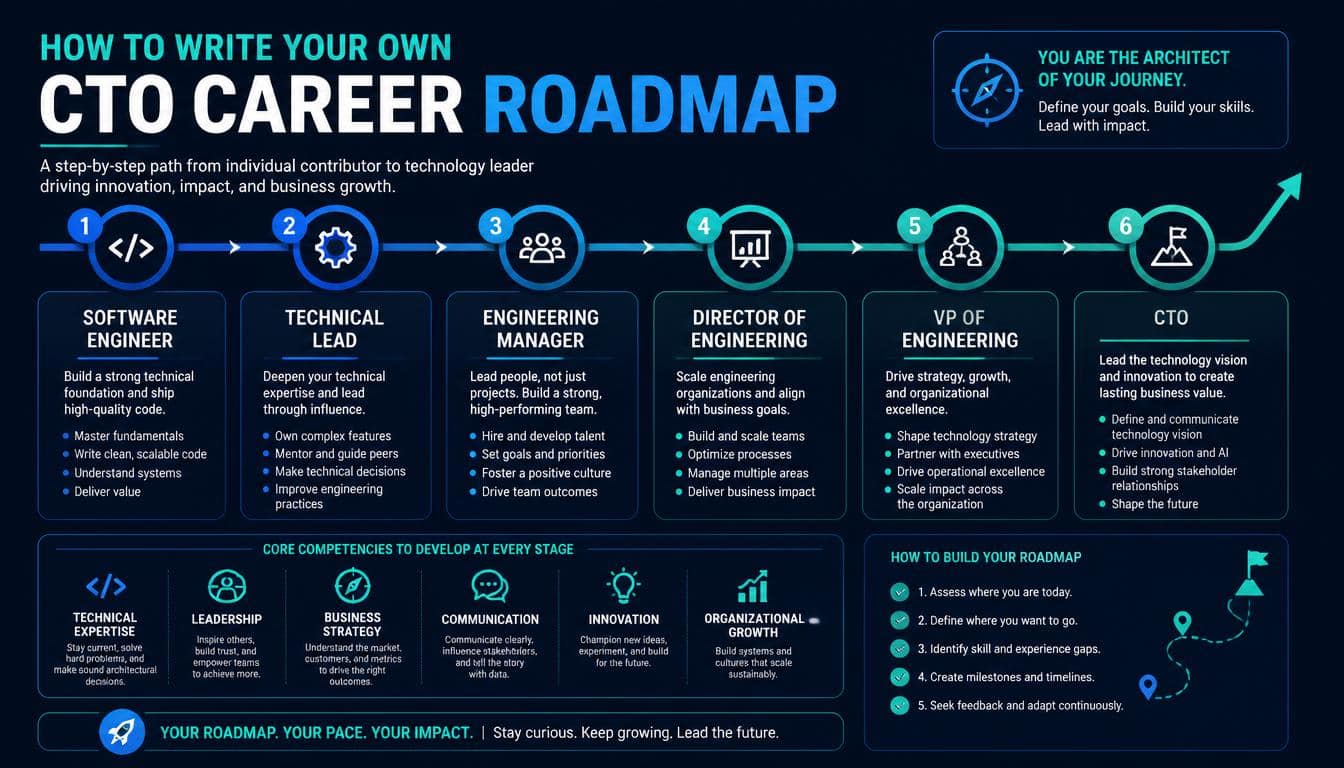
A career roadmap turns an ambitious goal into practical actions. Instead of simply telling yourself that you’ll become a CTO one day, identify the skills and experiences you need to develop next.
Start by assessing your current position. Perhaps you’re an excellent developer but have little management experience, or maybe you’re an IT manager who wants a deeper understanding of software architecture and product development.
Choose two or three priorities for the next six months. You might lead a cross-functional project, complete a relevant technical course, improve your understanding of business finance, or mentor junior colleagues. Keep the goals realistic enough that you can make steady progress alongside your existing responsibilities.
Review your progress regularly and ask a trusted manager or mentor for feedback. Their perspective can help you identify blind spots that are difficult to notice on your own. Remember, a career roadmap is a guide, not a promise that every promotion will happen on schedule.
Frequently Asked Questions About Becoming a CTO
How many years of experience does a CTO need?
There is no fixed requirement. Many CTOs reach the position after substantial experience in technical and leadership roles, often over a decade or more, but the timeline varies considerably.
A growing startup may appoint an experienced technical founder earlier, while a large enterprise may expect extensive executive experience.
What degree is required to become a CTO?
No single degree is universally required. Computer science, software engineering, information technology, cybersecurity, and information systems are common educational backgrounds.
Some employers prioritize relevant experience and leadership achievements over formal qualifications.
Is programming necessary for a CTO?
Programming experience is valuable for many CTO positions, especially those involving software products and engineering teams. However, not every CTO needs to be an active programmer.
The important thing is to understand the technology well enough to make informed decisions and lead specialists effectively.
Can an IT manager become a CTO?
Yes. An IT manager can progress toward a CTO role by broadening their technical expertise, gaining experience with business strategy, developing leadership skills, and taking responsibility for larger technology initiatives.
The most useful next step depends on the person’s existing strengths and the type of CTO position they want.
Is becoming a CTO worth it?
For professionals who enjoy technology, leadership, problem-solving, and business strategy, it can be a rewarding career.
The role offers opportunities to influence products and organizational direction, but it also brings considerable responsibility, difficult decisions, and pressure when systems or projects encounter problems.Frequently asked Questions
Chief technical officer
A Chief Technical Officer (CTO) is an executive responsible for managing a company’s technology and driving innovation. They oversee technology development, IT operations, and technical strategies to improve products and services.
Chief tech officer
A Chief Tech Officer leads a company’s technical teams and makes key decisions about technology. Their role includes adopting new technologies, improving systems, and supporting business growth.
cto organization
A CTO organization refers to the teams and departments managed by the Chief Technology Officer. It may include software development, IT infrastructure, cybersecurity, engineering, and research and development.
Chief technical officer job description
A Chief Technical Officer job description includes overseeing technology strategy, managing technical teams, evaluating new technologies, and ensuring data security. The CTO also aligns technology initiatives with business goals and promotes innovation.
Chief technology officer definition
A Chief Technology Officer (CTO) is a senior executive who directs an organization’s technological vision and strategy. They ensure technology supports business objectives, enhances customer experiences, and improves operational efficiency.
Read More: https://gracethemes.com/most-new-data-centers-in-the-u-s-are-coming-to-rural-areas/
Conclusion: Building a Future as a Chief Technical Officer
A Chief Technical Officer brings together technology, people, and business strategy to help an organization move forward with confidence. The role involves much more than choosing software or overseeing technical projects; it requires thoughtful leadership, clear communication, sound judgment, and the ability to prepare for change.
The journey toward becoming a CTO usually begins with curiosity and practical experience. Over time, technical expertise grows into broader responsibility, individual achievements become team successes, and the ability to solve problems develops into the ability to guide an entire organization.
You don’t have to be an expert in everything to begin. Learn consistently, take ownership of meaningful work, listen to people with different perspectives, and develop the courage to make decisions when the answers aren’t obvious.
Your next step might be learning a programming language, leading a small project, improving your business knowledge, or helping a colleague solve a difficult problem. Each experience can become part of the foundation you build for the future.
And if becoming a CTO is your ambition, give yourself permission to grow into the role rather than expecting yourself to be ready for it today.
Great technology leadership isn’t about knowing everything; it’s about helping the right people do their best work and making technology serve a purpose that truly matters.
