

Most New Data Centers in the U.S. Are Coming to Rural Areas
The internet may feel weightless. We send a photograph, ask an artificial intelligence tool a question, save family memories to the cloud, or join a video call without giving much thought to the machinery working behind the screen.
Yet somewhere in America, a quiet stretch of farmland may soon become home to a massive building filled with computers, cooling equipment, electrical cables, and the constant hum of digital activity.
The future of the internet, it turns out, is increasingly being built in places where the loudest sound used to be a tractor in the early morning.
That is the interesting story behind the growing number of data centers in the U.S. While many existing facilities are concentrated around established cities and
technology hubs, a large share of new projects are being planned for rural counties. The shift isn’t simply about finding empty land.
It reflects the growing demand for computing power, the rapid expansion of artificial intelligence, the availability of electricity and fiber-optic connections, and the practical challenges of building enormous facilities close to densely populated communities.
According to figures attributed to Pew Research Center’s analysis of Data Center Map data, more than 3,000 data centers were already operating across the country, with more than 1,500 additional facilities in development.
The figures supplied for this analysis suggest that approximately 67% of planned facilities are in rural areas, compared with 87% of existing facilities located in urban areas.
These numbers describe a striking change in the geography of America’s digital infrastructure, although the distinction between a proposed project and an operating facility matters enormously.
The implications stretch far beyond technology companies. Rural residents may see new construction jobs, additional tax revenue, and improved infrastructure, but they may also face questions about electricity bills, water consumption, land use, and the long-term character of their communities.
The big question is not only where the next data center will be built. It is whether the benefits and burdens of this digital expansion will be shared fairly.
Why Most New Data Centers in the U.S. Are Heading Toward Rural Areas
A data center is essentially a highly specialized building that houses computer servers, storage systems, networking equipment, and the infrastructure needed to keep everything running safely. These facilities store information, power websites, support cloud computing, process financial transactions, and increasingly provide the computing capacity behind artificial intelligence tools.
Their physical needs, however, are anything but small. A large campus can require substantial land, dependable electricity, sophisticated cooling systems, backup power, and high-capacity connections to communications networks.
Finding all of those things in a crowded urban neighborhood can be expensive and difficult.
Rural locations sometimes offer a more practical combination. Land may be available in larger parcels, local development authorities may be eager to attract investment, and industrial sites may offer room for expansion.
A developer that needs hundreds of acres for several buildings may find that a rural county provides options that a tightly developed city simply cannot.
Still, rural doesn’t automatically mean suitable. A site must have access to sufficient power, reliable connectivity, roads, and the necessary planning approvals.
Some remote properties lack the infrastructure required for a large computing campus, meaning that developers may need to invest heavily before construction can even begin.
The changing geography of rural data centers therefore reflects a balance between space, infrastructure, cost, and future demand. The companies aren’t necessarily abandoning cities; they’re searching for places where their next enormous facilities can actually be built.
The AI Boom Is Changing America’s Data Center Map
Artificial intelligence has made the demand for computing capacity feel almost insatiable. Training advanced AI models and serving millions of users can require powerful processors, specialized networking equipment, and extensive electricity supplies.
Ordinary online services also continue to grow, adding pressure to an industry that was already expanding before the latest AI boom arrived.
This is one reason AI-driven data center expansion has become such an important part of the national infrastructure conversation.
An AI system may look like a conversation on a phone screen, but behind that simple interaction can sit a complicated network of processors, storage systems, and power-hungry equipment.
Traditional cloud computing, video streaming, online shopping, enterprise software, and digital backups still need facilities too. AI is not the only reason for the growth, though it has intensified competition for available computing capacity and suitable sites.
The location of a facility can influence how quickly a project moves forward. Companies often look for areas with access to large electrical substations, transmission lines, reliable internet connections, and room to build additional capacity. A rural industrial corridor with these features can become more attractive than a more crowded metropolitan site.
But there is a catch. Building the structure is only one part of the challenge. A facility can rise quickly while the electricity infrastructure needed to support it takes years to plan and complete. That gap between construction and grid readiness is becoming an important issue for communities hosting new projects.
Rural Data Centers Versus Urban Data Centers: What the Numbers Tell Us
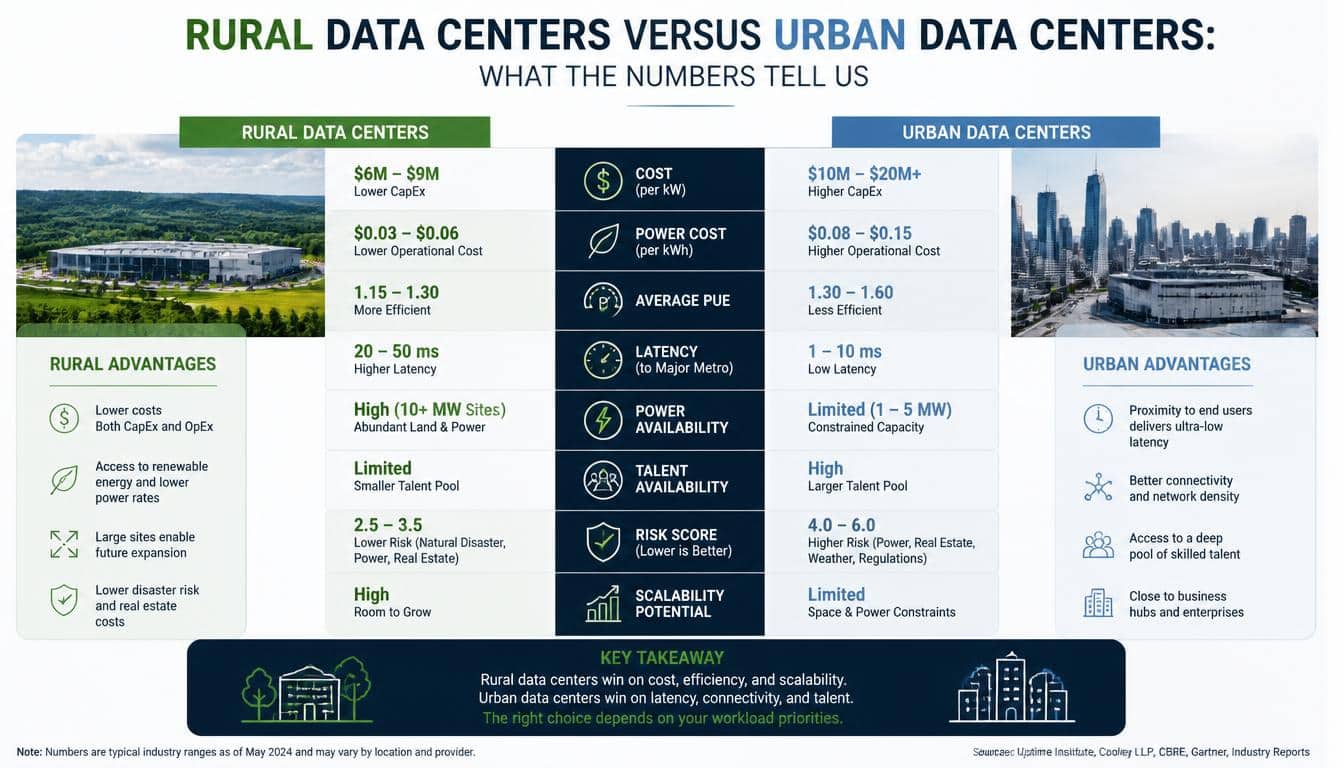
The contrast between existing and planned facilities helps explain why the geography of data centers is changing.
According to the supplied figures, roughly 87% of existing facilities are located in urban areas, while about 67% of planned facilities are in rural areas.
In other words, the established network reflects older development patterns, while the development pipeline points toward a different future.
These percentages should not be read as proof that every rural county is about to receive a data center. National totals can hide enormous differences between states, counties, and individual development corridors.
A handful of heavily developed regions may account for a substantial share of projects, even while many rural counties never see a proposal at all.
The supplied data also indicate that 39% of planned facilities are in counties without an existing data center. That is a notable finding because it suggests that expansion is not limited to places where the industry has already established a strong presence.
For these counties, a proposed project could be the beginning of a new local industry. It could also introduce infrastructure demands that local officials have never had to manage at this scale.
A community accustomed to approving housing developments or agricultural buildings may suddenly be reviewing plans for a facility that consumes as much electricity as a small town, or potentially much more depending on its size.
The difference between planned data centers and operational data centers is therefore essential. A planned facility might be announced, under review, awaiting a power connection, or still seeking financing.
Not every announced project will be built, and some projects change size, ownership, or location before they become operational.
How Researchers Map Data Center Development Across America
Understanding the shift requires more than counting buildings. Researchers need to distinguish operating facilities from those under construction, planned projects, and sites where land has been reserved for possible future development.
These categories represent different stages of investment and shouldn’t be treated as interchangeable.
The figures discussed here are attributed to a Pew Research Center analysis using Data Center Map information. Geographic classifications based on U.S.
Census Bureau categories help researchers compare facilities in urban and rural settings, rather than relying only on informal descriptions of what looks like a small town or a large city.
That approach is useful because rural and urban classifications have specific statistical meanings. A facility outside a major downtown area may still sit within a densely developed metropolitan region.
Likewise, a county classified as rural may contain an industrial district with excellent transportation and electrical infrastructure.
Researchers also need to consider the date of the underlying data. Data center projects can change rapidly as companies secure permits, revise investment plans, and negotiate electricity supply.
A map published several months ago might not capture every new announcement or project cancellation.
For readers, the lesson is simple: data center statistics are most useful when their source, date, definitions, and development-status categories are clear. The broad trend toward rural development is important, but individual numbers should be interpreted in their proper context.
Where New Data Centers in the U.S. Are Growing: A Regional Breakdown
The geographic shift is not happening evenly. The supplied figures place the South at the front of the planned-development pipeline, followed by the Midwest, the West, and the Northeast.
These regional patterns reflect differences in land availability, power infrastructure, existing technology clusters, and state and local economic development policies.
The South: America’s Biggest Data Center Development Pipeline
With 754 planned facilities in the supplied dataset, the South stands out as a major center of future development.
The region includes established technology corridors as well as smaller communities seeking new sources of industrial investment.
Virginia is especially significant because it already hosts a large concentration of data center infrastructure. Texas and Georgia also feature prominently in the planned-development figures.
Across the wider region, developers may be attracted by available land, growing electricity infrastructure, and local governments interested in attracting high-value investment.
Yet the South’s growth comes with practical questions. Hot weather can increase cooling requirements, while water availability varies considerably from one location to another.
Rapidly growing electricity demand can also complicate planning for homes, businesses, and other industrial customers.
The Midwest: A New Chapter for Rural Infrastructure
The supplied figures list 419 planned facilities in the Midwest, making it another important region in the development pipeline.
States such as Illinois and Ohio have established data center markets, while other locations may offer opportunities for new projects around industrial sites, power infrastructure, and major communications routes.
The Midwest has a combination of agricultural land, industrial communities, transportation networks, and established electrical infrastructure.
Some rural counties may see data centers as an opportunity to diversify local economies that have depended heavily on farming or traditional manufacturing.
However, the benefits will depend on the details. A large project can generate significant construction activity, but the number of permanent jobs may be much smaller than the construction workforce.
Communities need to understand those differences before treating a proposed campus as a guaranteed economic transformation.
The West: Space, Technology, and Energy Constraints
The West accounts for 277 planned facilities in the supplied figures. The region contains important technology markets and growing communities, but it also faces varied challenges involving water supply, electricity transmission, land prices, and climate.
Arizona, California, Oregon, and Washington illustrate the diversity of western data center development. Some locations benefit from existing technology infrastructure, while others attract interest because of their position along major digital networks or access to suitable industrial sites.
In drier areas, water planning deserves particular attention. Cooling technologies differ, and not every facility consumes water in the same way, but local conditions can make the choice of cooling system especially important.
The Northeast: Established Markets and Limited Space
The Northeast has 106 planned facilities in the supplied figures. Although that is lower than the totals for the South and Midwest, the region remains relevant because of its population centers, businesses, financial institutions, and established communications networks.
Dense development can make large new campuses difficult to site. Developers may therefore consider industrial outskirts, former commercial sites, or less densely populated areas connected to major metropolitan markets.
The Northeast’s experience illustrates an important point: rural development isn’t only a story about remote farmland. It can also involve the edges of established economic centers, where land and infrastructure conditions differ from those found in city centers.
Which States Have the Most Planned Data Centers?
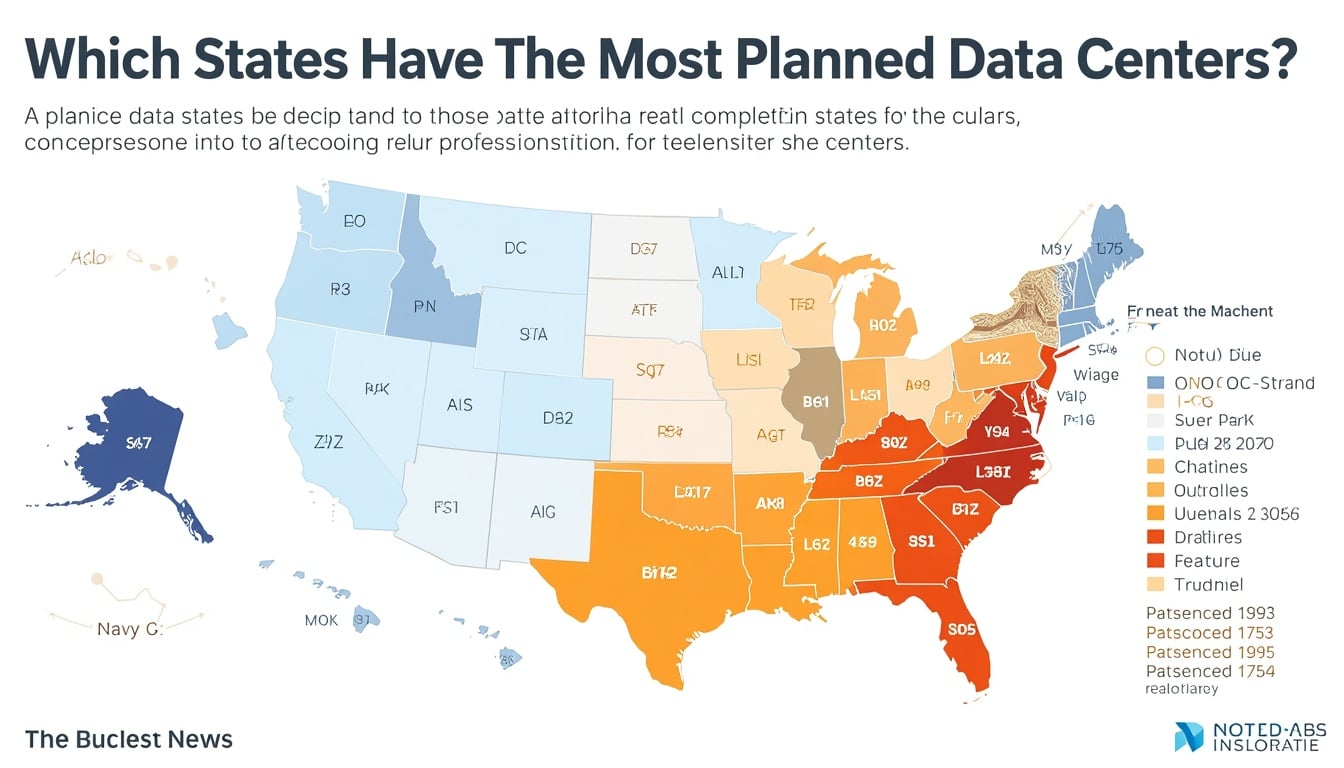
State-level figures offer a closer look at where the next wave of data center construction projects may take place.
According to the supplied dataset, Virginia leads the planned-facility count, followed by Texas, Georgia, Illinois, and Arizona. These states have different economic conditions, but each has reasons to attract computing infrastructure.
| State | Planned data centers |
| Virginia | 287 |
| Texas | 170 |
| Georgia | 141 |
| Illinois | 123 |
| Arizona | 86 |
Virginia’s position is particularly interesting because it already has a substantial operational data center industry. The region around Northern Virginia has developed into a major digital infrastructure hub, supported by network connectivity and a concentration of technology businesses. New projects may expand that established cluster into surrounding communities.
Texas offers a different combination of industrial land, energy infrastructure, and large-scale development opportunities.
Georgia has also become an important location for computing facilities, while Illinois benefits from established metropolitan and communications networks.
Arizona attracts attention for its technology sector and available development sites, though water and electricity planning remain important considerations.
These figures represent the supplied snapshot of planned facilities, not a definitive ranking of projects that will ultimately be completed. Counts may change as permits are approved, plans are revised, and companies reconsider their investments.
How the Planned Numbers Compare With Existing Facilities
The supplied operational-facility figures show a somewhat different picture. Virginia has 398 operating data centers, Texas has 296, California has 277, Ohio has 166, and New York has 148.
This comparison illustrates why existing infrastructure matters. States with established markets can attract further investment because businesses already have access to network connections, specialized workers, power infrastructure, and supporting services.
But a state with fewer existing facilities may still experience rapid growth if a suitable development corridor emerges.
For readers tracking data centers by state, the most useful approach is to compare operational facilities, construction projects, and planned developments separately. One number describes the industry that exists today; another offers a glimpse of what might be built tomorrow.
Why Rural Counties Are Becoming Attractive to Developers
A rural location might look like an unlikely place for one of the world’s most technologically advanced industries. In reality, many data center requirements align surprisingly well with certain rural and semi-rural locations.
- Land availability: Large campuses need space for server buildings, cooling equipment, substations, access roads, and potential future expansion. Rural properties can offer more room than developed urban neighborhoods.
- Electrical infrastructure: Access to transmission lines and substations can make a site attractive, provided that sufficient capacity is available or can be added.
- Development costs: Land acquisition and some construction expenses may be lower outside major metropolitan centers, although grid upgrades and other infrastructure can offset those savings.
- Local investment incentives: Counties and municipalities may compete for projects through tax arrangements, infrastructure support, or economic development programs. The value of these incentives depends on the specific agreement.
- Network connectivity: Fiber-optic networks and reliable telecommunications links are essential. A rural site without suitable connectivity may be less attractive than a suburban industrial property.
- Room to expand: Companies planning several buildings or future phases may prefer locations where neighboring land is available and construction can proceed without disrupting a densely populated district.
These factors help explain the changing data center site selection process. But there is an important distinction between a location that looks attractive on a map and one that is actually ready for development.
Electricity capacity, water availability, environmental conditions, permitting, and community acceptance can make or break a project.
What Does Data Center Growth Mean for Rural Communities?
For a small community, a major development proposal can feel like an unexpected visitor arriving with a very large suitcase. It brings the possibility of investment and new employment, but it also asks residents to make decisions about the place they call home.
The economic effects can be meaningful. Construction may create temporary demand for electricians, equipment operators, engineers, truck drivers, concrete suppliers, and other trades. Local hotels, restaurants, and service businesses may benefit while a project is being built.
Once the facility opens, however, the employment picture often changes. Data centers require specialized staff for operations, security, maintenance, and technical support,
but a highly automated facility may employ fewer permanent workers than a similarly expensive factory. Communities should therefore ask developers for realistic estimates of both construction jobs and long-term positions.
Tax revenue is another potential benefit. Depending on the agreement, a project may contribute property taxes, business taxes, utility payments, or other local revenue.
That money could help support public services and infrastructure, but tax abatements and development incentives may reduce the amount a county receives during the early years.
There are also indirect effects. A new facility may encourage improvements to roads or electrical infrastructure, yet those improvements can bring costs of their own.
Residents deserve a clear account of who will pay for the upgrades and whether other customers could end up carrying part of the expense.
In short, rural infrastructure development can provide genuine opportunities, but the outcome depends on the contract, the location, and the quality of local planning. A headline announcing billions of dollars in investment is only the beginning of the story.
Data Center Energy Consumption and the Question of Home Electricity Bills
Electricity is among the most important issues in any discussion of new computing facilities. Servers need power continuously, and cooling equipment, networking systems, and supporting infrastructure add to the total demand.
The rapid growth of AI workloads has intensified interest in data center energy consumption.
Facilities designed for demanding computing tasks can require substantial amounts of electricity, while several large campuses operating in the same area can place significant pressure on regional power systems.
That does not mean every new data center will automatically increase household electricity bills.
The outcome depends on how electricity is generated, how transmission and distribution costs are allocated, what investments are needed, and how regulators structure utility rates.
In some cases, large customers pay for dedicated infrastructure; in others, costs may be distributed across a broader customer base under applicable rules.
Residents should ask a few direct questions before a project receives final approval:
- How much electricity is the facility expected to use at full capacity?
- Does the local grid have enough available capacity, or will major upgrades be required?
- Who pays for new substations, transmission lines, and other infrastructure?
- Will the utility recover any of those costs through rates charged to residential customers?
- Are the developer’s electricity commitments consistent with the needs of existing homes and businesses?
These questions are especially important where several projects are planned within the same utility service area. A single development might be manageable, while a cluster of facilities could require a much larger coordinated investment.
The broader lesson is that data center electricity demand should be evaluated before construction begins, rather than treated as a problem to solve after the servers arrive.
Water Use, Cooling Systems, and Environmental Impact
Electricity isn’t the only resource worth examining. Data centers generate heat, and that heat must be removed to keep equipment operating reliably. Depending on the design, cooling may involve air-based systems, water-based cooling, evaporative processes, or other technologies.
The environmental impact of data centers therefore varies from one facility to another. A project in a water-stressed region raises different questions from one located where water supplies are more plentiful. Even within the same state, local conditions can vary significantly.
Water use should be measured in the context of the particular cooling system and its operating conditions. Some designs use water directly for cooling, while others rely more heavily on mechanical equipment and may have different electricity requirements. No single description accurately fits every facility.
Communities should also examine backup generators, construction traffic, noise, lighting, land clearing, and the source of the electricity that powers the campus.
The environmental effects may extend beyond the property line, especially when supporting infrastructure is built across a wider area.
A responsible development review can ask for projected water consumption, details of wastewater management, plans for reducing noise, and an assessment of local ecological conditions. Where information is missing, residents should be able to ask for it.
The goal isn’t to assume that every data center is environmentally harmful, nor to pretend that a massive computing facility has no footprint. It is to make decisions using site-specific evidence and transparent commitments.
Data Centers Near Residential Areas: How Close Is Too Close?
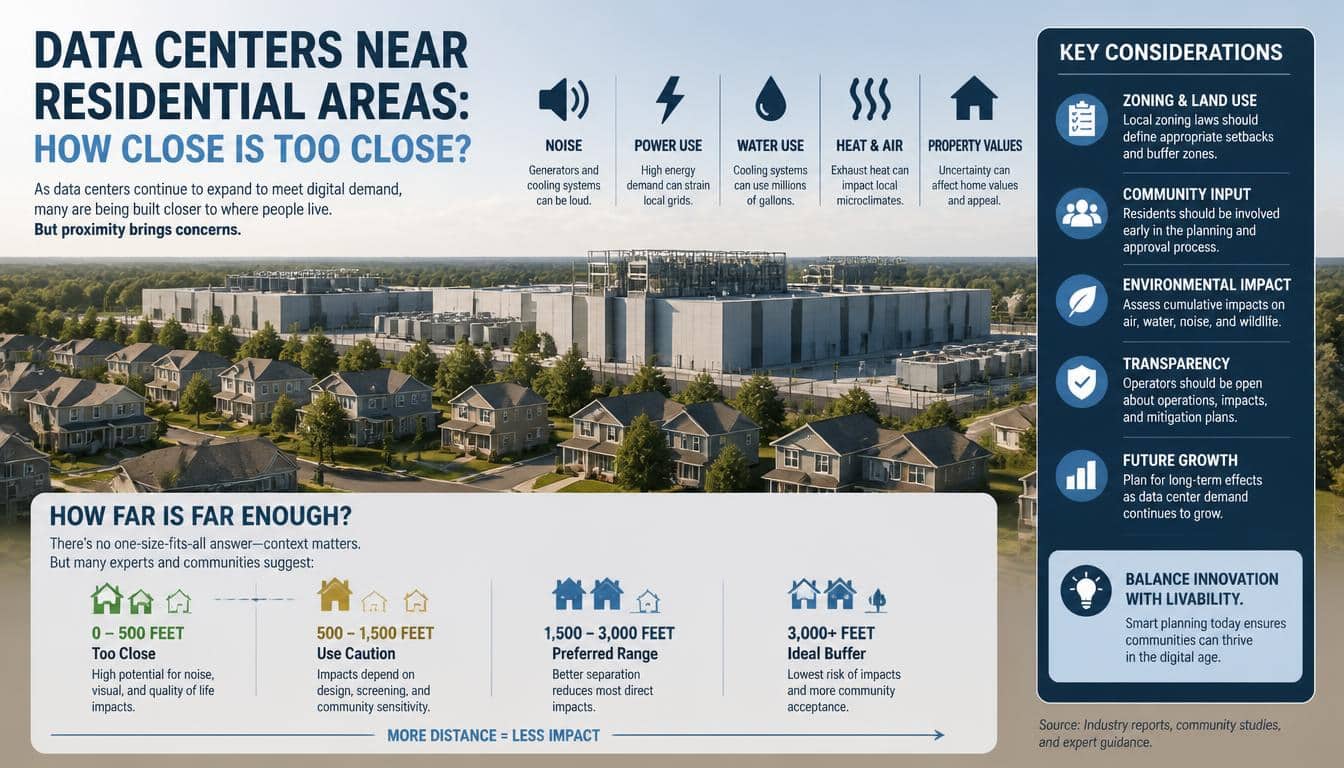
The geographic relationship between people and computing facilities is another important part of the story.
The supplied figures suggest that approximately 38% of Americans live within five miles of an operating data center.
An additional 4% are reported to live within five miles of a planned facility that is not yet operational, bringing the reported total near 42% for proximity to existing or planned facilities.
Those figures should be interpreted carefully. The exact result depends on how researchers define a facility, calculate distance, handle overlapping areas, and distinguish planned sites from operating ones.
The five-mile measure is a useful geographic indicator, but it doesn’t tell us whether a person can see a facility from their home, experiences its noise, or is exposed to a particular environmental effect.
The supplied dataset also indicates that 90% of data centers are within five miles of another data center.
This suggests substantial clustering rather than a uniform distribution across the country. Existing network infrastructure, electricity availability, and established industry ecosystems can encourage multiple projects to locate near each other.
Clustering can offer practical benefits. Developers may be able to connect to existing infrastructure or share access to specialized services. However, the combined demand from several nearby facilities can be more important than the impact of any single building.
For residents, data center proximity to residential areas should therefore be considered alongside noise levels, traffic, lighting, water resources, and the cumulative demand placed on utilities. Distance alone doesn’t tell the whole story, and a project review should look beyond a simple map.
Public Awareness and Community Involvement Matter More Than Ever
A proposed data center can move through several stages before the wider community fully understands what is being planned.
Land may be purchased or reserved, preliminary agreements may be signed, and infrastructure discussions may begin before residents see a detailed construction proposal.
That can leave people feeling as if a major decision has already been made without them. Local officials can reduce this frustration by publishing project information early, holding accessible public meetings, and explaining what is known and what remains uncertain.
A useful public discussion should cover more than the headline investment figure. Residents need to understand expected water and electricity use, the number of permanent jobs,
proposed tax arrangements, construction schedules, environmental safeguards, and the consequences of future expansion.
Independent analysis can also help. A county may benefit from reviewing utility projections or environmental assessments with qualified advisers rather than relying exclusively on a developer’s summary.
Public participation is most meaningful when people have enough time and information to evaluate the proposal.
For developers, early engagement can prevent misunderstandings and reveal concerns that might otherwise become obstacles later. For residents, it provides an opportunity to influence decisions while there is still time to change plans.
Community awareness of data centers should not be treated as an optional courtesy. When a project can shape local infrastructure for decades, public understanding is part of responsible development.
What Is the Future of Data Center Development in America?
The next phase of U.S. data center growth will likely reflect several competing pressures. Demand for AI computing and cloud services may encourage companies to pursue larger facilities, while the cost and availability of electricity could limit how quickly some projects proceed.
States and counties will continue to compete for investment, but the most successful locations may not simply be those offering the cheapest land.
Reliable power, a capable workforce, good connectivity, water planning, and predictable regulations all contribute to a project’s long-term viability.
Rural areas will remain important because they can offer space for large developments and opportunities to extend infrastructure beyond established technology hubs. Yet rural growth won’t happen everywhere.
Some proposals may be delayed or abandoned because grid connections are unavailable, community opposition is strong, environmental constraints are significant, or financial conditions change.
Another likely development is greater attention to energy efficiency and alternative cooling methods. Operators have financial reasons to reduce wasted electricity, while communities have reasons to demand better resource management.
Advances in computing hardware and facility design may change the amount of infrastructure required for particular workloads, although efficiency improvements don’t guarantee lower overall energy consumption when demand keeps increasing.
Policymakers will also face questions about how to allocate infrastructure costs fairly. If data centers become increasingly important to the digital economy, the communities that host them should have a clear understanding of both their contributions and their obligations.
The future is not simply a contest between cities and rural America. It is a question of how the country builds essential digital infrastructure while maintaining reliable utilities, protecting local resources, and ensuring that economic development delivers tangible public value.
How to Evaluate a Proposed Data Center in Your Community
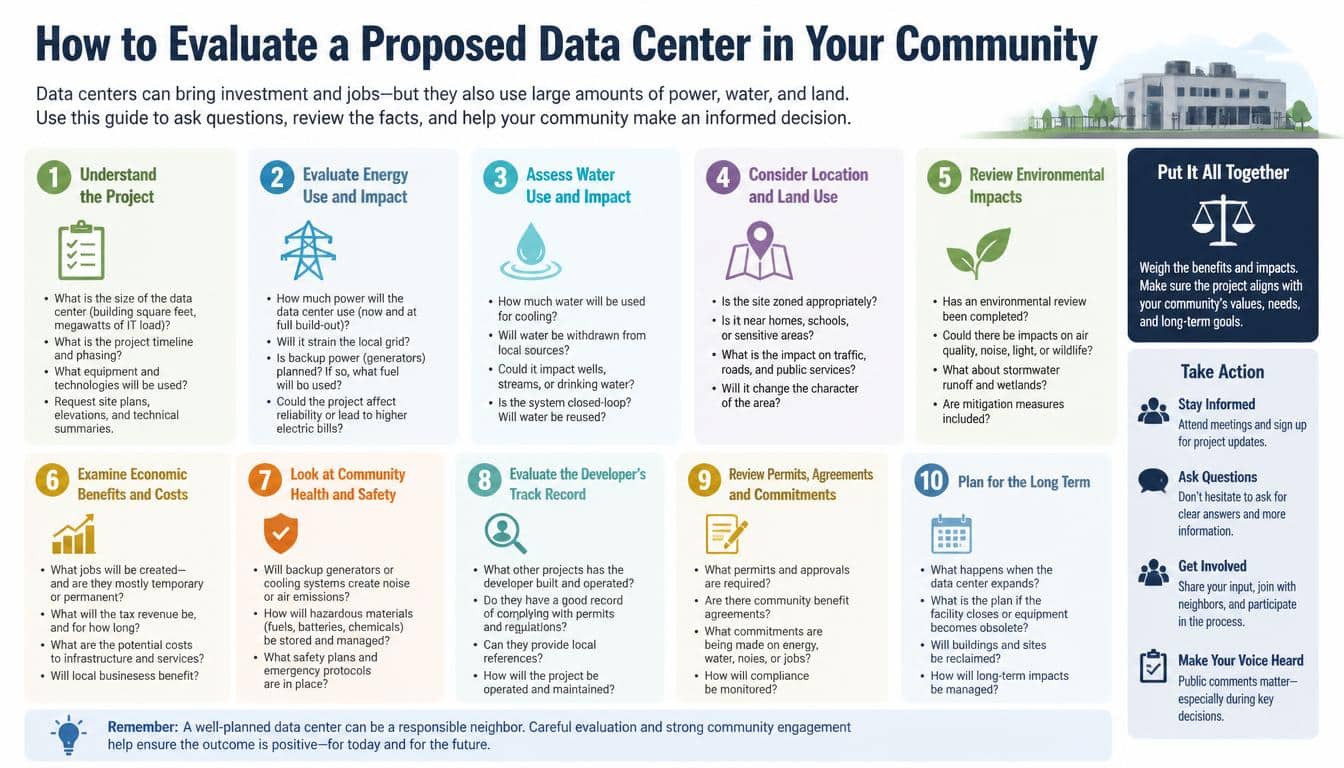
If a development announcement appears in your county, start with the original planning documents rather than relying solely on headlines or social media discussions.
The most useful information usually comes from local planning departments, public hearing records, utility filings, environmental assessments, and the developer’s published project materials.
Pay particular attention to the proposed facility’s size, anticipated electricity use, cooling method, water requirements, construction timeline, and expected permanent employment.
Ask whether the project includes additional phases that could increase its footprint or resource demand later.
It is also worth checking the financial arrangements. Tax incentives, infrastructure contributions, and utility agreements can influence whether a development produces a lasting public benefit.
A project described as a major economic investment should be assessed on its actual commitments, not just the impressive number attached to its construction budget.
Finally, look for independent evidence. Reliable data about operating facilities, proposed sites, local electricity demand, and water availability can help residents separate realistic concerns from speculation.
When facts are incomplete, asking for clarification is more useful than assuming the best or the worst.
Frequently aSked questions
Data centers usa
Data centers in the USA are essential facilities that store, process, and manage digital information. They support cloud computing, artificial intelligence (AI), online services, and business operations across the country.
How many ai data centers are in the us
The exact number of AI data centers in the US is difficult to determine because many facilities handle both AI and traditional computing workloads. However, the number of data centers supporting AI is growing as demand for AI computing power increases.
What state has the most data centers
Virginia has the most data centers of any US state, particularly in Northern Virginia, which is one of the world’s largest data center hubs. Its strong network infrastructure and connectivity make it an attractive location for data center development.
Data centers in the us
Data centers in the US are expanding to meet growing demand for cloud services, digital storage, and AI computing. These facilities are located in major technology hubs as well as smaller cities and rural communities.
Data centers in usa
The USA is a global leader in data center infrastructure, with facilities operated by major technology companies and specialized providers. Increasing investment in AI and cloud computing is driving the construction of new data centers nationwide.
Why are most new data centers being built in rural areas?
Rural areas can offer larger parcels of land, opportunities for expansion, and access to suitable industrial sites.
Locations with sufficient electricity capacity, fiber-optic connectivity, and supportive planning policies can be especially attractive. Rural land alone, however, is not enough to make a project feasible.
How many operational data centers are in the United States?
The figures supplied for this article indicate that more than 3,000 data centers were operational in the United States. Exact counts vary according to the database, the date of collection, and whether smaller facilities are included.
What percentage of planned data centers are in rural areas?
The supplied figures place the rural share of planned facilities at approximately 67%, compared with 87% of existing facilities in urban areas.
These percentages reflect the dataset’s geographic classifications and should not be interpreted as a guarantee that every planned project will be completed.
Which U.S. states have the most planned data centers?
In the supplied dataset, Virginia leads with 287 planned facilities, followed by Texas with 170, Georgia with 141, Illinois with 123, and Arizona with 86. These are snapshot figures rather than permanent rankings.
How does data center construction affect local communities?
Potential benefits include construction employment, infrastructure investment, tax revenue, and business activity.
Possible challenges include electricity demand, water consumption, noise, land-use changes, and pressure on public infrastructure. The overall outcome depends on the site’s characteristics and the terms of the development agreement.
Do data centers increase home energy costs?
They can contribute to local electricity demand, but higher household bills are not an automatic result. The effect depends on grid capacity, infrastructure investment, utility-rate rules, and how the costs of serving large customers are allocated.
Will every planned data center actually be built?
No. Projects may be delayed, redesigned, relocated, or cancelled because of financing, permitting, power availability, environmental restrictions, or changes
in computing demand. Planned facilities should always be distinguished from projects under construction and operational sites.
Read More:
Conclusion: America’s Digital Future Is Being Built Beyond Its Cities
The story of new data centers in the U.S. is ultimately about more than computers and concrete. It is about the changing relationship between technology and the places where people live.
As AI tools, cloud platforms, and digital services become more deeply woven into everyday life, the physical infrastructure behind them must find room to grow.
Rural America is increasingly part of that transformation. Some communities may welcome new investment and a chance to strengthen their local economies. Others may worry about electricity costs, water supplies, and changes to familiar landscapes. Both responses deserve to be heard, because neither technological progress nor community protection should be treated as an afterthought.
The most promising future is one in which developers plan responsibly, local governments negotiate transparently, utilities prepare carefully, and residents have a meaningful voice in decisions that affect their homes.
That approach won’t eliminate every disagreement, but it can help ensure that the digital economy serves the communities that make its growth possible.
After all, the internet may live in the cloud in our imagination, but its infrastructure lives somewhere very real. It occupies land, draws power, uses resources, and becomes part of a community’s future.
Building it wisely means recognizing that progress is not measured only by how many servers we can install, but by how thoughtfully we make room for them.
What do you think about the growing number of data centers in rural America? Have you seen a proposed project in your area, or has a new facility already changed your community? Share your experiences and perspectives in the comments.
Those local stories can help make a national conversation about digital infrastructure more grounded, more informed, and ultimately more useful to everyone.
