

What Date Is 20 Weeks From Today?

Sometimes a date looks like a small thing on a calendar, but it can quietly become an important marker for a plan, deadline, trip, appointment, or personal goal.
If you are wondering what date is 20 weeks from today, the answer is Tuesday, January 12, 2027, when the starting date is August 25, 2026.
That may sound like a simple piece of date calculation, and really it is, but knowing how the result is reached makes the answer easier to trust.
Instead of just staring at a calendar and counting little boxes, you can use a straightforward method that works for many other dates too.
| Start Date | Date 20 Weeks From Today |
| August 21, 2026 | January 8, 2027 |
| August 22, 2026 | January 9, 2027 |
| August 23, 2026 | January 10, 2027 |
| August 24, 2026 | January 11, 2027 |
| August 25, 2026 | January 12, 2027 |
| August 26, 2026 | January 13, 2027 |
| August 27, 2026 | January 14, 2027 |
| August 28, 2026 | January 15, 2027 |
| August 29, 2026 | January 16, 2027 |
What Date Is 20 Weeks From Today? Explane
If Today is August 25, 2026, then the start date for the calculation is August 25, 2026. Adding 20 weeks means moving forward exactly 20 complete weekly periods.
One week contains seven days, so 20 weeks contains 140 days. When those 140 days are added to August 25, 2026, the resulting future date is Tuesday, January 12, 2027, which is the target date you are looking for.
The Short Answer: 20 Weeks From Today
The direct answer to 20 weeks from today is January 12, 2027. The starting point is August 25, 2026, and the time duration between the two dates is exactly 20 weeks.
So, if you searched for twenty weeks from today, 20 weeks from now, or the date in 20 weeks, all of those searches lead to the same calendar result. The wording changes, but the calculation does not, thankfully.
How to Calculate the Date 20 Weeks From Now
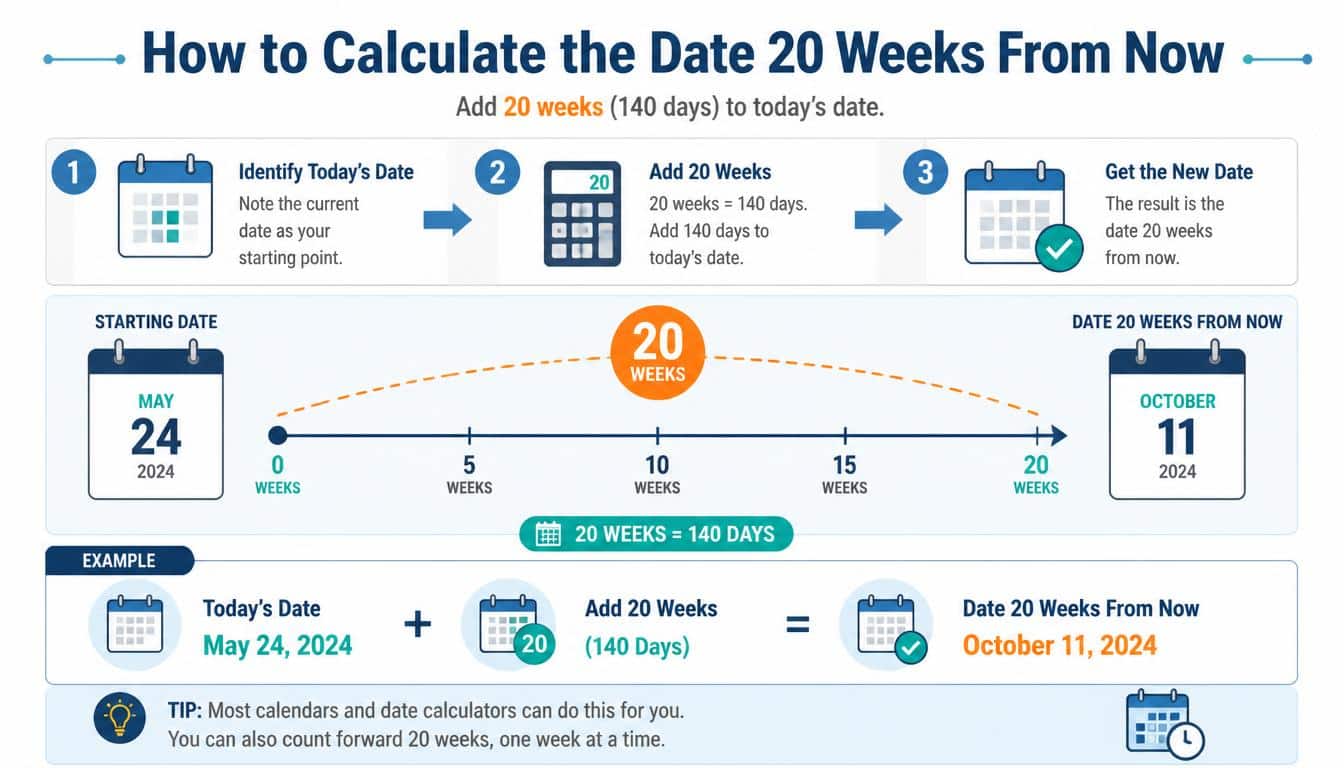
The easiest method is to convert weeks into days before doing the calendar date calculation. Since one week equals seven days, multiplying 20 by seven gives 140 days, and then those days are added to the starting date.
You can also count forward week by week on a physical or digital calendar. Starting at August 25, 2026, move forward one week at a time until you have completed 20 total weeks, and you will land on January 12, 2027.
20 Weeks From Today: The Calendar Method
A calendar makes this calculation surprisingly visual, especially when you want to double-check the result without using a tool.
Start with August 25, 2026, then mark the same weekday seven days later, repeating the process until the twentieth move.
The sequence eventually crosses from August into September, October, November, December, and finally January.
Your final weekly landing point is Tuesday, January 12, 2027, not January 11 or January 13, which is an easy mistake when counting manually.
20 Weeks in Days, Hours, Minutes, and Seconds
The phrase 20 weeks in days has a simple conversion: 20 multiplied by seven equals 140 days. That means the period from August 25, 2026, to January 12, 2027, represents 140 complete days.
For a more detailed time conversion, 140 days equals 3,360 hours, or 201,600 minutes, or 12,096,000 seconds. Those numbers get rather enormous very quickly, even though the original question was only about 20 weeks.
A Simple 20-Week Timeline
The following timeline shows how the calculation moves through the calendar without making the process feel like a mathematics exam. Each step represents another completed week from the original starting point.
- Start date: August 25, 2026
- 1 week: September 1, 2026
- 2 weeks: September 8, 2026
- 3 weeks: September 15, 2026
- 4 weeks: September 22, 2026
- 5 weeks: September 29, 2026
- 6 weeks: October 6, 2026
- 7 weeks: October 13, 2026
- 8 weeks: October 20, 2026
- 9 weeks: October 27, 2026
- 10 weeks: November 3, 2026
- 11 weeks: November 10, 2026
- 12 weeks: November 17, 2026
- 13 weeks: November 24, 2026
- 14 weeks: December 1, 2026
- 15 weeks: December 8, 2026
- 16 weeks: December 15, 2026
- 17 weeks: December 22, 2026
- 18 weeks: December 29, 2026
- 19 weeks: January 5, 2027
- 20 weeks: January 12, 2027
Looking at the timeline this way is useful because every date remains on a Tuesday. That is not coincidence; adding a whole number of weeks preserves the weekday, which gives you a nice little check on the calculation.
August 25, 2026 Is the Reference Date
For this calculation, August 25, 2026 is the reference date and the starting point. It falls on a Tuesday, which means the date 20 weeks later also falls on a Tuesday.
Nearby dates such as August 21, 2026, August 22, 2026, August 23, 2026, and August 24, 2026 would produce different answers because even a one-day change in the starting date shifts the final result.
August 26, 2026, August 27, 2026, August 28, 2026, and August 29, 2026 work the same way.
Why 140 Days Equals 20 Weeks
There is nothing mysterious behind the number 140. A standard week has seven days, so the calculation is simply 20 × 7, giving 140 days.
This is useful when a date calculator accepts days instead of weeks. You can enter 140 days rather than 20 weeks, and the calendar should arrive at the same target date, assuming the starting date and counting method are the same.
What Date Is 20 Weeks From Today on a Calendar?
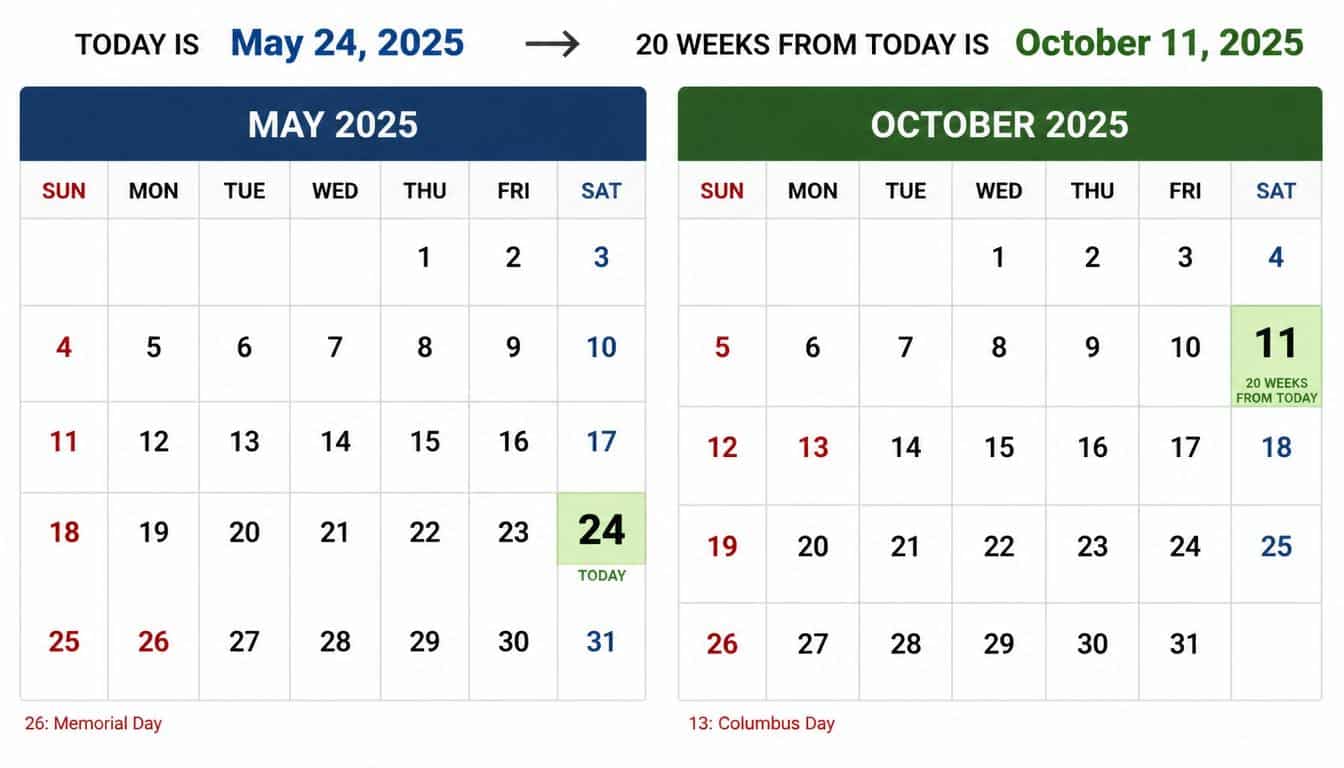
To find date on calendar, locate August 25, 2026, first. From there, you can count seven days forward repeatedly, or you can move exactly 20 weekly spaces if your calendar displays weeks clearly.
The important part is to count completed weeks rather than casually counting calendar pages.
Twenty weeks can cross five different months, so trying to estimate it by saying “about five months” can leave you several days off, which is kinda annoying when precision matters.
The Date 20 Weeks From Today Is in January 2027
The final date, January 12, 2027, sits comfortably inside January rather than at the beginning or end of the month. That makes the answer especially easy to remember if your plan is connected with a January deadline or event.
The surrounding January dates are useful for checking your result too. The nearby sequence is January 8, 2027, January 9, 2027, January 10, 2027, January 11, 2027, January 12, 2027, January 13, 2027, January 14, 2027, January 15, 2027, and January 16, 2027.
What Is 20 Weeks From Now?
When someone asks what is the date 20 weeks from now, they usually want a future date relative to the current day.
For this article, “now” and “today” refer specifically to August 25, 2026, so the answer remains January 12, 2027.
If you read the same question on another day, however, the result changes. A future date is always connected to its starting date, which is why reliable calculators display both dates rather than giving a number without context.
Twenty Weeks From Today Versus 20 Weeks Ago
There is an important difference between twenty weeks from today and 20 weeks ago. The first moves forward from the reference date, while the second moves backward by the same amount of time.
Starting from August 25, 2026, moving backward 20 weeks gives a past date. Because 20 weeks equals 140 days, the reverse calculation is simply subtracting 140 days instead of adding them, which is a handy trick when checking older dates.
Related Dates: 21, 22, 23, and 24 Weeks From Today
People often search beyond one answer because their schedule does not always fit exactly 20 weeks.
Once the first result is known, the next few dates are easy to calculate by adding another seven days each time.
- 21 weeks from today: January 19, 2027
- 22 weeks from today: January 26, 2027
- 23 weeks from today: February 2, 2027
- 24 weeks from today: February 9, 2027
The same pattern works backward too. A search for 21 weeks ago, 22 weeks ago, 23 weeks ago, or 24 weeks ago can be solved by subtracting seven additional days for every extra week.
Why the Weekday Helps Confirm the Answer
One of the nicest little tricks in date calculation is using the weekday as a sanity check. Adding seven days returns you to the same weekday, so adding 20 complete weeks to a Tuesday must also end on Tuesday.
Since August 25, 2026, is a Tuesday and January 12, 2027, is also a Tuesday, the result passes that simple check. It doesn’t prove every arithmetic step by itself, but it is a very useful second glance.
Using a Weeks From Today Calculator
A weeks from today calculator is convenient when you need an answer quickly or when several dates must be checked.
Usually, you provide the starting date and the number of weeks, and the tool returns the corresponding future or past date.
A date calculator, weeks calculator, or time duration calculator can perform similar jobs, though their interfaces may look different.
The important thing is to check whether the tool is adding complete weeks rather than interpreting the number as another kind of duration.
How a Date Calculator Gets the Answer
A basic future date calculator follows a surprisingly ordinary process. It takes the starting date, converts the requested number of weeks into days, and advances the calendar by that number of days.
For this example, the calculation can be written simply as: 20 weeks × 7 days = 140 days. Then the calculator adds those 140 days to August 25, 2026, producing January 12, 2027.
Why Exact Dates Matter
Knowing the exact target date is more useful than saying “about five months from now.” Months do not all have the same number of days, while weeks always represent seven days, so the two expressions aren’t interchangeable.
For planning, that distinction can matter quite a bit. A deadline, booking, subscription period, project milestone, or personal reminder may depend on the exact calendar date, not a rough estimate that sounds close enough.
Common Mistakes When Counting 20 Weeks
The biggest mistake is counting the starting date as if it were already the first completed week.
If August 25 is your start, the first full week ends on September 1, so zero weeks means you are still at August 25.
Another common slip is forgetting that 20 weeks means 20 × 7 days, not 20 calendar months or an approximate five-month period. Calendar arithmetic is fussy in that way, but at least its fussiness is consistent.
What About 20 Weeks From August 21, 2026?

Changing the starting date changes everything, even when the requested duration stays at 20 weeks. If the starting date were August 21, 2026, the resulting date would be January 8, 2027.
This shows why the phrase “from today” is important. A date relative to today only makes sense when today itself is clearly established, otherwise two people can perform perfectly correct calculations and still get different answers.
What About August 22 Through August 29?
The dates surrounding the reference day create a useful miniature example of how date calculations shift. If you start on August 22, 2026, 20 weeks later is January 9, 2027; starting on August 23 gives January 10.
Starting on August 24 gives January 11, while August 25 gives January 12. Continuing forward, August 26, August 27, August 28, and August 29 correspond to January 13, January 14, January 15, and January 16, 2027.
A Quick Reference for Nearby Starting Dates
When several people are working with dates, a compact reference can prevent the same calculation being repeated again and again. Every one-day shift in the starting date creates a one-day shift in the target date.
- August 21, 2026 → January 8, 2027
- August 22, 2026 → January 9, 2027
- August 23, 2026 → January 10, 2027
- August 24, 2026 → January 11, 2027
- August 25, 2026 → January 12, 2027
- August 26, 2026 → January 13, 2027
- August 27, 2026 → January 14, 2027
- August 28, 2026 → January 15, 2027
- August 29, 2026 → January 16, 2027
That pattern is also a good reminder that the calendar is not guessing. Once the duration is fixed, changing the starting date simply carries the whole result forward or backward by the same amount.
20 Weeks From Today in Everyday Planning
A 20-week duration can be useful for tracking a long project without needing to think in months. If a plan begins on August 25, 2026, its 20-week milestone falls on January 12, 2027.
You might use that date as a checkpoint rather than treating it as an ordinary Tuesday.
A long timeline becomes easier to understand when it has clear markers, and a precise week count gives those markers a tidy rhythm.
Why Counting Weeks Can Be Better Than Counting Months
Weeks provide a fixed unit of seven days, while months vary between 28 and 31 days. For that reason, “20 weeks” has a precise duration, whereas “five months” does not describe exactly the same number of days in every situation.
This is why a time duration calculator can be more appropriate when the question is explicitly measured in weeks.
It keeps the original unit intact instead of quietly changing the meaning halfway through the calculation.
How to Calculate a Date Using a Calendar
To calculate a future date manually, begin by writing down the starting date. Then add one week at a time, keeping each new date on the same weekday until you reach the requested number of weeks.
For 20 weeks, you move forward 20 times. If you accidentally count only 19 or jump forward twice during one step, the final answer will be wrong, so writing the intermediate dates down can save a surprisingly silly mistake.
When You Need to Subtract Weeks
The same method works for past dates. Instead of moving forward, subtract weeks from the starting date, moving backward seven days for each week.
For example, to calculate the date 20 weeks ago, take August 25, 2026, and subtract 140 days. This reverse approach is especially useful when checking when an earlier milestone, meeting, or event occurred.
The Difference Between 20 and 24 Weeks
A request for 24 weeks from today is not simply another way of saying 20 weeks from today. The extra four weeks equal another 28 days, so the target date moves forward by exactly four weekly periods.
From the August 25, 2026 reference date, 20 weeks lands on January 12, 2027, while 24 weeks lands on February 9, 2027. A small difference in the requested duration can therefore cross into another month.
What “20 Total Weeks” Really Means
The phrase 20 total weeks means that twenty complete seven-day periods have passed.
It does not mean that you should count the names of twenty calendar weeks loosely or estimate the length by looking at month boundaries.
That distinction matters when precision is the whole reason for asking the question. The starting point is fixed, the duration is fixed, and the target date follows from those two pieces.
Understanding Date Difference
The date difference between August 25, 2026, and January 12, 2027, is 140 days. Expressed in weeks, that same difference is exactly 20 weeks.
This is another way to validate the result. If your calculator says the dates are separated by 139 or 141 days, something has gone sideways somewhere, probably in the counting rather than in the calendar itself.
A Note About January 8 to January 16, 2027
The January sequence around the target date can be helpful if you are checking an appointment or planning a deadline window.
The dates January 8, January 9, January 10, January 11, January 12, January 13, January 14, January 15, and January 16, 2027 form the immediate nine-day neighborhood around the answer.
The target is still January 12, 2027, sitting right in the middle of that little sequence. Seeing the surrounding dates can make the result feel more concrete than a single isolated number.
The Practical Value of a Date and Temporal Calculator
A good date calculator is not just about getting a number instantly. It helps you compare future dates, reverse calculations, durations, and recurring milestones without manually wrestling with months of different lengths.
For people handling several deadlines, a calculator can also reduce mental clutter. You can reserve your brain for deciding what the date means, rather than spending ten minutes wondering whether you counted the third Tuesday correctly.
Frequently Asked Questions
20 Weeks from now
20 weeks from now is Tuesday, January 12, 2027, based on today’s date, August 25, 2026.
What is 20 weeks from today
20 weeks from today will be Tuesday, January 12, 2027. This is exactly 140 days from August 25, 2026.
When is 20 weeks from now
20 weeks from now falls on January 12, 2027. The date is a Tuesday.
What day will it be in 20 weeks
It will be Tuesday, January 12, 2027, 20 weeks from today.
What date is 20 weeks from now
The date 20 weeks from now is January 12, 2027. This calculation adds 20 weeks, or 140 days, to August 25, 2026.
Read This Blog: https://gracethemes.com/cost-to-install-a-water-softener/
Final Answer: What Date Is 20 Weeks From Today?
So, if today’s date is August 25, 2026, then 20 weeks from today is Tuesday, January 12, 2027. The calculation is based on 20 weeks = 140 days, which also equals 3,360 hours, 201,600 minutes, and 12,096,000 seconds.
In its simplest form, the answer is: August 25, 2026 + 20 weeks = January 12, 2027. If you were searching for what date is 20 weeks from today, what date is 20 weeks from now, or calculate date 20 weeks from today, this is the calendar result you need.
Final Thoughts on the 20-Week Calculation
Dates have a funny way of making the future feel both far away and strangely close. Twenty weeks sounds substantial when spoken aloud, yet once converted into 140 days, it becomes something you can place neatly on a calendar and understand.
The useful lesson is simple: always identify the start date, keep the time duration in the correct unit, and then count or calculate forward carefully.
For August 25, 2026, that path ends on Tuesday, January 12, 2027, a small piece of calendar information that can make a larger plan feel much easier to organize.
If this calculation helped you, the same approach can be used for 21 weeks, 22 weeks, 23 weeks, 24 weeks, or almost any other week-based date question.
Once you know how to add weeks to a date, the calendar stops looking like a maze and starts behaving more like a very patient little ruler.
