

Cost to Install a Water Softener – 2026 Price Guide
Hard water has a funny way of becoming a household character you never invited in. It leaves white rings on the faucet, makes soap behave like it has forgotten its job, and quietly builds calcium and magnesium deposits inside the plumbing system.
The question eventually becomes less “Do I need one?” and more “What is the cost to install a water softener in 2026, really?”
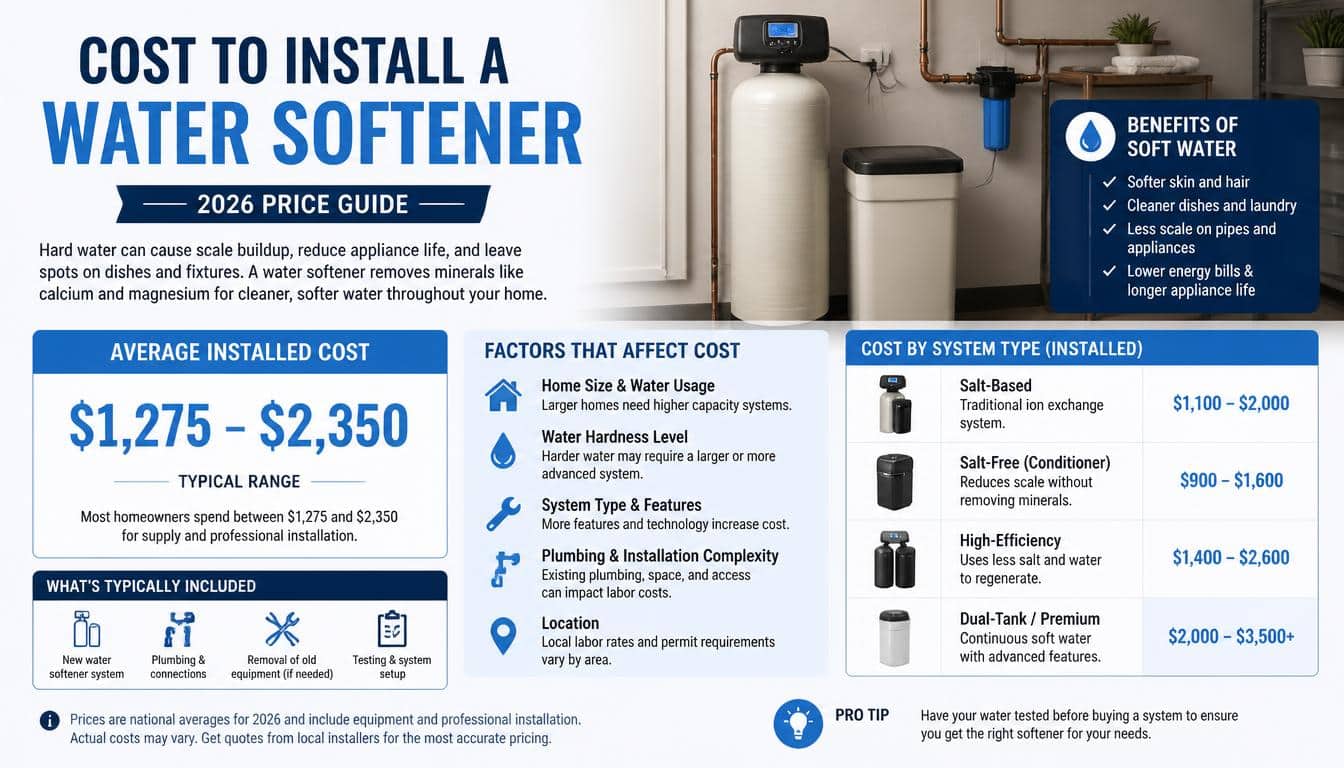
For most homeowners, the national average price for a professionally installed water softener system is around $1,500, while broader installed prices commonly fall
somewhere between roughly $200 and $6,000, depending on system type, capacity, plumbing work, and location.
Water Softener Installation Cost at a Glance
A water softener is not just a tank that sits in the basement looking important. It is part of your home’s water treatment setup, and the final bill can include equipment, labor, fittings, drainage, electrical work, permits, and sometimes water testing too.
For a typical whole-house project, the numbers below give a useful 2026 starting point, though local quotes can wander quite a bit from these figures.
- 6,000 is a practical broad range for many installed residential systems.
- Around $1,500 is a commonly reported national average for installation with the system included.
- A basic salt-based water softener may cost about 1,200 for equipment alone.
- Professional installation labor can range from roughly 1,000, depending on the plumbing situation.
- A dual-tank water softener can move into the 2,200 range or higher.
- More elaborate whole-house treatment packages may reach several thousand dollars.
- A 40-pound bag of salt may cost around 10, depending on the product and retailer.
- Potassium chloride generally costs more, sometimes around 50 or more per bag.
- A water testing cost may be about 100, depending on whether you use a kit or professional testing.
- A plumbing permit, where required, might add approximately 100, but local rules are the boss here.
The important little detail is that an advertised water softener price is often the equipment price, not the finished project.
A cheap unit can become a less-cheap installation once pipes need changing, and thats where many budgets get surprised.
What Makes the Water Softener Cost Rise or Fall?
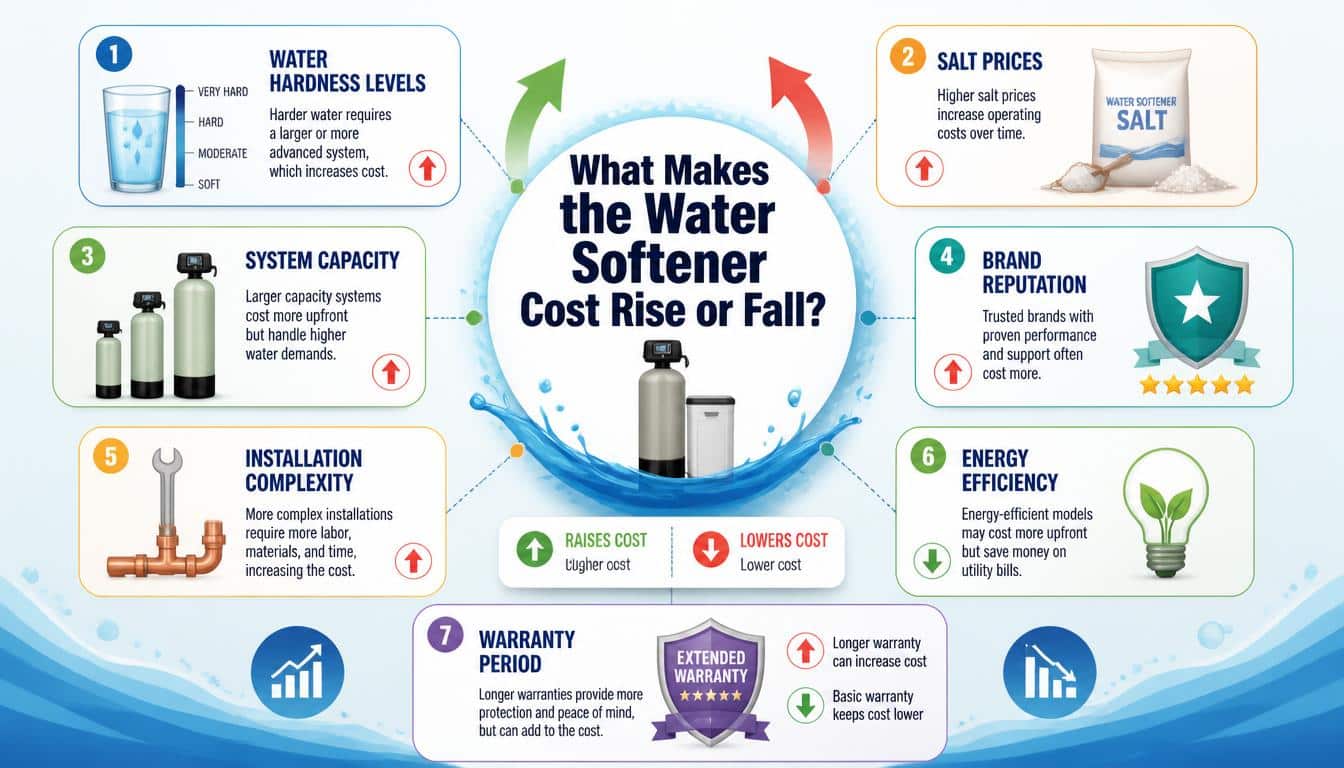
Two homes can buy almost identical-looking systems and somehow end up with bills that look like distant cousins.
The reason is usually the home’s water hardness, household size, installation location, and the amount of plumbing modification needed.
- Water hardness: More calcium and magnesium usually means greater softening capacity.
- Household size: Five people using lots of water need more capacity than one quiet occupant.
- Grain capacity: Systems are commonly sized using grains per gallon (GPG) and daily water use.
- Installation location: A basement with easy access is friendlier to installers than a cramped crawl space.
- Existing plumbing: A ready-made softener loop can reduce labor.
- Drain access: Regeneration requires proper drainage, which may mean additional plumbing work.
- Electrical access: Some systems need a nearby outlet or electrical adjustment.
- Local labor rates: The same installation can cost very differently across regions.
A useful sizing idea is to consider people, daily water consumption, and hardness together rather than simply buying the biggest tank in the showroom.
One 2026 cost guide, for example, uses household water use and GPG hardness to estimate required capacity, which is much more sensible than guessing by house size alone.
Water Softener Installation Cost by System Type
The type of system you choose can change the bill dramatically, because water softening technologies do not all do the same thing. A conventional ion-exchange softener removes hardness minerals, while other products may only reduce mineral scaling.
- Salt-based water softener: Usually the classic choice for removing calcium and magnesium through ion exchange.
- Sodium chloride system: Uses salt to regenerate the resin that captures hardness ions.
- Potassium chloride system: Performs a similar softening process but uses potassium instead of sodium chloride.
- Magnetic water softener: Attempts to alter how minerals behave, but it should not be treated as equivalent to conventional softening.
- Electronic or magnetic treatment: Often cheaper to install, but performance claims vary and these devices generally do not remove hardness minerals.
- Dual-tank water softener: Uses two resin tanks, allowing one to regenerate while the other continues supplying softened water.
- Whole-house water softener: Treats the home’s main water supply instead of only one faucet or appliance.
- Reverse osmosis system: Uses high-pressure filtration and can address a broader range of dissolved contaminants, so it is not simply another name for a softener.
The distinction matters more than it first appears. Reverse osmosis and conventional softening belong in the same larger water-treatment conversation, but they solve different problems.
A softener focuses mainly on hardness minerals; reverse osmosis is a broader water filtration technology. Mixing those two ideas can lead to spending money on the wrong machine, which is a rather expensive way to learn chemistry.
Hard Water Problems That Can Justify the Expense
Hard water is usually not a dramatic plumbing villain. It works more like a very patient houseguest who slowly leaves souvenirs everywhere.
Over time, mineral buildup can affect fixtures, appliances, pipes and the general feeling of cleanliness.
- White hard water stains can appear on sinks and faucets.
- Bathtubs and showers may develop stubborn scale.
- Dishwashers can leave spots on glasses and silverware.
- Soap may lather poorly in very hard water.
- Laundry can feel stiff or rough after repeated washing.
- Mineral deposits may accumulate inside pipes and water-using appliances.
- Significant buildup can contribute to restricted flow and reduced water pressure.
- Some people notice their skin feels drier after washing with hard water.
- Hair can feel less smooth when mineral residue accumulates.
- Water heaters and other appliances can suffer from repeated scale exposure.
A softener can help reduce calcium buildup, magnesium buildup, and other hardness-related deposits.
It will not magically fix every water-quality problem, however, and thats a distinction worth keeping before you sign a contract.
Water Softener Installation Cost: Labor, Plumbing, and Permits
The equipment may arrive in a neat box, but installation is where your house gets involved in the conversation. A licensed plumber may need to cut and reconnect supply lines, create or modify a drain connection, install bypass components, and make sure the system is correctly positioned.
- Basic water softener installation labor may start around $150.
- More complicated professional installation can reach $1,000 or more.
- New or rerouted pipes increase the project cost.
- A missing drain connection may require additional work.
- Electrical modifications can add another expense.
- Difficult basement or crawl-space access can increase labor time.
- Removing an old softener can add disposal or labor charges.
- A required water softener permit may add roughly 100 in some locations.
- Inspection requirements vary by locality.
- Older plumbing may reveal unrelated leaks or repairs once work begins.
Current 2026 cost data places professional installation broadly around 1,000, with the final amount depending heavily on system type and plumbing complexity.
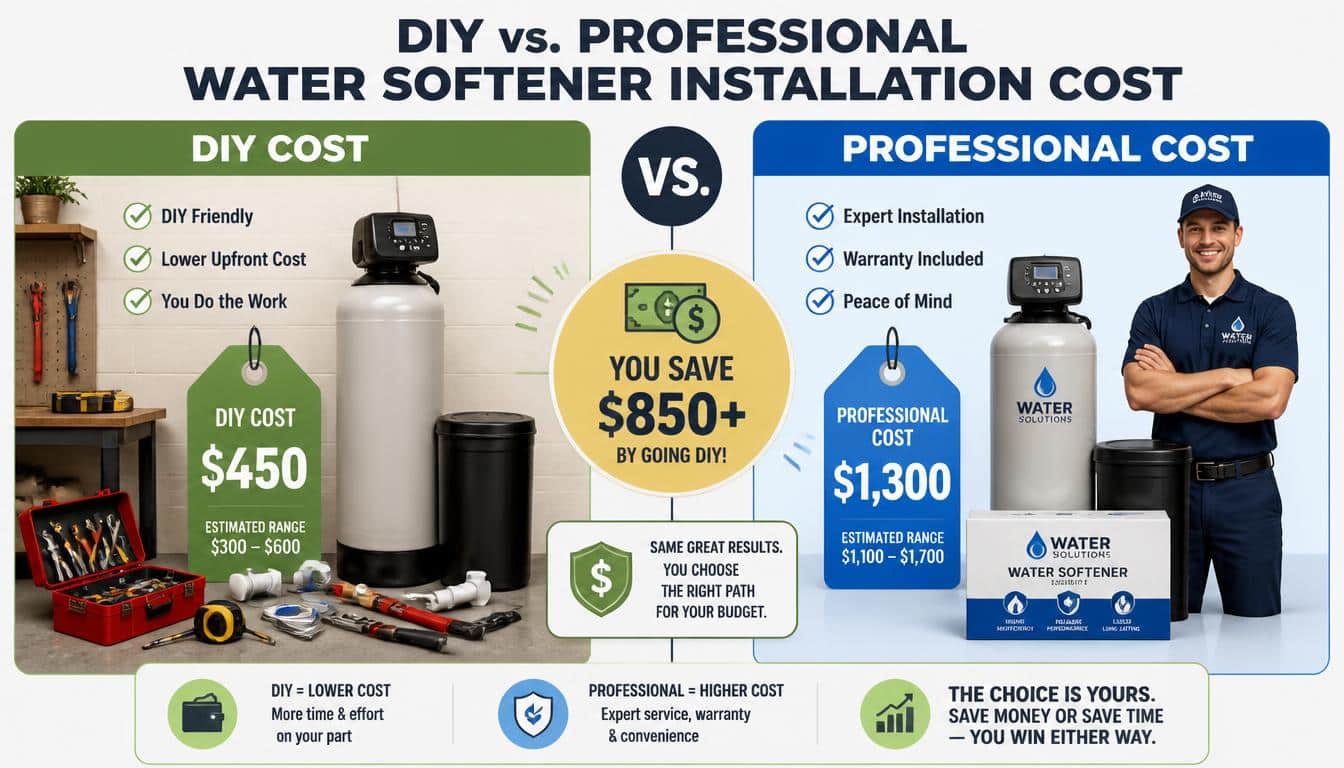
DIY Water Softener Installation Cost vs. Professional Installation
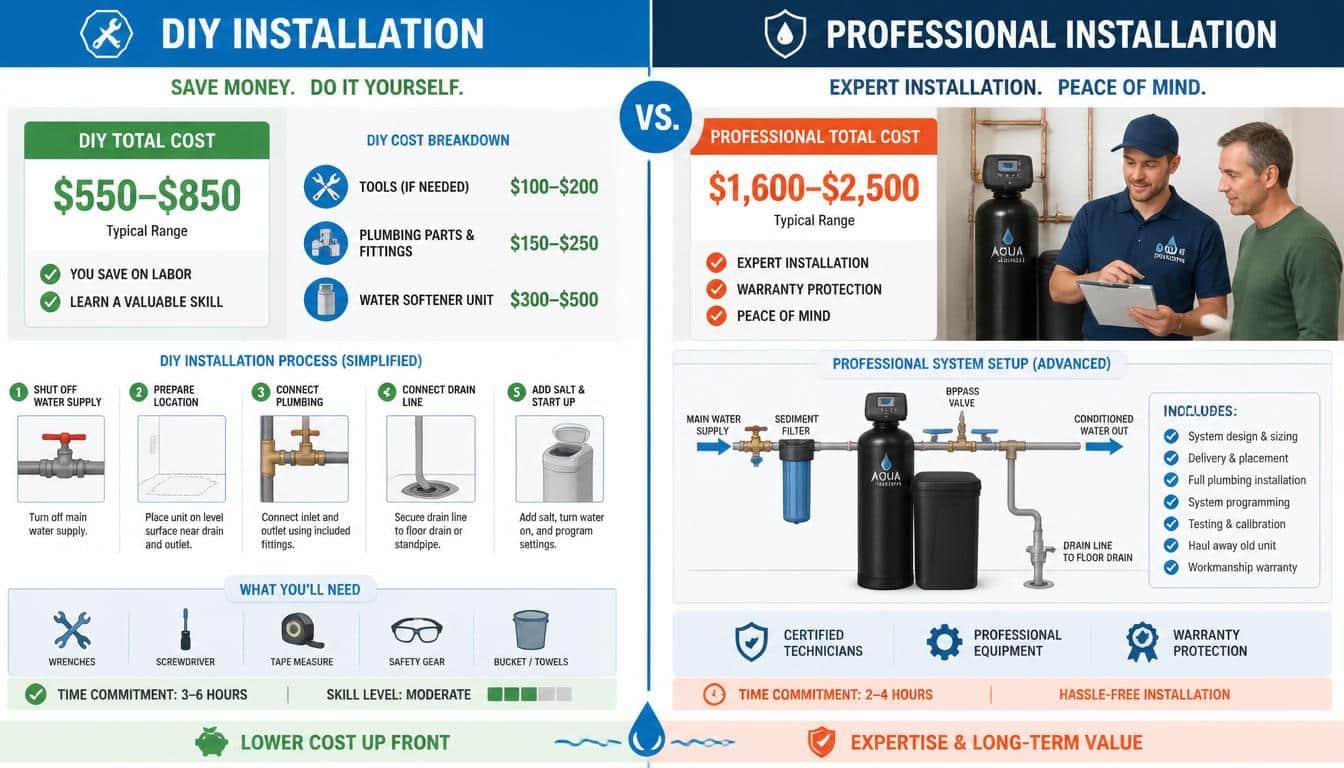
For a confident homeowner, DIY water softener installation can look temptingly simple. Turn off the water, connect the lines, install the drain, plug things in, follow the instructions and hopefully nobody discovers a surprise indoor swimming pool.
- DIY can reduce or eliminate professional labor costs.
- Basic plumbing tools may be enough for a straightforward installation.
- Manufacturer instructions should be followed closely.
- The water supply must be shut off before cutting existing pipes.
- Connections need careful leak testing.
- Drain routing must follow the system requirements.
- Incorrect sizing can leave a household with inadequate softening capacity.
- A DIY installation may not satisfy local permit or inspection rules.
- Warranty requirements may sometimes influence installation choices.
- Professional installation can be worthwhile when plumbing changes are extensive.
A straightforward setup may be manageable for someone with real plumbing experience, but water is remarkably good at finding the one connection you thought was “probably fine.”
Professional installation can also reduce the chance of leaks, incorrect connections, and poorly configured regeneration cycles.
Water Softener Maintenance Cost in 2026
The initial purchase is only the opening chapter. A water softener maintenance cost budget should include salt or potassium, cleaning, occasional service, and eventually replacement parts. The machine does not send you a thank-you note when it needs attention, sadly.
- Salt refill: A 40-pound bag may cost around
- Potassium refill: Often costs considerably more than standard salt.
- Salt usage: Depends on hardness, household consumption, system efficiency, and settings.
- Regeneration: Uses water and salt to recharge the resin.
- Filter replacement: Applies when the setup includes a prefilter or additional filtration.
- Tank cleaning: Periodic cleaning may be recommended by the manufacturer.
- Inspection: A professional check can identify valve or resin problems early.
- Replacement parts: Control valves, seals and other components may eventually need replacement.
- Water testing: Testing after installation can confirm that the system is performing properly.
- Long-term operating costs: Should be considered before choosing between systems.
For a typical salt-based system, salt expense can be modest compared with the original purchase, while potassium chloride can make the recurring bill noticeably larger.
Some households may spend around $10 a month on salt, while potassium use can approach $50 a month in higher-consumption situations, although actual usage varies quite a lot.
Water Testing Before You Install a Softener
A water hardness test is one of the less glamorous steps in the project, but it can save you from buying a system that is either too small or wildly oversized. Testing can reveal hardness levels and, depending on the test, other water impurities.
- A basic DIY water test kit may cost around
- Professional water testing may cost approximately
- Hardness is commonly expressed in GPG water hardness.
- Testing can identify calcium and magnesium concentration.
- Private well owners may need broader well water testing.
- Well water can contain impurities that require treatment beyond softening.
- Municipal water may have different treatment needs.
- Chlorine is a separate water-quality concern from hardness.
- Volatile organic compounds (VOCs) require specialized testing and treatment.
- Testing helps determine whether you need softening, filtration, or both.
This is especially important for a private well. A softener can handle hardness, but it isn’t a universal answer to poor well-water quality, bacteria, iron, VOCs, or every other possible contaminant. A proper test tells you what problem you are actually buying a solution for.
Whole-House Water Softener Cost for Different Homes
A whole-house water softener is usually sized around the household’s actual water demand rather than simply the number of bedrooms.
A large family may need considerably more capacity than a small household, even if both live in similarly sized homes.
- A small household may use a lower-capacity system.
- A five-member household often needs greater grain capacity.
- Large families should consider peak water use as well as average use.
- A system starting around 24,000 grains may suit some smaller applications, but sizing must be calculated.
- Very hard water can require higher capacity.
- Multi-bath homes can experience greater simultaneous demand.
- A private well may require additional pretreatment.
- A municipal water customer may have different filtration needs.
- Second-floor bathrooms do not automatically require a separate softener.
- Commercial or multi-family applications need a more specialized calculation.
Buying a giant system “just to be safe” is not always smart. Oversizing can mean paying more upfront and potentially carrying unnecessary operating expense,
while undersizing can produce frequent regeneration and disappointing results. The sweet spot lives somewhere in the middle, annoyingly enough.
How to Save on Water Softener Installation Cost
The easiest way to save money is not always buying the cheapest tank. Sometimes it means making the installation boring, straightforward and properly planned before the plumber arrives.
- Get at least three free estimates when practical.
- Ask whether the quote includes labor and materials.
- Confirm whether permits and inspections are included.
- Compare equipment capacity, not just brand names.
- Test your water before choosing a system.
- Check whether an existing softener loop can be reused.
- Ask about disposal of an old unit.
- Compare salt and potassium operating costs.
- Avoid paying for filtration you do not actually need.
- Consider DIY only when the plumbing work genuinely suits your skills.
A written quote should explain what happens if the contractor discovers old pipes, inadequate drainage, or another installation obstacle.
“Installation included” can mean different things to different people, and that little phrase deserves a few more questions than it usually gets.
Is a Water Softener Worth the Cost?
For homes suffering from persistent hard water problems, the value can extend beyond the nicer-looking faucet.
Reduced mineral buildup, easier cleaning, softer-feeling laundry, and less scale exposure for plumbing and appliances can make the system useful for years.
- It can reduce mineral deposits around faucets.
- It can help limit scale inside plumbing.
- It may improve the feel of washed laundry.
- It can make soap and detergents work more effectively.
- It may reduce spotting on dishes and glassware.
- It can reduce hard-water scale on bathroom fixtures.
- It may help protect water-using appliances from mineral buildup.
- It can make cleaning routines less irritating.
- It may be especially useful in areas with high water hardness.
- It provides a long-term hard water treatment option rather than repeatedly scrubbing symptoms.
Still, value depends on the actual hardness level, household priorities, and system price. If your water is only mildly hard, spending thousands on an elaborate setup
may be overkill; sometimes the most sensible water treatment is the one that solves the actual problem and then quietly goes about its business.
Read This Blog: https://gracethemes.com/what-time-was-it-9-hours-ago/
Final Thoughts on Water Softener Installation Cost in 2026
The water softener installation cost in 2026 is best thought of as a range, not a magic number.
Around $1,500 is a useful national benchmark, but a real project may land much lower or climb toward $6,000 or beyond when capacity, plumbing modifications, premium equipment, or additional filtration enter the picture.
Before buying, test the water, calculate household demand, compare system types, and ask a qualified installer for a detailed quote.
A good water softener system should match your water hardness and household usage rather than simply matching the biggest number printed on a product box.
Most importantly, remember that a softener is a mineral removal system, not a cure-all for every water impurity.
Calcium and magnesium are one problem; chlorine, VOCs, bacteria and other contaminants may need different water filtration or treatment technology. Getting that distinction right can save both money and a fair bit of future head-scratching.
If you have recently installed a softener, sharing what you paid, what type you chose, and whether you hired a plumber can be genuinely useful to other homeowners comparing their options.
Real-world experiences often explain the final bill better than a shiny brochure ever could, and thats where a price guide becomes actually helpful.
