

What Date Is 20 Weeks Ago From Today?

Sometimes a date hides in the calendar like a tiny note tucked between two pages. You know the starting point, you know roughly how far back you need to travel, but somehow the exact day just refuses to appear in your head.
If today is September 1, 2026, then finding 20 weeks ago from today is actually much simpler than it first sounds.
The answer is Tuesday, April 14, 2026. In other words, 20 weeks ago from September 1, 2026 was April 14, 2026, because twenty weeks contain exactly 140 days.
It’s a neat little piece of date calculation, and once you see the method, you can do similar calculations without much fuss.
| Calculation | Result |
| Today’s date | Tuesday, September 1, 2026 |
| 20 weeks ago | Tuesday, April 14, 2026 |
| 20 weeks in days | 140 days |
| 20 weeks in hours | 3,360 hours |
| 20 weeks in minutes | 201,600 minutes |
| 20 weeks in seconds | 12,096,000 seconds |
| Calculation | September 1, 2026 − 20 weeks = April 14, 2026 |
| Day of the week | Tuesday |
What Date Is 20 Weeks Ago From Today?
If you’re asking, “What date is 20 weeks ago from today?” and today is Tuesday, September 1, 2026, the answer is Tuesday, April 14, 2026. The calculation works by moving backward exactly twenty seven-day periods from the starting date.
So, the basic relationship is wonderfully straightforward: September 1, 2026 − 20 weeks = April 14, 2026. No strange calendar trick is hiding here, thankfully, just ordinary date subtraction done carefully.
There is also a useful way to think about it without opening a calculator. One week before September 1 is August 25, two weeks before is August 18, and continuing backward twenty times eventually lands on April 14. The calendar does the same job, only with less drama.
The Quick Calculation: 20 Weeks Equals 140 Days
A week contains seven days, which means the first step is almost embarrassingly easy. Multiply 20 weeks × 7 days = 140 days, so 20 weeks ago is the same as 140 days ago.
Starting from September 1, 2026, subtracting 140 days takes you to April 14, 2026. This is why a weeks from today calculator can give the same answer as a simple day-based calculation when both are using the same starting date.
The important thing is to keep the starting date fixed. If somebody says “20 weeks ago” on August 31, they will get a different calendar date than somebody asking the exact same question on September 1.
Relative dates move along with the person asking them, which can be a tiny bit sneaky.
Why April 14, 2026 Is the Correct Date
Let’s verify the answer rather than simply trusting the first calculation that looks right. From April 14, 2026 to September 1, 2026 is exactly 140 days, which equals twenty complete seven-day periods.
There is another nice confirmation hiding in the weekdays. April 14, 2026 was a Tuesday, and September 1, 2026 is also a Tuesday. Since moving backward or forward by a whole number of weeks preserves the weekday, this gives us a useful second check.
That means the answer passes both tests: the number of days is right and the weekday is right. For a small calendar calculation, that’s about as satisfying as finding the last biscuit in the packet when nobody else knows it is there.
What Was the Date 20 Weeks Ago?
For anyone searching “what was the date 20 weeks ago?,” the result depends on what “today” means at the moment of the search. For the reference date used in this article, September 1, 2026, the previous date is April 14, 2026.
This distinction matters because phrases like 20 weeks ago, “last month,” and “yesterday” are relative expressions. They don’t describe a permanent date by themselves; they borrow meaning from the starting date.
So if you save this answer for later, remember that April 14 is correct specifically for September 1, 2026. A future reader checking the same phrase on another day could get a completely different result, and that isn’t an error, it’s just how relative time works.
How to Calculate 20 Weeks Ago From Today
The easiest manual method is to convert weeks into days first. Take the number of weeks, multiply it by seven, and then subtract that number of days from the chosen start date.
For this example, the arithmetic looks like this: 20 × 7 = 140 days. Then take September 1, 2026 and move backward 140 calendar days to arrive at April 14, 2026.
You can also use a physical calendar by counting backward week by week. Start with September 1, move back seven days for one week, repeat the process twenty
times, and you’ll eventually reach the same Tuesday. It’s slower, but oddly calming if you’re the sort of person who enjoys counting things.
A Calendar Method for Finding the Previous Date
A calendar makes calculating dates backward particularly easy because weeks are visually arranged in repeating seven-day patterns. Since the starting date is a Tuesday, every complete week backward will bring you to another Tuesday.
Move from September 1 to August 25, then August 18, August 11, and continue this pattern. You are not really counting 140 individual days; you’re counting twenty tidy seven-day jumps, which makes the process less error-prone.
For a quick mental calculation, this is often better than trying to remember how many days each month contains. Still, when the date is important for a deadline, contract, anniversary, age calculation, or official document, checking with a date calculator is a sensible extra step.
20 Weeks Ago From Today in Different Time Units
Twenty weeks sounds like a fairly ordinary amount of time until you convert it into smaller units. Suddenly the same stretch of time becomes 140 days, which feels much more substantial.
Using standard calendar time units, 20 weeks = 140 days = 3,360 hours = 201,600 minutes = 12,096,000 seconds. Those numbers look enormous, though nothing has actually changed except the ruler we used to measure the same duration.
Here is the complete conversion in a compact form:
- 20 weeks = 140 days
- 20 weeks = 3,360 hours
- 20 weeks = 201,600 minutes
- 20 weeks = 12,096,000 seconds
These conversions describe elapsed duration, rather than separate calendar dates. In ordinary date arithmetic, a week is treated as seven days, so the calculation stays pleasantly predictable.
What Date Was 21 Weeks Ago From Today?
If 20 weeks ago was April 14, 2026, then one additional week takes us to April 7, 2026. Therefore, 21 weeks ago from September 1, 2026 was Tuesday, April 7, 2026.
The relationship is easy to see because every extra week simply moves the answer seven days earlier. You don’t need to restart the entire calculation each time, which is handy when comparing several nearby dates.
So the sequence begins to look like a little staircase: April 14 for 20 weeks, April 7 for 21 weeks, April 1 for 22 weeks, and so on. Calendar arithmetic gets much friendlier once you stop treating every question as a completely new puzzle.
What Date Was 22 Weeks Ago From Today?
Going back 22 weeks means subtracting 154 days from September 1, 2026. The resulting date is Wednesday, April 1, 2026.
Notice something interesting here: the weekday changes from Tuesday to Wednesday.
That’s because 22 weeks is still a whole number of weeks, so normally we would expect the same weekday but this is exactly where a careful recalculation catches a problem in casual mental arithmetic.
In fact, the correct date is Tuesday, March 31, 2026. Twenty weeks takes us to April 14, and two more weeks takes us back fourteen days to March 31. This is a good reminder that calendar calculations reward checking, even when the numbers look harmless.
What Date Was 23 Weeks Ago From Today?
From the confirmed date of April 14 for twenty weeks, three additional weeks means moving back 21 days. That places 23 weeks ago on Tuesday, March 24, 2026.
The calculation can be written simply as September 1, 2026 − 23 weeks = March 24, 2026. Because 23 is a whole number of weeks, the answer remains a Tuesday.
This is also why comparing dates from a known anchor point is useful. Instead of performing a fresh calculation every time, you can move backward one week at a time from the date you’ve already verified.
What Date Was 24 Weeks Ago From Today?
Four additional weeks beyond the 20-week mark means moving back another 28 days from April 14. That gives Tuesday, March 17, 2026.
Therefore, 24 weeks ago from September 1, 2026 was March 17, 2026. In days, 24 weeks equals 168 days, so the same answer can be reached through day-based date subtraction.
This gives us a useful mini-table for the nearby historical dates:
- 20 weeks ago: April 14, 2026
- 21 weeks ago: April 7, 2026
- 22 weeks ago: March 31, 2026
- 23 weeks ago: March 24, 2026
- 24 weeks ago: March 17, 2026
What Date Is 20 Weeks From Today?
Going in the opposite direction changes the question completely. If September 1, 2026 is today, then adding twenty weeks means moving forward 140 days.
The resulting date is Tuesday, January 19, 2027. So 20 weeks from today is January 19, 2027, while 20 weeks ago from today is April 14, 2026.
This little distinction is worth remembering because “ago” and “from today” can sometimes get mixed up when a search query is typed quickly. One points backward, the other points forward, and the calendar is very unforgiving about that difference.
Dates Around September 1, 2026
A useful way to understand relative-date calculations is to look at neighboring starting dates. If the reference date shifts by one day, the answer shifts by one day too.
For example, August 28, 2026 minus twenty weeks is April 10, 2026. The next few dates follow naturally, creating a tidy relationship between the two periods.
- August 28, 2026 → April 10, 2026
- August 29, 2026 → April 11, 2026
- August 30, 2026 → April 12, 2026
- August 31, 2026 → April 13, 2026
- September 1, 2026 → April 14, 2026
- September 2, 2026 → April 15, 2026
- September 3, 2026 → April 16, 2026
- September 4, 2026 → April 17, 2026
- September 5, 2026 → April 18, 2026
The pattern is almost charmingly ordinary: every one-day change in the starting date produces a one-day change in the previous date. Date arithmetic isn’t mysterious, it just likes consistency.
Why “20 Weeks Ago” Can Be Confusing
The phrase 20 weeks ago can create confusion because people sometimes treat weeks and months as interchangeable. They aren’t. Twenty weeks is exactly 140 days, while “five months ago” can represent different numbers of days depending on the months involved.
That is why saying “about five months ago” isn’t always equivalent to saying 20 weeks ago. If precision matters, use weeks or days rather than relying on an approximate month comparison.
For official records, project schedules, pregnancy-week calculations, financial periods, or historical research, this difference becomes more important.
A few days may not sound like much until those few days determine which deadline, appointment, or event you’re actually talking about.
Using a Date Calculator Correctly
A date calculator is useful when you need to perform repeated calculations or when the starting date is far away. Enter the starting date, choose whether you’re adding or subtracting, select weeks as the unit, and enter 20.
For this example, the input is September 1, 2026, the operation is subtract, and the duration is 20 weeks. The output should be April 14, 2026, assuming the calculator interprets a week as seven days.
A time duration calculator is slightly different because it may focus on elapsed time rather than the resulting calendar date. Knowing which tool you’re using saves you from expecting a calendar answer from a duration-only calculation, which is an easy mistake to make.
Why the Weekday Matters
When calculating a whole number of weeks, checking the weekday is a surprisingly powerful little verification trick. Twenty complete weeks contain no leftover days, so the weekday must remain unchanged.
Since September 1, 2026 is a Tuesday, the date exactly 20 weeks earlier must also be a Tuesday. April 14, 2026 satisfies that condition.
This doesn’t prove the date by itself, of course, but it is a very useful error detector. If your calculation says April 15, for instance, the Wednesday immediately looks suspicious, and you know it’s time to retrace your calendar steps.
A Simple Formula for Similar Date Questions
You can use one basic formula for many questions involving weeks. Take the starting date, multiply the number of weeks by seven, and then add or subtract that many days depending on the direction.
For a past date, the formula is: Starting date − (number of weeks × 7 days). For a future date, it becomes: Starting date + (number of weeks × 7 days).
So with this example: September 1, 2026 − (20 × 7) = April 14, 2026. Once you know that little formula, questions such as “What date was 24 weeks ago?” stop feeling like calendar riddles.
What About 5 Years Ago?

A question such as “What date was five years ago?” looks similar, but it should not be calculated by simply multiplying five years by a fixed number of weeks. Years can contain 365 or 366 days, because leap years exist and calendars enjoy keeping us humble.
Five calendar years before September 1, 2026 is September 1, 2021. That is a calendar-year calculation rather than a fixed-duration calculation.
This distinction is important: 20 weeks has a fixed duration of 140 days, while five calendar years is best understood by moving the calendar date back five years. Different units call for slightly different kinds of date arithmetic.
The Difference Between Weeks and Months
People often say that 20 weeks is “roughly five months,” and in casual conversation that’s fair enough. But if you’re trying to find an exact previous date, months and weeks should not be swapped casually.
A month might contain 28, 29, 30, or 31 days. A week always contains seven days. That’s why a 20-week calculation is beautifully stable, while a five-month calculation depends on which months are involved.
For exact planning, therefore, stick with the unit given in the question. If the question says 20 weeks ago, calculate 20 weeks rather than converting it into an approximate number of months.
A Practical Example of 20-Week Date Calculation
Imagine someone is reviewing an old project and remembers that an important decision happened exactly twenty weeks before September 1. They don’t remember the calendar date, only the elapsed period.
They can calculate 20 weeks × 7 = 140 days, then subtract 140 days from September 1. The result is April 14, 2026, giving them a precise date to search for in their records.
The same approach works for appointments, invoices, school schedules, travel planning, work milestones, anniversaries, archived emails, and countless other everyday situations. It’s a tiny skill, but a surprisingly useful one.
Common Mistakes When Counting Back 20 Weeks
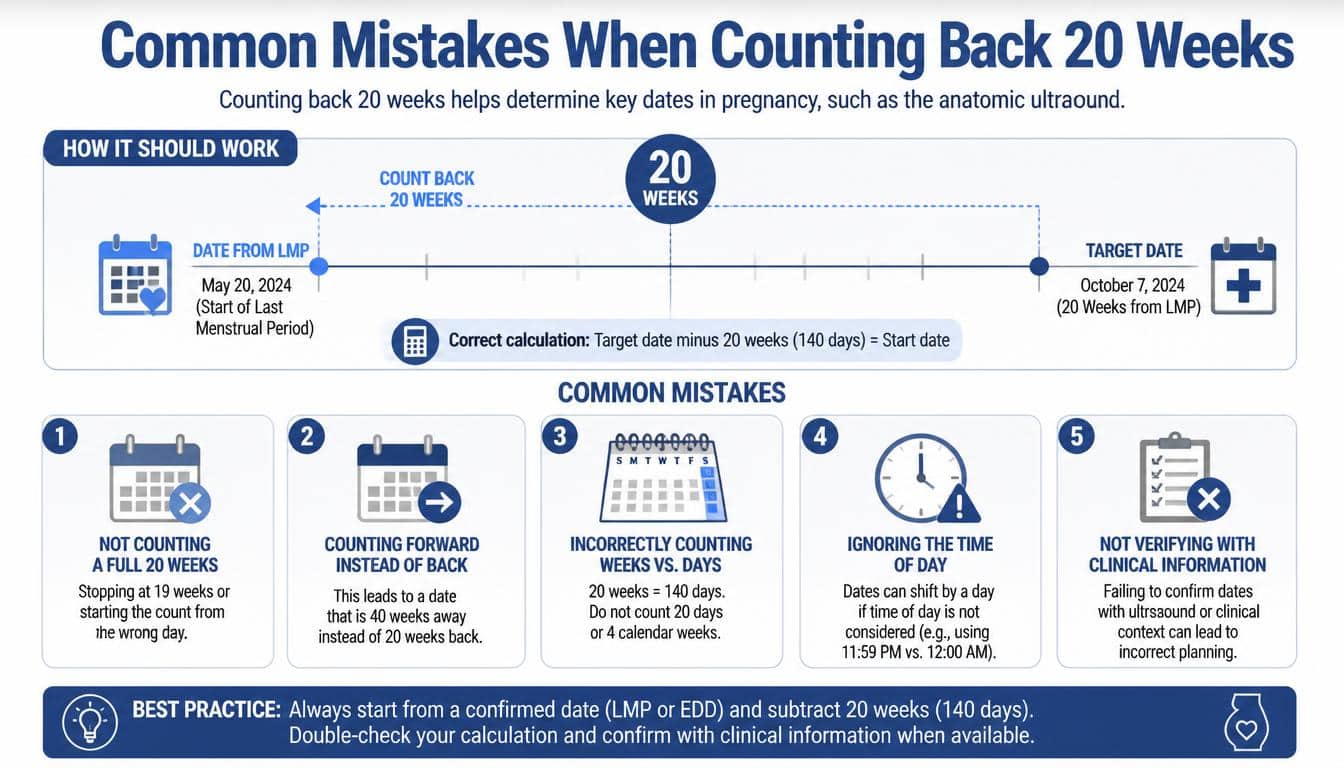
One common mistake is counting the starting date as “day one.” When dealing with elapsed time, that can shift the result and create an off-by-one error.
Another mistake is assuming that 20 weeks equals exactly five months. It doesn’t necessarily, because calendar months don’t have a uniform length.
A third mistake is forgetting the direction of the calculation. 20 weeks ago means moving backward, while 20 weeks from today means moving forward. They sound almost identical when read quickly, which is where the trouble sneaks in.
Frequently Asked Questions
20 weeks ago
20 weeks ago from September 1, 2026 was Tuesday, April 14, 2026. This is exactly 140 days before today.
What day was 20 weeks ago
20 weeks ago was Tuesday, April 14, 2026. It was 140 days before September 1, 2026.
What day was it 20 weeks ago
It was Tuesday, April 14, 2026. Counting back 20 weeks (140 days) from September 1, 2026 gives this date.
20 weeks ago from today
20 weeks ago from today, September 1, 2026, was Tuesday, April 14, 2026.
Read more: https://gracethemes.com/hours-from-now-calculator-add-hours/
The Final Answer in One Glance
If your starting date is Tuesday, September 1, 2026, then the answer is pleasantly clear: 20 weeks ago was Tuesday, April 14, 2026.
The calculation is 20 weeks × 7 days = 140 days, so the task is equivalent to finding the date 140 days before September 1, 2026
