

Hours From Now Calculator – Add Hours
Time has a funny habit of slipping away while we are busy doing everything else. One moment it is morning coffee, and suddenly the evening is standing at the door.
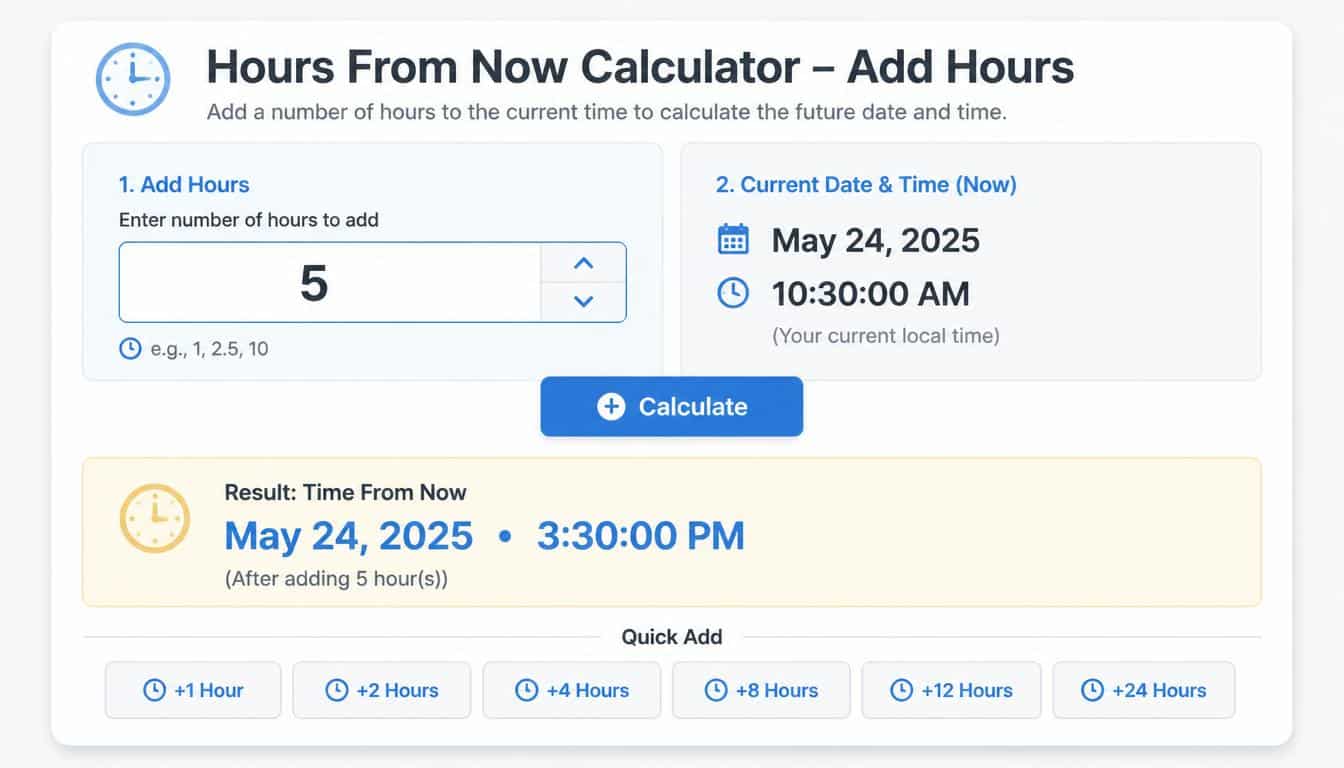
An Hours From Now Calculator makes that little mystery easier by showing exactly what happens when you add a certain number of hours to a starting time.
For some people, calculating future time is just about scheduling a meeting. For others, it can mean knowing when a reminder should ring, when an appointment begins, or when a long-awaited family moment finally arrives.
Even welcoming a baby girl can make people suddenly very aware of every passing minute, which is kinda beautiful.
| Hours From Now | Equivalent Time |
| 1 hour from now | Current time + 1 hour |
| 2 hours from now | Current time + 2 hours |
| 4 hours from now | Current time + 4 hours |
| 4.5 hours from now | Current time + 4 hours 30 minutes |
| 8 hours from now | Current time + 8 hours |
| 10 hours from now | Current time + 10 hours |
| 18 hours from now | Current time + 18 hours |
| 20 hours from now | Current time + 20 hours |
| 24 hours from now | Same time on the next day |
| 32 hours from now | 1 day + 8 hours from now |
| 48 hours from now | Same time 2 days later |
| 72 hours from now | Same time 3 days later |
What Is an Hours From Now Calculator?
An Hours From Now Calculator is a simple time calculator designed to add hours to a particular starting point. Instead of doing time arithmetic in your head, you enter the starting time and the specified number of hours, and the calculator determines the resulting time.
The result can be useful for everyday planning because it may also show the corresponding date. If your calculation passes midnight, the answer moves into the following day, and that small detail is where manual calculations sometimes get a bit messy.
Think of it as a tiny bridge between current time and future time. You give it “now” or another starting time, tell it how many hours to add, and it tells you where the clock lands. Simple, yes, but surprisingly handy.
Hours From Now Calculator: How Does It Work?
The basic idea behind an Hours From Now Calculator is really just hour addition. The calculator takes a starting point and moves forward by the requested number of hours, while keeping track of AM, PM, minutes, and calendar changes.
Suppose your starting time is 3:00 PM and you want to add 2 hours. The answer is 5:00 PM. Nothing dramatic happened there, thankfully, because the calculation stayed inside the same afternoon.
Now imagine starting at 11:00 PM and adding 2 hours. You arrive at 1:00 AM on the following day. The clock did not simply keep moving from 12 to 13 in the 12-hour system; the calendar itself had to change too.
This is why a proper time and date calculation can be more useful than mental arithmetic. It handles the little traps, especially when calculations involve midnight, multiple days, or unfamiliar time formats.
How to Add Hours to a Time
To add hours to time, begin with the exact starting time. Then identify the number of hours you want to add. Move forward hour by hour, remembering that every 60 minutes makes one complete hour.
For example, if you start at 11:00 AM and add 2 hours, the answer is 1:00 PM. The clock crosses the AM/PM boundary, but the date stays the same. It sounds obvious, though these are exactly the calculations people occasionally second guess.
If your calculation begins at 11:00 PM and you add 2 hours, the answer becomes 1:00 AM on the following day. This is called crossing midnight, and it is one of the most common reasons a simple calculation becomes confusing.
For longer calculations, an hours calculator can save a surprising amount of effort. Adding 10 hours from now, 18 hours from now, or 20 hours from now manually is possible, but a calculator gives you the answer without making your brain do overtime.
Hours From Now Calculator and the 12-Hour Clock
The familiar 12-hour clock divides the day into two sections: AM and PM. Hours from 1 through 12 appear twice during a complete day, which is convenient for conversation but sometimes confusing for calculations.
For example, 1:00 PM and 1:00 AM are twelve hours apart, even though the number displayed on the clock is exactly the same. The little AM or PM label is doing alot of work there, more than we tend to notice.
When adding hours, always pay attention to whether the starting time is AM or PM. Forgetting that tiny detail can transform a correct calculation into a completely different future time.
An AM/PM conversion becomes especially important when moving between digital schedules, travel plans, reminders, and written invitations. A time like 8:00 can mean two very different things depending on the context.
24-Hour Clock and Military Time
The 24-hour clock removes much of that ambiguity by numbering the hours from 00 through 23. This format is often called military time, although it is also widely used in transportation, healthcare, technology, public services, and everyday schedules around the world.
In this system, 1:00 PM becomes 13:00, while 11:00 PM becomes 23:00. Midnight is normally represented as 00:00, which makes calculations feel a little cleaner once you get used to it.
A 24-hour to 12-hour time converter can help when you need to switch formats. If a schedule says 13:00, for example, the equivalent in the 12-hour system is 1:00 PM. It is the same moment, just wearing different clothes.
What Time Is 8 Hours From Now?
The question “what time is 8 hours from now?” sounds simple, but the exact answer depends on the current time and location. If your current time were 8:59 PM, adding 8 hours would take you to 4:59 AM on the next day.
That example shows why a time calculator needs both a starting point and a duration. “Now” is always moving, so an answer calculated at one moment will eventually become outdated, which is just time being time.
Similarly, someone searching “what time is 10 hours from now” needs to know the precise starting time. A calculation based on 9:00 AM will obviously differ from one based on 9:00 PM, even though the number of hours is identical.
Calculating Hours From Now Across Midnight
Crossing midnight is one of the easiest places to make a mistake when trying to calculate hours from now. The clock resets, but the elapsed time does not. That distinction is important.
Imagine a starting time of 11:00 PM. After one hour, it is midnight. After another hour, it is 1:00 AM. Therefore, adding 2 hours gives 1:00 AM on the following day, not 1:00 AM on the same date.
The same principle works when adding larger amounts. 72 hours from now is exactly three days later, assuming the calculation is based on elapsed clock hours rather than unusual daylight-saving adjustments. It is a longer jump, but the underlying idea remains the same.
Adding Minutes Along With Hours

Not every real-world calculation involves whole hours. Sometimes you need to add hours and minutes together, especially when arranging appointments or calculating travel durations.
There are 60 minutes in an hour, so 90 minutes can be understood as 1 hour and 30 minutes. A minutes to hours converter can make this conversion easier when the numbers get awkward.
For instance, adding 1 hour and 45 minutes to 11:30 PM first takes you to 12:30 AM, then to 1:15 AM. The result is on the following day, which again shows why the date matters as much as the clock.
Hours From Now for Scheduling Meetings
A time calculator is particularly useful when several people need to coordinate a meeting. Rather than saying “let’s meet three hours after lunch,” you can calculate the exact time and place it directly on a calendar.
For international teams, the situation gets even more interesting. A meeting at 13:00 in one person’s schedule may appear differently for someone using a 12-hour time format, and time-zone differences add another layer entirely.
Still, basic time calculation remains useful before you even consider time zones. First determine the future time in the relevant local clock, then check whether participants are actually in the same zone. Otherwise, the calendar may look innocent while quietly causing chaos.
Hours From Now for Reminders and Daily Planning
People use adding hours to a time for much more than meetings. You might want to set reminders, plan activities, calculate deadlines, organize study sessions, or decide when to start preparing for an appointment.
If you know your exact starting time, adding a specific duration gives you a clear target. This can be especially helpful when planning tasks that need to happen later in the evening or early the next morning.
A calculator also makes it easier to check unusual questions, such as “what time will it be in X hours?” Instead of repeatedly counting around the clock, you can enter the values and get a precise result.
What Time Was It 15 Hours Ago?
Calculating backward works much like adding hours, except the direction changes. Questions such as “what time was it 15 hours ago?” or “what time was it 18 hours ago?” require subtracting the requested duration from the starting point.
The tricky part is again the date. If the current time is early morning, subtracting several hours may move the result into the previous day. So the calculation needs to identify both the exact time and the correct calendar date.
The same idea applies to 16 hours ago, 17 hours ago, and 19 hours ago. Whether you’re checking a previous event or simply curious about when something happened, the calculation is still ordinary time arithmetic, just moving backwards instead of forward.
Future Dates and Multiple Days
Sometimes the requested duration is large enough to move beyond the next day. A calculation of 24 hours generally reaches the same clock time on the next calendar day, while 48 hours reaches the same clock time two days later.
When adding 72 hours from now, you are moving three complete days forward. This can be useful for planning deadlines, travel arrangements, recurring tasks, or events happening several following days from the starting point.
A good future time calculator should therefore be capable of handling both clock changes and date changes. Otherwise, you may get a technically correct hour but the wrong day, which isn’t terribly helpful when an appointment is involved.
Time Format Conversion Made Simple
Different schedules often use different formats, so knowing how to convert 24-hour time is a practical skill. The basic rule is easy: values from 13:00 through 23:00 correspond to 1:00 PM through 11:00 PM.
For example, 13:00 becomes 1:00 PM, while 23:00 becomes 11:00 PM. Midnight is 00:00, and noon is 12:00 PM. That last distinction catches people now and then, because 12:00 AM means midnight.
A 12-hour clock is common in casual communication, while the 24-hour clock is often preferred where precision matters. Neither system is inherently better; they simply organize the same 24-hour day in different ways.
Real-Life Moments Where Time Calculators Help

Imagine a parent waiting for relatives to arrive after a newborn baby girl has come home. Someone says, “We’ll be there in four hours.” Suddenly everybody is checking the clock, estimating traffic, and doing tiny calculations in their head.
This is where a time addition calculator feels surprisingly human. It turns a vague “later” into an exact moment, giving families something concrete to plan around during an already emotional day.
Across cultures, welcoming a daughter may involve flowers, prayers, family meals, naming ceremonies, gifts, photographs, or simply a very sleepy gathering around a tiny new person. The traditions differ, but the excitement of marking that moment is wonderfully familiar.
Sweet Baby Girl Wishes You Can Send
When a baby girl arrives, a short message can become a keepsake. It doesn’t need to sound grand or overly polished; sometimes the slightly imperfect message is the one parents remember because it sounds like you.
- “Congratulations on your beautiful baby girl! May her little life bring a giant amount of happiness to your home, every single day.”
- “A tiny daughter has arrived, and somehow she has already made the whole family smile wider. Wishing you endless cuddles and peaceful nights, or at least a few!”
- “Your little princess is here, and what a lovely reason to celebrate. May she grow surrounded by kindness, laughter, and people who adore her.”
- “Congratulations on welcoming your daughter! May her first days be soft, her future bright, and your home forever noisy with happy memories.”
- “She may be tiny today, but she has already filled a huge space in everyone’s heart. Sending warm newborn blessings to your growing family.”
- “Welcome to the world, little girl. May your journey be full of curious questions, brave dreams, muddy shoes, big laughs, and people who always cheer for you.”
- “A beautiful daughter has joined your family, and suddenly ordinary days have a whole new meaning. Wishing you love, patience, sleep, and plenty of sweet moments.”
- “Congratulations to the proud parents! Your baby girl has arrived with her own little story waiting to unfold, and I hope every chapter is wonderful.”
Warm Wishes From Grandparents and Relatives
Grandparents often experience a baby girl’s arrival as something almost circular: they remember raising their own children, and now another generation has entered the family story. The emotions can be surprisingly deep, even when the message is only a few lines.
- “Your daughter is a precious new branch on our family tree. We cannot wait to watch her grow, laugh, learn, and become wonderfully herself.”
- “Dear little granddaughter, you have arrived into a family already waiting to love you. Your grandparents are officially wrapped around your tiny finger!”
- “Congratulations to our growing family. This little girl has brought a new kind of sunshine into our lives, and we are grateful beyond words.”
- “May your daughter always know where home is, where love lives, and where she can return whenever the world feels too big.”
- “A granddaughter is a beautiful surprise in the story of a family. May every generation around her give her wisdom, laughter, and a safe place to land.”
- “She has the smallest hands and somehow the biggest ability to bring everyone together. Congratulations on this precious new arrival.”
- “May your baby girl grow with courage in her heart and kindness in her hands. We are already so proud of the little person she will become.”
Funny and Playful Newborn Messages
Not every baby announcement needs to sound like it belongs inside a greeting card. A little humor can make a congratulations message feel much more personal, specially when the parents already have a playful relationship with you.
- “Congratulations on your baby girl! Your household has officially hired a tiny boss, and rumor says she does not negotiate bedtime.”
- “She is adorable, she is tiny, and she already has everyone working for her. Welcome to parenthood’s cutest management position!”
- “Congratulations! May your coffee be strong, your naps be surprisingly available, and your baby girl’s smiles be unlimited.”
- “A daughter has arrived, which means your camera roll is about to become 97% baby pictures. Honestly, nobody will complain.”
- “Welcome, little one! Your parents looked like they knew what they were doing. We now understand that was probably confidence, not evidence.”
- “Congratulations on your beautiful baby girl. May she sleep peacefully tonight, although newborns apparently enjoy keeping mysterious schedules.”
- “Tiny socks, tiny fingers, giant responsibilities. Wishing your family loads of love and just enough sleep to remember what day it is.”
Poetic and Inspirational Newborn Blessings
Poetic wishes work beautifully when you want something that feels more memorable than an ordinary congratulations.
You can keep them simple, because a newborn doesn’t need complicated language to inspire complicated feelings.
- “May your daughter’s first sunrise be the beginning of a lifetime filled with bright mornings, gentle people, and brave dreams.”
- “A little girl has arrived like a quiet poem, bringing new meaning to ordinary rooms and turning familiar days into memories.”
- “May her laughter become one of the sounds your family treasures most, and may her courage grow as naturally as she does.”
- “Let her childhood be full of wonder, her friendships full of kindness, and her future wide enough to hold every dream she dares to imagine.”
- “May tiny footsteps one day travel far, while her heart always remembers the love that welcomed her home.”
- “She arrived small enough to hold in your arms, yet somehow large enough to rearrange an entire family’s idea of happiness.”
- “May your daughter grow not simply into someone successful, but into someone compassionate, curious, confident, and beautifully comfortable being herself.”
How to Write a Custom Message
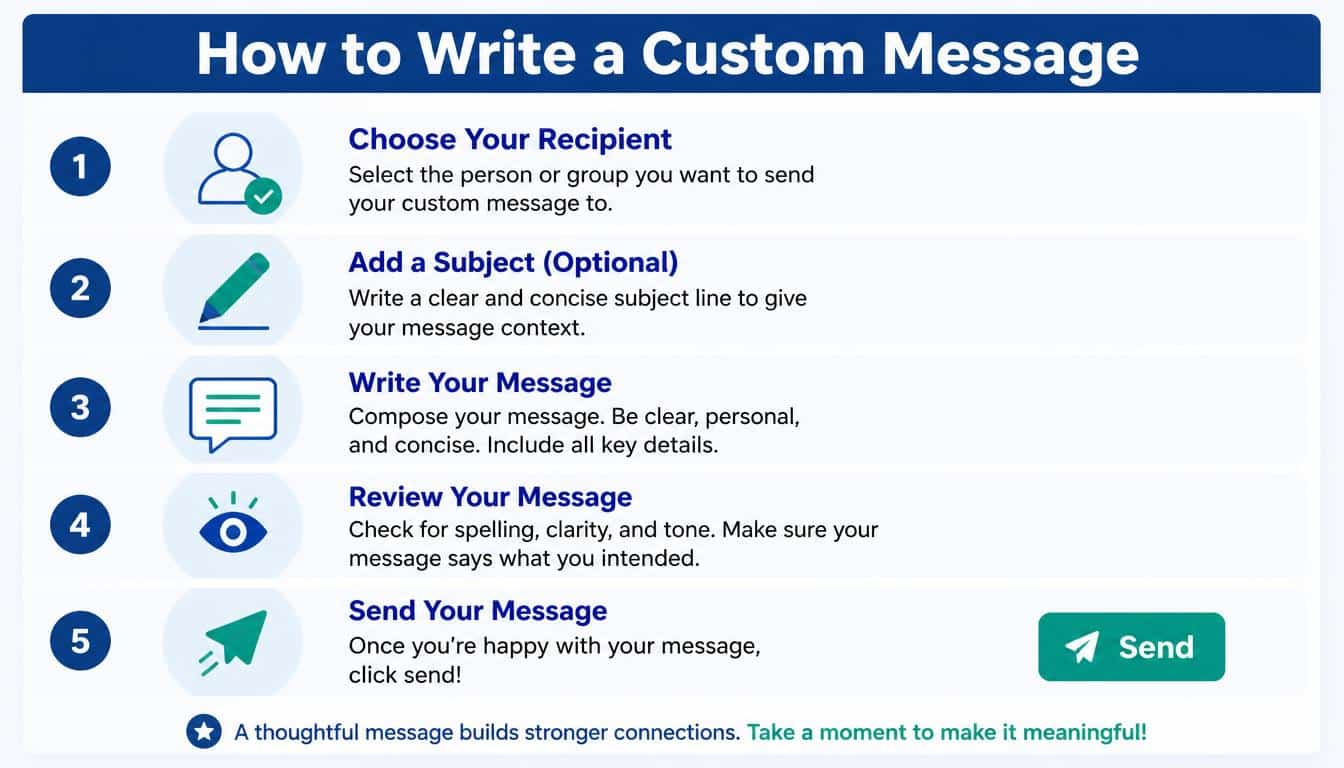
The easiest way to personalize a baby girl congratulations message is to mention one real detail. It could be the baby’s name, the parents’ excitement, a family tradition, or even a funny moment from the birth announcement.
Try combining three things: congratulations, a personal observation, and a hopeful wish. For example, mention how thrilled the grandparents are, then finish by wishing the baby a life filled with kindness. That small detail makes the message feel genuinely written rather than copied.
You can also match your wording to your relationship. A close friend may appreciate humor, while a colleague might prefer something warm and respectful.
The best message isn’t necessarily the fanciest one; it is the one that sounds like it came from an actual person.
Creative Ways to Deliver Your Wishes
A thoughtful message doesn’t always need to arrive as a standard text. You could write it inside a card, add it to a baby gift, record a short voice message, or leave a note for the parents to read when they finally have a quiet minute.
For digital congratulations, a personalized message can accompany a family photograph or a simple digital card.
If several relatives are sending wishes, collecting them into one shared keepsake can make the messages meaningful years later.
And yes, timing matters. Sending a message immediately is lovely, but sending one a few days later can also be thoughtful because new parents are often overwhelmed during the first rush.
A well-timed note can feel like someone quietly remembering them after the excitement settles.
Quick Guide to Using a Time Calculator
When you need to calculate time, start by identifying the exact starting time. Next, enter the number of hours or minutes you want to add, then check whether the result moves across AM/PM or midnight.
For example, starting at 4:59 AM and adding 8 hours produces 12:59 PM. Starting at 3:00 PM and adding 2 hours produces 5:00 PM. These examples are straightforward, but they demonstrate the same rules used for much larger calculations.
If your starting point is Wednesday, September 2, 2026, adding enough hours to cross midnight will move the result into Thursday. The calculator isn’t merely changing the displayed clock; it is calculating the complete time and date relationship.
Why Accurate Time Calculation Matters

Time seems ordinary until you need an exact answer. Missing a meeting by one hour, misunderstanding a deadline, or setting a reminder for the wrong part of the day can create unnecessary problems that were completely avoidable.
An Hours From Now Calculator reduces that uncertainty by handling repetitive arithmetic for you. It is especially useful when the calculation involves crossing AM and PM, crossing midnight, adding minutes, or moving into multiple days.
Whether you’re planning activities, scheduling meetings, calculating deadlines, setting reminders, or simply wondering what time it will be later, understanding the relationship between starting time + hours = future time is genuinely useful.
Frequently Asked Questions
Sure headings bilkul same rahengi. Neeche har H3 heading ke liye 1–2 line ka simple English answer hai:
4.5 hours from now
4.5 hours from now means 4 hours and 30 minutes after the current time. Add 4 hours and 30 minutes to find the exact time.
32 hours from now
32 hours from now is 1 day and 8 hours after the current time. Since it passes 24 hours, the result will be on the following day.
18 hours from now is what time
To find the time 18 hours from now, add 18 hours to the current time. If the calculation passes midnight, the date will change to the next day.
8 hours from now is what time
To calculate 8 hours from now, simply add 8 hours to the current time. Check whether the result crosses midnight or the AM/PM period.
2 hours from now
2 hours from now is the current time plus 2 hours. For example, if it is 3:00 PM now, 2 hours from now will be 5:00 PM.
Read This Blog: https://gracethemes.com/what-date-is-12-weeks-ago-from-today/
Final Thoughts on Hours From Now Calculations
Time calculation doesn’t have to feel like a puzzle hidden inside a clock. Once you understand hour addition, AM and PM, the 24-hour clock, minutes, and date changes, most calculations become wonderfully ordinary.
An Hours From Now Calculator simply makes that process quicker and less error-prone. You can use it to add hours to the current time, determine a future appointment, check a deadline, or understand exactly when something will happen.
And perhaps that is the nicest thing about measuring time: it gives shape to moments we might otherwise describe only as “later.”
Whether later means a meeting, a reminder, a deadline, or the moment a family gathers around a newborn baby girl, knowing the exact time helps us make room for what matters.
So when you next wonder “what time will it be in X hours?”, don’t wrestle with the clock longer than you need to.
Enter the starting time, add the specified number of hours, check the date, and carry on with your day. Time keeps moving anyway, might as well let the calculation be the easy part.
If you’d like, I can also turn this into a more SEO-aggressive 2,000–2,500 word version with a meta title, meta description, FAQ section, and keyword-rich H2/H3 structure.
