

What Date Is 2 Weeks Ago From Today
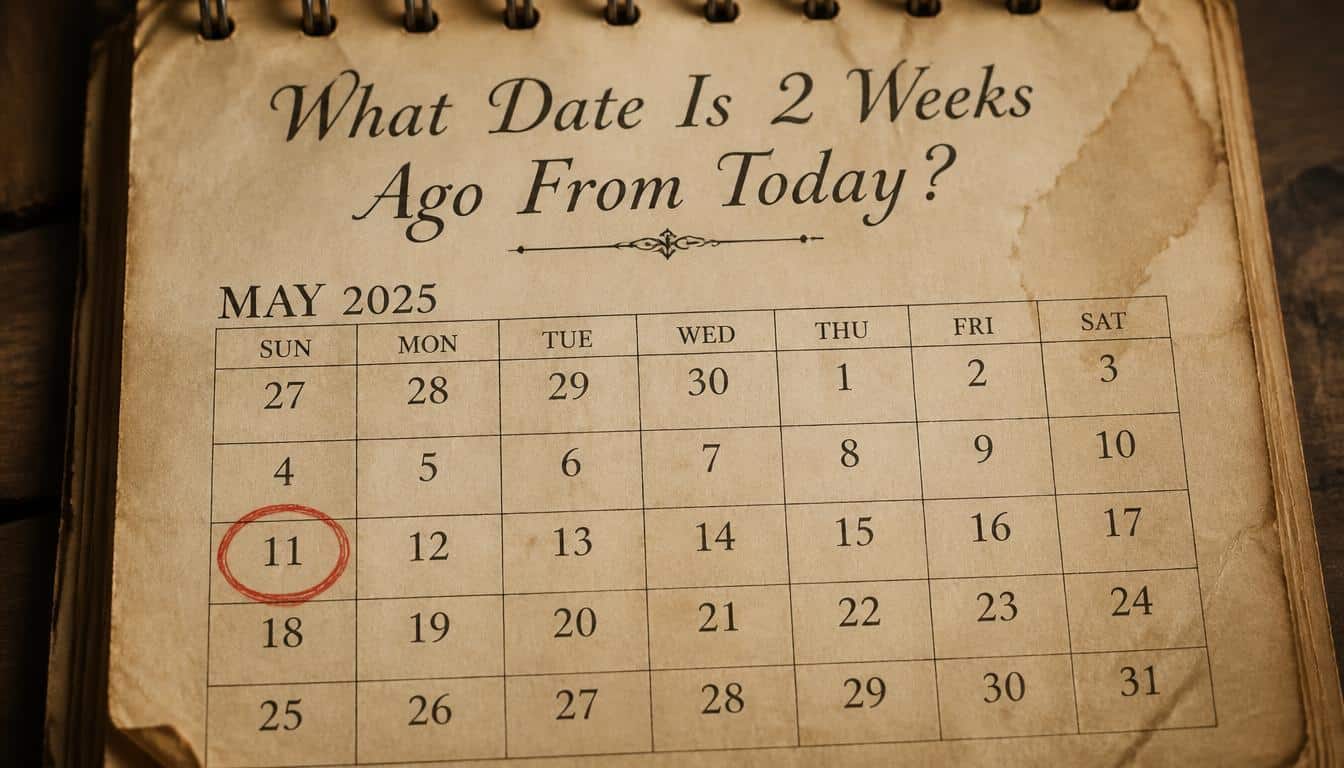
When a calendar question looks tiny, it can still make you pause for a second. If today is September 5, 2026, and you want to know what date is 2 weeks ago from today, the answer is August 22, 2026.
It sounds almost too simple, but relative dates can get surprisingly slippery when months change or when you’re counting quickly in your head, and that’s where a clear date calculation helps.
The good news is that 2 weeks always equals 14 days, so finding the answer only requires moving backward fourteen calendar days.
Starting with September 5, 2026, subtract fourteen days and you arrive at August 22, 2026, which was a Saturday. Thats the whole calculation, although there are a few useful ways to understand it.
| Calculation | Result |
| Today | September 5, 2026 |
| 2 weeks ago | August 22, 2026 |
| Days ago | 14 days |
| Hours ago | 336 hours |
| Minutes ago | 20,160 minutes |
| Seconds ago | 1,209,600 seconds |
| Day of the week | Saturday |
What Date Is 2 Weeks Ago From Today?
If Today is September 5, 2026, then the date 2 weeks ago was August 22, 2026. The calculation is simply: September 5 minus 14 days equals August 22.
Since two weeks contains exactly fourteen days, there is no special conversion needed before doing the basic calendar arithmetic, which makes this a pretty clean example.
So, if someone asks what date was 2 weeks ago from today, you can answer confidently: Saturday, August 22, 2026.
The word “ago” means moving backward from the reference date, while “from today” tells us that September 5, 2026 is the starting date for the calculation, not some earlier date.
A handy way to picture it is to imagine a small calendar sitting open on September 5. Move back one week and you land on August 29. Move back another week and you land on August 22.
That two-step movement is sometimes easier than counting every individual day, specially when you’re doing the calculation without a calculator.
The relative date is therefore August 22, 2026, while September 5, 2026 is the reference date. This distinction matters because “two weeks ago” is not a permanent date; it changes whenever today changes.
Tomorrow, the same phrase would point to a different day, which is why relative dates always need a reference point.
Date 2 Weeks Ago: The Simple Calculation
The easiest date calculation is to convert the weeks into days first. Since 1 week contains 7 days, 2 weeks contain 2 × 7, or 14 days. Once you have that number, simply subtract days from date rather than trying to guess the previous calendar date.
Starting date: September 5, 2026. Time period: 2 weeks, or 14 days. Subtraction: September 5 minus 14 days equals August 22, 2026. The result is therefore August 22, and there really isnt a hidden calendar trick behind it.
Another way to perform the calendar date calculation is to subtract one week twice. September 5 minus 7 days gives August 29.
Then August 29 minus another 7 days gives August 22. This method is especially comfortable when someone thinks naturally in weekly appointments, work schedules, school weeks, or recurring events.
You can also count backward directly on a physical calendar date. Beginning at September 5, move backward seven squares or days to reach August 29, then continue seven more days to August 22.
It may look old-fashioned beside a date calculator, but honestly, the calendar method remains one of the quickest ways to check your answer.
How to Calculate 2 Weeks Ago From Today

To calculate 2 weeks ago, start by identifying the exact today date. Here, that date is September 5, 2026. Next, convert the duration into days: 2 weeks equals 14 days. Finally, move backward fourteen days on the calendar, and you get August 22, 2026, nice and neatly.
The important word in this process is “backward.” When you calculate a date two weeks prior, you are moving into the past. When you calculate a date two weeks from today, without the word “ago,” you normally move forward instead.
Those two expressions sound almost identical, but they point in opposite directions, which causes confusion more often than you might expect.
For a quick mental calculation, split the fourteen days into two groups of seven. September 5 → August 29 → August 22.
This approach avoids counting individual dates and reduces the chance of accidentally counting September 5 itself as one of the fourteen days, a tiny mistake that can shift the final answer by one day.
A weeks ago calculator essentially performs this same operation automatically. You give it a starting date, enter 2 weeks as the duration, choose the past direction, and the tool returns the previous date.
A good date calculator can be useful when the calculation involves months, years, business days, or larger intervals where mental arithmetic becomes less friendly.
August 22, 2026: The Exact Date 14 Days Ago
The exact answer to what date was 14 days ago from September 5, 2026 is August 22, 2026.
Because fourteen days and two weeks represent the same duration, the expressions date 14 days ago and date 2 weeks ago point to exactly the same calendar date in this example.
There is also a useful day-of-week check. September 5, 2026 falls on a Saturday, and moving backward seven days gives Saturday, August 29. Moving backward another seven days gives Saturday, August 22. The matching weekday provides a quick little confirmation that the previous date has been calculated consistently.
This also shows why weeks are convenient units for date arithmetic. If you move backward or forward by a whole number of weeks, the day of the week stays the same.
Two weeks before a Saturday is another Saturday, while two weeks after it will also be Saturday, assuming you are talking about ordinary calendar weeks rather than a special business-day calculation.
So the complete relationship can be written simply as: September 5, 2026 → 2 weeks backward → August 22, 2026. In other words, the date two weeks prior to today is August 22, 2026, and the interval between the two dates is exactly fourteen calendar days.
2 Weeks Ago From Today in Days, Hours, Minutes, and Seconds
A little time conversion makes the same answer easier to understand from another angle. 2 weeks equals 14 days, and 14 days equals 336 hours.
These are different ways of describing the exact same duration, although the calendar date calculation itself is normally easiest when you use days.
In minutes, 2 weeks equals 20,160 minutes. The arithmetic is 336 hours × 60 minutes per hour. It’s a strangely large number for such an ordinary phrase, but it shows how quickly a short-looking period becomes substantial when expressed in smaller units.
In seconds, 2 weeks equals 1,209,600 seconds. That comes from 20,160 minutes × 60 seconds per minute.
Nobody really wants to count that many seconds by hand, obviously, but the conversion is useful when a time duration calculator asks for a smaller unit.
Here is the complete conversion in one view, so you dont have to bounce between different calculations:
- 2 weeks = 14 days
- 2 weeks = 336 hours
- 2 weeks = 20,160 minutes
- 2 weeks = 1,209,600 seconds
These numbers describe elapsed time, while August 22, 2026 describes the corresponding calendar date.
That distinction is useful because a duration such as 336 hours tells you how long the interval is, whereas a calendar date tells you exactly where that interval lands on the calendar.
Finding the Date 2 Weeks Prior on a Calendar
The classic calendar method starts with the reference date, which here is September 5, 2026. Find September 5 on the calendar and move backward one full week.
You reach August 29. Move backward one more week and you reach August 22, and thats the visual version of the calculation.
If you prefer counting individual days, you can also move backward fourteen calendar squares.
The first seven days take you from September 5 to August 29, while the next seven take you from August 29 to August 22. Breaking the calculation into weekly pieces usually makes it less messy.
Month boundaries sometimes make people hesitate. September 5 sits only a few days into September, so fourteen days earlier naturally takes you into August.
There is nothing unusual about crossing from one month to another; you simply continue counting backward through the calendar, which is where a physical or digital calendar can be reassuring.
A find a date task becomes more complicated only when the requested period involves unusual rules, such as weekdays only, holidays, working days, or business-day schedules.
A normal “2 weeks ago” question uses ordinary calendar days, so weekends remain part of the fourteen-day period, as they should be.
Related Date Calculations From September 5, 2026

Once you understand the date 2 weeks ago, it becomes easy to calculate nearby periods. Three weeks ago means moving backward 21 days, four weeks means 28 days, and so on.
The same date subtraction principle works each time, though the final date changes according to the length of the interval.
From September 5, 2026, the nearby calculations are:
- 1 week ago: August 29, 2026
- 2 weeks ago: August 22, 2026
- 3 weeks ago: August 15, 2026
- 4 weeks ago: August 8, 2026
- 5 weeks ago: August 1, 2026
- 6 weeks ago: July 25, 2026
Notice how every whole-week calculation lands on a Saturday. Thats because September 5, 2026 is a Saturday, and subtracting a complete number of weeks preserves the weekday.
This is one of the easiest mental checks available when you’re calculating previous weeks.
The same principle works in the opposite direction. If you ask for weeks from today, you move forward instead of backward.
One week after September 5 is September 12, two weeks after is September 19, and three weeks after is September 26. “Ago” and “from” therefore create the direction of the calculation.
This is why understanding the wording matters more than memorizing dates. A past date requires subtraction, while a future date requires addition.
Once that small rule becomes automatic, questions such as “what was the date 3 weeks ago?” or “what is the date 4 weeks from today?” become very quick to solve.
Why Relative Dates Can Be Confusing
The phrase two weeks ago from today seems straightforward, but relative dates can become confusing when the reference date is unclear.
If someone says “two weeks ago” in a message without giving the date they were thinking of, the answer depends entirely on when the message was written or when the conversation is being interpreted.
For this calculation, the reference point is explicitly September 5, 2026. That gives us a stable date relative to today, allowing the calculation to produce August 22, 2026 without ambiguity.
If the reference date changed, the answer would change too, even though the duration remained exactly two weeks.
Another common confusion is mixing up “two weeks ago” with “14 days ago” and then accidentally counting the starting day as day one.
In normal date subtraction, you move fourteen days backward from the starting date rather than treating the starting date as the first elapsed day. This keeps the calculation accurate and consistent.
There is also a difference between elapsed duration and calendar labeling. 2 weeks is a duration of fourteen days, while August 22, 2026 is a specific calendar date.
One describes the distance between two points, and the other identifies the point you reach after moving backward, pretty simple once you see the distinction.
Using a Date Calculator for 2 Weeks Ago

A date calculator can make this process nearly instant. Enter September 5, 2026 as the start date, choose a backward calculation, and enter 2 weeks or 14 days. The calculator should return August 22, 2026, provided it is using standard calendar-day calculations.
A weeks from today calculator works in much the same way, except it may ask you to choose whether the interval belongs in the past or future.
Always check the direction before accepting the result, because entering “2 weeks” alone doesnt tell a calculator whether you want August 22 or September 19.
For more detailed tasks, a time duration calculator may also be helpful. It canconvert weeks into days, hours, minutes, or seconds, while a date calculator handles the calendar position. These tools overlap a little, but their purposes arent quite identical.
Still, for this particular question, no specialized tool is actually required. The manual calculation is short enough to verify in your head: September 5 minus 7 days equals August 29, then minus another 7 days equals August 22, 2026. Sometimes the simplest calculator is just a calendar and thirty seconds of attention.
Frequently Asked Questions
What day was it 2 weeks ago
Two weeks ago from today was Saturday, August 22, 2026. It was exactly 14 days before September 5, 2026.
2 weeks ago from today
The date two weeks ago from today was August 22, 2026. That is exactly 14 days before today.
What day was 2 weeks ago
Two weeks ago was Saturday, August 22, 2026. You can find this by counting back 14 days from today.
How long ago was 2 weeks ago
Two weeks ago means 14 days ago, or 336 hours. It represents a period of exactly two weeks in the past.
What was 2 weeks ago from today
Two weeks ago from today was Saturday, August 22, 2026. This date is 14 days before September 5, 2026.
Read More: https://gracethemes.com/weeks-from-today-calculator/
Final Answer: What Date Is 2 Weeks Ago From Today?
So, if today is September 5, 2026, the answer to what date is 2 weeks ago from today is Saturday, August 22, 2026. The calculation is based on subtracting 2 weeks, or 14 days, from the starting date.
The complete relationship is easy to remember: September 5, 2026 − 14 days = August 22, 2026. In duration terms, those two weeks equal 336 hours, 20,160 minutes, or 1,209,600 seconds, although the calendar-date answer remains August 22.
If you need to calculate two weeks ago for another date, use the same little rule every time: identify the starting date, convert two weeks to fourteen days, then subtract fourteen calendar days.
Crossing a month boundary is perfectly normal, so dont let the change from September to August make the calculation look harder than it is.
The key takeaway is simple: 2 weeks ago from September 5, 2026 was August 22, 2026. Once you understand the difference between a reference date, a relative date,
and a time duration, these calendar questions become almost pleasantly boring and for date arithmetic, boring is actually a very good thing.
