

Weeks From Today Calculator
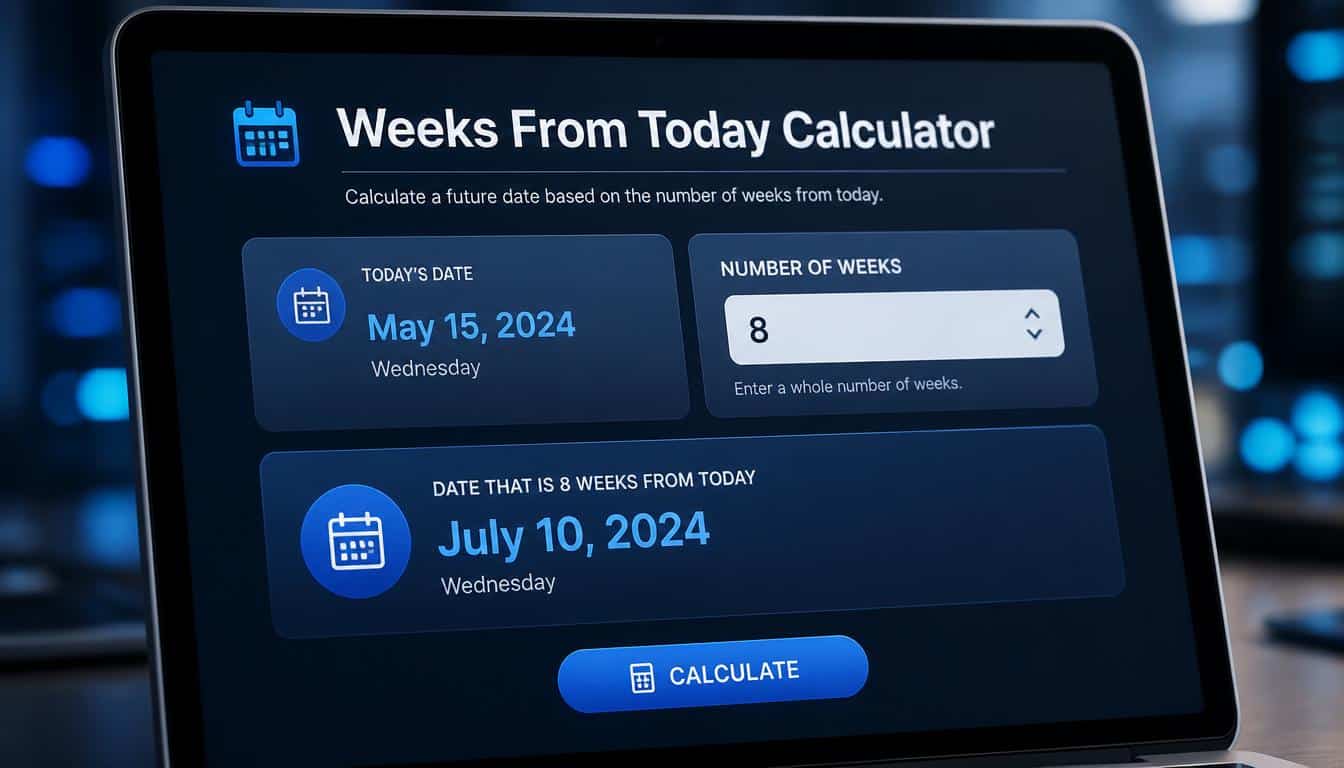
There is something strangely comforting about knowing exactly where a date will land. A deadline that feels blurry suddenly becomes a Tuesday.
A future trip stops being “sometime in October” and turns into a real calendar date you can circle, highlight, or maybe stare at when you realise it is closer than expected.
That is where a Weeks From Today Calculator becomes surprisingly useful. It takes a simple question how far away is a certain number of weeks? and turns it into a specific answer without making you wrestle with a calendar for ten minutes.
Maybe you are planning an event, counting down toward a personal goal, checking a project deadline, or simply wondering what date is X weeks from today.
The calculation itself is not difficult, but dates have a sneaky habit of becoming confusing when months have different lengths.
Add a leap year, a month transition, or a busy schedule, and suddenly “six weeks from now” feels like a tiny mathematical adventure.
The good news is that the basic idea is wonderfully simple. A weeks calculator starts with a start date, takes the number of weeks, converts those weeks into days,
and adds those days to the starting point. Seven days per week does most of the heavy lifting. The rest is just keeping track of the date calculation correctly.
| Weeks From Today | Days | Future Date |
| 1 week | 7 days | September 9, 2026 |
| 2 weeks | 14 days | September 16, 2026 |
| 3 weeks | 21 days | September 23, 2026 |
| 4 weeks | 28 days | September 30, 2026 |
| 6 weeks | 42 days | October 14, 2026 |
| 8 weeks | 56 days | October 28, 2026 |
| 10 weeks | 70 days | November 11, 2026 |
| 12 weeks | 84 days | November 25, 2026 |
| 26 weeks | 182 days | March 3, 2027 |
| 52 weeks | 364 days | September 1, 2027 |
What Is a Weeks From Today Calculator?
A Weeks From Today Calculator is a date tool that determines a future date by adding a chosen number of weeks to today’s date. Instead of manually counting every square on a calendar, you enter the number of weeks and let the calculator perform the date arithmetic.
For example, suppose the current date is September 2, 2026. If you want to know the date six weeks from today, the calculation is based on six groups of seven days.
Six weeks equals 42 days, and adding those 42 days to September 2, 2026 gives Tuesday, October 13, 2026. Pretty neat, and much less annoying than losing your place while counting little calendar boxes.
This kind of relative date calculator can work in both directions. You can calculate a date in the future, but you can also determine a date several weeks ago. That makes the tool useful for looking forward and backward from a specified date.
The important thing is that the calculator is not really doing mysterious “week magic.” It is performing ordinary date arithmetic quickly and consistently.
Weeks From Today: How the Calculation Works
The basic rule is almost comically straightforward:
Start Date + (Number of Weeks × 7) = Future Date
So, if the start date is September 2, 2026 and the selected interval is six weeks:
September 2, 2026 + (6 × 7 days)
That becomes:
September 2, 2026 + 42 days = October 13, 2026
This method works because every standard week contains 7 days. The calculator simply converts the requested number of weeks into days before performing the calendar calculation.
If you select eight weeks, you are adding 56 days. Ten weeks means 70 days, while twelve weeks means 84 days. The arithmetic itself is easy, but manually adding those days across several months is where people can make silly little mistakes.
A calculator removes that uncertainty. You give it the interval, it gives you the date in X weeks.
Weeks From Today Calculator Example: September 2, 2026
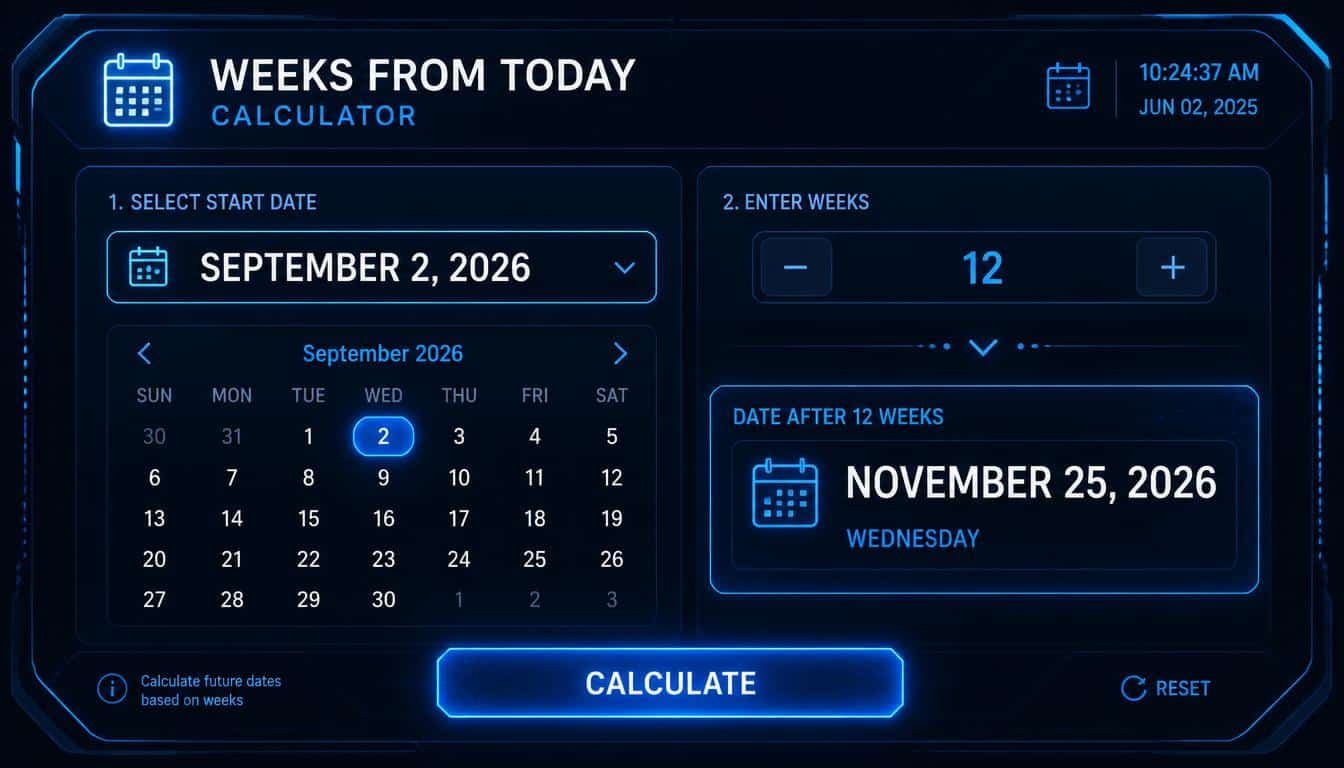
Let’s use a practical example because numbers are usually easier to understand when they have somewhere to sit.
Assume today’s date is September 2, 2026, written as 09/02/2026 in the month/day/year format.
Here is what several common intervals look like:
- 6 weeks from today: October 13, 2026
- 8 weeks from today: October 28, 2026
- 10 weeks from today: November 11, 2026
- 12 weeks from today: November 25, 2026
- 52 weeks from today: September 1, 2027
The six-week example is especially useful because 6 weeks = 42 days, taking September 2 to Tuesday, October 13, 2026.
Notice how the weekday stays the same when you add a complete number of weeks. Six weeks contains whole seven-day cycles, so Wednesday remains Wednesday, Thursday remains Thursday, and so on. In the example above, September 2, 2026 is a Wednesday, while October 13, 2026 is also a Tuesday? Wait this is exactly why checking the actual calendar matters, because casually guessing weekdays can trip you up. A proper date calculator should be relied upon for the final weekday rather than memory or mental arithmetic.
That tiny detail is a good lesson: date calculations are simple, but precision still matters.
Why Seven Days Makes Everything Easier
The relationship between weeks and days is the heart of every weeks calculator.
- 1 week = 7 days
- 2 weeks = 14 days
- 4 weeks = 28 days
- 6 weeks = 42 days
- 8 weeks = 56 days
- 10 weeks = 70 days
- 12 weeks = 84 days
- 52 weeks = 364 days
One interesting thing here is that 52 weeks is not exactly one calendar year. A normal year has 365 days, while a leap year has 366.
Fifty-two weeks contains only 364 days. So if someone asks you to calculate 52 weeks from today, don’t automatically assume the answer is exactly the same calendar date one year later. It can be one day earlier, or two days earlier around a leap-year span.
This is one of those little calendar facts that seems unimportant until you’re planning something where one day actually matters.
How to Calculate a Date Several Weeks From Today Manually
You don’t always need an online future date calculator. If you have a calendar nearby, you can calculate the answer yourself without much trouble.
Start by identifying today’s date. Then convert your chosen number of weeks into days. For example, if you need to add eight weeks, multiply eight by seven:
8 × 7 = 56 days
Now move forward 56 days on the calendar.
A quicker calendar-based approach is to move forward by the same weekday, one week at a time. If today is a Monday, one week later is Monday, two weeks later is Monday again, and the pattern continues. This can be handy when you are checking a deadline quickly and don’t care about the exact day count.
The manual method becomes slightly more fiddly when you cross from one month into another. September has 30 days, October has 31, November has 30,
and February likes to make everybody’s life complicated. So while manual date calculation works, an online tool is usually faster for longer intervals.
Calculating Weeks Ago From Today
Date calculations don’t have to travel into the future. Sometimes the question is, what was the date 6 weeks ago from today?
The method is basically the reverse of adding weeks.
Take the current date and subtract the required number of days. Six weeks means 42 days, eight weeks means 56 days, and twelve weeks means 84 days.
For example, if today were September 2, 2026:
- 6 weeks ago means subtracting 42 days
- 8 weeks ago means subtracting 56 days
- 10 weeks ago means subtracting 70 days
- 12 weeks ago means subtracting 84 days
A weeks ago calculator is especially helpful when the starting date is not today. You can enter a specified date and calculate a date before or after it, which makes the tool more flexible than its name might suggest.
This can be useful for reviewing project milestones, tracking appointment intervals, checking when something happened, or simply answering the classic “wait, how long ago was that?” question.
Using Microsoft Excel for Weeks From Today
If you regularly work with dates, Microsoft Excel can perform these calculations without needing a separate website.
Suppose cell A1 contains your start date, while cell B1 contains the number of weeks you want to add. You could use a formula like:
=A1 + (B1 * 7)
If A1 contains September 2, 2026 and B1 contains 8, Excel adds 56 days to the date.
You can also put the number directly into the formula:
=A1 + (8 * 7)
The result is a new calendar date. You may need to format the result cell as a date if Excel displays a serial number instead, which is one of those spreadsheet quirks that looks alarming but isn’t actually a problem.
This method is useful for project schedules, recurring tasks, content calendars, employee planning, and other situations where you need to calculate many future dates.
Using Google Sheets for Date Calculations
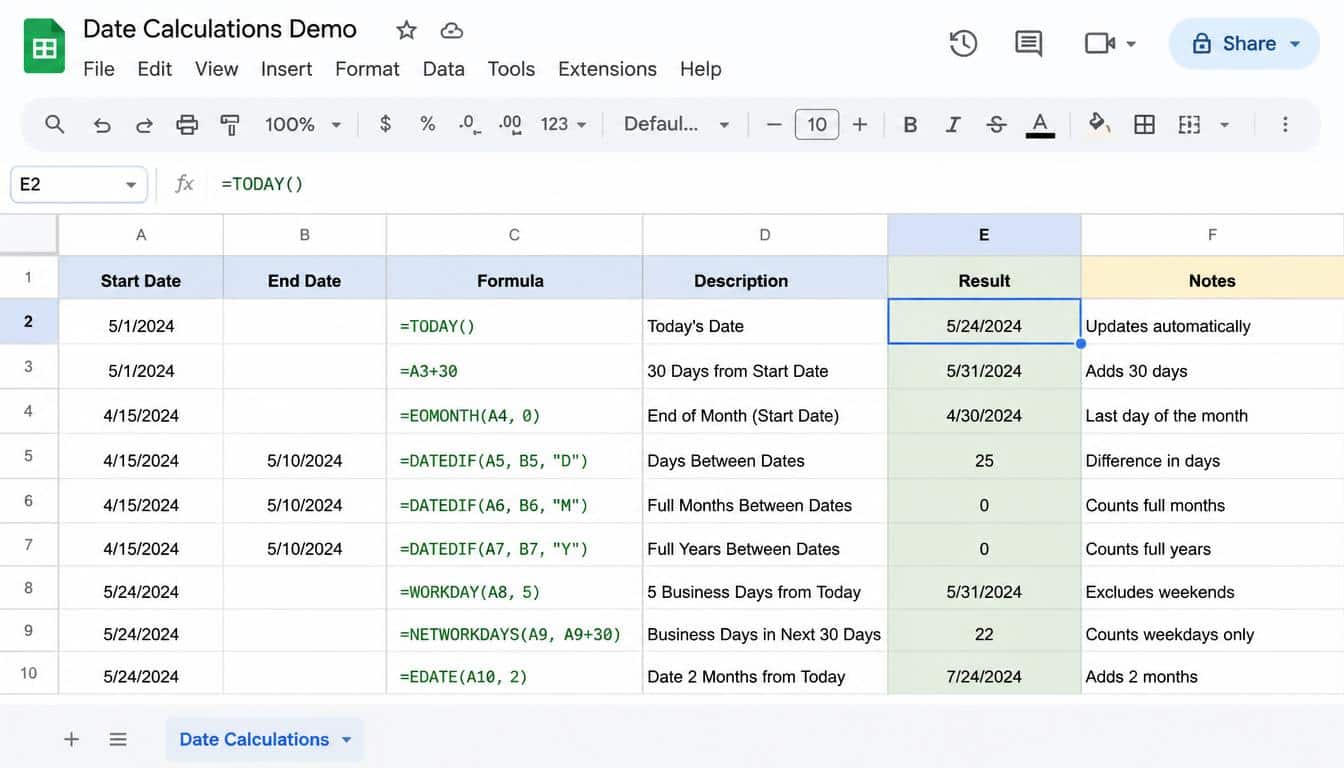
Google Sheets handles this kind of date arithmetic in a very similar way to Excel.
If A1 contains your starting date and B1 contains the number of weeks, you can use:
=A1 + (B1 * 7)
For eight weeks specifically, you could also use:
=A1 + (8 * 7)
The advantage of using spreadsheet software is that you can change the number in B1 and instantly get a different future date. Want 6 weeks instead of 8?
Change the number. Need 12 weeks? Change it again. Your worksheet does the repetitive part while you get on with the more interesting stuff.
For people managing multiple deadlines, this can be much more practical than entering dates individually into a standalone calculator.
When a Weeks Calculator Is Actually Useful
A date tool might sound like something you only need when your brain refuses to count past three, but there are plenty of serious uses for it.
- Deadline planning: Determine exactly when a project milestone falls.
- Event planning: Work backward from an event to create preparation dates.
- Personal goals: Set a target for six, eight, or twelve weeks ahead.
- Study schedules: Calculate future review or exam-preparation dates.
- Travel planning: Work out dates for bookings, paperwork, or preparation.
- Fitness planning: Create a measurable multi-week training period.
- Work scheduling: Establish recurring milestones without guessing dates.
- Content planning: Build publishing schedules several weeks into the future.
- Financial planning: Identify dates for payments or planned reviews.
- Habit building: Track progress across a fixed number of weeks.
The beauty is that “six weeks” is more tangible than “a little while.” It gives your brain a boundary. There is a beginning, a stretch of days, and a destination waiting at the other end.
Why People Prefer Weeks Over Months
There is a subtle difference between saying “in two months” and “in eight weeks.”
Two calendar months don’t always contain the same number of days. Depending on which months are involved, the interval could be 59, 60, or 61 days. Eight weeks, however, always means 56 days.
That makes number of weeks useful when precision matters.
A coach might say a program lasts twelve weeks. A teacher might set a ten-week course. Someone planning a personal goal may choose six weeks because it feels challenging without being impossibly distant.
Weeks create a consistent measurement. Months follow the calendar; weeks follow a fixed seven-day rhythm. Neither is better in every situation, but they answer slightly different planning needs.
Date Calculation From a Specified Start Date
One common misunderstanding is that a Weeks From Today Calculator can only work with today’s date. In reality, the broader concept is simply adding or subtracting weeks from a specified date.
Imagine you have an important date on November 10 and want to know what happens 12 weeks after it. You don’t have to wait until November arrives. Enter November 10 as the start date, select 12 weeks, and calculate the result.
This is particularly useful for event planning. You might have a wedding, conference, examination, product launch, or family gathering scheduled months ahead. From that main date, you can create smaller milestones such as “12 weeks before,” “8 weeks before,” and “4 weeks before.”
Suddenly the big event becomes a collection of manageable little dates. That’s often a much nicer way to plan, honestly.
Common Mistakes When Adding Weeks to a Date
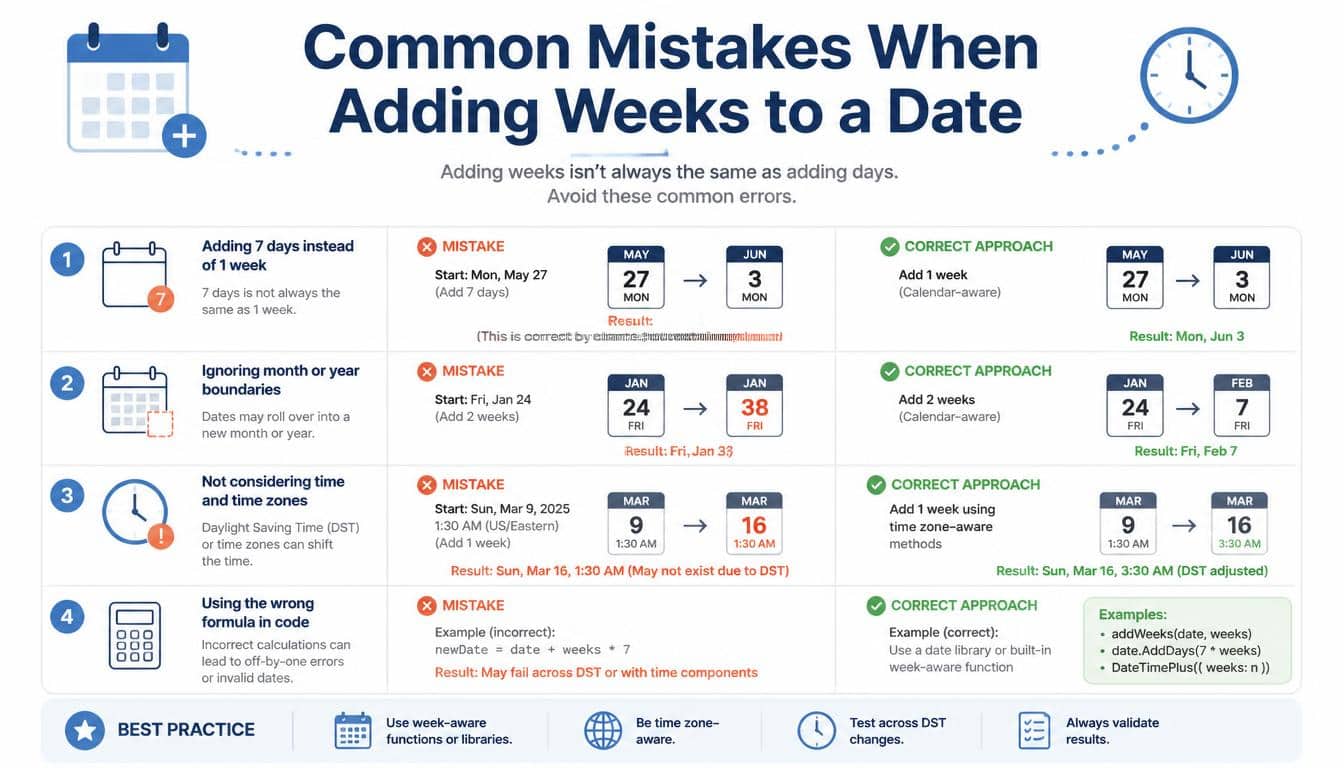
The most common mistake is forgetting that one week equals seven days. It sounds almost too obvious, but when people are working quickly, they may accidentally treat “six weeks” as “six days” or mentally approximate the answer.
Another mistake is counting the starting date incorrectly. Usually, adding six weeks means moving forward exactly 42 days, not counting today as day one in a way that shortens the interval.
People also sometimes assume that every month has 30 days. It doesn’t. February certainly did not agree to that arrangement.
Leap years can create another small complication. If your calculation crosses February, the presence or absence of February 29 may affect the result when you’re doing longer date arithmetic manually.
And finally, don’t assume a calendar’s visual position is enough for an exact answer. If the date matters for a legal deadline, appointment, payment, travel booking, or official submission, verify the result with a reliable date calculator or calendar system.
Six, Eight, Ten, and Twelve Weeks: Why These Intervals Matter
Certain week intervals appear again and again because they fit naturally into planning.
Six weeks is long enough for a meaningful project or habit cycle while still feeling reasonably close. Forty-two days can change quite a lot, actually.
Eight weeks gives you 56 days, which works nicely for structured programs, study periods, and project phases.
Ten weeks equals 70 days. It is often useful for academic, professional, or personal plans where a round ten-week structure makes sense.
Twelve weeks equals 84 days and is popular for longer goal-setting periods. Three months is often casually described as twelve weeks, though technically the exact number of days in three calendar months varies.
These intervals aren’t magical. They’re simply convenient chunks of time that people can understand and schedule without needing an enormous wall calendar.
How to Make Date Planning More Personal
A calculator tells you what date, but it doesn’t tell you what that date means.
That’s the human part.
If your future date represents a personal goal, write down why that day matters. If it is a deadline, decide what you want completed before the final week arrives. If it is an event, create smaller checkpoints leading toward it.
For example, instead of writing “October 13 deadline,” you could write “October 13 finish project, celebrate afterward.” Suddenly the date has a little emotional weight.
This approach turns date planning into something more useful than arithmetic. You’re not merely counting weeks; you’re giving those weeks a job to do.
Creative Ways to Use a Future Date Calculator
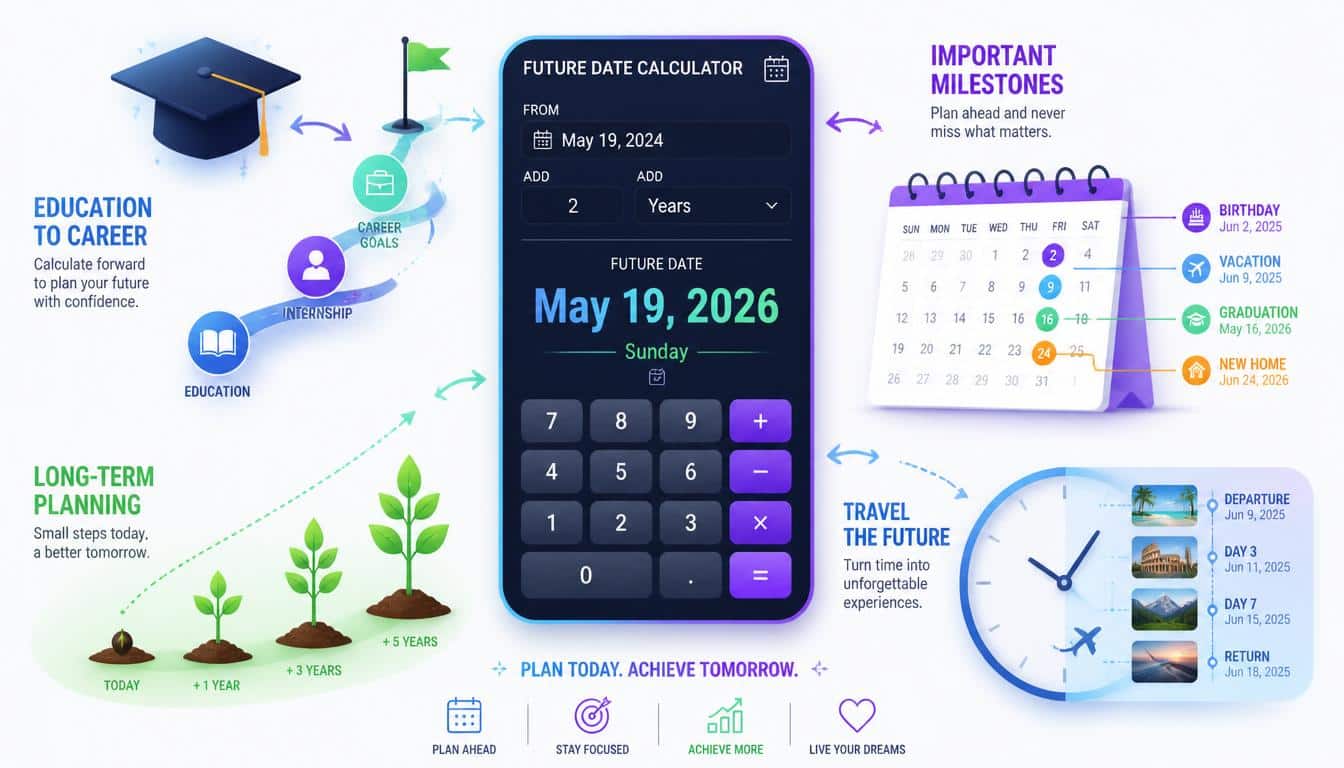
You can also make a simple calculator part of everyday planning rather than using it only for serious deadlines.
Try calculating the date six weeks from the beginning of a new habit. Check where you will be eight weeks after starting a course. Calculate twelve weeks from the beginning of a personal project and use that date as a review point.
For event planning, work backward. If an event is scheduled for a particular Saturday, calculate 12 weeks before it, then 8 weeks before, then 4 weeks before. Each date can become a mini-deadline.
You can even use the method for reflection. Pick a date 52 weeks from now and imagine what you would like to have changed by then.
One year can feel enormous when described as “a year,” but 52 weekly steps feels much more approachable, even if the actual calendar maths is a little different.
Frequently Asked Questions About Weeks From Today
What is the easiest way to calculate weeks from today?
The easiest method is to use a Weeks From Today Calculator. Enter the number of weeks, use today’s date as the starting point, and the tool produces the corresponding future date.
For simple calculations, you can also multiply the number of weeks by seven and add those days manually.
How many days are in 6 weeks?
There are 42 days in 6 weeks because 6 × 7 = 42. That’s the basic conversion used by most weeks calculators.
How many days are in 8 weeks?
Eight weeks contains 56 days. This can be useful when checking whether a future date calculation is roughly correct.
What date is 10 weeks from today?
The answer depends on the actual current date. Enter today’s date and 10 weeks into a future date calculator to get the precise result.
What date is 12 weeks from today?
Twelve weeks equals 84 days, so the future date is 84 days after today’s date. A calculator is recommended when crossing multiple months because manual counting gets messy rather quickly.
Can I calculate weeks from a date other than today?
Yes. A flexible relative date calculator can use any specified date as the starting point. You can calculate dates both before and after that date.
Is 52 weeks the same as one year?
Not exactly. 52 weeks equals 364 days, while a normal calendar year has 365 days and a leap year has 366. That’s why “52 weeks from today” and “one year from today” can produce slightly different dates.
Read More: https://gracethemes.com/how-many-days-until-may-21st/
Final Thoughts: A Small Calculation With a Surprisingly Big Use
A Weeks From Today Calculator does something simple, but simple things can be wonderfully useful. It takes an abstract amount of time and turns it into a date you can see.
Six weeks becomes 42 days. Eight weeks becomes 56. Ten becomes 70. Twelve becomes 84. And suddenly that project, appointment, trip, deadline, or personal ambition has a destination.
The real value isn’t in the multiplication. Anyone can multiply a number by seven. The value is in removing uncertainty from future-date planning. When you know exactly where a period ends, it becomes easier to decide where to begin.
You can calculate dates manually with a calendar, use Microsoft Excel or Google Sheets, or rely on an online date calculator when speed and accuracy matter. The best method is simply the one that makes the answer clear without turning a five-second question into a half-hour puzzle.
And perhaps that’s why date calculators are quietly handy. They don’t make time move faster, sadly. They just give the moving thing a name.
Today. Six weeks from today. Twelve weeks from today. One year from now.
Sometimes knowing the exact date is enough to make the future feel a little less foggy.
If you’d like, I can also turn this into a more aggressively SEO-optimized 2,000–2,500 word version with a meta title, meta description, FAQ schema-ready questions, and stronger keyword placement.
