

What Date Is 11 Weeks From Today?
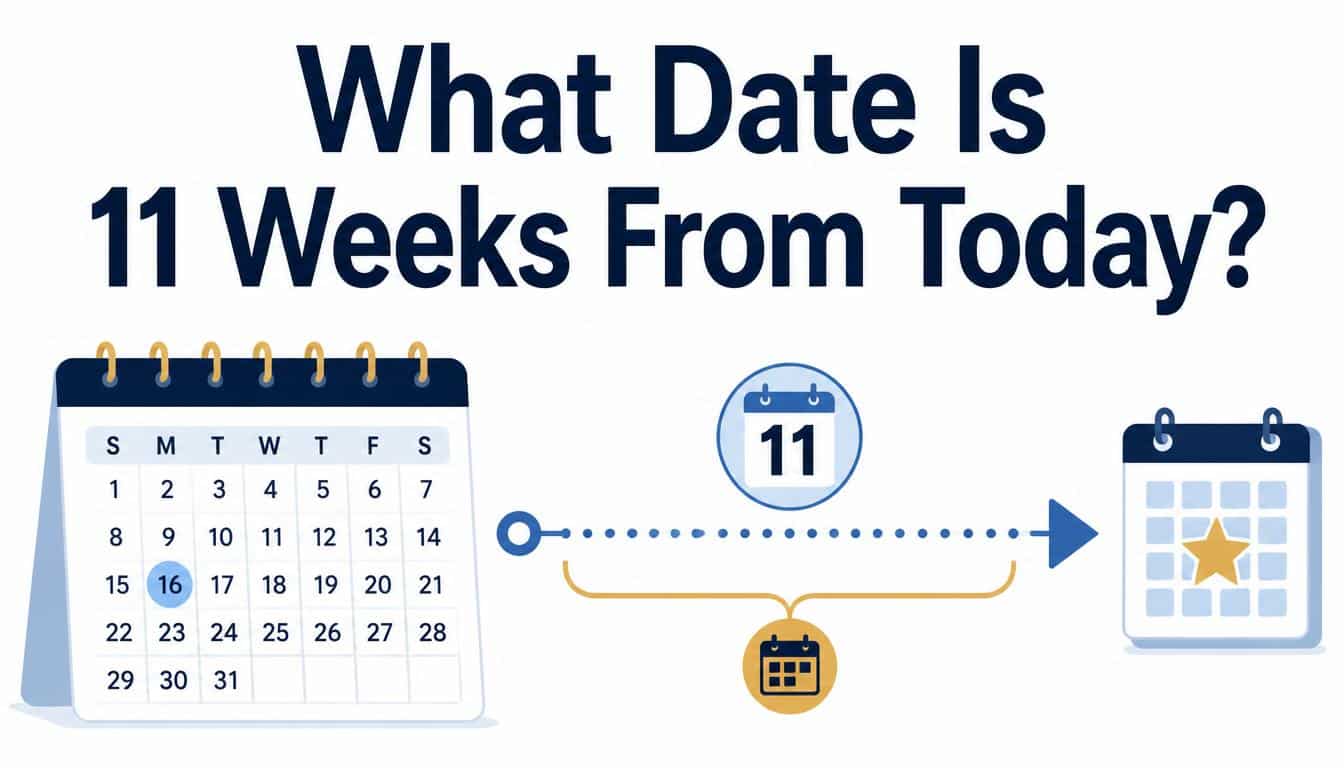
There is something oddly satisfying about asking a calendar a simple question and getting a very specific little piece of the future back.
Maybe you are planning a trip, marking a deadline, counting toward a celebration, or simply wondering where 11 weeks from today lands. Whatever brought you here, the answer is pleasantly straightforward.
Today is October 7, 2026, a Wednesday. Add 11 weeks, and the calendar takes us exactly 77 days forward to Wednesday, December 23, 2026.
It sounds like a long stretch when you say “eleven weeks,” but watch those weeks pass one by one and suddenly December is knocking at the door.
So, if your question is what date is 11 weeks from today, the result is:
Wednesday, December 23, 2026.
That is the future date you reach when you count 11 complete weeks from October 7, 2026. No mysterious calendar gymnastics needed, thankfully.
What Date Is 11 Weeks From Today?
Let’s make the calculation easy to see. One week contains seven days, so the basic date calculation is simply:
11 weeks × 7 days = 77 days
Starting with October 7, 2026, moving forward by 77 days brings us to December 23, 2026.
There is a useful little detail here: because 11 weeks is a whole number of weeks, the day of the week stays the same. October 7, 2026 is Wednesday, and 11 weeks later is also Wednesday. Calendars are wonderfully predictable when they feel like behaving.
If you are using a weeks from today calculator, a date calculator, or doing the calculation by hand, you should arrive at the same result:
- Starting date: October 7, 2026
- Time duration: 11 weeks
- Total days: 77 days
- Result date: December 23, 2026
- Day of week: Wednesday
That is the entire journey, from one October Wednesday to another Wednesday just before Christmas.
How to Calculate 11 Weeks From Today
You don’t actually need a fancy time duration calculator to work out the answer. A calendar and a tiny bit of patience will do the job.
The simplest method is to count forward one week at a time. Starting at October 7, move seven days ahead repeatedly until you have made 11 moves. The dates progress like this:
- October 7 → October 14
- October 14 → October 21
- October 21 → October 28
- October 28 → November 4
- November 4 → November 11
- November 11 → November 18
- November 18 → November 25
- November 25 → December 2
- December 2 → December 9
- December 9 → December 16
- December 16 → December 23
And there it is. Eleven small calendar jumps, ending on December 23, 2026.
Another way is to convert weeks into days first. Since one week has seven days, 11 weeks in days equals 77. Add 77 days to the starting date, and you get the same future calendar date.
The nice thing about both methods is that they validate each other. If your calculator says December 23 but your calendar counting says December 24, something went a little sideways somewhere.
How Long Is 11 Weeks?
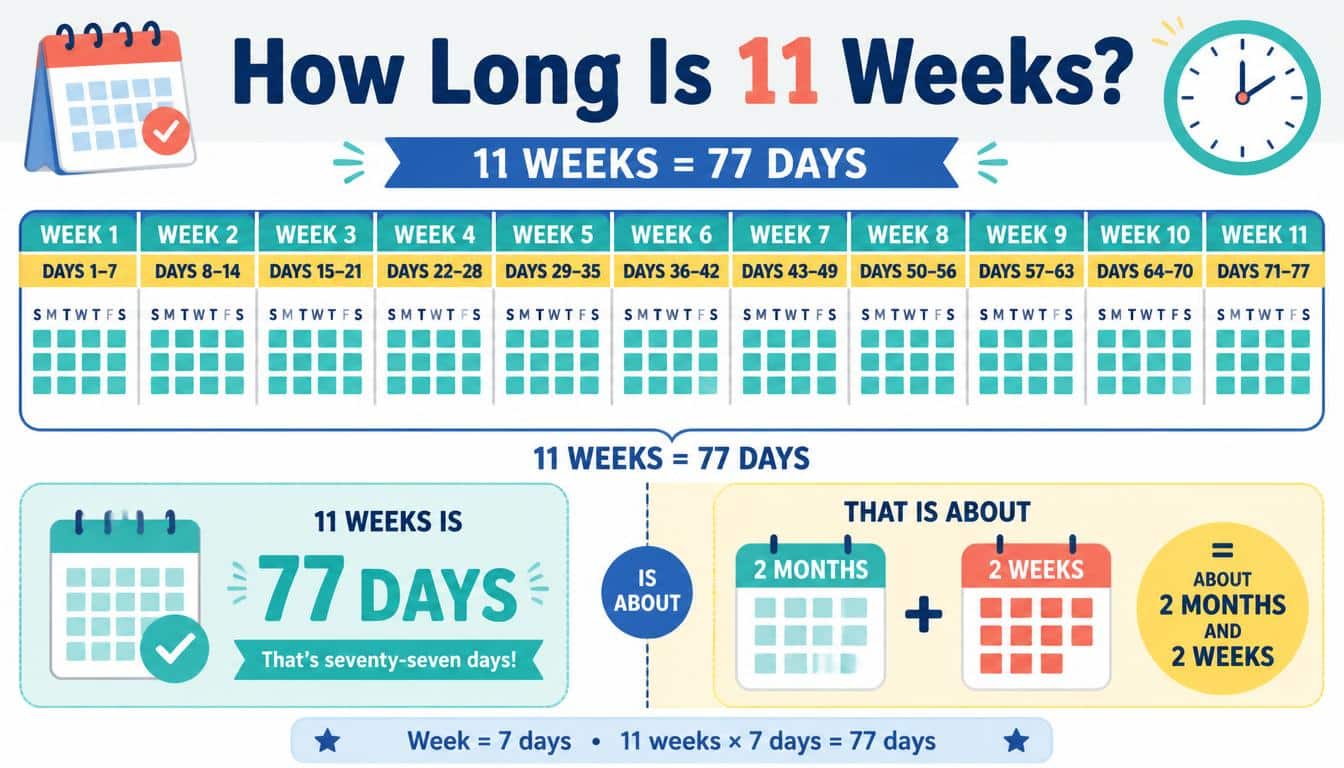
Eleven weeks can feel different depending on what you’re waiting for. Eleven weeks until a holiday can feel surprisingly close; eleven weeks until a difficult deadline may feel like an entire small lifetime.
In exact time units, 11 weeks equals:
- 77 days
- 1,848 hours
- 110,880 minutes
- 6,652,800 seconds
That last number looks almost comically enormous. Six million six hundred fifty-two thousand eight hundred seconds is the same stretch of time as 77 ordinary days, which is a reminder that time becomes rather dramatic when measured in tiny pieces.
For most practical planning, however, 77 days is the most useful conversion. It gives you a clear sense of the time duration without turning your calendar into a mathematics exam.
The Calendar Progression From October 7 to December 23
Sometimes the easiest way to understand a date range is to look at the dates immediately surrounding the starting point and ending point.
For this particular calculation, the calendar progression is:
- October 3, 2026 → December 19, 2026
- October 4, 2026 → December 20, 2026
- October 5, 2026 → December 21, 2026
- October 6, 2026 → December 22, 2026
- October 7, 2026 → December 23, 2026
- October 8, 2026 → December 24, 2026
- October 9, 2026 → December 25, 2026
- October 10, 2026 → December 26, 2026
- October 11, 2026 → December 27, 2026
This little sequence demonstrates something useful about a date offset: every starting date in this group moves forward by exactly 77 days.
It also shows why the result is so easy to validate. If October 7 lands on December 23, then October 8 should land on December 24. The calendar has a rather strict personality about these things.
What Date Is 11 Weeks From October 7, 2026?
If you are searching specifically for 11 weeks from October 7 2026, the answer remains December 23, 2026.
October has 31 days. From October 7 to October 31 there are 24 days remaining after the starting date. November contributes another 30 days, and the remaining 23 days take us into December.
So:
24 + 30 + 23 = 77 days
Therefore:
October 7, 2026 + 77 days = December 23, 2026.
It lands on a Wednesday, too, which is exactly what we would expect after adding a whole number of weeks.
This is the useful distinction between adding a number of days and adding a number of weeks. Add 77 days and you reach the same place, but thinking in weeks makes the day-of-week relationship much easier to understand.
Is December 23, 2026 Really 11 Weeks Away?
Yes. Wednesday, December 23, 2026 is exactly 11 weeks after Wednesday, October 7, 2026.
It is not “about eleven weeks” or “roughly two and a half months.” It is the exact resulting date under ordinary calendar arithmetic.
That matters when you’re working with appointments, project milestones, school schedules, travel plans, payment dates, or any other situation where “close enough” isn’t really close enough.
If today is October 7 and someone says, “Let’s check again in 11 weeks,” you now know the appointment belongs on December 23, unless they meant 11 weeks in some unusual business-calendar sense.
What Date Is 11 Weeks From Now?
The phrases 11 weeks from now and 11 weeks from today generally mean the same thing when “now” and “today” refer to the same calendar date.
On October 7, 2026, that means:
11 weeks from now = December 23, 2026.
The important part is the starting date. Relative-date questions always depend on when the calculation is performed. If you ask the same question tomorrow, the answer moves forward by one day.
That’s why a current date is essential for any reliable date relative to now calculation. “Eleven weeks from today” isn’t a permanently fixed date; it changes every day, quietly marching forward while we are busy doing other things.
What Date Was 11 Weeks Ago?
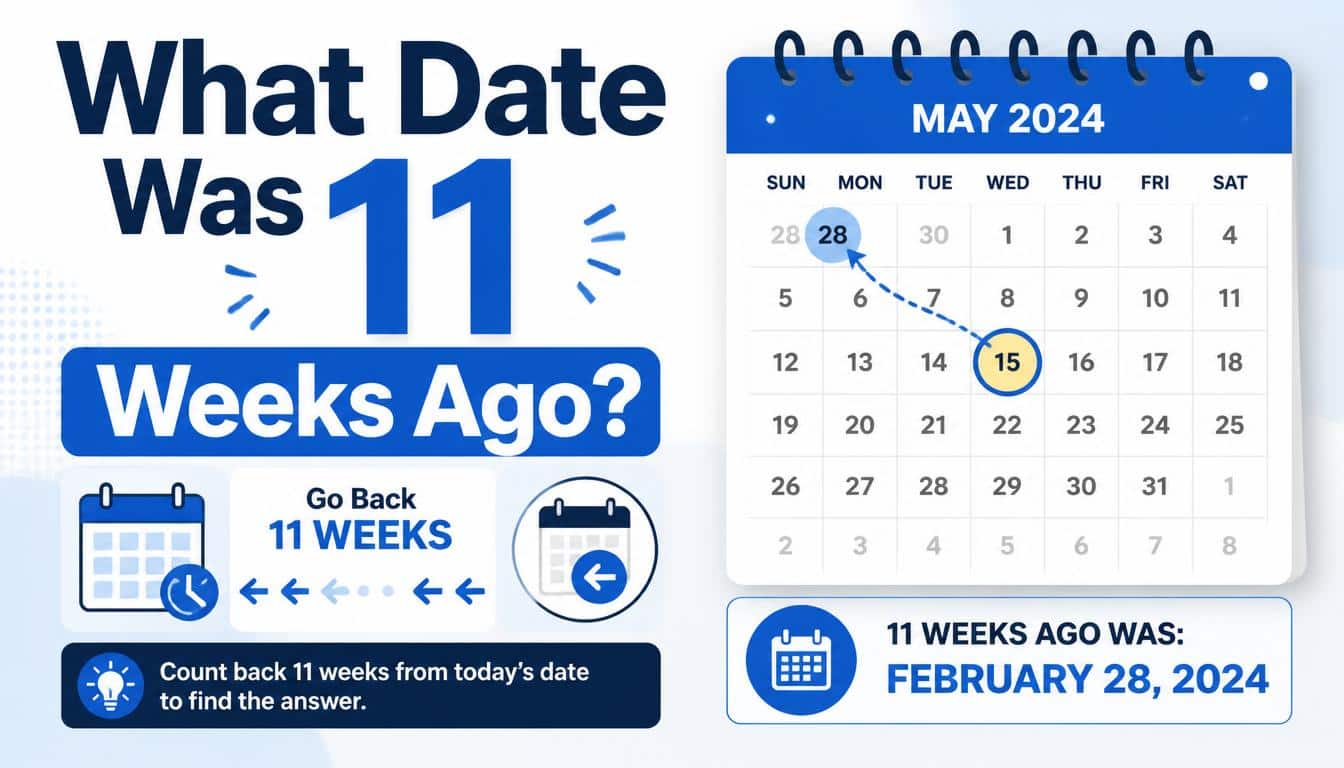
Date calculations can also run backward.
If 11 weeks from October 7, 2026 is December 23, 2026, then 11 weeks ago from October 7, 2026 was July 22, 2026.
The reverse calculation is:
October 7, 2026 − 77 days = July 22, 2026.
This is useful if you are trying to find a date 11 weeks ago, compare an earlier event with today’s date, or work backward from a deadline.
The same principle applies to any number of weeks. Add weeks to move into the future; subtract weeks to move into the past. Very simple, once you stop letting the calendar look more complicated than it really is.
What About 12, 13, 14, or 15 Weeks From Today?
Once you know how the calculation works, the nearby questions become easy.
Starting from October 7, 2026:
- 12 weeks from today: December 30, 2026
- 13 weeks from today: January 6, 2027
- 14 weeks from today: January 13, 2027
- 15 weeks from today: January 20, 2027
Notice the pattern: every extra week moves the result forward by seven days.
So if December 23 is 11 weeks away, December 30 is 12 weeks away, January 6 is 13 weeks away, and so on. The calendar keeps its rhythm even when our brains occasionally lose count somewhere around week eight.
The reverse direction works the same way:
- 12 weeks ago: July 15, 2026
- 13 weeks ago: July 8, 2026
- 14 weeks ago: July 1, 2026
- 15 weeks ago: June 24, 2026
These examples are helpful when comparing a future date and a previous date without needing to perform a fresh calculation every single time.
Why Knowing the Exact Date Can Be Surprisingly Useful
A question like what date will it be 11 weeks from today may seem tiny, but dates quietly organize a huge portion of everyday life.
You might be counting toward a work deadline, planning a family gathering, estimating a delivery milestone, scheduling a recurring appointment, or simply wondering whether something falls before the end of the year.
For example, December 23 is very close to Christmas. Someone planning a project that lasts 11 weeks from October 7 might therefore want to know that the final date arrives just two days before December 25.
That kind of context can matter more than the arithmetic itself. A date isn’t merely a number on a calendar date; it tells you where an event sits inside the rhythm of ordinary life.
Using a Date Calculator Without Getting Confused
A good date calculator is useful when you need to perform several calculations or compare different dates.
Usually, the process has three ingredients:
- Enter the starting date.
- Choose whether you’re adding or subtracting time.
- Enter the number of weeks, days, or another time unit.
For this example, the inputs are:
Starting date: October 7, 2026
Operation: Add
Duration: 11 weeks
The result is December 23, 2026.
Some calculators describe this as a weeks from today calculator, while others call themselves a time calculator, date and time calculator, or duration calculator. The names vary, but the underlying calendar calculation is essentially the same.
The one thing worth checking is whether the tool interprets “today” according to your own time zone. Usually this won’t matter for a whole-week calculation during the middle of a day, but relative dates can become surprisingly slippery around midnight.
Why 11 Weeks Equals 77 Days
The relationship is beautifully uncomplicated:
1 week = 7 days
Therefore:
11 × 7 = 77
So 11 weeks = 77 days.
There are no leap-day complications here because the interval is measured as a straightforward number of complete weeks. Whether the 77-day span crosses from October into November and December doesn’t change the basic conversion.
It also explains the other time conversions:
77 days × 24 hours = 1,848 hours
1,848 hours × 60 minutes = 110,880 minutes
110,880 minutes × 60 seconds = 6,652,800 seconds
Same duration, different measuring sticks. Time is a little funny like that; change the unit and suddenly an ordinary stretch of life looks gigantic.
A Simple Calendar Method for Finding the Date
If you prefer doing things without a calculator, use the calendar method.
Begin at October 7 and move forward exactly one week at a time. Don’t count individual days unless you need to. Just find the same weekday in the next week and repeat the process 11 times.
Because October 7, 2026 is a Wednesday, each checkpoint will also be Wednesday:
October 14, October 21, October 28, November 4, November 11, November 18, November 25, December 2, December 9, December 16, and finally December 23.
This “one week at a time” approach is especially handy when you are looking at a physical wall calendar. There is something reassuring about putting your finger on October 7, sliding across the weeks, and watching December 23 appear.
Common Mistakes When Counting Weeks
The most common error is accidentally counting the starting date as week one.
If October 7 is your starting point, you don’t call October 7 “one week.” The first completed week ends on October 14.
In other words:
- October 7 = starting date
- October 14 = 1 week later
- October 21 = 2 weeks later
- October 28 = 3 weeks later
Continue that pattern and December 23 becomes 11 weeks later.
Another mistake is mixing “11 weeks” with “11 calendar weeks” in a context where business days, working days, or special scheduling rules apply. For ordinary calendar arithmetic, however, 11 weeks means 77 days.
And yes, it is very easy to lose one week while counting manually. Calendars have been causing this little problem to humans for centuries, apparently.
Does the Time of Day Change the Answer?

For a normal date calculation, no. If it is October 7 today, then 11 weeks later is December 23.
If you are calculating an exact duration down to the hour, minute, or second, then the starting time matters. For example, 11 weeks after 9:00 a.m. on October 7 would be 9:00 a.m. on December 23, assuming the same time-zone conditions.
But when someone asks, “What date is 11 weeks from today?” they almost always want the calendar date rather than an exact timestamp.
So there is no need to make the question scarier than it is. The date is December 23, 2026.
The Answer at a Glance
If you only came here for the result, here is the whole calculation without making you hunt through paragraphs:
Today: October 7, 2026
Add: 11 weeks
11 weeks: 77 days
Future date: December 23, 2026
Day: Wednesday
So, what date is 11 weeks from today?
Wednesday, December 23, 2026.
That is the exact date in 11 weeks based on today’s date of October 7, 2026.
Frequently asked questions
What is the date today?
Today is October 7, 2026. It is Wednesday.
nay là ngày mấy
Today is Wednesday, October 7, 2026.
hôm nay ngày dưới ngày mấy
Today’s date is October 7, 2026.
hôm nay là ngày mấy tháng mấy năm mấy
Today is October 7, 2026 the 7th day of October 2026.
tìm ngày
You can find today’s date by checking a calendar or using an online date calculator.
Read More: https://gracethemes.com/what-time-is-13-hours-from-now/
Final Thoughts on Counting 11 Weeks Ahead
There is a quiet usefulness in knowing how to calculate a date without guessing. Eleven weeks can sound vague, but once converted into 77 days, the future becomes much easier to picture.
From October 7, 2026, the calendar moves through October, crosses November, and arrives at December 23, 2026. It is a small journey on paper, yet knowing the exact destination can make planning feel much more solid.
So if you’re counting down to a deadline, marking an important milestone, or simply satisfying that little itch to know exactly where “11 weeks from now” lands, you’ve got your answer: Wednesday, December 23, 2026.
And perhaps that’s the nicest thing about date calculations. They take an abstract amount of time and turn it into something you can circle, remember, plan around, and eventually reach.
