

What Time Is 13 Hours From Now?
Time has a funny little habit of moving while we are busy doing something else. You look at the clock, wonder about a meeting tomorrow, a flight, a deadline, or simply when you can finally go to sleep, and suddenly the question appears:
what time is 13 hours from now? It sounds simple, and really it is, but crossing from one day into the next can make even an easy time calculation feel slightly confusing.
If your current time is 8:02 PM on October 5, 2026, in a GMT+5 time zone, then adding 13 hours takes you to 9:02 AM on Tuesday, October 6, 2026.
The important bit is that the calculation does not only change the clock; it also changes the date, because 13 hours carries us past midnight and into the following morning.
That small date rollover is where people often make mistakes. So, lets walk through exactly how the calculation works, why AM and PM change, and how you can calculate other hours from now without needing to stare at the clock for ten minutes.
What Time Is 13 Hours From Now?
The direct answer depends on your current time and time zone, because “now” is never exactly the same everywhere on Earth. At the reference time of 8:02 PM GMT+5 on October 5, 2026, adding 13 hours gives a resulting time of 9:02 AM on October 6, 2026.
Here is the calculation in plain language. From 8:02 PM, adding four hours brings the clock to 12:02 AM. That uses four of the thirteen hours, leaving nine hours. Add those remaining nine hours and the answer becomes 9:02 AM.
So, in this example:
- Current date: October 5, 2026
- Current time: 8:02 PM
- Time zone: GMT+5
- Duration: 13 hours
- Resulting date: October 6, 2026
- Resulting time: 9:02 AM
- Day: Tuesday
The minutes stay at 02 because we are adding whole hours rather than minutes. Thats one of those tiny details that makes time arithmetic much easier once you notice it.
How to Calculate 13 Hours From Now
You do not need a special 13 hours from now calculator to solve this. A clock, a little patience, and a reasonably awake brain can do it.
Start with the current time. Then add the number of hours requested. If the calculation passes midnight, reduce the resulting clock time by 12 hours and move the date forward by one day.
For example, imagine it is 8:02 PM.
Adding one hour gives 9:02 PM.
Adding two gives 10:02 PM.
Adding three gives 11:02 PM.
Adding four gives 12:02 AM.
At this point, the calendar has rolled over. You are no longer on October 5. You are now on October 6. Continue adding the remaining nine hours, and you arrive at 9:02 AM.
This is the basic method for how to calculate 13 hours from now, and it works whether the starting time is morning, afternoon, evening, or night. The only thing that changes is whether you need a next-day calculation.
Why 13 Hours Can Change the Date
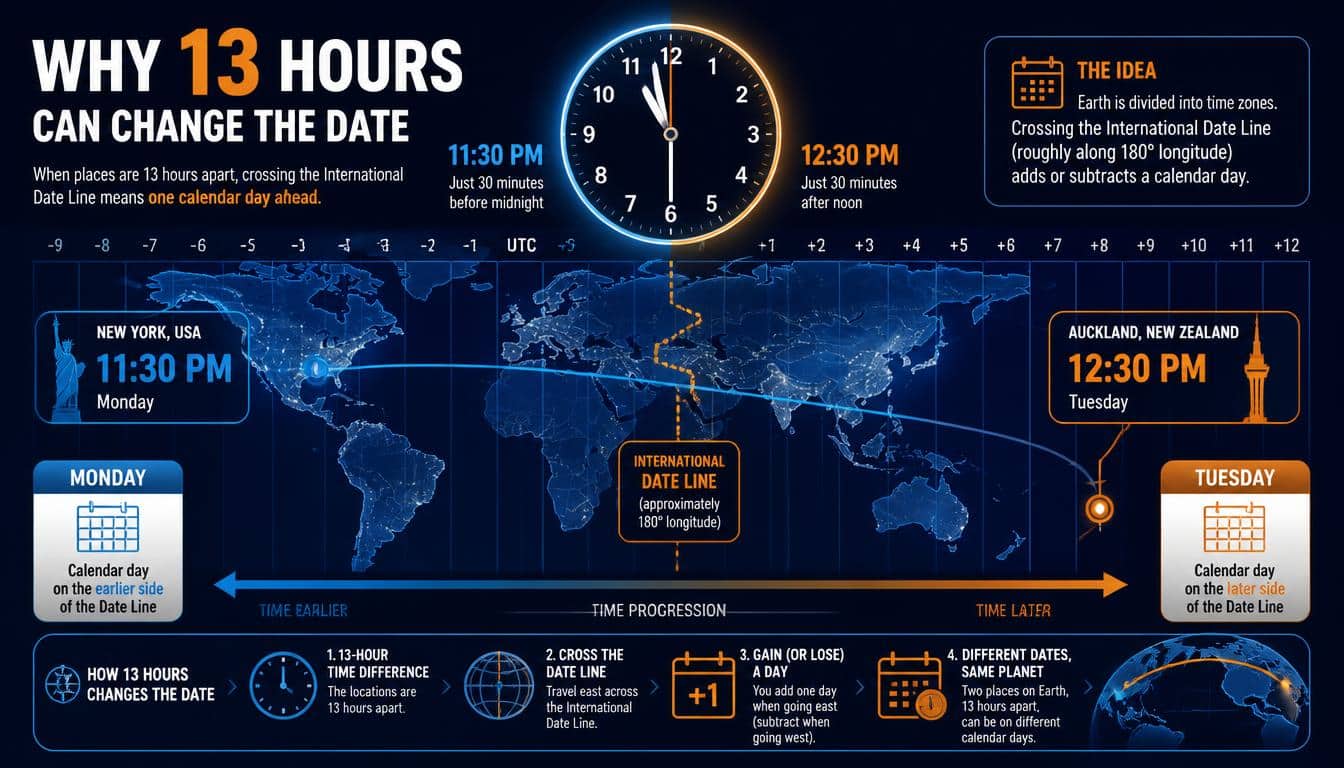
A duration of 13 hours is longer than half a day, but shorter than a full 24-hour day. That means it often crosses midnight when you begin somewhere in the afternoon or evening.
Consider an afternoon example. If the current time is 3:00 PM on October 5, adding 13 hours produces 4:00 AM on October 6. The clock moves forward normally, but the calendar quietly flips to the next day.
With an evening starting point, the rollover becomes even more obvious. Starting at 8:02 PM and adding 13 hours means moving through midnight, into the early morning, and finally stopping at 9:02 AM.
This is called date rollover or day rollover, and it matters whenever you’re calculating appointments, travel times, medication schedules, work shifts, delivery windows, or anything else that depends on an exact date and time. A one-day mistake can be a surprisingly expensive little error.
13 Hours From Now in AM or PM
One of the easiest ways to get confused is the 12-hour clock. The same moment can be described using AM/PM notation or a 24-hour time format, and switching between them sometimes makes the calculation look harder than it really is.
For the example above, the starting point is 8:02 PM. In a 24-hour format, that is 20:02.
Add 13 hours:
20:02 + 13 hours = 33:02
Since a day contains 24 hours, subtract 24:
33:02 − 24:00 = 09:02
Therefore, the answer is 9:02 AM the next day.
Notice that the minutes never changed. The “02” simply traveled along with the hour. Thats useful when doing time arithmetic, because you can often separate the hour calculation from the minutes.
How Much Time Is 13 Hours?
The phrase 13 hours describes a duration, not a specific time of day. A duration tells us how long something lasts, while a clock time tells us when something happens.
Thirteen hours can therefore begin at 1:00 AM, 8:02 PM, noon, or practically any other point. The final answer depends entirely on the starting current time.
For basic duration conversion, 13 hours equals:
- 13 hours
- 780 minutes
- 46,800 seconds
- 46,800,000 milliseconds
The conversion is straightforward. One hour contains 60 minutes, so 13 × 60 = 780 minutes. One hour contains 3,600 seconds, so 13 × 3,600 = 46,800 seconds.
For milliseconds, 13 hours contains 46,800 seconds, and each second contains 1,000 milliseconds. That gives 46,800,000 milliseconds. It looks like a huge number, but it is still just the same thirteen-hour duration wearing a more microscopic outfit.
What Time Will It Be in 13 Hours?
If someone asks, “what time will it be in 13 hours?” they are asking for a future-time calculation. The fastest approach is to add 12 hours first and then add one more hour.
For example, from 8:02 PM:
After 12 hours: 8:02 AM the next day.
After one additional hour: 9:02 AM the next day.
So the final answer is 9:02 AM.
This method is especially handy because adding 12 hours simply switches AM to PM or PM to AM while keeping the minutes and clock numbers visually familiar. Then you add the final hour.
It is not the only method, of course. You can also convert everything into 24-hour time, which is often cleaner when calculations involve midnight or several dates.
What Time Was It 13 Hours Ago?
The reverse calculation is almost exactly the same, except you subtract instead of add. If the current time is 8:02 PM on October 5, then 13 hours ago was 7:02 AM on October 5.
Here is why.
Subtract 8 hours from 8:02 PM and you reach 12:02 PM. You have five hours left to subtract. Five more hours takes you to 7:02 AM.
So:
8:02 PM − 13 hours = 7:02 AM
This also shows an interesting difference between 13 hours from now and 13 hours ago. The future calculation crosses into October 6, while the past calculation remains on October 5.
When working backward, the same date-rollover idea applies, just in reverse. If you subtract enough hours to pass midnight, the date moves backward to the previous day.
Using a 24-Hour Clock for Easier Time Calculation
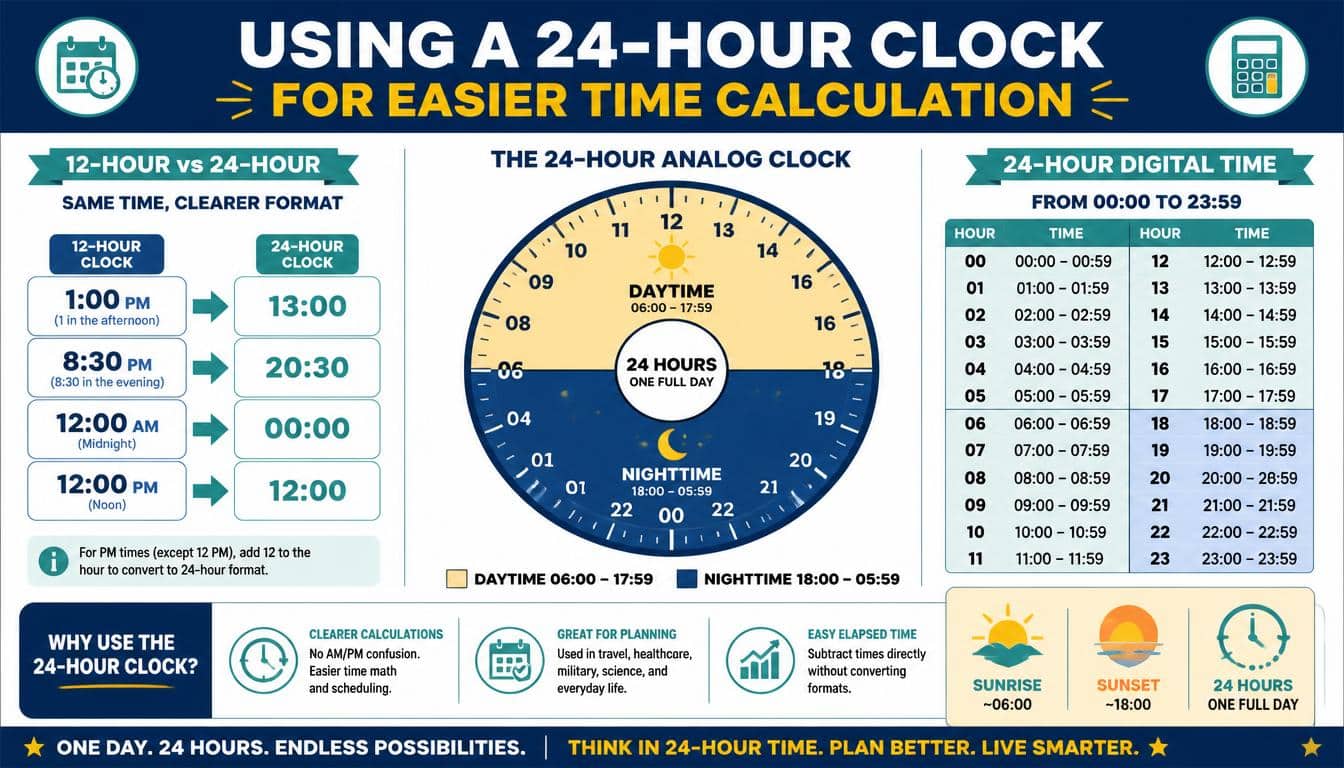
The 24-hour clock can make time calculation pleasantly boring, which is actually a compliment. There is no AM or PM to worry about, so you can simply add or subtract numbers.
Suppose the time is 8:02 PM. Write it as 20:02.
Now add 13:
20:02 + 13:00 = 33:02
Because the clock only goes to 23:59, subtract 24 hours:
33:02 − 24:00 = 09:02
The answer is therefore 09:02, or 9:02 AM, on the next day.
This method is particularly useful for international travel, railway schedules, workplaces, hospitals, airports, and technical systems where ambiguity between AM and PM can cause real problems. Nobody wants to discover at 7 PM that “7:00” on the schedule meant 7 AM.
Does the Time Zone Change the Answer?
Yes, the time zone matters whenever “now” is being interpreted from a particular location. The duration of 13 hours itself never changes, but the local clock showing the starting point can be different from one region to another.
For instance, a person in a GMT+5 region and someone using GMT could see different local clock times at the same instant. If you simply take a time from one location and apply it to another without accounting for the time zone, your answer can be wrong.
This is why online time calculators may ask for a location or time-zone setting. They need to know what “now” means before calculating a future time.
For a simple personal calculation, use your own current time zone and local clock. For international appointments, always confirm the zone rather than assuming everybody is looking at the same hour.
13 Hours From Now Tomorrow: Understanding the Next Day
People sometimes search 13 hours from now tomorrow because they already suspect the calculation will cross midnight. That is a useful clue, but it should not be assumed automatically.
Whether the answer lands tomorrow depends on the starting time.
If it is 8:02 PM today, 13 hours later is tomorrow morning. If it is 8:02 AM today, 13 hours later is 9:02 PM today. Same duration, completely different date result.
This is why date and time should be treated as a pair whenever accuracy matters. The clock alone tells only half the story.
A future time without a date can become ambiguous surprisingly quickly, especially around midnight. Writing “9:02 AM tomorrow” is much clearer than writing simply “9:02 AM.”
What About 14, 15, 16, 17, and 18 Hours From Now?
Once you understand 13 hours from now, nearby calculations become almost automatic. You can continue adding one hour at a time.
Starting from 8:02 PM on October 5:
- 14 hours from now: 10:02 AM on October 6
- 15 hours from now: 11:02 AM on October 6
- 16 hours from now: 12:02 PM on October 6
- 17 hours from now: 1:02 PM on October 6
- 18 hours from now: 2:02 PM on October 6
The pattern is simple: each additional hour moves the resulting clock forward by one hour. The date rollover has already happened after the first four hours in this example, so all the remaining answers occur on October 6.
The same principle works backward. If you know 13 hours ago, you can find 14, 15, 16, 17, or 18 hours ago by continuing to subtract one hour at a time.
13 Hours From Now: A Simple Mental Shortcut
If you need an answer quickly, there is a handy shortcut. Add 12 hours first, then add one.
Why 12? Because on a 12-hour clock, adding 12 hours keeps the displayed hour the same while switching AM and PM.
So:
8:02 PM
- 12 hours = 8:02 AM tomorrow
Then:
8:02 AM
- 1 hour = 9:02 AM tomorrow
That gives the result with very little mental juggling.
For another example, suppose the starting time is 10:30 AM. Twelve hours later is 10:30 PM, and one additional hour gives 11:30 PM. No date change is needed in that case.
If the starting time were 4:30 PM, however, twelve hours later would be 4:30 AM tomorrow, and one more hour would produce 5:30 AM tomorrow.
The trick works because the clock itself repeats every twelve hours. The calendar, meanwhile, keeps track of which cycle you’re actually in.
Common Mistakes When Calculating 13 Hours
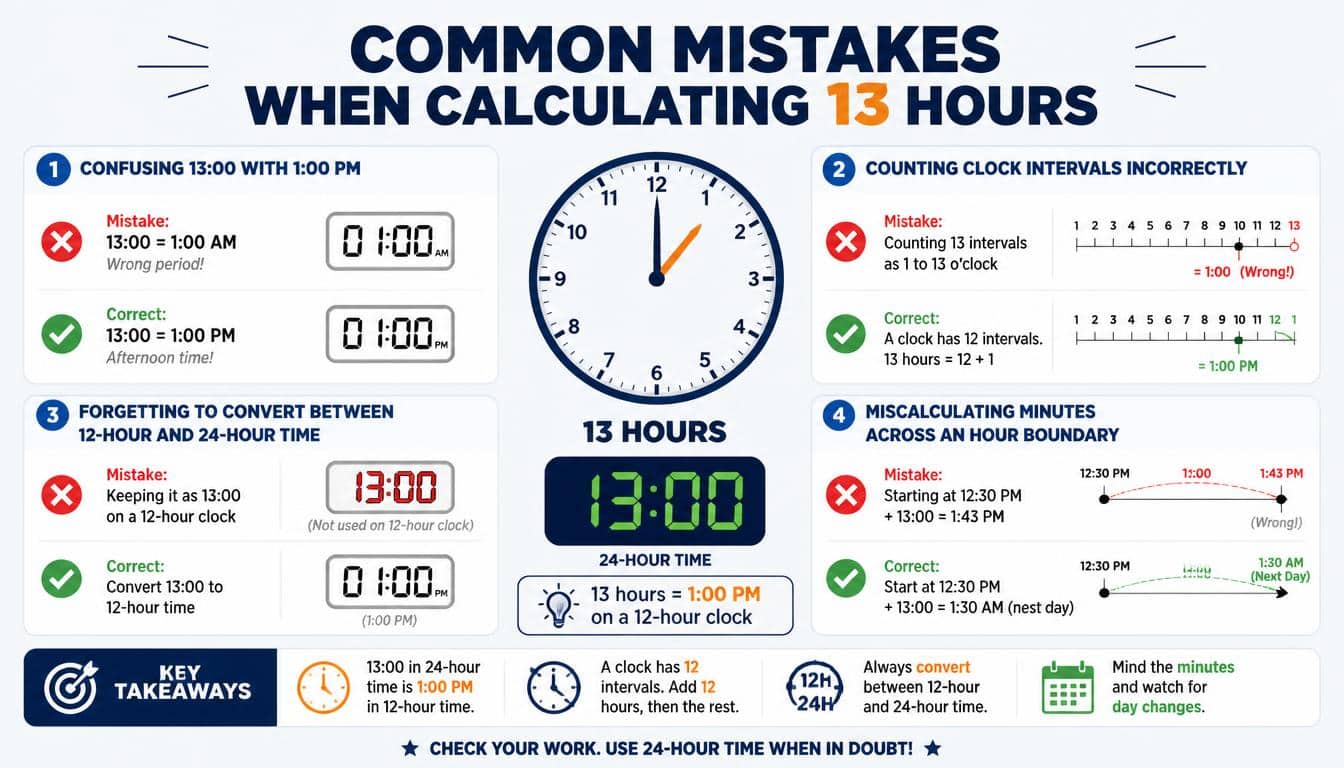
The most common mistake is forgetting the date rollover. Someone may correctly calculate 9:02 AM but write October 5 instead of October 6. The clock is right, but the calendar is wrong.
Another frequent mistake is switching AM and PM incorrectly. Adding 13 hours is not the same as simply changing PM to AM. You still need to account for the extra hour beyond 12.
People also sometimes change the minutes by accident. If the starting time is 8:02, adding whole hours does not make the answer 9:00. The minutes remain 02.
Finally, don’t confuse a duration with a time. 13 hours tells you how long; it doesn’t tell you the resulting clock time until you know the starting point.
When an Online Hours From Now Calculator Helps
For ordinary calculations, mental math is perfectly enough. But an hours from now calculator can be useful when the calculation involves several days, unusual time zones, daylight-saving changes, or a precise future date.
An online time and date calculator can also reduce errors when you need to calculate many different durations. Instead of manually repeating the process for 13, 14, 15, 16, and 18 hours, you can enter the starting point and let the calculator handle the arithmetic.
Still, understanding the calculation yourself is valuable. A calculator can give you an answer, but knowing why the answer is correct lets you catch mistakes when a setting, date, or time zone has been entered incorrectly.
How 13 Hours Relates to Other Time Units
A good understanding of time units makes these calculations easier to visualize.
Thirteen hours is half a day plus one hour. Since half a day is 12 hours, the extra hour is exactly why a 13-hour calculation often feels like it “flips” the clock and then moves one step further.
In smaller units:
13 hours = 780 minutes = 46,800 seconds = 46,800,000 milliseconds.
If you are calculating a duration for a project, sleep period, countdown, journey, or scheduled event, choosing the right unit can make the information easier to understand.
Hours are generally best for everyday planning, while minutes or seconds become useful for more precise activities.
Quick Reference for 13 Hours From Now
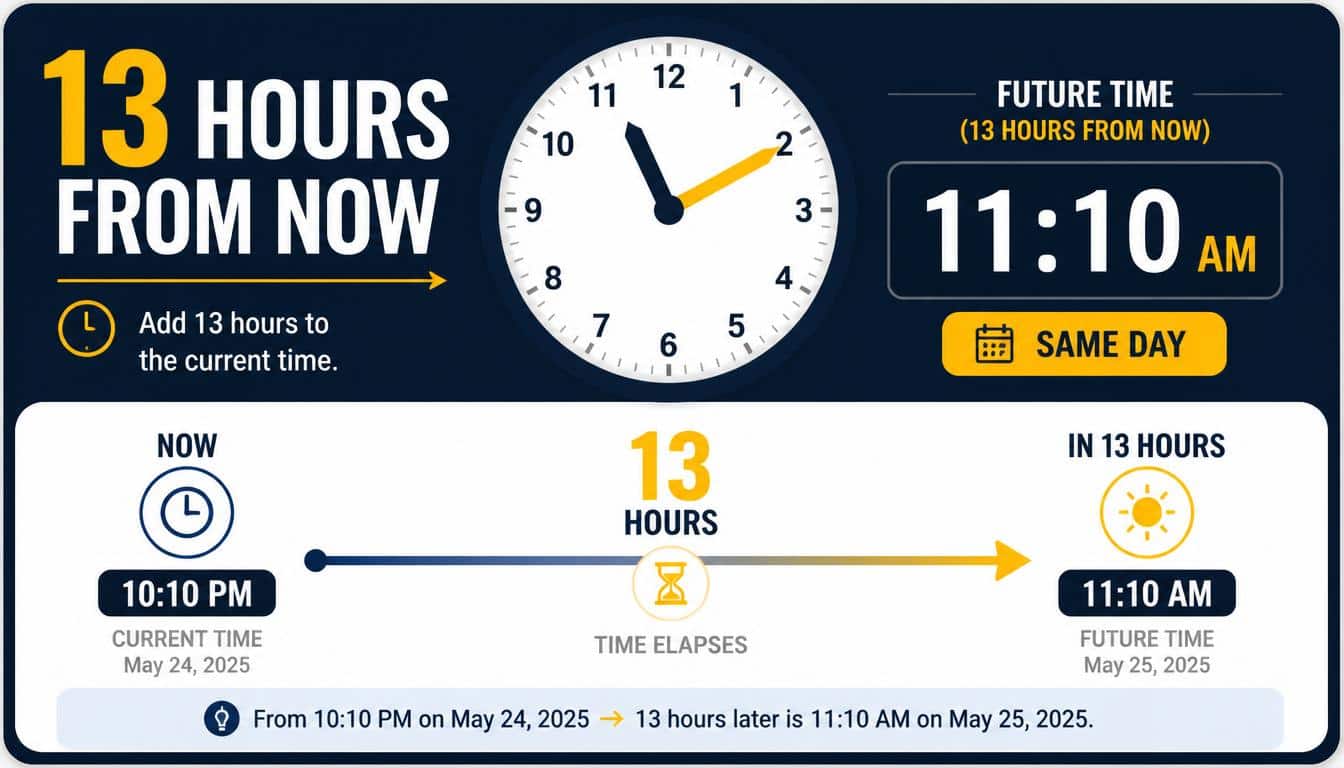
For the reference calculation used throughout this article, the answer can be summarized very simply:
- Now: 8:02 PM, October 5, 2026
- Add: 13 hours
- Crosses midnight: Yes
- Future date: October 6, 2026
- Future day: Tuesday
- Future time: 9:02 AM
- 13 hours in minutes: 780
- 13 hours in seconds: 46,800
- 13 hours in milliseconds: 46,800,000
- Time zone used: GMT+5
So if your question is specifically what time is 13 hours from now, using that starting point, the answer is 9:02 AM on Tuesday, October 6, 2026.
Frequently asked Questions
What is 13 hours from now
13 hours from now means adding 13 hours to the current time. The exact result depends on your current time and time zone.
What time is it in 13 hours
To find the time in 13 hours, simply add 13 hours to the current time. If the calculation passes midnight, the result will be on the following day.
Time in 13 hours
The time in 13 hours is calculated by adding 13 hours to the current time. This may change the AM/PM period or move the date to the next day.
13 hours from now is what time
To determine what time it will be 13 hours from now, add 13 hours to the current time. For example, 13 hours after 8:07 PM is 9:07 AM the next day.
What time is 13 hours from now
13 hours from now is found by adding 13 hours to the current time. If the calculation crosses midnight, the answer will fall on the following day.
Read More: https://gracethemes.com/what-date-is-7-weeks-from-today/
Final Thoughts on Calculating 13 Hours From Now
A question like what time is 13 hours from now looks tiny on the surface, but it teaches a useful lesson about how clocks and calendars cooperate. The clock measures the movement of time, while the date tells us where that movement lands.
Using the reference time of 8:02 PM on October 5, adding 13 hours takes us to 9:02 AM on October 6. The calculation is simply 13 hours forward, but the important detail is the next-day calculation caused by crossing midnight.
Once you understand that, almost every variation becomes easier. You can calculate 13 hours ago, add 14 hours from now, work out 15 or 16 hours from now, or convert the duration into minutes and seconds without much fuss.
And perhaps that is the nicest thing about time arithmetic: underneath all those AMs, PMs, dates, and time zones, the basic idea is wonderfully ordinary.
Start somewhere, move forward or backward by a known duration, and pay attention when the calendar quietly turns the page.
