
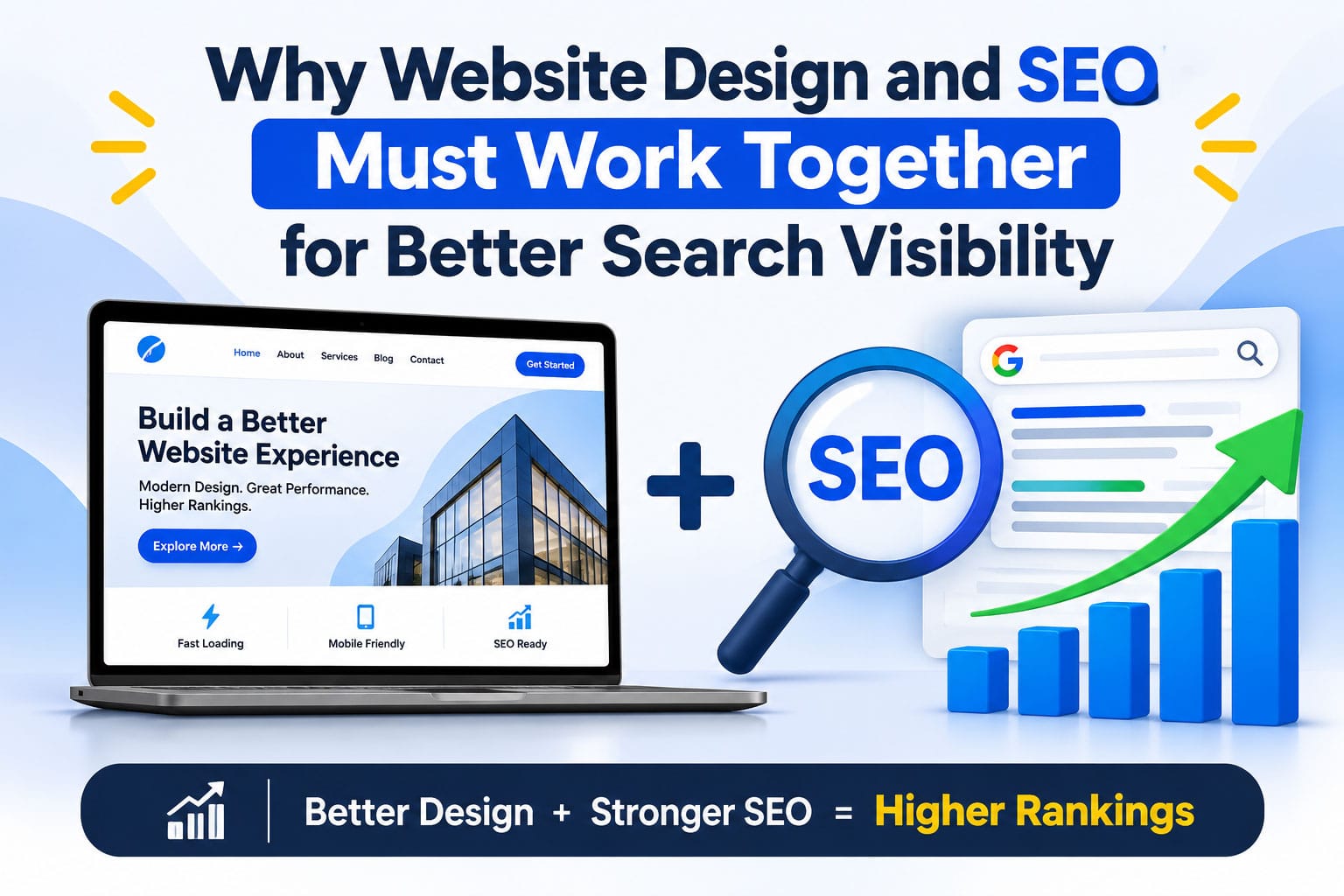
Why Website Design and SEO Must Work Together for Better Search Visibility
You can’t simply have a pretty site or a great content and expect to make one a success. The design of a website makes the first impression, but search engine optimization (SEO) helps a website to be found by search engines. Both are crucial to building good online reputation. The combination of website design and SEO can help businesses design websites that are more likely to attract visitors, offer a great user experience, and rank high in search results.
It is especially crucial for WordPress website owners to merge these two. If the website fails to adhere to the basic principles of SEO then it will not receive the organic traffic that is needed to boost their visibility to create a visually attractive site. Likewise, a site that is optimized for the content it contains can attract few visitors if it is poorly designed and confusing.
1. Website Structure Creates a Strong SEO Foundation
An organized website helps visitors and search engines to understand the information that is being presented. Users can easily locate information and the navigation is logical, with descriptive URLs.
The structure of a website can also have an impact on the way search engine crawlers navigate and navigate different pages. Content that is important should be linked to from the inside; unnecessary complexity of navigation should be avoided.
Themes for WordPress that have simple designs and flexible menus provide website owners with a means to establish a more structured online identity. Having the content well organized, with relevant page titles and descriptive headings further reinforces the connection between design and SEO.
2. Responsive Design Improves the Mobile Experience
Mobile responsiveness has become a must. Many people conduct research online on their mobile devices, so it’s crucial for contemporary websites to be mobile-friendly.
Responsive WordPress site automatically resizes itself based on the screen size of the person on the website. Text is readable and images scale well, navigation elements are easier on smaller devices.
Google indexes and ranks the content on a site as presented in the mobile site. As such, businesses need to make sure their mobile website offers the same vital details and capabilities as their desktop site.
The first step to take is to choose a responsive WordPress theme. The owner of a web page should also conduct tests on buttons, menus, forms and images on various screen sizes to uncover usability issues.
3. Website Speed and Performance Matter
Site speed plays a direct impact on visitors’ interaction with the website. If pages are slow to load, particularly on mobile connections people are more likely to leave.
Slow websites can also cause issues with regards to search visibility as page experience and Core Web Vitals are also some of the things Google take into account when assessing websites.
There are a number of things that can be done to improve the performance of the website:
- Compress images without sacrificing unnecessary visual quality.
- Use lightweight WordPress themes with clean code.
- Minimize unnecessary plugins and scripts.
- Enable browser caching and suitable performance optimization.
- Choose reliable web hosting.
- Use a content delivery network when appropriate.
Visual creativity must be balanced with performance in the designs. While large animations, oversized pictures or visual effects can be impressive, they can also have negative impacts on loading times of a website.
4. Content Presentation Makes Information Easier to Discover
SEO friendly content isn’t all about the keyword. It’s also essential to communicate your information in a method that the visitors can read and navigate.
An effective web design enhances the readability of the content through the use of proper typography, space between the sentences, contrasting colors, and clear headings. Scannable paragraphs help visitors find the information they’re looking for easily.
For instance, a WordPress business website could break its service descriptions, blog posts, customer resources, and contact information into clearly defined categories.
Another valuable source of information for businesses seeking to boost their organic rankings is professional SEO resources like Searchtides.com, which can provide insights into larger search optimization landscape and its potential for website growth.
When you add in useful information and put it into a thoughtful presentation, it’s a better experience for visitors and better for search engines.
5. User Experience Encourages Better Engagement
User experience (UX) is the relationship between user and website design. An action that a user wants to do on a website should be easy to do. If a user wants to read an article, browse through products, fill in a contact form or make a purchase, it should be made easy.
Some of the factors that are pivotal to a great user experience are:
- Simple and consistent navigation menus.
- Clearly visible calls to action.
- Readable fonts and appropriate text sizes.
- Accessible color combinations.
- Logical page layouts.
- Functional contact forms and interactive elements.
If it’s easy to find what you’re looking for, you’ll most likely continue to go through other pages and use the site. Even though it is not a direct Google ranking factor, as the simplicity of the idea implies, a positive experience can be a part of larger business and marketing goals.
6. Technical SEO Should Be Considered During Design
It is best to think about technical SEO when developing a website as opposed to when you’re finished.
Key technical factors to consider for website designers and developers are HTML structure, image alt text, canonical URLs, XML sitemaps, indexing and secure HTTPS connections.
There are a number of WordPress SEO plugins available to assist website owners with managing their metadata, sitemaps and other SEO needs. But, adding a plug-in doesn’t guarantee higher ranking. It’s still important to configure and maintain the website properly.
Accessibility must be considered when developing. Making websites easy to use with descriptive links, meaningful image descriptions, keyboard-friendly navigation, and well organized headings.
7. Choose a WordPress Theme That Supports Long-Term Growth
Choosing the perfect WordPress theme is crucial for any website owner. A good theme should give flexibility in design, not affect performance, responsiveness or usability.
When you pick a theme, take into account the loading time, mobile-friendliness, customization features, navigation and compatibility with key WordPress plugins.
Also, don’t consider themes with extras that your website won’t use. An overloaded design may not be a good base for long-term development.
Conclusion
Don’t view website design and optimization as two distinct functions. The design dictates how visitors interact with a website, and the SEO efforts make it easier for visitors to find it via search engines. Both are important in helping to create a valuable, accessible and functional online presence.
Businesses can build websites that meet their search visibility objectives and that will serve their visitors by selecting responsive WordPress themes, speeding up loading time, organizing content correctly and employing technical SEO tactics.
A successful site is not only an attractive site or a high ranking site. It’s one that offers both features and provides sustained value to readers.
