
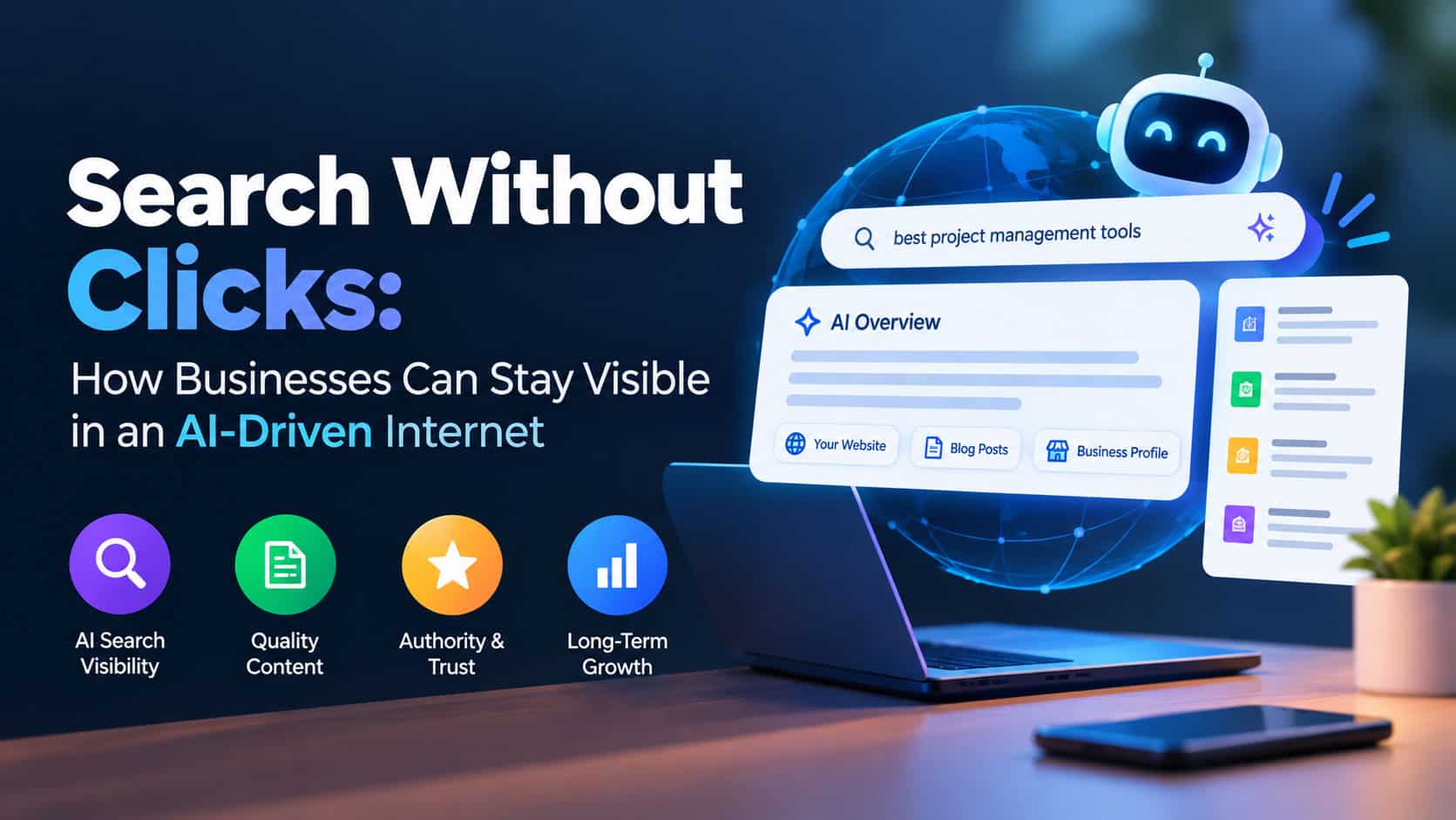
Search Without Clicks: How Businesses Can Stay Visible in an AI-Driven Internet
A customer asks which roofing company serves their ZIP code. Google shows hours, reviews, and an AI-written summary. The customer calls without ever opening a website. That interaction still has business value, even if analytics records no visit.
This is the uncomfortable reality behind zero-click search. Companies weighing premium link building services should first ask a harder question: will stronger recognition, credible references, and qualified inquiries matter more than a higher raw click count? Often, yes. But links alone cannot solve the problem.
What Does “Search Without Clicks” Mean?
A zero-click search ends without a click on a search result. The answer may appear in a featured snippet, map listing, knowledge panel, or AI-generated response. Sometimes the user simply changes the query; not every zero-click event represents a satisfied customer.
SparkToro and Datos estimated that 58.5% of US Google searches in 2024 ended without a click. In a separate study of US adults’ browsing, Pew Research Center found that users clicked a traditional result in 8% of visits with an AI summary, compared with 15% when no summary appeared. Only 1% clicked a link inside the AI summary. [1][2]
The trend deserves attention, not panic. Ahrefs estimated in February 2026 that AI Overviews correlated with a 58% lower click-through rate for the top organic result in its desktop keyword sample. Google, by contrast, has reported relatively stable aggregate organic click volume and more engaged visits. These measures answer different questions; neither predicts an individual site’s outcome. [3][4]
How Businesses Can Stay Visible When Visits Shrink
Make every important answer easy to find
Lead service pages with specific answers: who you serve, what a service costs or depends on, where it is available, and what makes your process different. Add first-hand examples, clear qualifications, current pricing ranges when feasible, and evidence that a stranger can check.
An accounting firm might explain its monthly bookkeeping scope in five plain sentences before offering a deeper comparison. Useful details give search systems material to understand, and give readers a reason to visit when the short answer is not enough.
Keep the technical basics intact
Ensure pages are indexable, connected by descriptive internal links, and readable as text. Apply accurate organization, product, or local-business structured data where appropriate. Google says there is no special markup required for AI Overviews or AI Mode, and inclusion is never guaranteed. [5]
Earn mentions rather than manufacture authority
Independent coverage, original research, supplier references, and relevant industry associations can help people encounter a business away from its own domain. A credible citation may influence discovery even when the reader never clicks immediately. That is a strategic possibility, not a proven formula for AI recommendations.
Be skeptical of vendors promising fixed numbers of placements or guaranteed AI visibility. Evaluate link-building providers by editorial relevance, transparent outreach, real readership, and placement quality. Google treats paid links that pass ranking credit and automated link schemes as spam; sponsored links should be qualified appropriately. [6]
Treat local search as a storefront
For location-based businesses, a complete Google Business Profile may answer the question before a website gets involved. Keep categories, hours, service areas, photos, and contact details accurate. Invite genuine customer reviews and reply thoughtfully. Google identifies relevance, distance, and prominence as key local ranking factors. [7]
Create distinct city or neighborhood pages only when you can offer truly local evidence: service coverage, project examples, staff, or logistics. Swapping city names on duplicated pages adds little value and can resemble doorway spam.
Measure Visibility Beyond Organic Sessions
Clicks still matter when users compare contracts, request quotes, or buy products. But they are no longer a complete proxy for discovery. Review branded-search demand, qualified leads, calls, direction requests, conversions, and referral traffic alongside Google Search Console impressions and clicks.
Test a consistent set of real customer questions in Google and answer tools such as Perplexity. Record whether your brand is named, whether the description is correct, and which sources get cited. Treat those observations as directional: answers can change with wording, timing, and location.
Common Questions About AI-Driven Search
Does zero-click search make SEO obsolete?
No. Search engines still need accessible, useful material, and buyers still visit websites to verify claims, compare offers, and complete transactions. The task is to win attention before the click and make the eventual visit worthwhile.
Can backlinks guarantee a mention in AI answers?
No. Relevant links and independent mentions can support broader credibility and traditional discoverability, but no reputable agency can promise an AI system will quote or recommend a business.
What should a small business prioritize first?
Fix inaccurate listings, strengthen the pages tied to revenue, publish answers based on customer conversations, and measure leads rather than rankings alone. Pursue thoughtful digital PR and link acquisition after these foundations work.
Visibility Is Bigger Than the Click
The goal is not to force every question into a website visit. It is to make your business recognizable, verifiable, and easy to choose wherever the customer encounters an answer. Traffic remains valuable. Trust travels farther.
