

Paver Base Calculator – Estimate Gravel and Sand for Your Patio
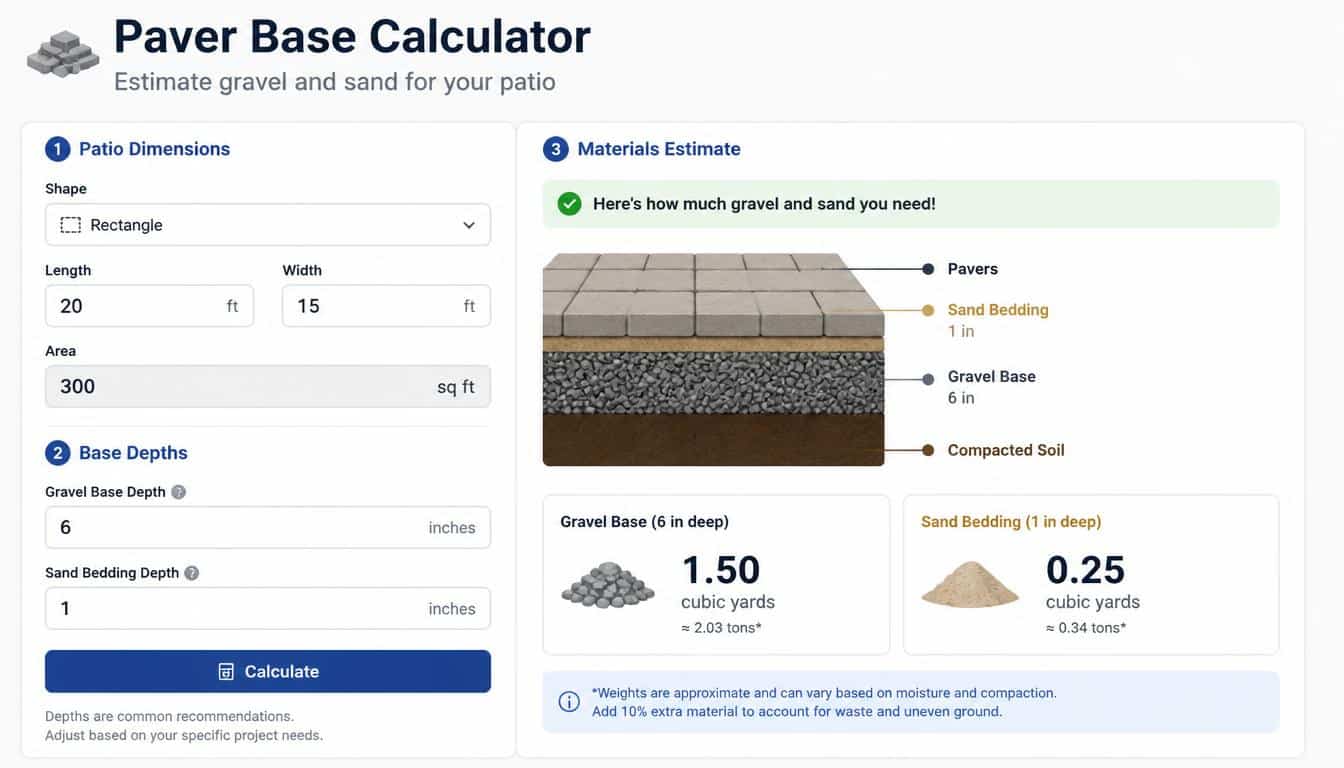
A beautiful patio often begins with something nobody will ever admire once the work is finished: the ground beneath it.
Those neat pavers, the little garden walkway, or the driveway that looks so perfectly arranged all depend on a strong foundation hiding underneath. And honestly, even the most expensive paving stones cannot rescue a surface that starts sinking after the first few rainy weeks.
That is where a Paver Base Calculator becomes a genuinely useful companion. It helps you estimate how much gravel, crushed stone, and bedding sand your project requires before you order materials or start digging.
Instead of guessing quantities and hoping the delivery truck brings enough, you can make a more sensible plan based on your patio dimensions and the depth of each layer.
Whether you’re preparing a small backyard sitting area, a winding garden path, or a driveway that needs to support heavier vehicles, understanding your material requirements can save money and plenty of frustration.
A little calculation today may prevent a rather expensive afternoon of fixing uneven pavers later.
What Is a Paver Base Calculator?
A Paver Base Calculator is a practical estimating tool that calculates the volume of materials needed beneath paving stones. You enter your project’s length and width, select the desired gravel base depth, and specify the bedding sand thickness. The calculator then estimates the amount of material required, commonly in cubic yards or cubic meters.
Think of it as a planning assistant for your hardscape project. It won’t dig the ground or compact the stone for you, unfortunately, but it can make the material-ordering stage much less confusing.
A typical paver foundation contains two important layers:
- Gravel base: A compactable layer of crushed stone or suitable aggregate that supports the pavers and helps distribute loads.
- Bedding sand: A relatively thin layer that provides a consistent setting bed for the paving stones.
Depending on the project, you may also need geotextile fabric, edge restraints, drainage materials, and polymeric sand for the joints between pavers. These are separate requirements, so a basic volume calculation won’t automatically include every item.
A reliable estimate begins with accurate measurements. If your patio measures 12 feet long and 10 feet wide, its surface area is 120 square feet. Once you know the area and the required depth of each layer, calculating the approximate material volume becomes quite straightforward.
Why Use a Paver Base Calculator Before Starting?
It’s tempting to buy a few extra bags of gravel, start spreading them around, and deal with the details as they come up. That approach sounds relaxed until you’re halfway through the project and discover that the remaining pile won’t cover the last corner.
A paver base material calculator helps you estimate quantities before placing an order, making budgeting and delivery planning easier. It’s particularly helpful when loose aggregate is sold by the cubic yard or cubic meter rather than by the square foot.
Here are several reasons to calculate your requirements first:
- Better budgeting: Estimate material quantities and compare supplier prices before spending your money.
- Fewer delivery problems: Reduce the chance of running short when the supplier is unavailable or delivery costs are high.
- Less leftover material: Avoid ordering substantially more gravel or sand than your project needs.
- Improved preparation: Determine the approximate excavation depth and plan how each layer will fit.
- More accurate scheduling: Arrange material deliveries around excavation, compaction, and installation.
- Easier project comparisons: Compare different patio sizes or base depths without starting every estimate from scratch.
For a small garden path, the difference between a rough guess and a careful calculation may not seem dramatic.
On a large patio or driveway, however, even a modest estimating error can mean several additional loads of aggregate. It’s better to spend five minutes with a calculator than spend Saturday morning wondering where the gravel went.
How to Calculate Paver Base Gravel and Sand
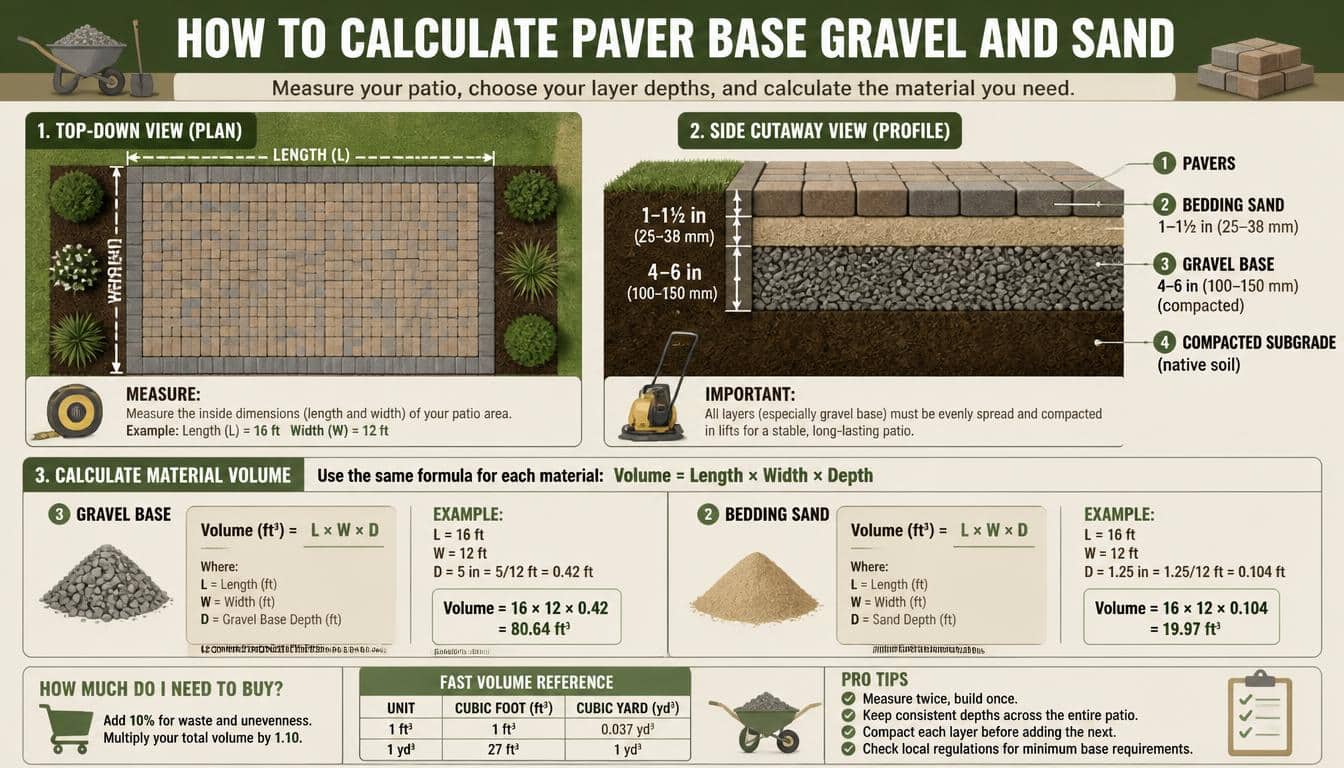
The basic method involves three measurements: project length, project width, and material depth. Measure each dimension in a consistent unit, calculate the area, and multiply that area by the depth of the material layer.
For a rectangular project, the area is:
Area = Length × Width
If your patio is 15 feet long and 12 feet wide, the surface area is:
15 × 12 = 180 square feet.
Next, convert the layer depth from inches to feet by dividing the depth by 12. For a six-inch gravel base, the depth is 6 ÷ 12, or 0.5 feet.
The volume calculation becomes:
Volume in cubic feet = Area × Depth in feet
For the example above:
180 × 0.5 = 90 cubic feet of gravel before allowing for compaction or other adjustments.
To convert cubic feet into cubic yards, divide by 27:
90 ÷ 27 = approximately 3.33 cubic yards.
That figure represents the geometric volume of the layer at the stated dimensions. The amount of loose aggregate you need to purchase may be higher because gravel settles and compacts during installation.
How to Calculate Bedding Sand
The bedding layer is normally much thinner than the gravel foundation. For many conventional paver installations, a roughly one-inch setting bed is a common starting point, although the appropriate method depends on the paver system and manufacturer instructions.
Using the same 180-square-foot patio, a one-inch sand layer has a depth of 1 ÷ 12 feet.
180 × (1 ÷ 12) = 15 cubic feet.
Dividing by 27 gives approximately 0.56 cubic yards of bedding sand.
This is a theoretical volume, not a guaranteed purchasing quantity. Actual requirements vary with the chosen sand, surface preparation, installation technique, and losses during handling.
Also, don’t confuse bedding sand with polymeric jointing sand. Bedding sand goes beneath the pavers, while polymeric sand is used in the joints after the paving stones are installed. They serve different purposes and should be estimated separately.
Paver Base Gravel Calculator: Finding the Right Quantity
A paver base gravel calculator focuses on the compactable stone layer beneath the bedding material. This layer is doing most of the structural work, so its depth and material quality deserve more attention than you might expect.
Suitable crushed aggregate usually contains a mixture of particle sizes that can interlock when compacted. The exact material specification varies by region and project, but a stable, compactable base is generally preferable to loose decorative gravel.
To estimate gravel requirements, begin by measuring the prepared paving area. Then determine the required compacted base depth based on the soil, intended use, drainage conditions, and local construction guidance.
For instance, consider a patio measuring 200 square feet with a six-inch compacted gravel base.
- Project area: 200 square feet.
- Compacted gravel depth: 6 inches, or 0.5 feet.
- Compacted volume: 200 × 0.5 = 100 cubic feet.
- Compacted volume in cubic yards: 100 ÷ 27 = approximately 3.70 cubic yards.
You may need to order more than 3.70 cubic yards of loose aggregate to achieve that compacted volume. The required allowance depends on the aggregate and how it is placed and compacted, so ask your supplier or installer for an appropriate conversion rather than treating a universal percentage as exact.
A 20% allowance is sometimes used as a preliminary planning assumption, but it should be verified for your material and installation conditions. Applying that assumption to 3.70 cubic yards gives roughly 4.44 cubic yards as an initial purchase estimate. It is still an estimate, not a guarantee.
Paver Sand Calculator: How Much Sand Do You Need?
A paver sand calculator estimates the volume of bedding material required beneath the paving stones. Since this layer is relatively shallow, small changes in depth can make a noticeable difference to the finished surface and installation process.
For a rectangular patio, calculate the surface area and multiply it by the chosen sand depth. If you’re working in feet, remember to convert inches into fractions of a foot before multiplying.
Here’s a quick example for a 100-square-foot patio with a one-inch bedding layer:
100 × (1 ÷ 12) = 8.33 cubic feet.
8.33 ÷ 27 = approximately 0.31 cubic yards.
This is the theoretical volume for a uniform one-inch layer. The amount purchased may differ depending on packaging, material moisture, handling losses, and the supplier’s selling units.
One important detail deserves a mention: bedding sand isn’t supposed to correct a badly prepared gravel base. If the stone layer has dips, humps, or soft spots, adding extra sand to hide the problem may lead to uneven support. Prepare and compact the foundation properly, then screed the bedding layer to the recommended thickness.
For jointing sand, use a separate estimate based on the paver dimensions, joint width and depth, and the manufacturer’s coverage information. A Polymeric Sand Calculator may be useful when you’re planning that finishing stage.
How Deep Should a Paver Base Be?
Base depth is one of the most important decisions in a paving project. Too little structural support can contribute to shifting, sinking, and uneven surfaces, while an unnecessarily thick base may increase excavation and material costs without providing a meaningful benefit.
The right depth depends on the type of paving, soil conditions, drainage, frost exposure, and expected loads. The following ranges are useful for preliminary planning, but they are not a substitute for project-specific specifications.
- Garden paths and lightly used areas: A compacted aggregate base around 4 inches may suit some installations on suitable ground.
- Residential patios: A base around 4–6 inches is a common preliminary range for many pedestrian-use projects.
- Driveways and heavier-duty paving: A base around 6–8 inches or more may be necessary, depending on soil and vehicle loads.
- Weak or frost-susceptible ground: Additional excavation, stabilization, drainage work, or a deeper designed foundation may be required.
These are general reference ranges, not universal building standards. Some installations require more substantial construction, and manufacturer recommendations or local requirements should take priority.
Gravel Base Depth Versus Sand Depth
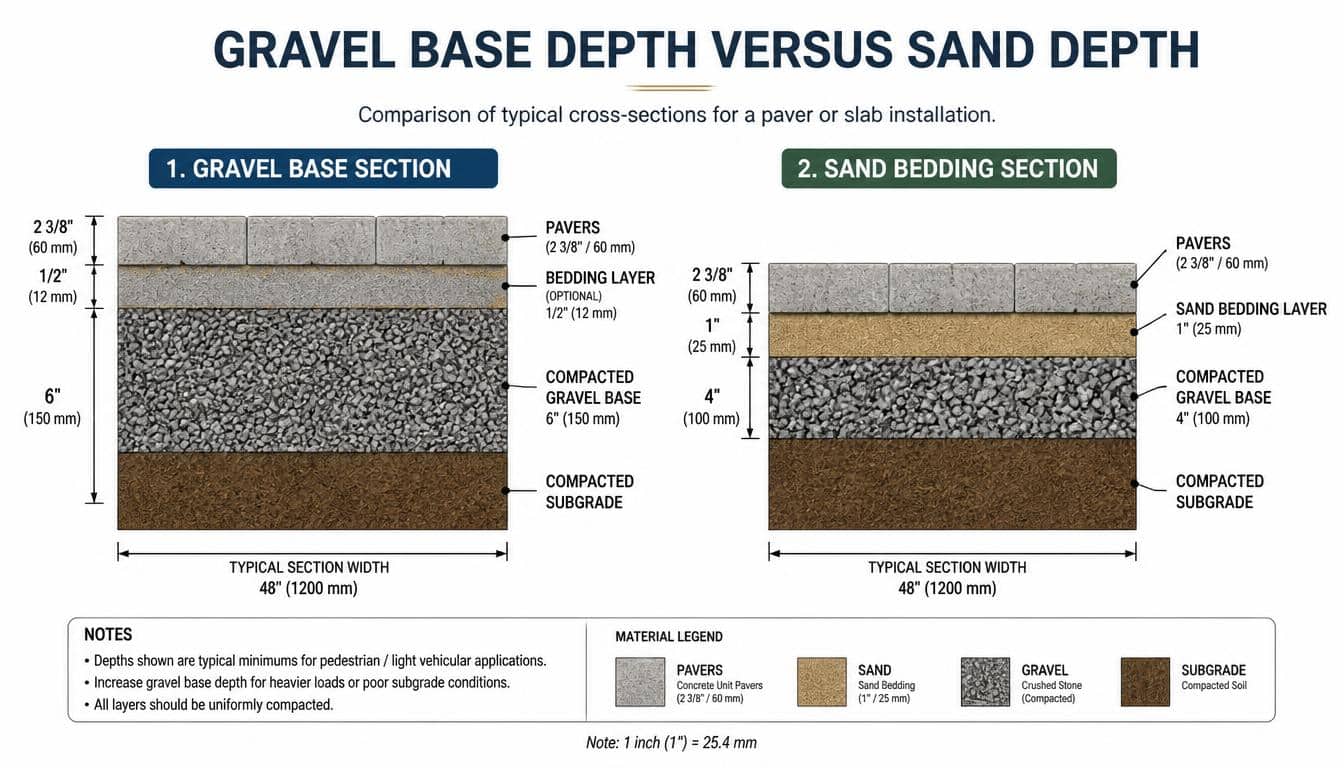
Gravel and sand have different jobs, which is why they shouldn’t be treated as interchangeable materials. Gravel creates the load-bearing foundation, while the bedding layer helps establish a consistent setting surface for the pavers.
For many conventional installations, the bedding sand layer is approximately one inch thick. The gravel base, meanwhile, may be several inches deep depending on the intended use and site conditions.
Increasing the sand thickness to compensate for inadequate gravel is not a good shortcut. A thick or inconsistent bedding layer can move under loading and contribute to settlement. Get the foundation right first; the neat appearance of the finished patio depends on it.
Paver Base Volume Calculator: Understanding Cubic Yards and Cubic Meters
A paver base volume calculator can display results in cubic feet, cubic yards, or cubic meters. Understanding these units makes it easier to compare supplier quotations, especially when one company sells material by the cubic yard and another quotes in metric units.
The main conversions are:
- 1 cubic yard = 27 cubic feet.
- 1 cubic meter = 1,000 liters.
- 1 cubic meter = approximately 35.315 cubic feet.
- 1 cubic yard = approximately 0.7646 cubic meters.
- 1 cubic foot = approximately 0.02832 cubic meters.
If your calculated gravel volume is 4 cubic yards, multiply by approximately 0.7646 to convert it into cubic meters.
4 × 0.7646 = approximately 3.06 cubic meters.
For a metric project, you can calculate the volume directly using meters:
Volume in cubic meters = Area in square meters × Depth in meters
Suppose a patio is 5 meters long and 4 meters wide, with a gravel base depth of 0.15 meters.
Area = 5 × 4 = 20 square meters.
Volume = 20 × 0.15 = 3 cubic meters.
The result is the geometric volume at the stated depth. If the depth represents the finished compacted layer, allow for the difference between loose delivered aggregate and compacted material when estimating the purchase quantity.
Paver Base Calculator for Patio Projects of Different Sizes
Different patio dimensions can make material estimates feel confusing, especially when you’re comparing several possible layouts. A simple reference table can help you understand how area and base depth affect gravel and bedding sand requirements.
The examples below assume a uniform rectangular surface, a six-inch gravel layer, and a one-inch bedding layer. All volumes are theoretical and exclude extra material for compaction, irregular ground, and handling losses.
| Patio area | Gravel volume | Bedding sand volume |
| 50 sq. ft. | 0.93 cu. yd. | 0.15 cu. yd. |
| 100 sq. ft. | 1.85 cu. yd. | 0.31 cu. yd. |
| 150 sq. ft. | 2.78 cu. yd. | 0.46 cu. yd. |
| 200 sq. ft. | 3.70 cu. yd. | 0.62 cu. yd. |
| 300 sq. ft. | 5.56 cu. yd. | 0.93 cu. yd. |
| 500 sq. ft. | 9.26 cu. yd. | 1.54 cu. yd. |
| 700 sq. ft. | 12.96 cu. yd. | 2.16 cu. yd. |
The gravel figures are calculated using an unadjusted six-inch depth, while the sand figures use an unadjusted one-inch depth. Rounded values are intended for quick planning, not final purchase orders.
For example, a 100-square-foot patio needs about 1.85 cubic yards of gravel at a six-inch depth before a compaction allowance is considered. The same patio requires about 0.31 cubic yards of bedding sand at a one-inch depth.
Notice how the material quantity increases with the surface area. Doubling the patio size doubles the theoretical volume if the layer depths remain unchanged. It’s a simple relationship, but it becomes very handy when deciding whether to build a compact seating area or extend the paving into a much larger outdoor space.
Paver Base Calculator for Driveways and Walkways
Not every paved surface experiences the same pressure. A garden walkway might carry pedestrians and a wheelbarrow, whereas a driveway needs to support the weight of vehicles and the repeated stresses of turning, braking, and parking.
For this reason, a patio base material calculator should not be used with identical assumptions for every project. A driveway may require a deeper aggregate foundation, stronger edge restraint, more careful drainage planning, and a base design appropriate for the underlying soil.
Walkway Base Preparation
Walkways often have smaller surface areas, but their long, narrow shapes can create awkward excavation and material calculations. Measure the length and width of each straight section, calculate their areas, and add the results together.
If the path curves or widens around a garden bed, divide it into simple geometric sections where possible. For a circular or irregular area, use an appropriate area calculation or measure the shape using a suitable estimating method.
Driveway Base Preparation
For driveway paving, the anticipated vehicle loads matter just as much as the surface dimensions. The subgrade must be suitable, the aggregate must be appropriate for the application, and the base needs to be compacted correctly.
Don’t assume that adding more gravel alone will solve poor drainage or weak soil. Depending on the site, a geotechnical assessment or professional paving specification may be necessary. The calculator estimates material quantities; it does not determine the structural adequacy of a driveway design.
Why Compaction Matters When Estimating Gravel
Loose aggregate occupies space differently from aggregate that has been properly compacted. As the particles settle and interlock, the material layer becomes denser, meaning the volume of loose material purchased can exceed the finished compacted volume.
This is why a gravel estimate should distinguish between the required finished depth and the loose quantity ordered from a supplier.
Suppose your project requires 5 cubic yards of compacted base material. You should not automatically assume that ordering exactly 5 cubic yards of loose gravel will produce the finished layer. The conversion depends on the aggregate grading, moisture, handling, placement, and compaction process.
Ask your aggregate supplier how the material is sold and whether their estimating guidance accounts for compaction. If you’re hiring a contractor, confirm whether the quoted quantity refers to loose delivered material or finished compacted volume.
Compaction also affects durability. A properly prepared aggregate foundation helps distribute loads and limits movement, but simply compacting the surface once is not always sufficient. Material should be placed in suitable lifts and compacted according to the project specifications and equipment requirements.
The small details matter here, even if they seem rather boring compared with choosing beautiful paver colours.
Choosing the Right Materials for a Paver Foundation
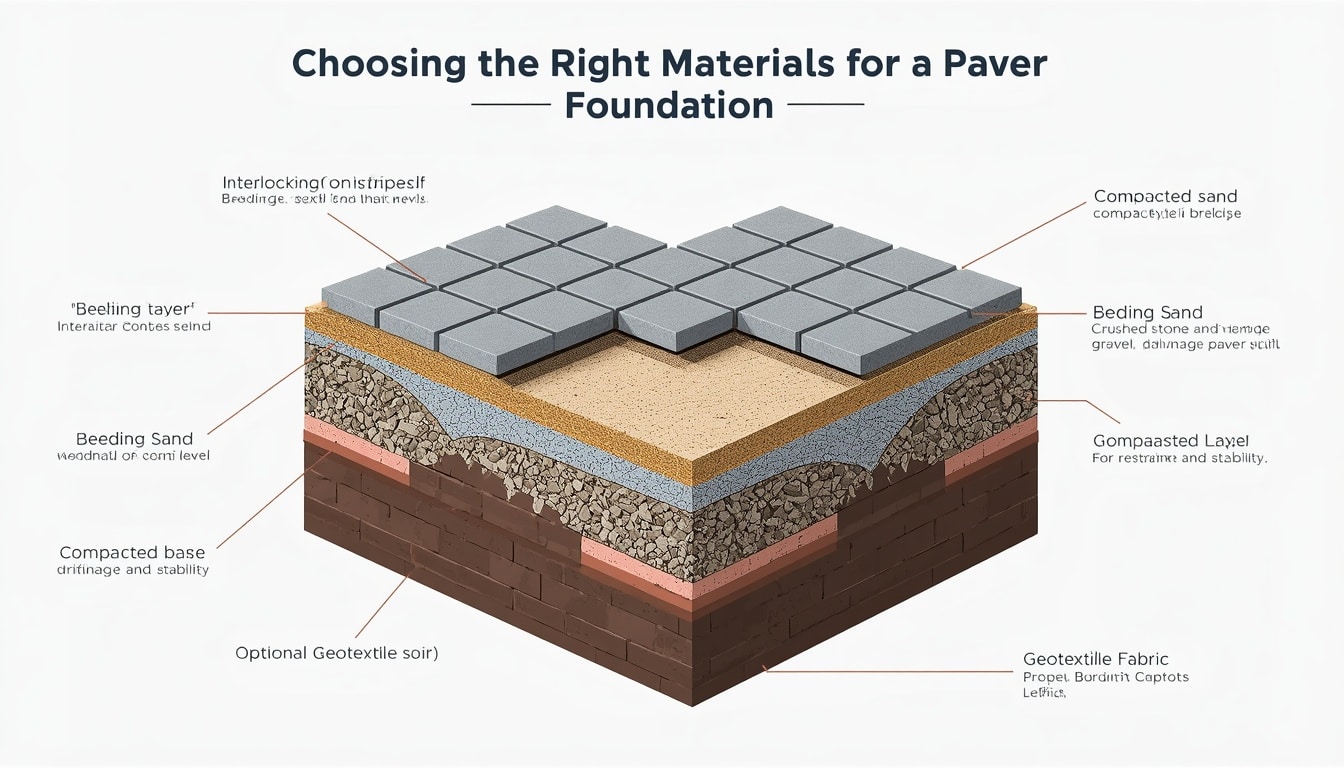
The material you choose affects drainage, stability, ease of installation, and the amount required to achieve the desired depth. Your local aggregate supplier can help identify products suitable for the climate, soil, and paving system.
Crushed Gravel and Aggregate
Crushed stone or an appropriately graded paver base aggregate is commonly used because angular particles can interlock under compaction. The precise gradation depends on local availability and project requirements.
Avoid choosing a product simply because it is labelled gravel. Decorative rounded stones may not compact or provide the same stability as a suitable crushed aggregate base.
Bedding Sand
Bedding sand must be compatible with the paver installation system. The required grading and thickness depend on the paving product and construction method.
Using a thicker layer to compensate for uneven base preparation is generally a poor idea. The bedding layer should be consistent and supported by a properly prepared foundation.
Polymeric Sand
Polymeric sand is designed for filling joints between compatible pavers. It typically contains binders that help the sand stay in place when installed according to the product instructions.
It is not a replacement for bedding sand or gravel. Estimate its quantity separately and follow the manufacturer’s guidance regarding joint dimensions, moisture, and curing.
Geotextile Fabric and Edge Restraints
Depending on the soil and project design, geotextile fabric may help separate the subgrade from the aggregate. Edge restraints help keep pavers from spreading outward over time.
Neither item is automatically required for every installation, so base your decision on site conditions and the paving system rather than adding materials without a clear purpose.
Common Paver Base Calculation Mistakes to Avoid
Even a well-designed calculator can only produce a useful estimate when the information entered is accurate. A few common mistakes are worth avoiding before you order a truckload of material.
- Mixing measurement units: Entering inches where feet are expected can produce a wildly inaccurate estimate.
- Forgetting the depth conversion: A six-inch layer is 0.5 feet, not 6 feet.
- Ignoring compaction: Loose aggregate and finished compacted base volume are not always equal.
- Using the wrong material: Decorative gravel may not be suitable for a load-bearing foundation.
- Assuming every surface needs the same depth: Pedestrian patios and vehicle-bearing driveways have different requirements.
- Forgetting irregular shapes: Curves, steps, borders, and cutouts can affect the area calculation.
- Confusing bedding sand with jointing sand: These materials perform different functions and should be estimated independently.
- Ignoring drainage and soil conditions: A volume estimate cannot compensate for poor site preparation or an unsuitable foundation.
A sensible approach is to calculate the area twice, confirm the selected depths, and compare the estimated volume with the supplier’s recommendations. It takes very little extra time, and it can save a surprising amount of trouble later.
How to Use a Paver Base Calculator Step by Step
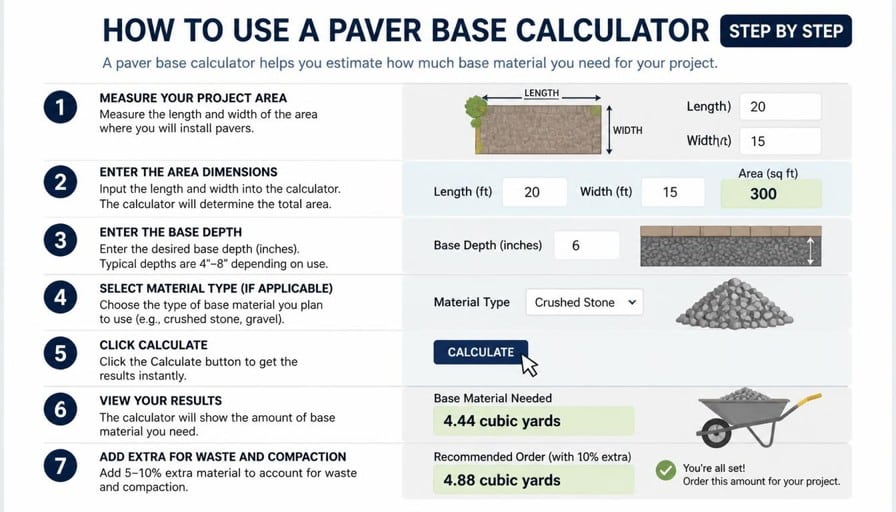
If you’re using a digital Paver Base Calculator, the process is usually straightforward. The important thing is to provide dimensions and depths that reflect the actual construction plan.
- Measure the project: Record the length and width of the patio, walkway, or driveway.
- Calculate the surface area: Multiply the dimensions for a rectangular layout, or divide an irregular layout into manageable sections.
- Choose the gravel depth: Use the depth appropriate for the soil, load, drainage, and paving specifications.
- Enter the bedding sand depth: Follow the manufacturer’s installation instructions for the selected pavers.
- Select your units: Confirm whether you’re entering measurements in feet, inches, centimeters, or meters.
- Review the volume: Check the calculated gravel and sand quantities in cubic yards or cubic meters.
- Add a justified purchasing allowance: Account for compaction, handling losses, and site irregularities using supplier guidance.
- Confirm delivery quantities: Check whether the supplier sells by loose volume, weight, bag, or another unit.
If the calculator provides only a geometric volume, treat that number as your starting point rather than the final order quantity. Some tools include a waste or compaction allowance, while others don’t, so check the assumptions before adding extra material.
Frequently Asked Questions About Paver Base Calculations
What is a Paver Base Calculator?
A Paver Base Calculator estimates the quantity of aggregate and bedding sand needed for a paving project. It uses project dimensions, layer depths, and volume conversions to help plan material purchases.
How much gravel do I need for a 100-square-foot patio?
With a six-inch base, a 100-square-foot patio requires approximately 50 cubic feet, or 1.85 cubic yards, of gravel at the stated depth. This is the theoretical compacted-layer volume if six inches is the finished depth; the loose quantity ordered may need to be higher.
How much sand is needed under pavers?
For a 100-square-foot patio with a one-inch bedding layer, the theoretical sand volume is approximately 8.33 cubic feet, or 0.31 cubic yards. Actual requirements depend on the installation system, surface preparation, and material handling.
How deep should a paver base be?
A base around 4–6 inches is a common preliminary range for many residential patios, while driveways may require 6–8 inches or more. Soil conditions, frost exposure, drainage, and loading can change these requirements substantially.
Can I use the same base depth for a patio and driveway?
Not necessarily. Driveways experience heavier loads and may require a deeper or specially designed foundation. The correct depth should be based on site conditions and the applicable paving specifications.
Why should I add extra gravel for compaction?
Loose aggregate settles and becomes denser during compaction, so the delivered volume may need to exceed the finished layer volume. The required allowance varies by material and installation conditions; a supplier can help determine a suitable estimate.
How do I convert cubic inches into cubic yards?
There are 46,656 cubic inches in one cubic yard. Divide the volume in cubic inches by 46,656 to convert it into cubic yards.
How do I calculate paver base volume in cubic meters?
Multiply the area in square meters by the layer depth in meters. For example, a 20-square-meter area with a 0.15-meter layer requires 3 cubic meters before any purchasing allowance.
Does a paver base calculator include pavers and jointing sand?
Not always. Many calculators estimate the gravel foundation and bedding sand only. Paver quantities, jointing sand, edge restraints, and geotextile fabric may require separate calculations.
Paver Base Depth Calculator
A paver base depth calculator helps you determine the required thickness of the gravel foundation based on your project type, soil conditions, and expected load. Most residential patios use a compacted gravel base around 4–6 inches deep, while driveways may require 6–8 inches or more.
Gravel Calculator for Pavers
A gravel calculator for pavers estimates how much crushed stone or aggregate you need using the project’s length, width, and base depth. It provides the estimated volume in cubic yards or cubic meters to help you plan material purchases accurately.
How Much Paver Base Do I Need
The amount of paver base you need depends on the total paved area and the required compacted base depth. For example, a 100-square-foot patio with a 6-inch gravel base requires approximately 1.85 cubic yards of compacted gravel volume, before allowing for compaction and material losses.
Patio Calculator
A patio calculator helps you estimate the surface area and materials needed for your patio installation, including pavers, gravel, and bedding sand. Enter your patio’s length and width to calculate its area and plan the quantities required for each layer.
Paver Gravel Calculator
A paver gravel calculator determines the estimated quantity of gravel required beneath paving stones based on the area and gravel layer thickness. It helps you calculate material volume and account for additional aggregate needed to achieve the desired compacted base.
Read More:
Practical Tips for Getting a More Accurate Estimate
Before ordering material, take a few minutes to review your site measurements. Measure the actual area to be paved rather than relying entirely on a rough sketch, and note any curves, steps, or sections with different base depths.
It is also useful to ask the supplier about the aggregate’s grading, typical bulk density, and compaction behaviour. Some suppliers quote material by weight, so the conversion between volume and tonnes depends on the specific material rather than a single universal number.
If the project is unusually large, the soil is unstable, or vehicles will place substantial loads on the paving, consider professional guidance. A calculator is excellent for quantity planning, but it cannot replace a suitable structural design.
Finally, keep a record of your assumptions. Write down the area, gravel depth, sand depth, and allowance used. If the project dimensions change, you can update the calculation without starting from scratch.
Read More: https://gracethemes.com/what-time-was-it-24-hours-ago/
Conclusion: Build a Strong Foundation for Beautiful Pavers
A successful paving project is about more than arranging attractive stones in a pleasing pattern. The real work begins underneath, where the aggregate foundation, bedding layer, and prepared ground determine how well the surface performs over time.
A Paver Base Calculator makes that hidden part of the project easier to plan. By calculating the area, selecting appropriate layer depths, converting volumes, and accounting for compaction, you can estimate gravel and sand requirements with much greater confidence.
Whether you’re creating a quiet garden walkway, a welcoming patio for family gatherings, or a durable driveway, careful preparation is worth the effort. Measure accurately, choose suitable materials, and confirm your estimates with the supplier or installer when needed.
The best paving projects aren’t necessarily the biggest or most expensive ones. They’re the ones built thoughtfully, with a foundation that does its job quietly for years to come. Get the numbers right before the first stone is laid, and you’ll be one step closer to an outdoor space that looks good, feels solid, and stays that way.
