

Liters to Fluid Ounces Converter
A measurement can look wonderfully simple until two different systems walk into the same recipe, bottle, spreadsheet, or instruction manual.
One person sees liters, another sees fluid ounces, and suddenly a perfectly ordinary amount of water feels like a tiny maths problem nobody invited.
That’s where a good liters to fluid ounces converter becomes useful, because it turns an unfamiliar unit of volume into something much easier to picture.
Whether you are checking a drink recipe, comparing bottle sizes, reading imported packaging, studying volume measurement, or simply wondering how many fluid ounces are in 1 liter, the underlying idea is pleasantly straightforward.
A liter belongs to the metric system, while the US fluid ounce belongs to the US customary system, so the two measurements need a reliable conversion ratio between them.
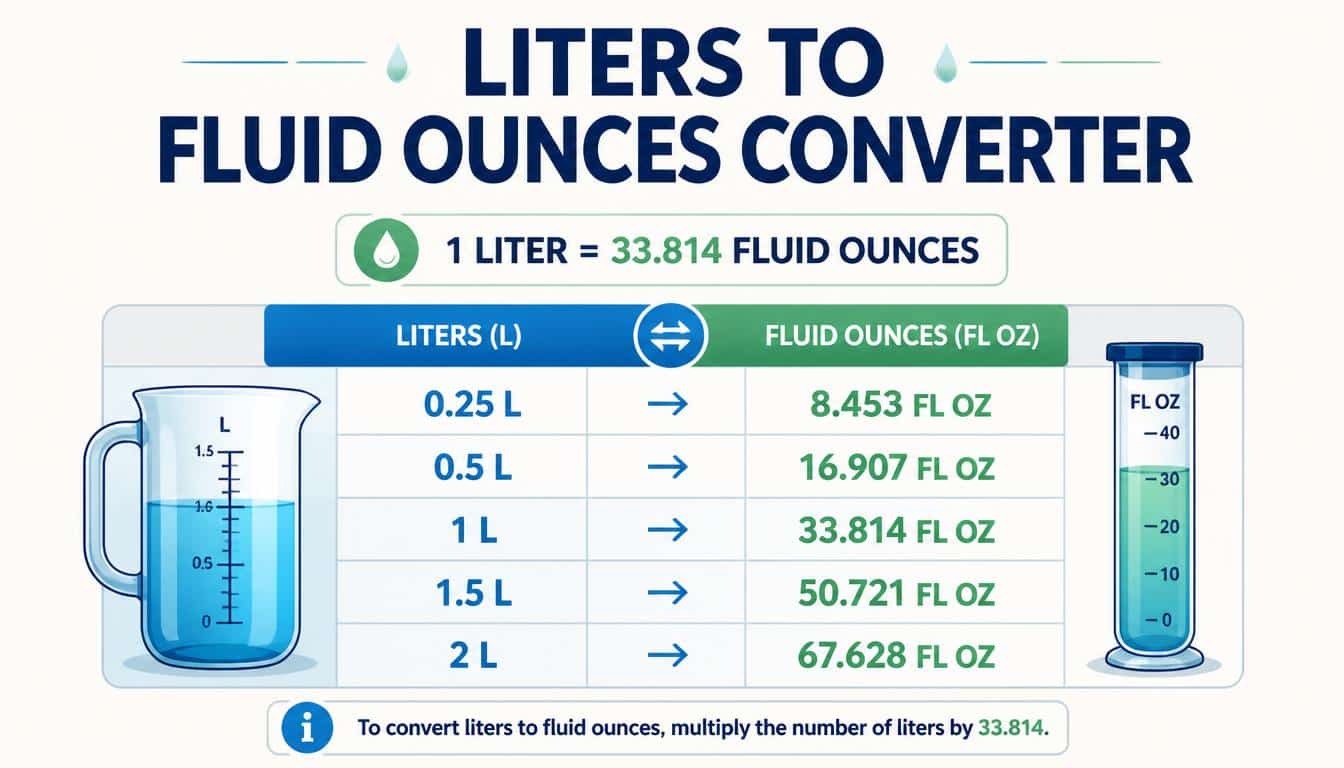
The standard US conversion is 1 liter = 33.814023 fluid ounces. In everyday writing, this is often shortened to 1 L = 33.814 fl oz.
The extra decimal places can be handy for calculations, though nobody really needs to whisper “thirty-three point eight one four zero two three” while pouring lemonade at a picnic. For ordinary household work, rounding to 33.814 fl oz is usually plenty.
| Liters (L) | Fluid Ounces (fl oz) |
| 0.1 L | 3.38 fl oz |
| 0.25 L | 8.45 fl oz |
| 0.5 L | 16.91 fl oz |
| 0.75 L | 25.36 fl oz |
| 1 L | 33.81 fl oz |
| 1.25 L | 42.27 fl oz |
| 1.5 L | 50.72 fl oz |
| 1.75 L | 59.17 fl oz |
| 2 L | 67.63 fl oz |
| 2.5 L | 84.54 fl oz |
| 3 L | 101.44 fl oz |
| 4 L | 135.26 fl oz |
| 5 L | 169.07 fl oz |
| 6 L | 202.88 fl oz |
| 7 L | 236.70 fl oz |
| 8 L | 270.51 fl oz |
| 9 L | 304.33 fl oz |
| 10 L | 338.14 fl oz |
| 20 L | 676.28 fl oz |
| 30 L | 1,014.42 fl oz |
| 40 L | 1,352.56 fl oz |
| 50 L | 1,690.70 fl oz |
What Is a Liter?
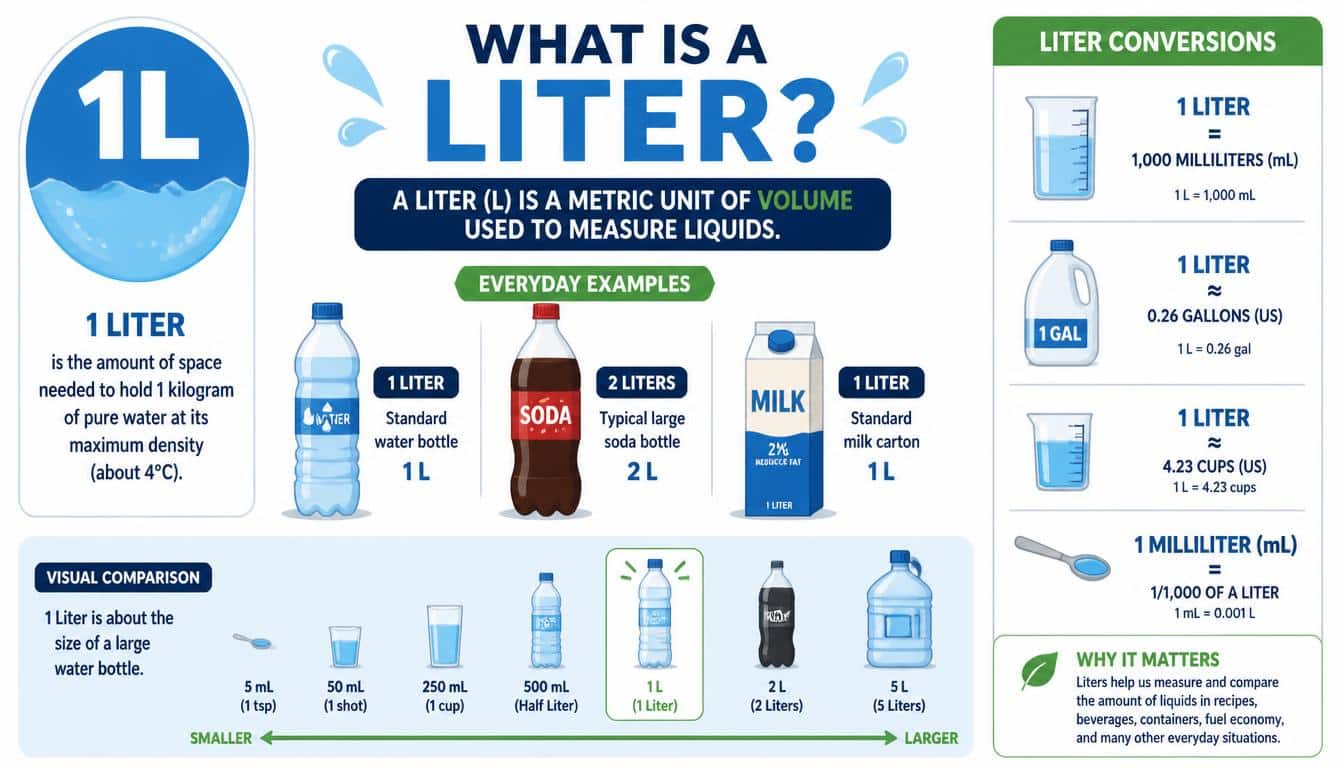
A liter is a familiar metric unit of volume used for measuring liquids and other capacities. Its symbol is generally L, although l is also encountered in some contexts, and the script form ℓ has historical use. NIST notes that the uppercase L is preferred because lowercase l can be confused with the number 1.
In the modern metric system, the liter has a particularly neat relationship with cubic measurement. 1 liter = 1 cubic decimeter, and 1 liter = 1,000 cubic centimeters.
That means a cube measuring one decimeter on each side has a volume of one liter. Since 1 decimeter = 10 centimeters, the little cube is 10 cm × 10 cm × 10 cm, which gives 1,000 cm³. Quite tidy, really.
NIST describes the liter as a special name for the cubic decimeter and lists 1 L = 1 dm³ = 1,000 cm³ = 10⁻³ m³ as its relationship to SI units. The liter is not the SI base unit for volume the cubic meter is but it is accepted for use with the SI and is extremely common for fluid volume.
That is why liters appear everywhere from water bottles to fuel containers. You may also see related metric measurements such as milliliters, cubic centimeters, cubic meters, and cubic decimeters. They all describe volume, just at rather different scales.
What Is a Fluid Ounce?
A fluid ounce is a unit of volume, not a unit of weight. This tiny distinction causes a surprising amount of confusion, because “ounce” by itself can refer to mass while “fluid ounce” refers to liquid volume. They are not interchangeable measurements, despite sharing the word ounce.
For US measurements, 1 fluid ounce ≈ 29.5735 milliliters. NIST’s tables give a US fluid ounce as approximately 29.573 mL, which is the basis for the familiar US conversion used in liquid measurements.
A US fluid ounce also has useful household relationships. 1 fluid ounce = 1/16 pint and 1 fluid ounce = 1/8 cup under the relevant US customary relationships. A US gallon contains 128 US fluid ounces, while a US gallon is approximately 3.785 liters.
There is one small trap hiding here: US and British Imperial fluid ounces are different. So when an online converter says “fluid ounce,” check which system it means.
The conversion in this article uses the US customary units definition, because that is the common target for the liters to fluid ounces conversion requested here.
Liters to Fluid Ounces: The Basic Conversion
The central conversion formula is refreshingly uncomplicated:
fluid ounces = liters × 33.814023
So, if you have 1 liter and want to calculate fluid ounces, multiply:
1 × 33.814023 = 33.814023 fluid ounces
Therefore:
1 liter = 33.814023 fluid ounces
For most everyday situations, you can write:
1 L ≈ 33.814 fl oz
And if you’re doing a quick mental calculation, even 33.8 fl oz is often close enough. The correct degree of precision depends on what you’re actually doing, because measuring a cocktail and calibrating laboratory equipment are very different adventures.
The conversion factor is therefore 33.814023 fluid ounces/liter. Once you remember that number, the entire liter-to-ounce conversion becomes multiplication rather than mystery.
How to Convert Liters to Fluid Ounces
To convert liters to fluid ounces, take the number of liters and multiply it by 33.814023. That’s the whole process, more or less, and there is no secret second step hiding behind the calculator.
For example, suppose a bottle contains 2 liters:
2 × 33.814023 = 67.628046 fluid ounces
So 2 liters = 67.628046 fluid ounces, or about 67.63 fl oz.
Try another amount, say 1.5 liters:
1.5 × 33.814023 = 50.7210345 fluid ounces
Therefore, 1.5 liters ≈ 50.721 fluid ounces.
If you’re converting a number with many decimal places, it can be sensible to round the final answer rather than carrying a parade of digits around forever. For a recipe, two decimal places is normally more than enough.
Liters to Fluid Ounces Conversion Examples
Here are several common values, because sometimes seeing the numbers lined up makes the relationship click faster than another paragraph ever could.
- 25 liters × 33.814023 = 8.453506 fl oz, so 0.25 L is about 8.45 US fluid ounces.
- 5 liters × 33.814023 = 16.9070115 fl oz, so 0.5 L is about 16.91 fl oz.
- 75 liters × 33.814023 = 25.36051725 fl oz, or about 25.36 fl oz.
- 1 liter × 33.814023 = 33.814023 fl oz, the classic starting point.
- 25 liters × 33.814023 = 42.26752875 fl oz, or about 42.27 fl oz.
- 5 liters × 33.814023 = 50.7210345 fl oz, or about 50.72 fl oz.
- 75 liters × 33.814023 = 59.17454025 fl oz, or about 59.17 fl oz.
- 2 liters × 33.814023 = 67.628046 fl oz, or about 67.63 fl oz.
- 5 liters × 33.814023 = 84.5350575 fl oz, or about 84.54 fl oz.
- 3 liters × 33.814023 = 101.442069 fl oz, or about 101.44 fl oz.
Those examples answer some of the most common long-tail questions, including how many fluid ounces are in 1.25 liters, how many fluid ounces are in 1.5 liters,
how many fluid ounces are in 1.75 liters, how many fluid ounces are in 2 liters, how many fluid ounces are in 2.5 liters, and how many fluid ounces are in 3 liters.
Liters to Fluid Ounces Conversion Table
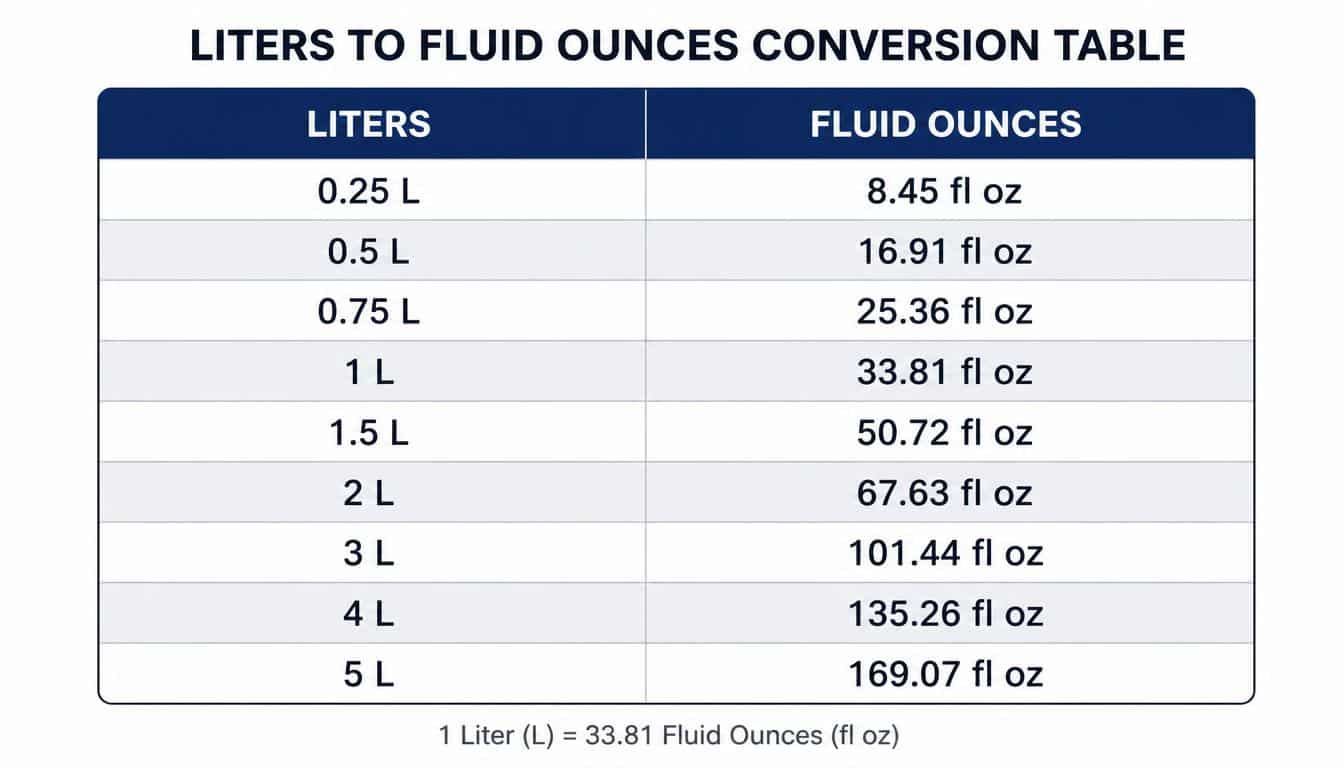
A conversion table is useful when you need the answer quickly and don’t fancy doing multiplication every time.
The values below are based on the US fluid ounce and rounded to two decimal places, which is usually a friendly level of precision for household measures.
| Liters | Fluid ounces |
| 0.1 L | 3.38 fl oz |
| 0.25 L | 8.45 fl oz |
| 0.5 L | 16.91 fl oz |
| 0.75 L | 25.36 fl oz |
| 1 L | 33.81 fl oz |
| 1.25 L | 42.27 fl oz |
| 1.5 L | 50.72 fl oz |
| 1.75 L | 59.17 fl oz |
| 2 L | 67.63 fl oz |
| 2.5 L | 84.54 fl oz |
| 3 L | 101.44 fl oz |
| 4 L | 135.26 fl oz |
| 5 L | 169.07 fl oz |
| 10 L | 338.14 fl oz |
| 40 L | 1,352.56 fl oz |
This liters and fluid ounces conversion chart can also help with packaging comparisons. A 500 mL container, for instance, is half a liter and therefore about 16.91 US fluid ounces.
Numbers start feeling much less abstract once they are attached to an actual bottle sitting on a kitchen counter.
Common Questions About Liters to Fluid Ounces
One of the most searched questions is how many fluid ounces are in 1 liter. The answer is 33.814023 US fluid ounces, or approximately 33.81 fl oz. That’s the main conversion relationship to keep nearby.
Another common question is how many ounces in 1 liter. Here, wording matters. If “ounces” means fluid ounces, the answer is about 33.81 US fl oz.
If someone means ounces by weight, there is no universal answer because weight depends on the substance’s density. Water, oil, honey and flour don’t all weigh the same volume, obviously.
People also ask how to convert liters to fluid ounces. The answer is simply to multiply the number of liters by 33.814023. For example, 5 liters × 33.814023 gives 169.070115 fl oz, so 5 liters to fluid ounces is about 169.07 fl oz.
For a larger example, 10 liters to fluid ounces is 338.14023 fl oz, while 40 liters to fluid ounces is 1,352.56092 fl oz. At those sizes, the calculator starts looking like a rather sensible friend.
Liters to Fluid Ounces and Milliliters
Milliliters provide another useful bridge between metric and US customary measurements. NIST identifies 1 liter = 1,000 milliliters, while a US fluid ounce is approximately 29.5735 mL.
This gives you another route for volume conversion. You can first convert liters into milliliters and then convert milliliters into fluid ounces. For example, 1.5 liters becomes 1,500 mL, and dividing by approximately 29.5735 gives about 50.72 US fluid ounces.
For nutrition labeling, however, there is a useful practical wrinkle. The U.S. Food and Drug Administration (FDA) states that for nutrition-labeling purposes, 1 fluid ounce = 30 milliliters.
This is a labeling convention and is slightly different from the precise physical conversion of approximately 29.5735 mL.
So don’t be surprised if a food label appears to use 30 mL for a fluid ounce while a technical measurement converter gives 29.5735 mL. They are serving different purposes, and that little distinction is worth knowing.
Liters to Fluid Ounces, Cups, Pints, and Gallons
Understanding neighboring units can make a unit conversion much easier to visualize. One liter is approximately 0.264172 US gallons, while one US gallon contains 128 US fluid ounces. NIST’s measurement tables give the US gallon as 3.785 liters and 128 US fluid ounces.
A fluid ounce is also connected to familiar household measures. 1 fluid ounce = 1/8 cup, and 1 fluid ounce = 1/16 pint. So when you’re looking at a recipe that jumps
between cups, pints, quarts, gallons, and fluid ounces, the units aren’t random islands they are part of the same customary measurement family.
You can similarly move from liters into gallons, quarts, pints, cups, tablespoons, and teaspoons, provided you use the appropriate conversion factors.
Likewise, metric quantities can be expressed as milliliters, cubic centimeters, or cubic meters, depending on the size and context.
Liters to Fluid Ounces: Why the Systems Differ
The reason the conversion isn’t a round number like 30 or 40 is historical. The metric system and US customary measurements developed from different measurement traditions, so their units don’t line up in neat whole-number relationships.
The liter belongs naturally with decimal-based metric quantities. A liter contains 1,000 milliliters, and a cubic meter contains 1,000 liters. NIST emphasizes this power-of-ten structure as one of the useful features of SI measurement.
The US fluid ounce, on the other hand, sits inside the US customary system alongside gallons, quarts, pints, and cups. That means the conversion between liters and fluid ounces needs a fixed numerical factor rather than a simple decimal shift.
It can seem slightly fussy at first, but once the conversion ratio is memorized, the whole thing becomes pleasantly boring which, in measurement, is actually a compliment.
A Note About Ounces, Weight, and Volume
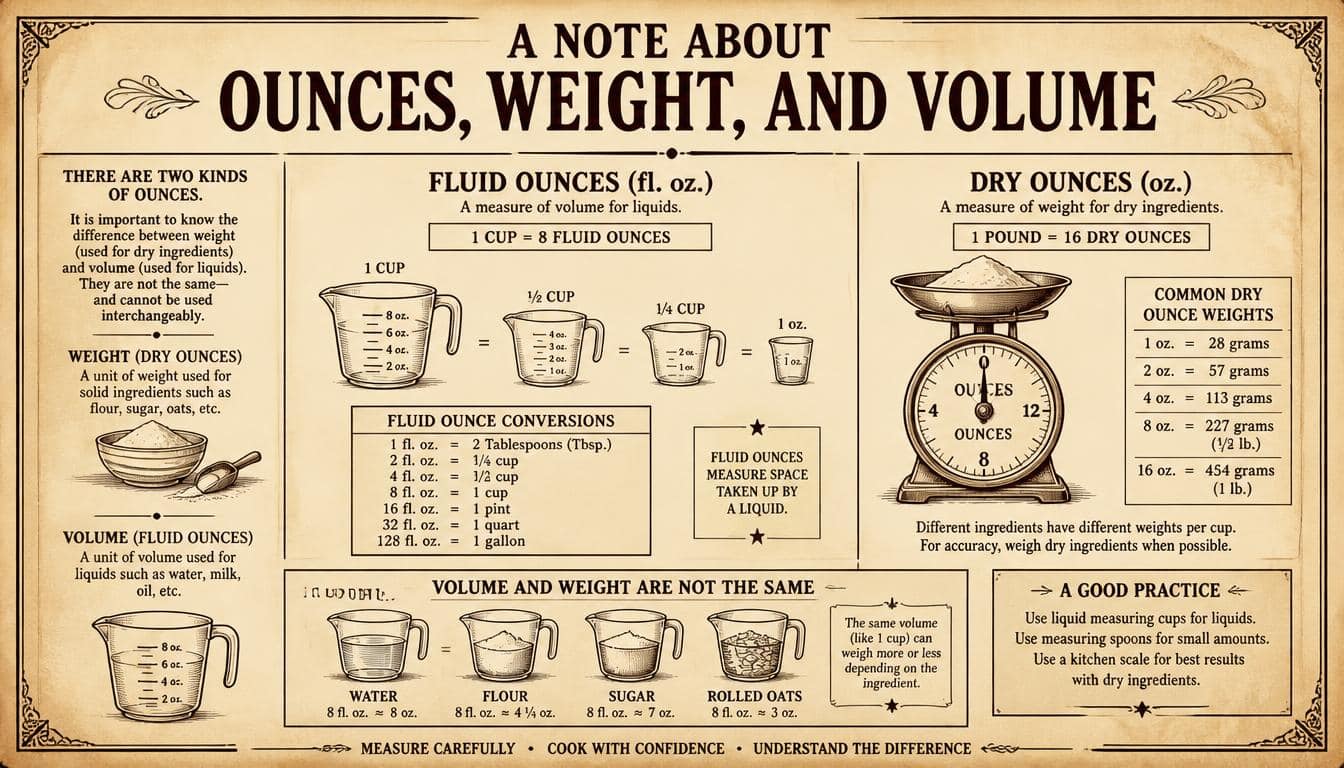
This is probably the most important warning in the whole article: fluid ounces measure volume, while ounces can measure mass. They may share a name, but they answer different questions.
If a recipe asks for 8 fl oz of milk, it is asking about liquid volume. If a package says 8 oz of a solid food, it may be describing mass. You cannot automatically say that 8 fluid ounces equals 8 ounces by weight, because the density of the material changes the relationship.
That is why a liters converter should be used for liquid or volume conversions, while a mass converter should handle grams, kilograms, milligrams, or weight-based ounces and pounds. Keeping the physical quantity straight prevents a surprisingly large number of kitchen mishaps.
Why a Liters to Fluid Ounces Converter Is Useful
A digital converter saves time when the number isn’t convenient to multiply manually. If you are converting imported drink sizes, adjusting a recipe, comparing product
packaging, or checking a measurement for schoolwork, entering the value into a fluid ounces converter gives you the equivalent quickly.
Still, knowing the formula is worthwhile. A converter can provide an answer, but understanding the conversion calculation lets you recognize whether that answer makes sense.
If someone tells you that 1 liter equals 3.38 fluid ounces, your internal measurement alarm should probably make a tiny noise.
The same principle applies to related conversions. You might need liters to gallons, liters to quarts, liters to pints, liters to cups, liters to milliliters,
liters to cubic centimeters, or liters to cubic meters. Once you understand what the units represent, the numbers become much easier to trust.
Related Volume Conversions Worth Knowing
The liters-to-fluid-ounces relationship is just one piece of a larger volume conversion landscape. Depending on the task, you may also encounter:
- Liters to gallons for large liquid containers.
- Liters to quarts for cooking and household measurements.
- Liters to pints when working with US customary recipes.
- Liters to cups for everyday kitchen quantities.
- Liters to tablespoons and liters to teaspoons for smaller recipe amounts.
- Liters to cubic inches for engineering and packaging calculations.
- Liters to cubic feet and liters to cubic yards for larger physical spaces.
- Liters to milliliters for metric kitchen and laboratory work.
- Liters to cubic centimeters because 1 mL corresponds to 1 cm³.
- Fluid ounces to liters when reversing the original calculation.
- Milliliters to fluid ounces when working with smaller containers.
- Cubic inches to fluid ounces for certain engineering or packaging contexts.
Conversions involving pounds, grams, kilograms, or milligrams require extra care because those are mass measurements rather than pure volume measurements.
A simple volume formula cannot convert a liter of an unknown substance into a mass without knowing its density.
Liters to Fluid Ounces: How to Reverse the Conversion
Sometimes the label gives you fluid ounces and you need liters instead. In that case, use the reverse conversion formula:
liters = fluid ounces ÷ 33.814023
For example, suppose a container holds 67.628046 US fluid ounces:
67.628046 ÷ 33.814023 = 2 liters
So the relationship works in both directions. Fluid ounces to liters means divide by 33.814023, while liters to fluid ounces means multiply by 33.814023.
You can remember it in a very simple way: going from the larger metric liter to the smaller US fluid ounce gives you a larger numerical count, so you multiply. Going back, you divide. It sounds almost too ordinary, but that little mental check can catch mistakes.
Accuracy, Rounding, and Real-World Measurements

Not every situation needs six decimal places. If you’re filling a water bottle, saying 33.814023 fl oz would be rather dramatic for no reason. About 33.8 fl oz communicates the useful information just fine.
For technical work, however, preserving additional digits may matter. The standard factor 33.814023 fluid ounces/liter gives a more precise result for calculations, while rounded figures are often preferable for communication.
The difference between precision and practical usefulness is important. A measurement should be as precise as the situation requires, not as precise as a calculator happens to be willing to print. More numbers don’t automatically mean more truth, oddly enough.
Frequently Asked Questions
l to oz
1 liter is equal to approximately 33.814 US fluid ounces. To convert liters to fluid ounces, multiply the liters by 33.814.
.5l to oz
0.5 liter equals approximately 16.907 US fluid ounces. Simply multiply 0.5 by 33.814 to get the result.
liters to ounces
To convert liters to fluid ounces, multiply the volume in liters by 33.814. For example, 2 liters equals about 67.628 fluid ounces.
2.5 liters to oz
2.5 liters equals approximately 84.535 US fluid ounces. Multiply 2.5 by 33.814 to calculate the conversion.
3l to oz
3 liters equals approximately 101.442 US fluid ounces. The conversion is calculated by multiplying 3 by 33.814.
Read this Blog: https://gracethemes.com/what-time-was-it-16-hours-ago/
Final Thoughts on Liters to Fluid Ounces
At first glance, liters to fluid ounces can seem like one of those tiny everyday puzzles that somehow grows teeth when you actually need an answer.
But the core relationship is wonderfully simple: 1 liter = 33.814023 fluid ounces, and the conversion is performed by multiplying liters by 33.814023.
The liter is closely connected with the metric system, the cubic decimeter, milliliters, and cubic centimeters, while the US fluid ounce belongs to the US customary measurement family.
NIST provides the underlying relationships between liters, cubic units, and US volume measures, while the FDA provides useful household and nutrition-labeling conventions such as 30 mL per fluid ounce for labeling purposes.
So whether you’re trying to answer how many fluid ounces are in 1 liter, converting 1.5 L for a recipe, checking 5 liters to fluid ounces, or moving in reverse from fl oz to L, the same little conversion factor keeps doing the work.
Keep 33.814023 nearby, remember that fluid ounces describe volume rather than weight, and check whether a source means US or Imperial fluid ounces.
Once those three things are clear, liter conversion becomes much less mysterious and perhaps even a little satisfying, in that quiet way that well-behaved numbers sometimes are.
If you want, I can also turn this into a more strongly SEO-focused version with a meta title, meta description, FAQ schema questions, and a shorter featured-snippet section.
