

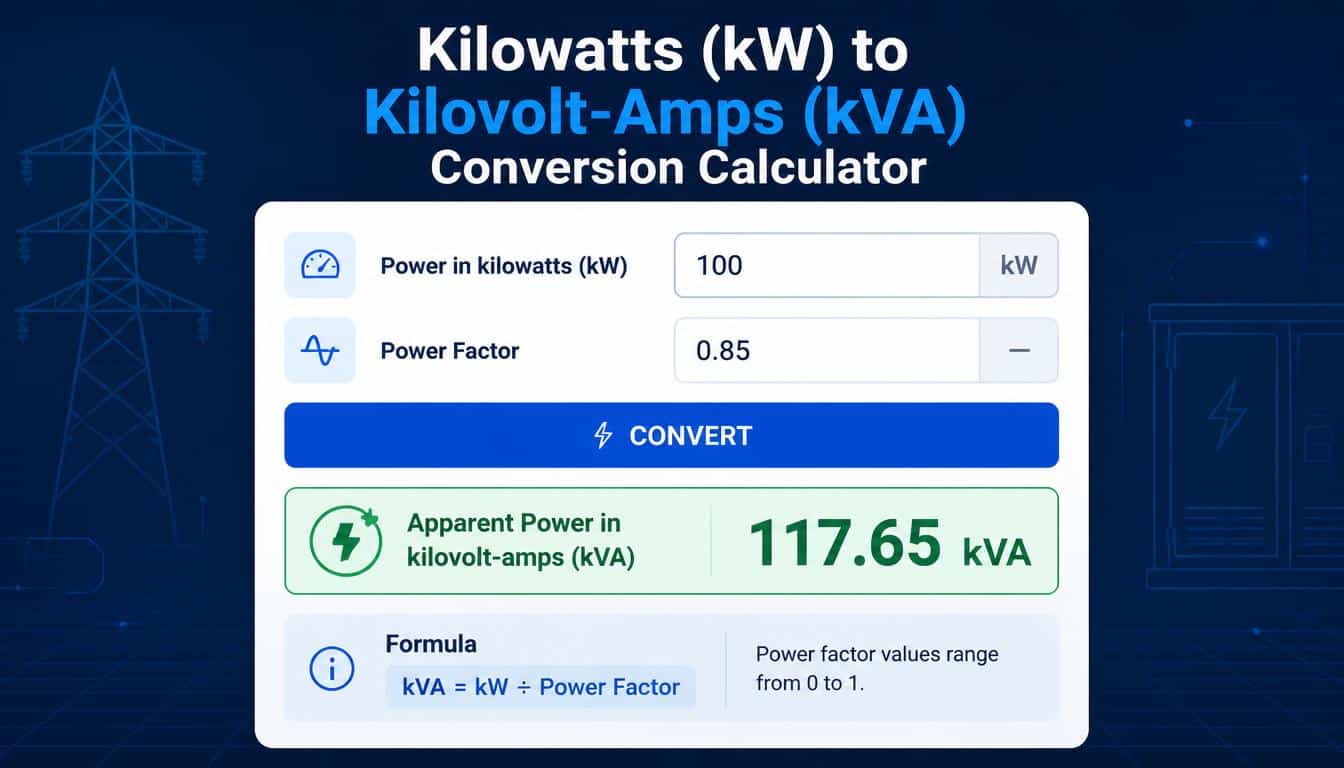
Kilowatts (kW) to Kilovolt-Amps (kVA) Conversion Calculator
Converting electrical power from kilowatts to kilovolt-amps might seem like a small calculation, but it can make a surprisingly big difference when selecting a generator,
sizing a transformer, or checking whether an electrical system can handle a particular load. One little number, the power factor, often holds the key to getting the answer right. And honestly, it is easier than it first appears.
A kW to kVA Conversion Calculator helps you turn real power into apparent power without getting lost in complicated electrical equations.
Whether you’re an electrician, an engineering student, a generator buyer, or simply someone trying to understand an equipment specification, knowing how to convert kilowatts (kW) into kilovolt-amps (kVA) gives you a clearer picture of your electrical power requirements.
The interesting part is that kilowatts and kilovolt-amps aren’t exactly the same thing, even though they are closely related.
A machine can consume a certain amount of real power while requiring a different amount of apparent power from the supply. That’s where the power factor (PF) enters the conversation.
Let’s walk through the calculator, the formula, practical examples, conversion tables, and the electrical concepts behind them.
By the end, you’ll know how to calculate kVA from kW, interpret the results, and avoid some common mistakes that can cause trouble when choosing electrical equipment.
What Is a kW to kVA Conversion Calculator?
A kW to kVA calculator is a simple electrical power conversion tool that calculates apparent power in kilovolt-amps from real power in kilowatts and a known power factor. You enter the kW value, provide the power factor, and the calculator gives you the corresponding kVA result.
For example, suppose you have a machine rated at 10 kW with a power factor of 0.8. The calculator determines that its apparent power is 12.5 kVA. The machine hasn’t magically become more powerful; the two measurements simply describe different aspects of the electrical system.
This kind of calculation is useful when comparing generator specifications, estimating electrical supply requirements, and reviewing transformer ratings. It can also help students understand why two devices with the same real-power demand may place different demands on an electrical supply.
A reliable calculator should make three things clear:
- Real power (kW): The power used to perform useful work, such as producing movement, heat, or light.
- Power factor (PF): The ratio of real power to apparent power in the electrical system.
- Apparent power (kVA): The combined electrical demand represented by voltage and current, expressed in kilovolt-amps.
Once you know these three values and their relationship, the conversion becomes pretty straightforward.
Understanding Kilowatts (kW) and Kilovolt-Amps (kVA)
Before using a kilowatt to kVA calculator, it helps to understand what the two units actually measure. They are related, but treating them as interchangeable can lead to incorrect equipment choices.
What Are Kilowatts?
A kilowatt is a unit of real power, also known as active power. One kilowatt equals 1,000 watts, and it measures the rate at which electrical energy is converted into useful work or another form of energy.
Think about an electric heater warming a room or a motor turning a pump. These devices use electrical power to produce a practical result. Their real-power demand is measured in watts or kilowatts.
When you see a 5 kW load, the figure tells you the amount of real power involved under the specified operating conditions. It does not, by itself, tell you the full apparent-power requirement of the electrical supply.
What Are Kilovolt-Amps?
A kilovolt-amp, abbreviated as kVA, is a unit of apparent power. It represents the product of voltage and current in an AC electrical circuit, expressed in thousands of volt-amps.
Apparent power matters because generators, transformers, cables, and other electrical components must accommodate current as well as voltage.
The current flowing through equipment determines important operating stresses, even when some of that current is associated with reactive rather than real power.
For this reason, electrical equipment is frequently rated in kVA. A transformer rated at 100 kVA, for instance, is specified according to its apparent-power capacity, subject to its operating and thermal limits.
The Difference Between kW and kVA
The simplest distinction is that kW describes real power, while kVA describes apparent power. In an AC system, these values are connected through the power factor.
When the power factor is 1, real power and apparent power have the same numerical value. When the power factor is less than 1, apparent power is greater than real power for the same operating point.
This distinction is especially important for motors, generators, and other equipment with significant reactive-power demand. A specification that lists only kilowatts may not provide enough information to determine the appropriate kVA rating.
kW to kVA Formula: The Simple Calculation
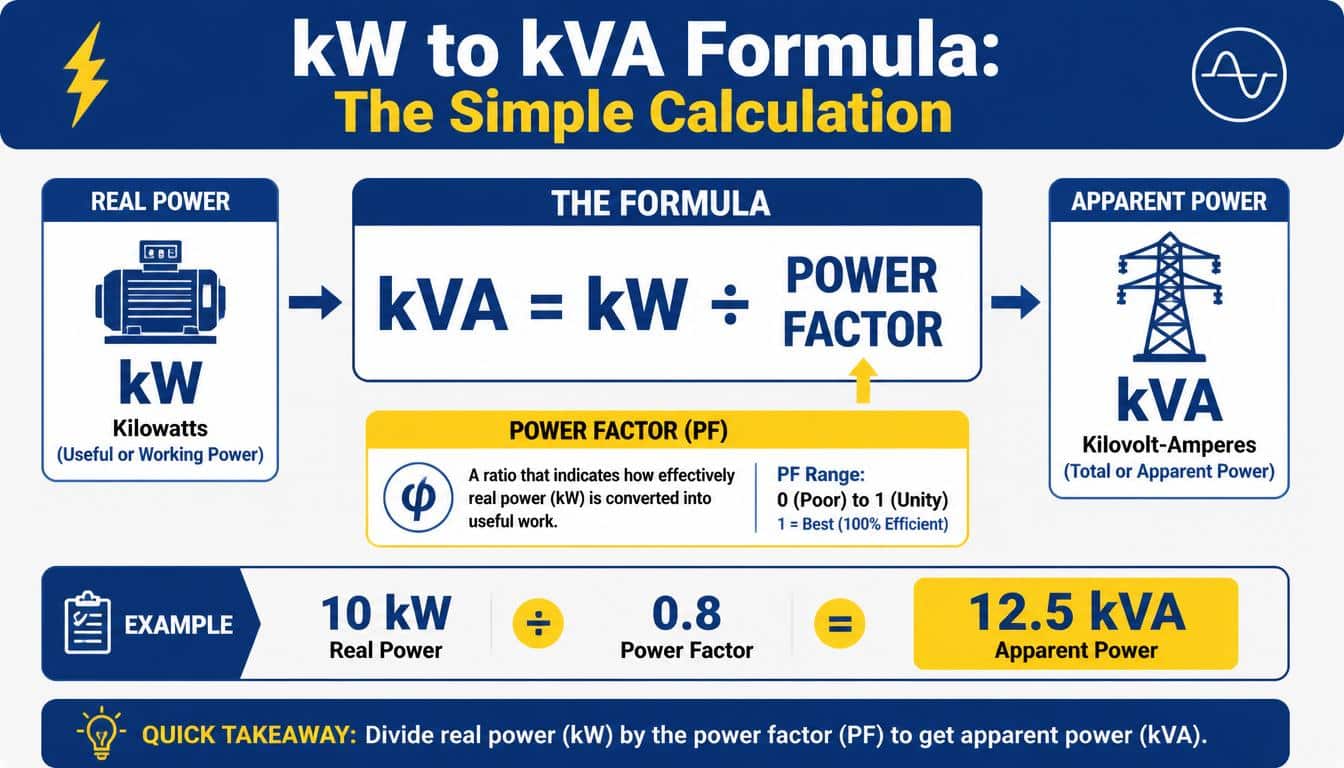
The kW to kVA formula is the central part of the conversion. Fortunately, you don’t need a complicated electrical engineering calculation to use it.
Formula:
kVA=kWPF\boxed{\text{kVA}=\frac{\text{kW}}{\text{PF}}}
Where:
- kVA is apparent power in kilovolt-amps.
- kW is real power in kilowatts.
- PF is the power factor, expressed as a decimal.
The formula works when the real-power value and power factor describe the same electrical operating condition. For a conventional sinusoidal AC system, the power factor is the ratio of real power to apparent power.
Let’s try a quick example. If a machine uses 8 kW and operates at a power factor of 0.8, divide 8 by 0.8. The answer is 10 kVA.
kVA=80.8=10\text{kVA}=\frac{8}{0.8}=10
There it is. Eight kilowatts corresponds to 10 kVA at that power factor, without any extra steps.
How to Convert kW to kVA in Three Steps
- Step 1: Identify the real power. Find the equipment’s kW rating or the real-power value measured during operation.
- Step 2: Find the power factor. Use the manufacturer’s specification, nameplate, or a suitable measurement. Don’t assume every device has a power factor of 0.8.
- Step 3: Divide kW by PF. The result is the apparent power in kVA.
For instance, a 15 kW load with a power factor of 0.75 requires an apparent power of 20 kVA at that operating point. If you use a different power factor, the answer changes, even though the real-power value stays the same.
kW to kVA Conversion Calculator: Worked Examples
Worked examples make the relationship much easier to understand. They also show why entering the correct power factor is just as important as entering the correct kilowatt value.
Example 1: Convert 10 kW to kVA
Suppose an electrical load operates at 10 kW and has a power factor of 0.8.
kVA=100.8=12.5\text{kVA}=\frac{10}{0.8}=12.5
The result is 12.5 kVA. This is a common example because a power factor of 0.8 is frequently used in illustrative calculations and appears in some equipment specifications.
Remember, though, 0.8 should not be treated as a universal power factor. Always use the value that applies to the actual equipment.
Example 2: Convert 25 kW to kVA
Imagine a commercial installation that draws 25 kW of real power with a power factor of 0.9.
kVA=250.9≈27.78\text{kVA}=\frac{25}{0.9}\approx27.78
The apparent power is approximately 27.78 kVA. A designer would consider this value alongside starting current, operating conditions, and future load growth before choosing the supply equipment.
Example 3: Convert 100 kW to kVA
Now consider a larger load with a real-power requirement of 100 kW and a power factor of 0.8.
kVA=1000.8=125\text{kVA}=\frac{100}{0.8}=125
The answer is 125 kVA. This calculation is useful when reviewing a large generator or electrical supply, but it does not automatically establish the correct generator size. Motor starting demands, load changes, environmental conditions, and manufacturer recommendations can affect the final selection.
Example 4: Conversion at Unity Power Factor
Suppose a load operates at 20 kW with a power factor of 1.
kVA=201=20\text{kVA}=\frac{20}{1}=20
The apparent power is 20 kVA, numerically equal to the real power. This is called unity power factor, and it is the simplest case for converting between these two units.
kW to kVA Conversion Chart and Table
A conversion table is handy when you need a quick estimate without calculating every value individually. The following kW to kVA conversion chart uses a constant power factor of 0.8.
| Real power (kW) | Power factor | Apparent power (kVA) |
| 1 | 0.8 | 1.25 |
| 2 | 0.8 | 2.50 |
| 5 | 0.8 | 6.25 |
| 10 | 0.8 | 12.50 |
| 15 | 0.8 | 18.75 |
| 20 | 0.8 | 25.00 |
| 25 | 0.8 | 31.25 |
| 30 | 0.8 | 37.50 |
| 40 | 0.8 | 50.00 |
| 50 | 0.8 | 62.50 |
| 75 | 0.8 | 93.75 |
| 100 | 0.8 | 125.00 |
| 150 | 0.8 | 187.50 |
| 200 | 0.8 | 250.00 |
These figures are calculated values, not guaranteed equipment ratings. A real generator or transformer must be selected using its actual specifications and the expected electrical load.
Notice how the kVA figure increases proportionally as the kW value increases when the power factor remains fixed. If the power factor changes, the table will produce different results for the same real-power value.
What Is Power Factor, and Why Does It Matter?
Power factor (PF) tells you how effectively apparent power corresponds to real power in an AC circuit. It is calculated as real power divided by apparent power.
PF=kWkVA\text{PF}=\frac{\text{kW}}{\text{kVA}}
For ordinary sinusoidal AC conditions, power factor is associated with the phase relationship between voltage and current. With distorted waveforms, the overall power factor also reflects waveform distortion, so it isn’t always identical to the cosine of the phase angle.
A power factor close to 1 means that most of the apparent power corresponds to real power. A lower value means that more apparent power is required for a given amount of real power.
This matters because current-carrying equipment must accommodate the electrical demand. Poor power factor can contribute to higher current for the same real-power delivery, potentially increasing resistive losses and voltage drop in the electrical distribution system.
Power Factor of 0.8
At a power factor of 0.8, the real power is 80% of the apparent power in the conventional power-factor ratio. To convert kW into kVA, divide the real-power value by 0.8.
For example, 40 kW at a power factor of 0.8 corresponds to 50 kVA. The difference between those numbers is not wasted real power in a simple one-to-one sense; it reflects the distinction between real power and apparent power.
Power Factor of 1
At unity power factor, the real and apparent power values are equal. A 12 kW load with a power factor of 1 corresponds to 12 kVA.
Some predominantly resistive loads, such as ideal electric heaters, can operate close to unity power factor. Real-world equipment may behave differently, so checking the actual specifications is still the sensible approach.
What Happens When Power Factor Decreases?
Let’s say a device needs 30 kW of real power. At a power factor of 0.9, the apparent power is approximately 33.33 kVA. At 0.6, it becomes 50 kVA.
The real-power requirement has not changed, but the apparent-power requirement has increased considerably. This is why power factor is an essential input for a kW to kVA conversion calculator, not an optional decoration on the screen.
Real Power, Reactive Power, and Apparent Power Explained
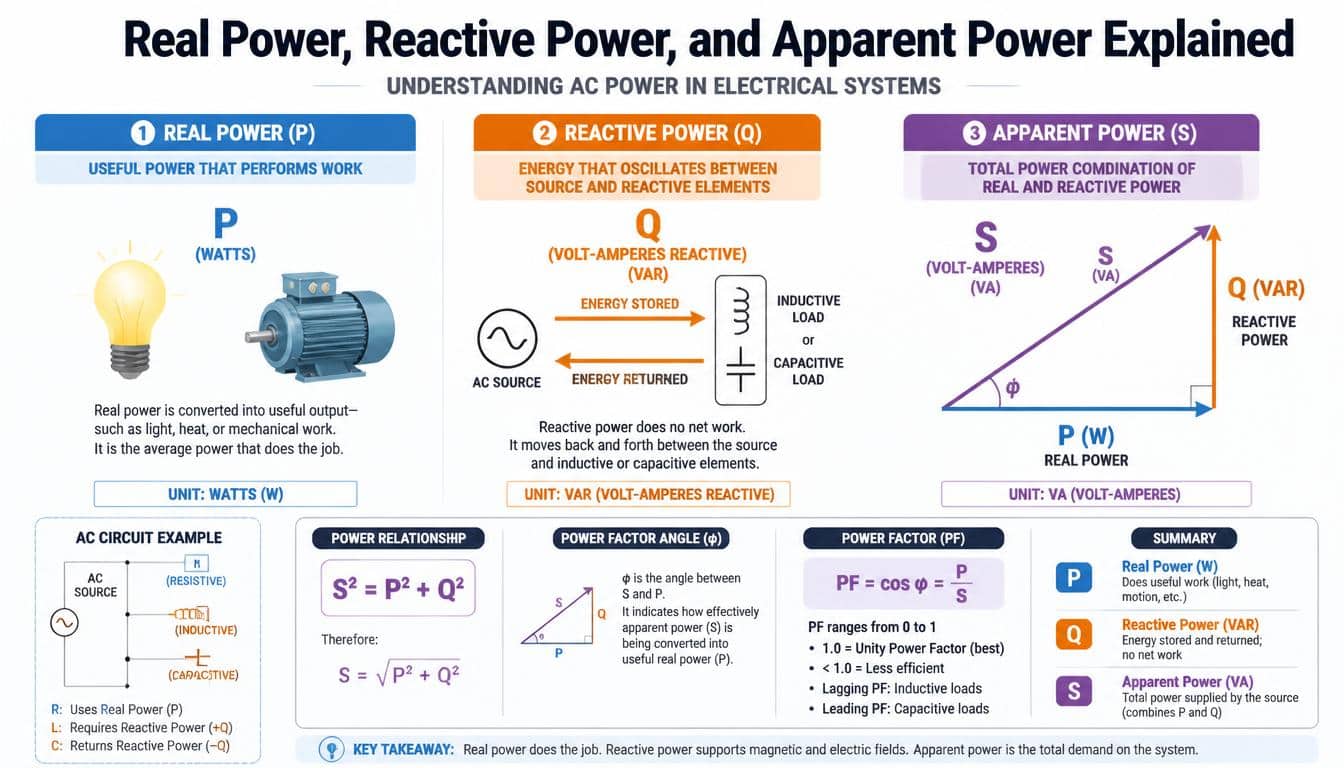
Electrical power in AC systems is often discussed using three related quantities: real power, reactive power, and apparent power. Understanding their relationship helps explain why kW and kVA differ.
Real Power (kW)
Real power, also called active power, performs useful work. It supplies the energy converted into motion, heating, lighting, or other practical output.
It is measured in watts or kilowatts. For a system delivering 10 kW of real power, the load receives real power at a rate of 10 kilowatts under the stated conditions.
Reactive Power (kVAR)
Reactive power, measured in kilovolt-amps reactive (kVAR), is associated with the periodic exchange of energy between the electrical source and reactive elements such as inductors and capacitors.
Electric motors and transformers often require magnetizing current to establish their magnetic fields. This contributes to reactive power demand, although the exact behavior depends on the device and operating condition.
Reactive power does not represent useful net energy consumption in the same way as real power, but it still affects current, voltage, and the capacity required from electrical equipment. That’s why it matters in practical system design.
Apparent Power (kVA)
Apparent power combines the effects of real and reactive power into a single rating. In a sinusoidal AC system, the relationship can be expressed as:
S=P2+Q2S=\sqrt{P^2+Q^2}
Here, SS represents apparent power, PP represents real power, and QQ represents reactive power, using consistent units.
For example, if a load uses 8 kW of real power and 6 kVAR of reactive power under sinusoidal conditions, its apparent power is 10 kVA.
S=82+62=10 kVAS=\sqrt{8^2+6^2}=10\text{ kVA}
This relationship forms the familiar power triangle. In systems with significant waveform distortion, however, the complete relationship between real, reactive, and apparent power can require additional care.
How Inductive, Capacitive, and Resistive Loads Affect Conversion
Different electrical loads behave differently, and those characteristics influence the power factor used in the conversion.
Inductive Loads
Inductive loads include many electric motors, transformers, and magnetic devices. They can draw magnetizing current, causing current to lag voltage under typical operating conditions.
This behavior often results in a lagging power factor. If the power factor falls, more kVA is needed to deliver the same real power, which is why motor specifications deserve a closer look before sizing a generator.
Capacitive Loads
Capacitive loads can produce a leading power factor, where current leads voltage under conventional sinusoidal conditions. Capacitors are sometimes installed to compensate for inductive reactive-power demand.
However, capacitor banks must be selected and controlled properly. Excessive compensation can create an undesirable leading power factor or contribute to resonance and other electrical problems. It’s not simply a case of adding capacitors until the numbers look good.
Resistive Loads
Resistive loads, such as ideal resistive heaters, generally have voltage and current in phase and operate at or near unity power factor. In that situation, the numerical values of kW and kVA are equal or very close.
Actual equipment can include electronic controls, motors, or other components that change its power-factor behavior. So a product that produces heat isn’t automatically guaranteed to have a power factor of exactly 1.
Using kW to kVA Conversion for Generators and Transformers
One of the most practical applications of the kW to kVA conversion formula is equipment sizing. Generator and transformer ratings are related to the apparent power they can supply, while the real-power capacity depends on the equipment’s design and rated power factor.
Generator Sizing
A generator may display both a kW rating and a kVA rating. These values tell you different things about its real-power output and apparent-power capability.
Suppose a load requires 80 kW at a power factor of 0.8. The calculated apparent power is 100 kVA. That is a useful starting point when reviewing generator options, but it isn’t enough to select the generator on its own.
You must also consider motor starting currents, load sequencing, nonlinear loads, ambient temperature, altitude, and the manufacturer’s continuous or standby ratings. A qualified electrical professional can assess these factors and the required reserve capacity.
Transformer Sizing
Transformers are commonly rated in kVA because their heating and operating limits are closely associated with voltage and current. When estimating a transformer’s required capacity, converting the load’s kW demand into kVA is often an important early step.
For example, a load requiring 60 kW at a power factor of 0.9 corresponds to approximately 66.67 kVA. The selected transformer must accommodate the expected apparent load while meeting applicable installation standards and operating requirements.
It is also wise to account for future expansion and any unusual load characteristics. A conversion result is a calculation, not a substitute for a complete electrical design.
Electric Motors
Electric motor calculations deserve particular attention because a motor’s output rating may refer to mechanical power rather than electrical input power.
If a motor is rated at 10 kW of mechanical output, its electrical input power will generally be higher because the motor is not perfectly efficient. To calculate the required apparent input power, you need the efficiency and power factor, as well as a clear understanding of what the rating represents.
For example, with 10 kW of mechanical output, 90% efficiency, and a power factor of 0.8:
Pinput=100.9≈11.11 kWP_{\text{input}}=\frac{10}{0.9}\approx11.11\text{ kW}S=11.110.8≈13.89 kVAS=\frac{11.11}{0.8}\approx13.89\text{ kVA}
The apparent input power is approximately 13.89 kVA under these assumptions. Using the motor’s mechanical output as though it were its electrical input would underestimate the supply requirement, and that mistake can be costly.
Common Mistakes to Avoid When Converting kW to kVA
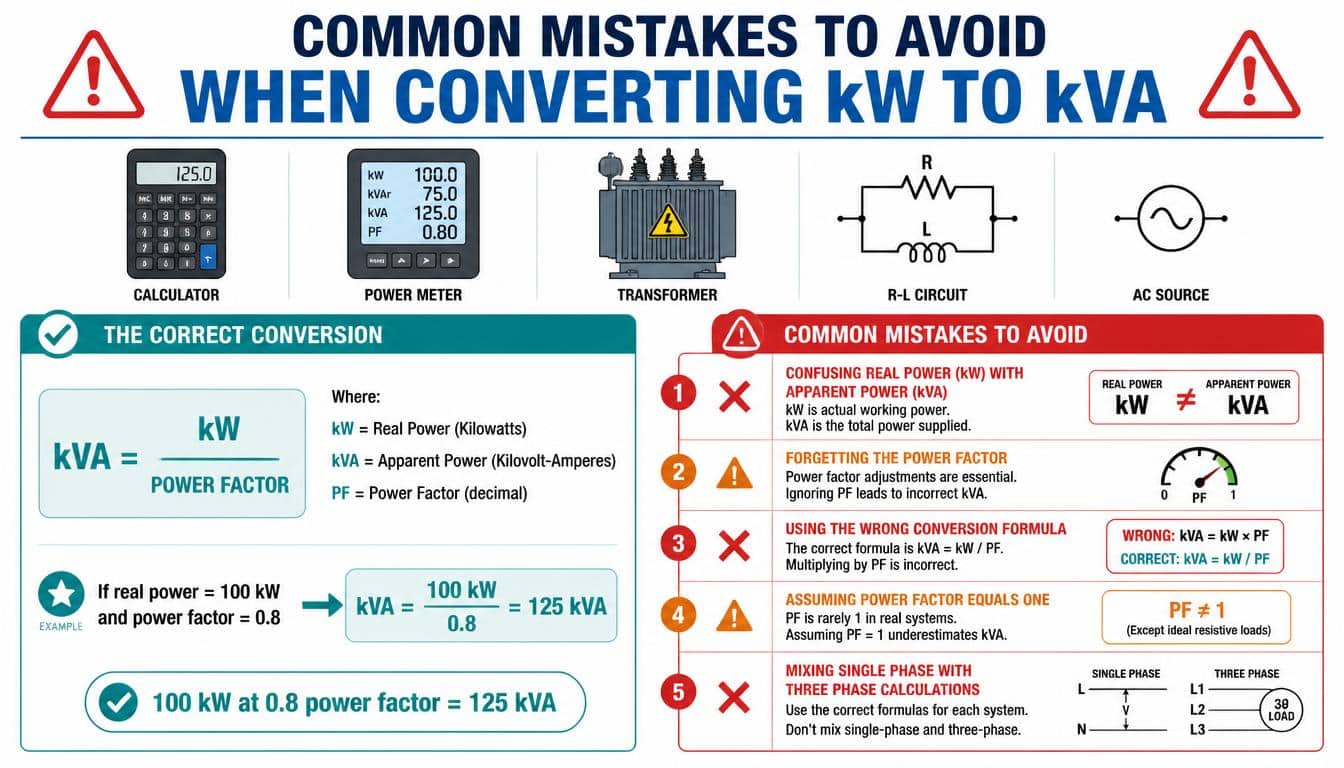
Even a simple conversion can produce a misleading answer when the inputs are misunderstood. A little attention here saves a fair amount of confusion later.
- Assuming the power factor is always 0.8. This value is common in examples and some equipment ratings, but the actual power factor varies with equipment type and operating conditions.
- Treating kW and kVA as interchangeable. They are equal at unity power factor, but not generally at lower power factors.
- Ignoring motor efficiency. When a motor’s kW rating describes mechanical output, calculate electrical input power before converting it to kVA.
- Confusing power with energy. Kilowatts measure power, while kilowatt-hours measure energy over time. A kW-to-kVA conversion does not calculate energy consumption.
- Using an incorrect power-factor value. A power factor entered as 80 instead of 0.8 will not give a meaningful result in the standard formula.
- Selecting equipment from the conversion alone. Starting current, load changes, derating, and operating limits must also be considered.
The calculator does the arithmetic, which is useful, but it cannot know whether the input figures accurately describe your equipment. That part still requires a bit of attention.
Frequently Asked Questions About kW to kVA Conversion
How do you convert kW to kVA?
Divide the real power in kilowatts by the power factor. The formula is kVA = kW ÷ PF. For example, 16 kW at a power factor of 0.8 corresponds to 20 kVA.
How many kVA is 10 kW?
The answer depends on the power factor. At 0.8, 10 kW equals 12.5 kVA. At 0.9, it equals approximately 11.11 kVA, and at unity power factor, it equals 10 kVA.
Can kW ever equal kVA?
Yes. When the power factor is 1, real power and apparent power have the same numerical value. For a conventional AC system, this is known as unity power factor.
Why is kVA usually higher than kW?
For a load operating with a power-factor magnitude below 1, apparent power is greater than real power. This reflects the relationship between voltage, current, and the portion of apparent power corresponding to real power.
Is kVA the same as kVAR?
No. kVA measures apparent power, while kVAR measures reactive power. They describe different quantities and are related to real power through the power relationships of the electrical system.
How do I convert kVA back to kW?
Multiply the apparent power by the power factor:
kW=kVA×PF\text{kW}=\text{kVA}\times\text{PF}
For example, 25 kVA at a power factor of 0.8 corresponds to 20 kW of real power.
Can I use the same formula for single-phase and three-phase systems?
The kW-to-kVA relationship is the same when the total real power and corresponding overall power factor are known. However, calculating power from voltage and current requires the appropriate single-phase or three-phase equations and consistent units.
Does a higher kVA rating always mean a better generator?
Not necessarily. A generator must suit the real-power demand, apparent-power demand, starting currents, load characteristics, and operating conditions. Choosing the biggest unit isn’t always the most economical or appropriate option.
How to calculate kva to kw
To convert kVA to kW, multiply the apparent power in kVA by the power factor. The formula is: kW = kVA × Power Factor (PF).
kw to kva calculator
A kW to kVA calculator converts real power in kilowatts into apparent power in kilovolt-amps using the power factor. Enter the kW value and power factor to calculate the result.
1 kw to kva
To convert 1 kW to kVA, divide 1 by the power factor. For example, at a power factor of 0.8, 1 kW = 1.25 kVA.
100 kw to kva
To convert 100 kW to kVA, divide 100 by the power factor. At a power factor of 0.8, 100 kW = 125 kVA.
kw to kva
To convert kilowatts (kW) to kilovolt-amps (kVA), divide the real power by the power factor. The formula is kVA = kW ÷ PF.
Read more: https://gracethemes.com/what-time-was-it-24-hours-ago-a-simple-guide-to-time-and-date-calculation/
Practical Tips for Getting the Most From a kW to kVA Calculator
A calculator is most helpful when you use it with accurate, relevant data. Before starting your calculation, check the equipment nameplate or technical documentation for the correct real-power rating and power factor.
If you are evaluating several devices, calculate their demands under realistic operating conditions. Don’t automatically add every nameplate rating together and assume all equipment will run simultaneously at full load. At the same time, don’t rely on diversity assumptions without checking that they are appropriate for the installation.
For larger installations, keep a small record of the kW value, power factor, calculated kVA, and the source of each input. This makes it easier to review your figures, compare equipment, and explain your reasoning to an electrician or electrical engineer.
And if you don’t know the power factor, don’t just guess because a calculator needs a number. Find the manufacturer’s value or have the system assessed. An answer with several decimal places is not necessarily an accurate answer if the original inputs were wrong.
Conclusion: Make Every Electrical Calculation Count
Understanding the relationship between kilowatts and kilovolt-amps is one of those practical electrical skills that becomes more useful the more you encounter it.
From comparing generator ratings to estimating transformer capacity, the right calculation helps you understand what your electrical system needs.
The central formula is simple: divide kilowatts by the power factor to calculate kilovolt-amps. Yet the information behind that formula matters just as much as the arithmetic itself.
Real power, apparent power, and reactive power describe different aspects of AC electricity, and understanding their relationship helps you make better-informed decisions.
Use a kW to kVA Conversion Calculator for quick results, double-check the power factor, and remember that equipment sizing involves more than a single number. When the load is large or the installation is safety-critical, seek guidance from a qualified electrical professional.
With the right inputs and a clear understanding of the units, a calculation that once seemed technical can become an easy part of your everyday work. And that’s the real value of a good calculator: it doesn’t just give you a number, it helps you understand what that number means.
