

Kilowatt-Hours (kWh) to Kilowatts (kW) Conversion Calculator
Electricity has a funny way of being invisible until the bill arrives. One day, the lights are glowing, the refrigerator is humming quietly in the corner, and the air conditioner is doing its best to fight the summer heat.
Then the electricity bill appears, displaying a number in kilowatt-hours (kWh), and suddenly everyone wants to know how much power was actually used.
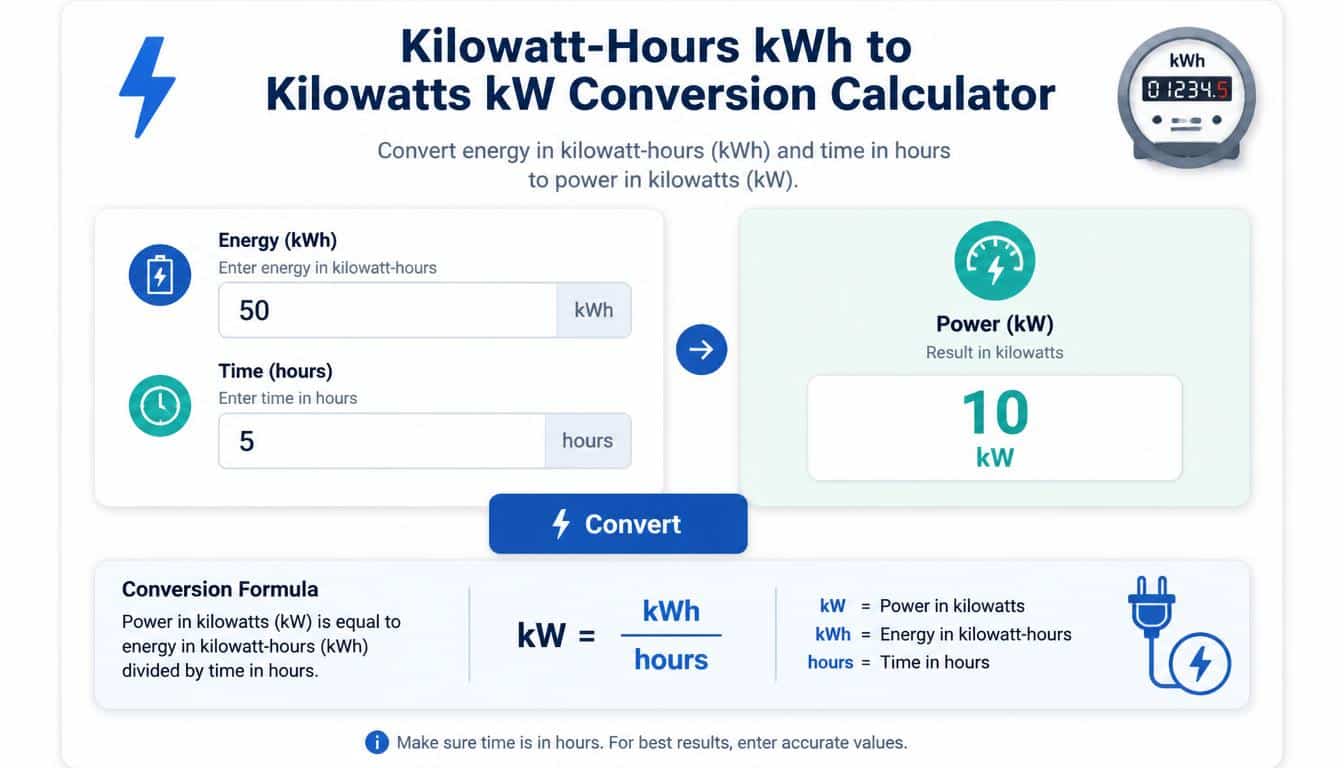
This is where a Kilowatt-Hours (kWh) to Kilowatts (kW) Conversion Calculator becomes a genuinely useful little tool.
Understanding electrical measurements doesn’t require an engineering degree or a desk covered in complicated textbooks. With a few simple numbers, anyone can learn how to convert energy consumption into average electrical power.
The trick is knowing how much energy was consumed and how long it took to consume it. Sounds simple enough, doesn’t it?
A reliable kWh to kW calculator helps homeowners, students, electricians, solar panel users, and curious people make sense of everyday energy usage.
It turns an unfamiliar electricity reading into a practical measurement that can help with appliance planning, energy monitoring, and understanding household consumption.
Whether you’re checking the electricity usage of your home, estimating the average power demand of a machine, or simply trying to understand the difference between two commonly confused electrical units, this guide will walk you through the process without making your head spin.
What Is a Kilowatt-Hour (kWh)?
A kilowatt-hour is a unit of electrical energy. It measures the total amount of energy consumed or transferred over a period of time, rather than how quickly that energy is being used.
For example, an appliance operating at a constant power of 1 kilowatt for one hour consumes 1 kilowatt-hour of energy. If it operates at the same power for five hours, it consumes 5 kWh. The maths is straightforward, even if the electricity meter makes the whole thing look rather mysterious.
A kilowatt-hour (kWh) is commonly used by electric companies to measure household electricity consumption. Your monthly electricity bill generally reports the energy consumed in kWh, making this unit an important part of everyday energy management.
Here are a few everyday examples:
- A 1 kW electric heater running for two hours consumes 2 kWh.
- A 2 kW appliance running for three hours consumes 6 kWh.
- A 500-watt device operating for four hours consumes 2 kWh.
Actual energy consumption depends on the appliance’s operating power and how long it runs. Some devices switch on and off automatically, so their total consumption may differ from what you’d estimate using their maximum rated power.
What Is a Kilowatt (kW)?
A kilowatt is a unit of power. It describes the rate at which electrical energy is consumed, generated, or transferred at a particular moment or averaged over a period.
One kilowatt equals 1,000 watts. A 2 kW appliance, for instance, uses energy at a rate of 2 kilowatts while operating at that power level. It doesn’t necessarily consume 2 kWh every time you switch it on, because the duration of operation matters too.
Power ratings appear on many electrical appliances, including air conditioners, water heaters, washing machines, electric ovens, and industrial motors. Understanding these ratings can help you estimate electrical loads and choose equipment that suits your available power supply.
In simple terms, power in kilowatts tells you how quickly energy is being used, while energy in kilowatt-hours tells you how much has been used altogether. They’re closely connected, but they aren’t interchangeable.
How the kWh to kW Conversion Calculator Works
The central purpose of a kWh to kW conversion calculator is to calculate average power from a known amount of electrical energy and the time over which that energy was consumed.
There is one important detail worth remembering: kilowatt-hours cannot be converted directly into kilowatts without knowing the time involved. The same energy quantity can correspond to different average power levels depending on how quickly it was consumed.
Imagine using 12 kWh of energy. If that energy is consumed over six hours, the average power is 2 kW. If it is consumed over three hours instead, the average power is 4 kW. The energy total hasn’t changed, but the average rate of consumption has doubled.
That’s why the time input is an essential part of the calculation. A good calculator makes this relationship easier to understand and reduces the chances of a small arithmetic mistake.
The kWh to kW Formula Explained
The standard kWh to kW formula is:
P (kW) = E (kWh) ÷ T (hours)
Where:
- P represents average power in kilowatts.
- E represents electrical energy in kilowatt-hours.
- T represents the duration in hours.
In everyday language, divide the total energy consumed by the number of hours over which it was consumed. The result is the average power in kilowatts.
For example, suppose a household consumes 48 kWh over 24 hours. The calculation is:
48 kWh ÷ 24 hours = 2 kW
Therefore, the average power consumption during that period is 2 kW. This doesn’t mean the household used exactly 2 kW at every moment. The actual load may have risen when the air conditioner started and fallen when several appliances were switched off.
This distinction matters because the formula gives average electrical power, not necessarily the instantaneous power at a particular second.
How to Convert kWh to kW Without a Calculator
You don’t always need a digital tool to perform an energy-to-power conversion. Once you understand the formula, the calculation can be completed using a basic calculator or even a little mental arithmetic.
Follow these steps:
- Identify the total energy consumption in kWh.
- Determine the time period in hours.
- Divide the energy value by the duration.
- Express the result in kW.
Consider a machine that consumes 30 kWh during ten hours of operation. Divide 30 by 10, and you get an average power of 3 kW.
For a less tidy example, suppose a device consumes 20 kWh over six hours. Dividing 20 by 6 gives approximately 3.33 kW. Keeping two decimal places is often sufficient for everyday estimates, though technical applications may require more precision.
Remember to use compatible units. If the time is provided in minutes, convert it into hours first by dividing the number of minutes by 60. A 30-minute period, for example, equals 0.5 hours.
Practical kWh to kW Conversion Examples
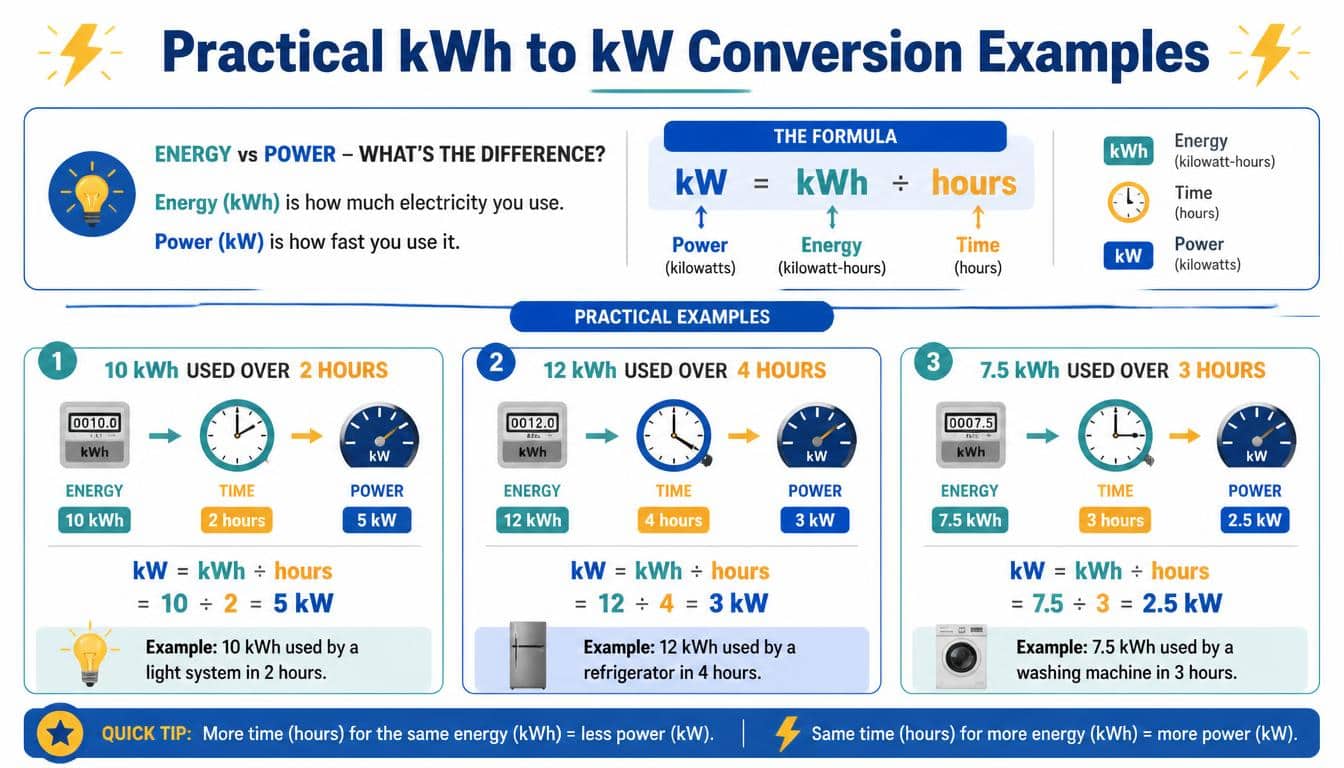
Numbers become much easier to understand when they are connected to real situations. Here are several examples showing how the kilowatt-hours to kilowatts conversion works in practice.
- 12 kWh over 4 hours: 12 ÷ 4 = 3 kW average power.
- 18 kWh over 6 hours: 18 ÷ 6 = 3 kW average power.
- 24 kWh over 12 hours: 24 ÷ 12 = 2 kW average power.
- 48 kWh over 24 hours: 48 ÷ 24 = 2 kW average power.
- 60 kWh over 5 hours: 60 ÷ 5 = 12 kW average power.
- 100 kWh over 10 hours: 100 ÷ 10 = 10 kW average power.
- 100 kWh over 20 hours: 100 ÷ 20 = 5 kW average power.
- 100 kWh over 50 hours: 100 ÷ 50 = 2 kW average power.
Notice how the same energy quantity of 100 kWh produces different average power values when the duration changes. Consuming that energy over ten hours requires a higher average power than consuming it over fifty hours.
These examples also show why energy and power calculations are useful for understanding the operating demands of equipment. Still, an average value cannot tell you every detail about changing loads or brief power surges.
kWh to kW Conversion Table
A kWh to kW conversion table provides a quick reference for calculating average power when the energy consumption and duration are known.
The following table uses 100 kWh as the fixed energy value.
| Energy (kWh) | Time (hours) | Average power (kW) |
| 100 | 1 | 100 |
| 100 | 2 | 50 |
| 100 | 3 | 33.33 |
| 100 | 4 | 25 |
| 100 | 5 | 20 |
| 100 | 6 | 16.67 |
| 100 | 8 | 12.5 |
| 100 | 10 | 10 |
| 100 | 12 | 8.33 |
| 100 | 20 | 5 |
| 100 | 24 | 4.17 |
| 100 | 50 | 2 |
| 100 | 100 | 1 |
The table makes one relationship especially clear: when the total energy remains fixed, increasing the duration reduces the average power. It is a handy reference for anyone working with electrical consumption estimates, and you can apply the same formula to energy values other than 100 kWh.
Understanding the Difference Between kW and kWh
The difference between kW and kWh is one of the most important concepts in basic electrical measurement. They sound similar, and both appear on electricity-related labels, but each tells you something different.
Think of a car travelling along a road. Its speed describes how quickly it is moving, while the distance travelled describes how far it has gone.
Power and energy have a similar relationship: power describes the rate of energy use, while energy describes the accumulated amount.
Here is a quick comparison:
| Feature | Kilowatt (kW) | Kilowatt-hour (kWh) |
| Measures | Power | Energy |
| Meaning | Rate of energy use | Total energy consumed |
| Common use | Appliance power ratings | Electricity bills |
| Depends on duration? | Not as a unit definition | Yes, when calculated from power |
| Example | A 2 kW heater | 4 kWh used by a 2 kW heater in 2 hours |
A kilowatt is not a quantity of energy, and a kilowatt-hour is not a unit of power. Mixing them up can lead to inaccurate calculations, especially when estimating electrical loads or comparing appliances.
Why Time Matters in Electrical Power Calculation
Time is the missing ingredient in many incorrect kWh to kW conversion attempts. Without a duration, you cannot determine the average power from an energy reading alone.
Suppose two households each consume 40 kWh. One household uses that energy over eight hours, while the other uses it over twenty hours. Their average power values are different:
- Household A: 40 ÷ 8 = 5 kW.
- Household B: 40 ÷ 20 = 2 kW.
Both households have consumed the same amount of energy, but the first has used it at a higher average rate. This difference can matter when assessing peak demand, equipment capacity, and the loading of electrical systems.
It’s also useful to distinguish total elapsed time from actual operating time. If a machine consumes 20 kWh during a four-hour production run, dividing by four hours gives the average power over that run. If the machine was active for only two hours and completely idle for the other two, dividing by the active operating time may better describe its average power while running.
The right time interval depends on the question you’re trying to answer.
Using the Calculator for Household Electricity Consumption
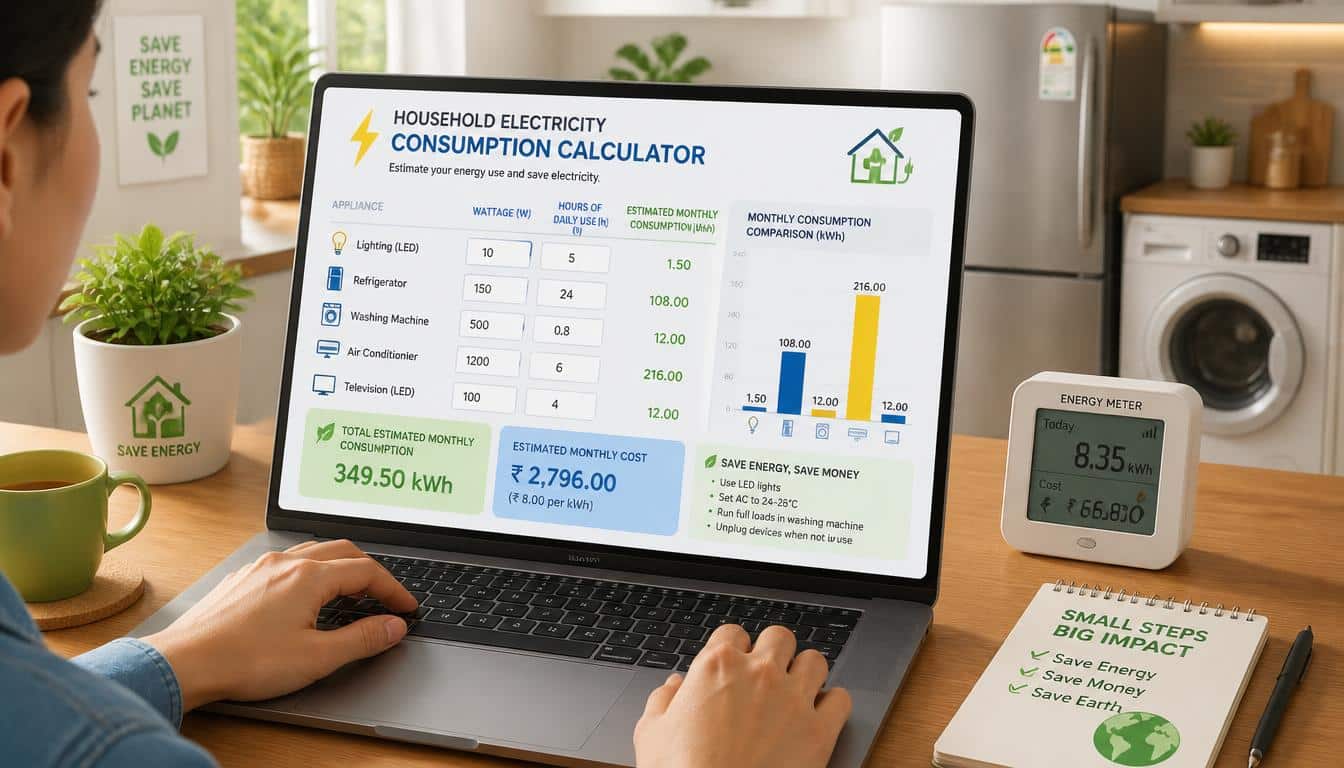
Household energy usage is a natural place to apply a kWh to kW calculator. Electricity bills provide total energy consumption, while appliance labels provide rated power. Understanding how the two relate can help you make more informed decisions about your energy use.
For instance, imagine a home consumes 360 kWh over a 30-day billing period. Thirty days contain 720 hours, so the average power consumption is:
360 kWh ÷ 720 hours = 0.5 kW
This equals an average load of 500 watts across the entire month. It doesn’t mean the household operated at exactly 500 watts all day. The refrigerator may cycle on and off, the air conditioner may run heavily during the afternoon, and the oven may be used only briefly.
A monthly average is helpful for understanding general consumption, but it cannot reveal short periods of high demand. For those details, interval readings from a smart meter or a suitable electricity monitoring system can be more informative.
Calculating Power for Solar Panels and Battery Systems
Solar energy systems introduce another practical reason to understand the relationship between kWh and kW. Solar panels are commonly rated by power capacity, while battery storage capacity is often expressed in kilowatt-hours.
For example, a battery containing 10 kWh of usable energy could theoretically deliver an average power of 2 kW for five hours, assuming ideal conditions and no energy losses.
The calculation is:
10 kWh ÷ 5 hours = 2 kW
Real systems are a little less tidy. Inverter limits, battery efficiency, reserve settings, temperature, and the actual connected load can affect how much power is available and how long the battery lasts.
A battery’s energy capacity and its maximum power output are separate specifications. A battery may store enough energy for several hours but still be unable to operate a particular appliance if the appliance’s power demand exceeds the battery system’s output limit.
For solar planning, the formula is a useful starting point, not a replacement for checking equipment ratings and system specifications.
Average Power Versus Instantaneous Power
An often-overlooked detail is that the kWh to kW formula calculates average power over a selected period. Instantaneous power, by contrast, refers to the power at a specific moment.
Imagine an electric kettle that operates at 2 kW while heating water. If it runs for six minutes at a constant 2 kW, its energy consumption is:
2 kW × 0.1 hours = 0.2 kWh
The average power during those six minutes is 2 kW, assuming the kettle draws a constant 2 kW throughout the heating period. But if you examine an entire hour during which the kettle runs for only six minutes, its average power across that hour is 0.2 kW, provided it consumes no additional energy during the remaining 54 minutes.
Both answers are correct because the time intervals differ. This is why you should always specify the period when reporting average power.
Common Mistakes When Converting kWh to kW
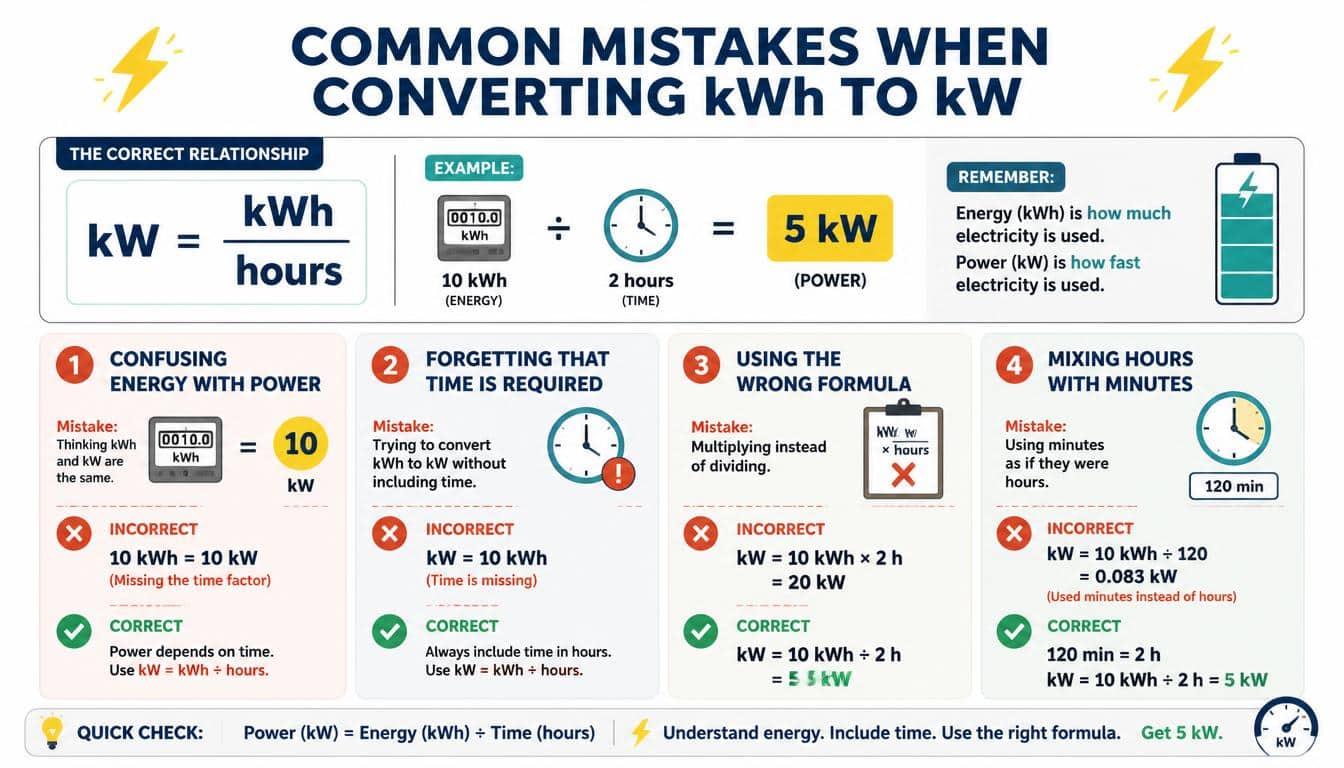
Even simple calculations can go wrong when units or assumptions are overlooked. Fortunately, most mistakes are easy to avoid once you know what to check.
- Dividing by the wrong duration: Make sure the time corresponds to the energy reading you’re using.
- Confusing energy with power: A value in kWh cannot be treated as a value in kW without considering time.
- Using minutes as hours: Convert minutes into hours before applying the formula.
- Assuming average power is constant power: An average does not reveal every change in the electrical load.
- Ignoring equipment losses: Real electrical systems may lose some energy during conversion or storage.
- Rounding too early: Keep sufficient decimal places during the calculation, then round the final result appropriately.
Another common misunderstanding is assuming that a 10 kWh battery must supply 10 kW. That isn’t necessarily true. The battery’s energy capacity is 10 kWh, but its maximum power output depends on its design and specifications.
A little care with units can save quite a bit of confusion later.
Related Electrical Conversions You May Find Useful
Once the relationship between energy and power makes sense, several other electrical calculations become easier to follow. These related conversions are useful when reading appliance specifications, evaluating electricity usage, or working with energy systems.
- kW to kWh calculator: Multiply power in kW by time in hours to calculate energy in kWh, assuming constant power.
- kWh to watts calculator: First calculate average power in kW by dividing energy by hours, then multiply the result by 1,000 to obtain watts.
- Watts to kilowatts converter: Divide watts by 1,000.
- Kilowatts to watts conversion: Multiply kilowatts by 1,000.
- Watt-hours to kilowatt-hours conversion: Divide watt-hours by 1,000.
- Energy consumption calculation: Multiply power by operating time to estimate energy use.
- Electrical load calculation: Consider the power demands of connected devices when evaluating a circuit or power supply.
Other electrical calculations, such as converting amp-hours to watt-hours, require additional information about voltage. Likewise, calculating kilowatts from current and voltage requires suitable electrical details and, for AC systems, may also require power factor information.
These units are related, but each conversion has its own requirements. It’s always better to identify the quantities you actually know before choosing a formula.
Frequently Asked Questions About kWh to kW Conversion
How do you calculate kW from kWh?
Divide the energy value in kWh by the time in hours. For example, 48 kWh consumed over 24 hours corresponds to an average power of 2 kW.
How many kilowatts are in one kilowatt-hour?
There is no single direct equivalent because kilowatts measure power and kilowatt-hours measure energy. One kilowatt-hour corresponds to one kilowatt operating for one hour, or two kilowatts operating for half an hour.
What is 100 kWh in kW?
The answer depends on the duration. If 100 kWh is consumed over ten hours, the average power is 10 kW. If it is consumed over 24 hours, the average power is approximately 4.17 kW.
How do you convert 48 kWh to kW?
You need the time period. Over 24 hours, 48 kWh corresponds to 2 kW average power. Over 12 hours, it corresponds to 4 kW.
Can I convert kWh to kW without knowing the time?
No, not uniquely. You need a duration to calculate average power from an energy quantity. Without that information, several different power values are possible.
Does a kWh to kW calculator show peak power?
Not ordinarily. The basic formula calculates average power over the period provided. Determining peak power requires more detailed measurements or information about how the electrical load changes over time.
Why does my electricity bill show kWh instead of kW?
Electricity bills generally measure the total energy consumed during a billing period because that is the quantity used to calculate standard energy charges. Some tariffs also include separate charges related to demand or maximum power, depending on the electricity provider and customer category.
Can I use the formula for a solar battery?
Yes, you can use it to estimate average power from a battery’s usable energy capacity and a specified discharge duration. However, the result does not establish the battery’s maximum output, and real-world losses may affect its performance.
kwh to kw
To convert kilowatt-hours (kWh) to kilowatts (kW), divide the energy in kWh by the time in hours. For example, 10 kWh used over 5 hours equals 2 kW of average power.
convert kwh to kw
Use the formula kW = kWh ÷ hours to convert energy into average power. Divide the total kilowatt-hours by the number of hours to get the result in kilowatts.
kw to kwh conversion
To convert kilowatts (kW) to kilowatt-hours (kWh), multiply power in kilowatts by time in hours. For example, a 2 kW appliance running for 3 hours consumes 6 kWh of energy.
How to Get the Most Accurate Result From a kWh to kW Calculator
A good calculation begins with reliable information. Before entering values into a kWh to kW conversion calculator, check that your energy reading and duration describe the same period.
If you are using a household electricity meter, note the difference between the starting and ending readings. If you’re analysing a particular appliance, use measured consumption where possible rather than assuming it always operates at its maximum rated power.
Choose the appropriate time interval for your purpose. A daily average can help you understand overall household usage, while a shorter interval may be more useful when estimating the power requirements of equipment operating during a specific task.
It’s also sensible to keep the original values available. If you later discover that the measurement covered 12 hours instead of 10, you can update the calculation without starting the whole process again.
Most importantly, treat the calculator as a practical measurement aid. For electrical installation decisions, circuit sizing, and safety-critical equipment, consult the relevant technical specifications and a qualified professional rather than relying on an average-power calculation alone.
Read More: https://gracethemes.com/kilowatts-to-kilovolt-amps-conversion-calculator/
Conclusion: Turning Energy Numbers Into Useful Knowledge
Understanding kilowatt-hours and kilowatts is less complicated than it first appears. A kilowatt-hour measures energy, a kilowatt measures power, and time connects the two. Once you know the energy consumed and the duration involved, the calculation becomes a simple division problem.
The Kilowatt-Hours (kWh) to Kilowatts (kW) Conversion Calculator makes that relationship easier to use in everyday situations, from understanding household electricity consumption to estimating average loads for solar batteries and electrical equipment.
Keep the essential formula in mind: P (kW) = E (kWh) ÷ T (hours). Check your units, choose the right time interval, and remember that average power is not necessarily the same as instantaneous or peak power.
A few accurate calculations can reveal useful patterns in the way electricity is consumed. And once those numbers start making sense, electricity bills and appliance specifications begin to look a lot less intimidating.
Whether you’re managing energy at home, studying electrical fundamentals, or planning a more efficient power system, a little knowledge goes a long way. Start with the energy value, account for the time, and let the numbers tell their story.
