

Foundation Repair SEO: The Complete Checklist for Contractors

Foundation repair SEO is the process of getting your foundation repair business found on Google by homeowners who are actively searching for help — whether that’s someone typing “foundation repair near me” at 9pm after noticing a new crack, or someone researching “signs of foundation problems” weeks before they’re ready to call anyone.
This article walks through a practical, step-by-step checklist built specifically for foundation repair companies — not generic small-business SEO advice. We’ll cover what to fix on your Google Business Profile, how to structure your website by service, what content actually builds trust in a fear-driven category like this one, and where SEO honestly falls short so you know what to expect.
What Is Foundation Repair SEO?
Foundation repair SEO is a hybrid of two things: local SEO and service SEO. Local SEO gets your business showing up in the map pack and local search results when someone nearby searches for help. Service SEO makes sure each specific repair method you offer — mudjacking, helical piers, crawl space encapsulation — has content that actually matches what someone typing that search term wants to know.
Most foundation repair companies only do half of this. They’ll claim their Google Business Profile and call it done, or they’ll write one “Services” page listing everything they do and hope it ranks for all of it. Neither approach captures the full range of searches homeowners actually run — from panicked “is my foundation crack serious” queries to comparison shopping like “best foundation repair company [city].”
Why SEO Matters for Foundation Repair Companies
Homeowners rarely click past the first page, and for local service searches, most of the clicks that matter go to the three businesses shown in the map pack before anyone scrolls to organic results. If your competitor shows up there and you don’t, they’re getting the call — even if your crew does better work.
SEO also tends to bring in higher-intent leads than cold outreach or general brand advertising. Someone searching “foundation repair near me” has already decided they need help; they’re just deciding who to call. That’s a fundamentally different (and more valuable) lead than someone who saw a billboard.
The tradeoff is time. SEO isn’t a lever you pull today for calls tomorrow. It’s closer to building a asset that keeps generating leads for years once it’s in place — but the setup and early months require patience most ad campaigns don’t.
The Foundation Repair SEO Checklist
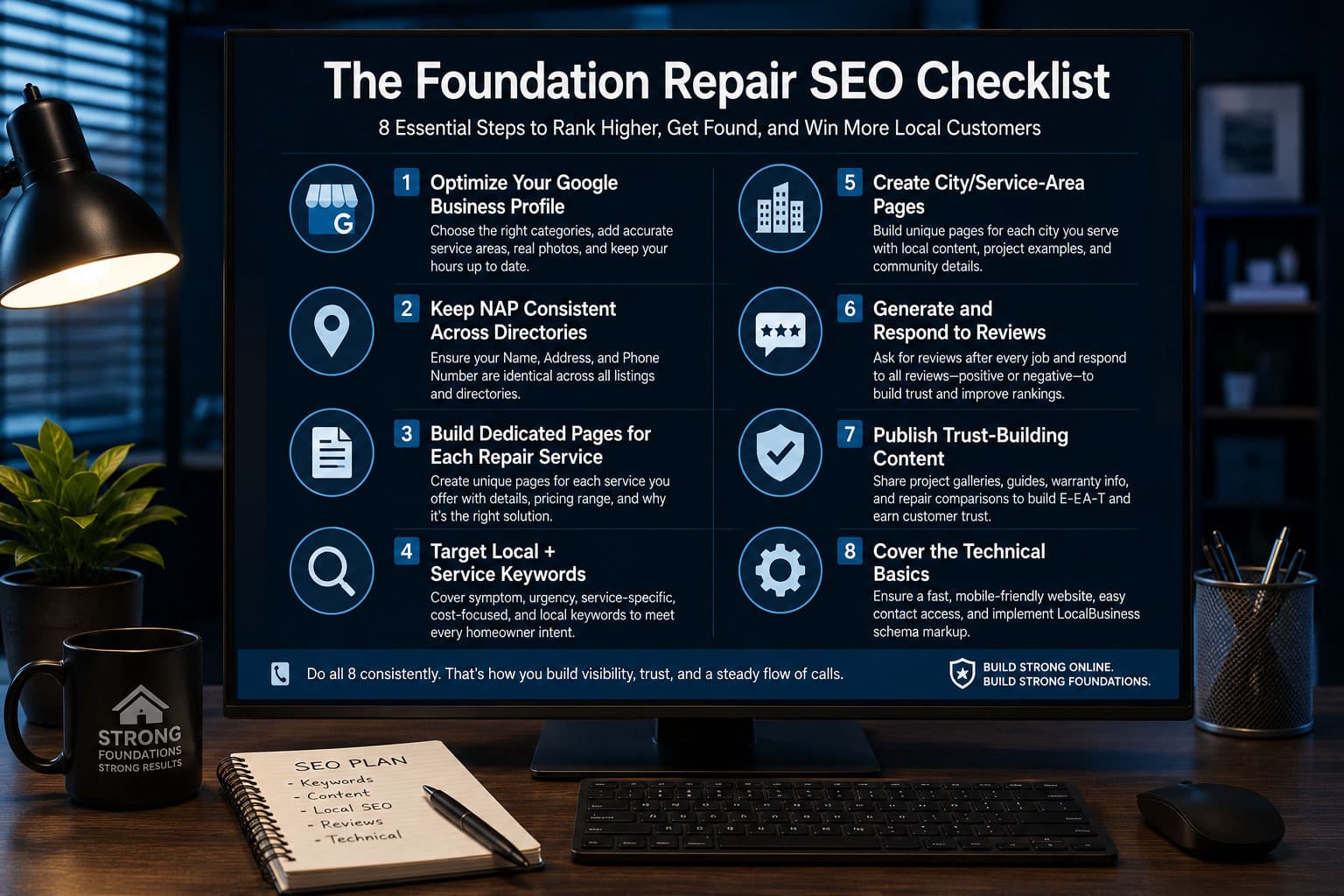
The rest of this article breaks down into eight concrete actions. None of them are exotic — the value comes from doing all eight consistently, not from finding one secret tactic. Here’s the checklist in order of priority for most foundation repair businesses.
1. Optimize Your Google Business Profile
Your Google Business Profile (GBP) is the free listing that shows up in Google Maps and the local pack — for most foundation repair companies, it drives more calls than the website itself. Start by choosing the right primary category (usually “Foundation Repair Service” if it exists, or the closest match like “Structural Engineer” or “Waterproofing Company”), and add every relevant secondary category your business actually performs.
Fill in your service area accurately — if you drive to a 50-mile radius, list it, but don’t inflate it to cities you rarely reach, since that can hurt relevance for your core area. Upload real project photos, not stock images; before/after shots of actual jobs perform well here and double as trust content. Keep your hours accurate, especially if you offer emergency service, since “emergency foundation repair” is a real search pattern worth capturing.
2. Keep NAP Consistent Across Directories
NAP stands for Name, Address, Phone — the three pieces of information Google cross-references across the web to confirm your business is legitimate and where you say it is. If your GBP lists “ABC Foundation Repair LLC” but your Facebook page says “ABC Foundation Repair Co.” and a directory listing has an old phone number, that inconsistency can quietly undercut your local rankings.
Audit your listings on Google, Yelp, Facebook, Angi, and any local chamber of commerce or trade association directories. Fix mismatches. This isn’t glamorous work, but it’s foundational — appropriately enough — to everything else on this list.
3. Build Dedicated Pages for Each Repair Service
This is where most foundation repair websites fall short. A single “Services” page listing mudjacking, helical piers, crawl space encapsulation, slab repair, and pier and beam leveling as bullet points cannot rank competitively for all of those terms at once. Each one represents a different search, often a different homeowner situation, and sometimes a different price point.
Build a separate page for each core service:
- Slab foundation crack repair
- Helical pier installation
- Mudjacking / slab jacking
- Crawl space encapsulation and waterproofing
- Pier and beam leveling
- Basement wall stabilization
Each page should explain what the problem looks like, how the repair method works, roughly what it costs (even a range builds trust), and why it’s the right fix for that specific situation. A homeowner searching “helical pier installation” wants a page about helical piers — not a paragraph buried in a general services list.
4. Target Local + Service Keywords
Foundation repair keyword research splits into a few natural categories, and your content should cover all of them, not just the obvious “foundation repair near me” phrase.
| Keyword type | Example | Homeowner intent |
| Symptom-based | “signs of foundation problems,” “what causes cracks in basement walls” | Early research, not ready to call yet |
| Urgency/diagnostic | “is my foundation crack serious” | Anxious, deciding whether to act now |
| Service-specific | “helical pier installation,” “crawl space encapsulation” | Knows what repair they likely need |
| Cost-focused | “cost of foundation repair,” “foundation repair cost” | Comparison shopping, budgeting |
| Local/service | “foundation repair near me,” “foundation repair contractor [city]” | Ready to call, choosing who |
Symptom and diagnostic keywords are often under-targeted, but they matter because they catch homeowners earlier — before they’ve decided who to hire, or sometimes before they’ve decided they need repair at all. A well-written page on “is my foundation crack serious” can become a trust-building first touchpoint that leads to a call weeks later.
5. Create City/Service-Area Pages
If your company serves more than one city or a wide metro area, a single location page won’t capture searches specific to each community. A contractor serving a metro area with five surrounding suburbs benefits from a dedicated page per city — “Foundation Repair in [City]” — each with locally relevant details rather than duplicated copy with the city name swapped out.
Duplicate, thin city pages (same paragraph, different town name) tend to underperform and can look low-quality to search engines. Each page needs at least some unique content — neighborhoods served, local soil conditions if relevant, or a couple of local project examples.
6. Generate and Respond to Reviews
Reviews function as both a ranking signal and a conversion factor — homeowners deciding between three foundation repair companies in the map pack often pick based on review count and recency as much as star rating. There’s no publicly confirmed number of reviews required to rank well; treat review generation as an ongoing habit, not a one-time push.
Build a simple, repeatable process: ask for a review right after project completion, when satisfaction is highest, ideally with a direct link that makes leaving one easy. Respond to every review, positive and negative — a thoughtful response to a critical review often reassures future customers more than a stack of five-star reviews with no owner engagement at all.
7. Publish Trust-Building Content
Foundation repair is a high-stakes, fear-driven category — homeowners are often worried about structural safety and spending several thousand dollars on something they don’t fully understand. Content that reduces that anxiety earns trust before the first call.
Useful formats include:
- Before-and-after project galleries with brief explanations of what was done and why
- A plain-language guide to warranty coverage (what’s covered, for how long)
- An explainer on what a structural engineer inspection involves and when it’s necessary
- Honest content comparing repair methods, including when a cheaper fix like mudjacking is appropriate versus when helical piers are genuinely needed
This kind of content also supports what Google calls E-E-A-T — Experience, Expertise, Authoritativeness, and Trustworthiness — the framework used to evaluate content quality, particularly for topics tied to safety or significant financial decisions. Licensing information, technician credentials, and years in business belong somewhere visible on the site, not buried on an “About” page nobody visits.
8. Cover the Technical Basics
None of the content or local optimization above matters much if the site itself is slow or hard to use on a phone — most local searches happen on mobile, often from someone standing in their basement looking at a crack. Confirm your site loads quickly, displays cleanly on a phone screen, and that contact information (especially a tap-to-call phone number) is easy to find on every page.
Adding LocalBusiness schema markup — structured code in your site’s backend that explicitly tells Google your business type, service area, and hours — can help search engines display your information more accurately, though it’s a smaller factor than the profile and content work above.
Foundation Repair SEO vs. Lead-Gen Directories
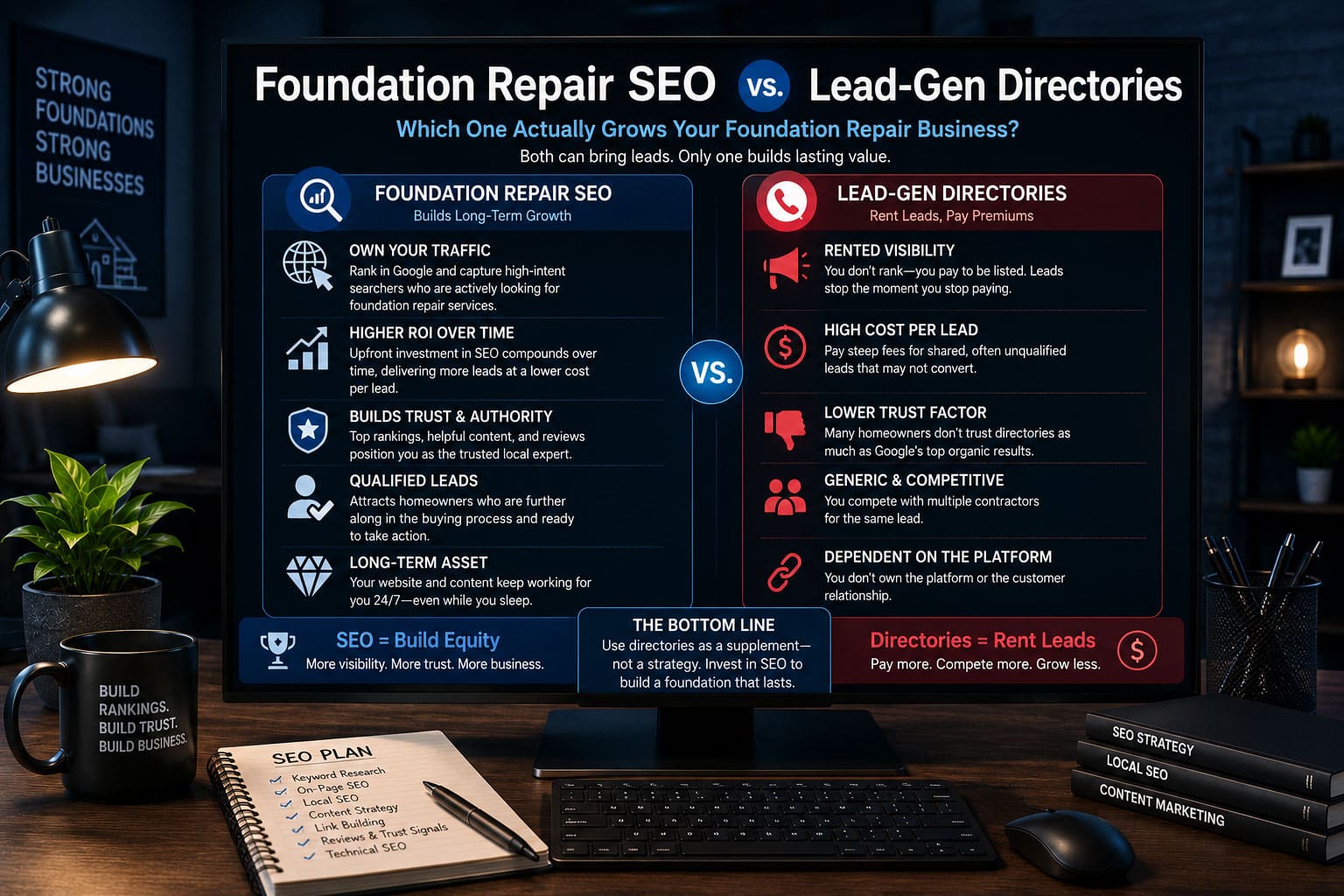
Many foundation repair contractors already pay for leads through directories like Angi, HomeAdvisor, or Thumbtack, and reasonably wonder whether SEO is worth the additional effort. The two aren’t really competitors — they’re different channels with different economics.
Directory leads are typically shared with multiple contractors bidding for the same job, and the cost is ongoing and per-lead. Organic SEO leads come directly to you, without splitting the opportunity with competitors, but they take months to build and don’t disappear the moment you stop paying, the way directory leads do. A reasonable approach for many companies is running both simultaneously in the early stages — directories for immediate leads while SEO builds — and shifting weight toward organic over time as rankings improve.
How Long Foundation Repair SEO Takes to Work
There’s no fixed timeline, and any guarantee of “page one in 30 days” should be treated skeptically. Foundation service pages and city pages often start showing measurable movement over a period of months rather than weeks, with more noticeable results as review count grows and content matures. Competitive metro markets take longer than smaller or less saturated ones.
The realistic expectation: treat SEO as a mid-to-long-term channel you invest in consistently, not a short-term campaign you launch and evaluate after a few weeks.
Common Mistakes to Avoid
- One generic services page instead of dedicated pages per repair method — covered above, but worth repeating since it’s the most common gap.
- Inconsistent NAP across directories, quietly undermining local trust signals.
- Ignoring reviews — either not asking for them, or not responding when they come in.
- Duplicating city pages with swapped-out town names and no real local content.
- Treating SEO as a one-time project rather than ongoing maintenance — content, reviews, and listings all need periodic attention.
- Skipping cost information entirely out of pricing sensitivity — vague or absent pricing content often loses homeowner trust rather than protecting it.
Frequently Asked Questions
How much does foundation repair SEO cost?
Costs vary widely depending on whether you handle it in-house, hire a freelancer, or work with an agency, and there’s no universal number to quote here without knowing your market and current site condition. What’s consistent is that it’s an ongoing investment, not a one-time expense.
How long does it take to rank for foundation repair keywords?
Expect a timeline measured in months, not weeks, especially for competitive local keywords. Less competitive symptom-based or city-specific pages can gain traction sooner than head terms like “foundation repair” in a large metro area.
Do I need separate pages for each repair service, or is one services page enough?
Separate pages generally perform better because each one can be built around the specific language and intent of that search — “helical pier installation” and “mudjacking” are different searches with different homeowner needs, and one combined page struggles to serve both well.
Is SEO better than paying for leads on Angi or HomeAdvisor?
Neither is strictly better — they solve different problems. Directories can produce leads faster but split them among competing bidders and stop the moment you stop paying. SEO takes longer to build but sends leads directly to you without ongoing per-lead cost once established.
How many Google reviews do I need to rank in the local map pack?
There’s no confirmed public number. Review count and recency both appear to matter, so a steady, ongoing collection process tends to outperform a one-time push for a specific number.
Should I target neighborhood-level pages or just city-level pages?
For most foundation repair companies, city-level pages are the more realistic starting point. Neighborhood-level pages can work for larger metro areas with real search demand at that level, but they require genuinely unique content to avoid looking like duplicated filler.
What’s the difference between foundation repair SEO and general local SEO?
General local SEO principles (Google Business Profile, reviews, NAP consistency) apply to any local business. Foundation repair SEO layers service-specific keyword targeting and trust-building content on top, because the category involves higher stakes, higher cost decisions, and more research-heavy searches than something like a lawn care business.
Can I do foundation repair SEO myself, or do I need an agency?
Many of the steps in this checklist — Google Business Profile setup, review requests, basic service pages — are realistic to handle in-house with time and consistency. More technical work like schema markup or larger-scale content strategy is where some companies choose to bring in outside help.
Conclusion
Foundation repair SEO isn’t complicated in concept — it’s a Google Business Profile done right, service pages that match how homeowners actually search, consistent reviews, and trust-building content for a category where people are naturally anxious about cost and safety. The difficulty is consistency, not complexity.
If you’re starting from zero, don’t try to tackle all eight checklist items at once. Claim and fully optimize your Google Business Profile first, since it’s free and often drives the fastest visible results, then move to building out dedicated pages for your two or three most-requested repair services before expanding further.
