

7 Best WordPress Image Gallery Plugins 2026
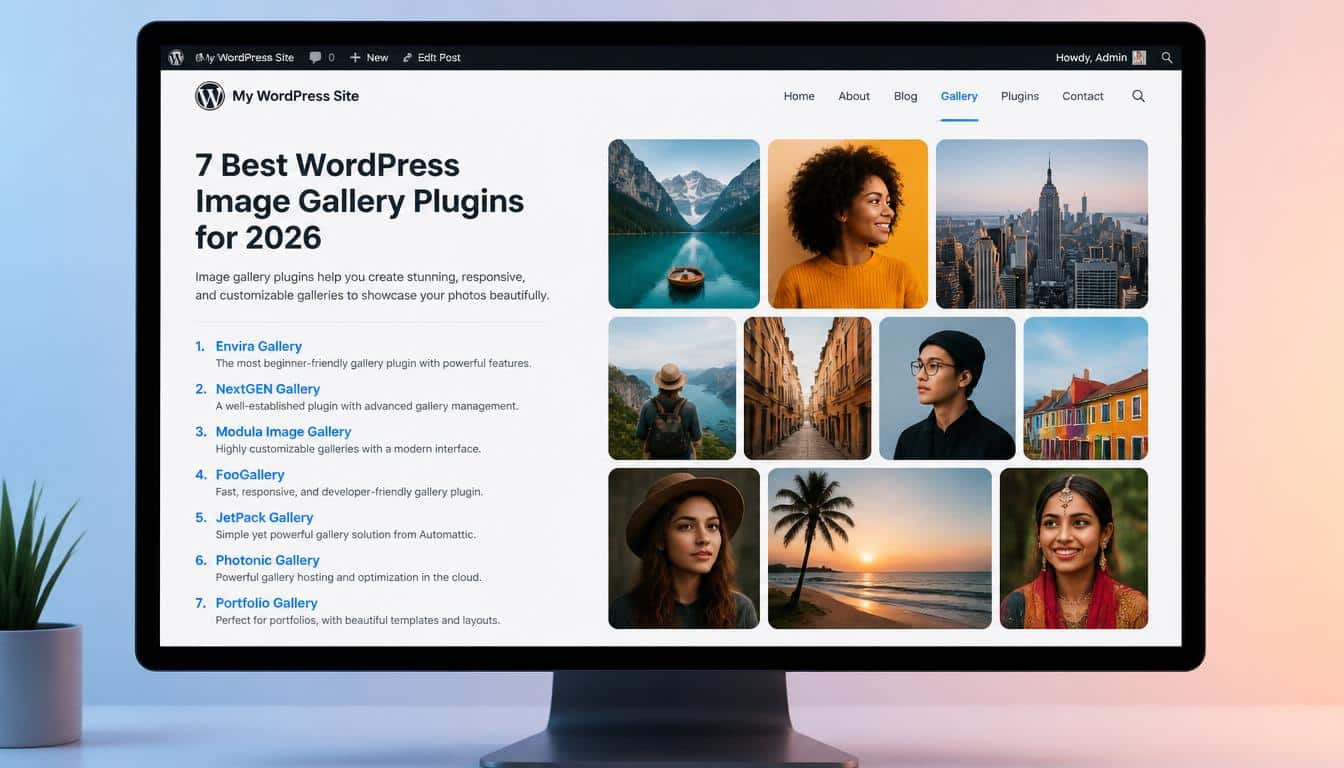
A good photograph can say plenty without making a single sound. But on a WordPress website, even a beautiful photograph can get lost when it is squeezed into a clumsy grid, loaded too slowly, or displayed in a way that feels like an afterthought.
That is where the right WordPress image gallery plugins quietly change the whole experience.
Maybe you are building a photography portfolio with hundreds of carefully edited images. Maybe you run an online store and need attractive product photos.
Or perhaps you simply want your travel blog to stop looking like someone emptied a phone camera roll onto every page.
The goal is the same: make your website images easier to explore, faster to load, and much nicer to look at.
WordPress already has a native WordPress Media Library and a basic gallery block, so a plugin is not automatically necessary.
In fact, for a small collection of photographs, the native Gutenberg tools may be perfectly adequate. But once you need advanced gallery layouts,
albums, filtering, lightboxes, video, social feeds, client proofing, watermarking, or eCommerce, a dedicated gallery plugin starts making a lot more sense.
This guide looks at seven strong options for 2026, with an emphasis on what each plugin is actually good at. Because “best” is a slippery little word, the best choice for a photographer may be a poor choice for a blogger, and vice versa.
What Should You Look For in WordPress Image Gallery Plugins?
Before installing anything, think about the job your gallery needs to do. A gallery that looks wonderful in a demo can become a rather expensive ornament if it doesn’t solve your actual problem.
The first thing to check is ease of use. A good plugin should let you upload, organize, and arrange images without turning every gallery update into a small coding project.
Drag-and-drop builders, live preview, Gutenberg blocks, and page-builder compatibility can save a surprising amount of time.
Then comes design. Look for useful choices such as masonry layout, custom grids, justified grids, sliders, carousels, thumbnails, albums, and a lightbox gallery.
Responsive behavior matters too, because your gallery will be viewed on smartphones, tablets, laptops and desktop monitors that all have different appetites for screen space.
Performance is the less glamorous part, but don’t ignore it. Large high-resolution photographs can make a beautiful site move like a sleepy tortoise.
Features such as lazy loading, image resizing, pagination, caching compatibility, and optimized delivery can help, although your hosting, image files, theme, and other plugins also influence website performance.
Finally, consider your future needs. Do you need client proofing today? Maybe not. Could you need it when your photography business grows? Quite possibly.
Choosing a plugin with room to expand can save you the slightly miserable job of rebuilding hundreds of galleries later.
1. Envira Gallery Best for Beginners Who Want More Control
Envira Gallery is one of the easiest places to start if you want a polished WordPress photo gallery without wandering too far into technical territory.
Its drag-and-drop gallery builder is designed around a simple workflow: upload photographs, rearrange them, select a template, customize the display, and publish.
Envira also supports responsive gallery templates, albums, tags, lightboxes, slideshows, video galleries, Instagram importing, and watermarking.
That combination is useful because beginners often don’t want fifty switches staring at them from the settings screen.
They want the gallery to look good first, then they can become adventurous later. Envira lets you grow into the feature set rather than demanding a technical degree on day one.
Its lazy loading and pagination options are particularly useful for larger collections, since visitors don’t necessarily need every image downloaded before they can see the first row.
Another nice point is compatibility with popular WordPress editing environments. Envira says it works with Gutenberg as well as builders such as Elementor, Divi, and Beaver Builder.
Best for: bloggers, small businesses, photographers, portfolios, and beginners.
Standout features:
- Drag-and-drop gallery builder
- Responsive templates
- Albums and image tags
- Built-in lightbox
- Slideshows and fullscreen viewing
- Video gallery support
- Lazy loading and pagination
- Watermarking
- Social integrations
- Page-builder compatibility
The catch: If you need a deeply specialized photography business system with built-in proofing, selling, and print fulfillment, another option below is more purpose-built.
2. NextGEN Gallery Best for Professional Photographers
NextGEN Gallery by Imagely approaches galleries less like decoration and more like infrastructure for a photography business.
That distinction matters.
NextGEN Gallery is designed around substantial photo management, large collections, professional layouts, client galleries, image protection, proofing, and sales.
Its higher-tier features include client proofing, digital downloads, print sales, Lightroom integration, watermarking, password protection, and built-in eCommerce.
Imagine a wedding photographer who has delivered 800 photographs to a couple. Sending a folder and saying “pick your favorites” is possible, sure, but it isn’t exactly the grand experience clients remember.
A dedicated proofing gallery can allow clients to browse images, mark favorites, and submit selections, making the workflow much cleaner.
NextGEN also supports automated print fulfillment through professional lab partnerships, so photographers can sell prints without personally becoming a one-person printing-and-shipping department.
Its Lightroom integration is another major attraction for professionals. Instead of constantly exporting images, uploading them manually, and repeating the same little dance, photographers can connect their Lightroom workflow with their WordPress galleries.
It is not necessarily the simplest choice. The abundance of controls is wonderful when you need them and slightly intimidating when you don’t. That is the trade-off.
Best for: professional photographers, wedding photographers, portrait studios, photography businesses, and large portfolios.
Standout features:
- Large-scale image management
- Client proofing
- Digital downloads
- Print sales
- Automated print fulfillment
- Adobe Lightroom integration
- Watermarking
- Password protection
- Responsive gallery layouts
- Image optimization and lazy loading
- Built-in photography eCommerce
If selling photographs is central to your business, NextGEN is one of the strongest choices in this list.
3. Soliloquy Best for Image Sliders and Carousels

Soliloquy is slightly different from the other choices because its heart is the WordPress image slider, rather than the traditional multi-image grid.
That makes it particularly useful when you want a hero slideshow, product carousel, featured-content slider, or rotating portfolio display.
Its drag-and-drop builder lets users create image and video sliders without coding, while its slider layouts are designed to work across desktop, tablet, and mobile screens.
The distinction is worth understanding. A gallery says, “Here are twenty photographs; wander around.” A slider says, “Look at these three things first.” Neither is universally better. They are different visual conversations.
Soliloquy also offers features for WooCommerce product sliders, featured content, lightboxes, carousels, thumbnails, Instagram imports, and dynamic sliders.
For example, a fashion store could use a product slider on its homepage, while a photographer might place a fullscreen slider above a portfolio section. A magazine could automatically build a featured-content slider from selected posts.
Best for: websites that need sliders, carousels, featured images, or visually prominent homepage displays.
Standout features:
- Drag-and-drop slider builder
- Responsive design
- Image and video sliders
- Carousel support
- Lightbox functionality
- WooCommerce sliders
- Featured-content sliders
- Instagram integration
- Thumbnail navigation
- Mobile-friendly layouts
One small warning: if what you really need is a giant searchable archive of thousands of photographs, a dedicated gallery-management system may fit better than a slider-first plugin.
4. FooGallery Best Balance of Design and Usability
FooGallery is a strong middle-ground option. It aims to make attractive galleries accessible without stripping away the customization experienced WordPress users may want.
FooGallery provides a live preview, responsive gallery layouts, Gutenberg integration, shortcode support, video support, albums, hover effects, and more advanced media organization capabilities.
Its documentation also highlights performance-oriented features such as filtering and pagination in its higher-level offerings.
That live preview is more important than it sounds. Gallery settings can otherwise become a strange guessing game: change three numbers, save, open the page, discover the images now look like postage stamps, return to settings, repeat. A visual workflow reduces that nonsense.
FooGallery is also useful for people who want their gallery and image management to live reasonably close together.
Its enhanced media-library functionality can add tags and categories to images, while its integrations can pull from other media-management systems.
The plugin is especially appealing if you care about layouts. Depending on the version and configuration, you can create masonry-style displays, responsive grids, video galleries, and other visual arrangements without hand-building them.
Best for: bloggers, agencies, portfolios, businesses, and users wanting a flexible everyday gallery builder.
Standout features:
- Live preview
- Responsive layouts
- Gutenberg block
- Gallery shortcode
- Masonry-style displays
- Video galleries
- Albums
- Hover effects
- Filtering and pagination
- WooCommerce-oriented functionality in its commerce offering
The important thing is not to choose FooGallery merely because a demo looks pretty. Compare the available layouts and premium features with your own workflow first. A beautiful gallery that takes ages to maintain stops being beautiful surprisingly fast.
5. Modula Best for Creative Custom Grids
Modula is the option for people who look at a perfectly symmetrical gallery and think, “Yes, but what if I moved that image over there?”
Modula puts substantial emphasis on visual freedom. Its gallery types include Custom Grid, Creative Gallery, Masonry, Slider, and Video.
The custom-grid system allows users to control image dimensions and arrangement, while masonry layouts can display photographs without forcing every image into the same crop.
This is handy for photographers and designers whose work doesn’t behave nicely inside rigid rectangles.
Portrait photographs, landscapes, square product shots, vertical artwork they can coexist without looking like they’re waiting for a ruler.
Modula has also expanded beyond simple static galleries. Its current feature set includes video galleries, WooCommerce support, Instagram, nested albums, image comments, watermarking, right-click protection, password protection, and SEO-oriented image sitemaps.
Its dynamic content galleries are interesting for sites where images should update automatically. Modula can generate galleries from posts, pages, WooCommerce products, portfolios, recipes, real-estate listings, and other custom post types, while allowing visitors to filter content by taxonomy.
Best for: designers, creative portfolios, photographers, agencies, and anyone who wants more control over grid composition.
Standout features:
- Custom grids
- Masonry galleries
- Creative layouts
- Sliders
- Video galleries
- Nested albums
- Dynamic content galleries
- Filtering
- Instagram integration
- Watermarking
- Password protection
- WooCommerce integration
If visual control is your main priority, Modula deserves a very serious look.
6. Smash Balloon Best for Social Media Galleries
Smash Balloon takes a different road again. Instead of primarily asking, “How should I arrange the images sitting in my WordPress Media Library?” it asks, “How can I bring my social content onto my website?”
That makes it especially useful for brands, creators, restaurants, influencers, and businesses whose best visual content is already living on Instagram, Facebook, YouTube, TikTok, or other supported platforms.
Smash Balloon provides dedicated social feed plugins and tools for Instagram, Facebook, YouTube, TikTok, reviews, and other feeds.
Its current feature set emphasizes no-code setup, visual customization, Gutenberg support, caching/performance tools, SEO-oriented embedding, moderation, and shoppable feeds.
This can solve a common problem: your website looks frozen while your social channels are alive. A dynamic social media gallery can help bring recent content into the website without requiring you to upload the same image twice.
The Instagram product, for example, provides a feed creation wizard, visual customizer, multiple feeds, and search-engine-accessible embedded content.
Best for: businesses, creators, restaurants, influencers, online stores, and brands built around social media.
Standout features:
- Instagram feeds
- Facebook feeds
- YouTube feeds
- TikTok feeds
- Social media galleries
- Visual feed customization
- Live previews
- Feed moderation
- Shoppable feeds
- Caching and performance features
- Gutenberg support
There is a catch, naturally: Smash Balloon is not the obvious choice if your main need is a traditional, carefully curated local photo album from the WordPress Media Library. It shines when your gallery needs to stay connected to social content.
7. Photo Gallery by 10Web Best for Feature-Rich Gallery Variety

Photo Gallery by 10Web is another broad gallery solution, particularly interesting for users who want many display styles in one system.
10Web currently highlights gallery views including masonry, mosaic, thumbnails, carousel, slideshow, image browser, blog-style layouts, and more.
It also offers a customizable lightbox, responsive behavior, albums and tags, watermarking, right-click protection, Instagram integration, and gallery widgets.
That variety makes it useful for websites where one gallery style isn’t enough. Perhaps your portfolio needs masonry, your event page needs thumbnails, and a particular project looks better as a slideshow. You don’t have to force every collection into the same visual box.
The plugin also supports video-related displays and integrations, while its documentation emphasizes mobile-friendly viewing and Google-oriented gallery optimization.
Best for: photographers, visual artists, bloggers, portfolios, and sites that want lots of gallery presentation options.
Standout features:
- Masonry galleries
- Mosaic layouts
- Slideshow
- Carousel
- Thumbnail views
- Image browser
- Blog-style galleries
- Customizable lightbox
- Albums and tags
- Watermarking
- Right-click protection
- Instagram integration
- Responsive layouts
It is a good candidate when variety is more important than having the absolute simplest interface.
WordPress Gallery Plugins Compared at a Glance
| Plugin | Best For | Strongest Feature |
| Envira Gallery | Beginners and general sites | Easy drag-and-drop galleries |
| NextGEN Gallery | Professional photographers | Proofing and photography eCommerce |
| Soliloquy | Sliders and carousels | Responsive image sliders |
| FooGallery | General-purpose galleries | Live preview and flexible layouts |
| Modula | Creative portfolios | Custom grids and masonry |
| Smash Balloon | Social-driven websites | Social media feeds |
| Photo Gallery by 10Web | Feature-rich galleries | Many gallery and lightbox views |
The table is useful, but don’t let it make the decision for you. “Best” depends heavily on what your site actually does.
Which WordPress Image Gallery Plugin Is Right for You?
If you are a beginner creating a normal business website or blog, Envira Gallery is a sensible starting point because its workflow is straightforward and its feature set leaves room to grow.
If photography is your profession, NextGEN Gallery is probably the most specialized choice here. Its combination of galleries,
client proofing, Lightroom integration, image protection, eCommerce, and print fulfillment is built around the photographer’s actual business workflow rather than merely displaying pictures.
If your website revolves around homepage sliders or featured content, choose Soliloquy. If you want flexible everyday galleries with a strong visual editing experience, FooGallery is worth testing.
For unusual layouts and creative portfolio work, Modula has a particularly attractive toolbox. Its custom-grid and masonry options give designers more freedom than a rigid gallery can.
If your content lives mainly on Instagram, Facebook, YouTube, or other social networks, Smash Balloon makes more sense than a conventional gallery plugin. And if you want a broad collection of gallery styles, Photo Gallery by 10Web offers an unusually wide menu of display possibilities.
Don’t Forget WordPress’s Native Gallery
Here is the slightly boring advice that can save you money: don’t install a plugin until you know you need one.
The WordPress block editor can handle basic image galleries without adding another third-party system.
For a personal blog with twenty photographs, that may be enough. Every plugin adds another piece of software to maintain, update, test, and occasionally troubleshoot when WordPress or a theme changes something.
A dedicated plugin becomes more valuable when you need advanced gallery customization, specialized layouts, large-scale image management, social integrations, eCommerce, proofing, or more sophisticated viewing experiences.
In other words, don’t buy a forklift when you only need to move one chair.
How to Keep Your WordPress Image Gallery Fast
Even the best WordPress gallery plugin cannot rescue enormous, poorly optimized images uploaded straight from a modern smartphone or professional camera.
Start with appropriately sized images. A visitor viewing a 1,200-pixel-wide gallery image usually doesn’t need a 7,000-pixel original downloaded into their browser.
Use modern image formats where appropriate, compress photographs sensibly, and keep original high-resolution files somewhere suitable for archival purposes.
Enable lazy loading where your plugin and setup support it. Pagination can also help when galleries become large, because there is little benefit in loading 300 photographs when the visitor has only seen the first twelve.
Don’t forget alt text, meaningful filenames, captions, and image descriptions when they genuinely help explain the content. These details can improve accessibility and give search engines more context, though stuffing keywords into every filename is not the magic SEO potion some people still imagine it is.
Finally, test your gallery on a real phone. Desktop previews can be flattering. A gallery that looks gorgeous on a 27-inch monitor but requires furious thumb gymnastics on a smartphone isn’t quite finished yet.
How to Make a Gallery SEO-Friendly
A gallery should not exist only for decoration. It can also become useful searchable content when images are properly organized and accompanied by relevant contextual information.
Use descriptive image captions where they add information. Write useful alt text for meaningful images, particularly where the image communicates information that surrounding text doesn’t. Keep image filenames sensible before uploading them, and make sure your pages have enough surrounding content to explain what visitors are looking at.
Your WordPress website should also remain technically healthy. Fast hosting, caching, optimized images, a responsive theme, and sensible plugin choices all matter more than simply ticking a box labelled “SEO.”
Some gallery systems offer specialized features such as image sitemaps, deeplinking, or search-engine-oriented gallery structures.
Those can be helpful, but they should be viewed as part of a broader SEO strategy rather than a shortcut to Google rankings.
For example, Modula currently promotes SEO-friendly image sitemaps, while NextGEN emphasizes optimization and SEO-oriented features.
Security and Image Protection Matter Too

Photographers sometimes discover the hard way that publishing an image online is not the same thing as protecting it.
If your work has commercial value, look for features such as watermarking, password-protected galleries, right-click protection, private client galleries, and controlled downloads.
These measures cannot make an image impossible to copy screenshots exist, sadly but they can discourage casual theft and give you better control over who sees certain work.
NextGEN, Envira, Modula, and Photo Gallery by 10Web all provide different combinations of image protection features.
For client work, password protection can be particularly useful. You might have a wedding gallery that should be available to the couple and their families but not publicly searchable by everyone who wanders past the website.
Free or Premium WordPress Gallery Plugin?
The free-versus-premium question is not really about being cheap or generous. It is about what the website needs.
A free gallery plugin can be entirely adequate for a simple portfolio or blog. Start there if your requirements are basic. Premium plans become more interesting when you need advanced layouts,
video, proofing, eCommerce, social integrations, watermarking, client management, or professional support.
Before paying, check exactly which features are included in the plan you are considering. Plugin companies change pricing, bundles, licenses, and feature availability, so an old comparison article may be describing a product that no longer exists in quite the same form.
Also think about support. When a gallery breaks three days before an important client presentation, a support team can suddenly seem worth every penny.
Frequently Asked questions
WordPress gallery plugin
A WordPress gallery plugin makes it easy to create, customize, and display image galleries on your website without coding. Most plugins offer layouts such as grids, masonry, sliders, and lightboxes.
WordPress image gallery plugin
A WordPress image gallery plugin helps you organize and showcase images in attractive, responsive galleries. Popular features include image optimization, lazy loading, lightbox effects, and mobile-friendly layouts.
WordPress photo gallery plugins
WordPress photo gallery plugins are designed to help photographers, bloggers, and businesses display photo collections professionally. They often include albums, slideshows, filters, watermarking, and social sharing options.
WordPress gallery plugins
WordPress gallery plugins provide different tools for creating and managing visual content, including images, videos, and albums. The best option depends on your needs, such as customization, performance, SEO, and ease of use.
wp gallery plugin
A WP gallery plugin lets you add professional-looking image galleries to WordPress with minimal effort. Many options provide drag-and-drop builders, responsive layouts, lightboxes, and performance optimization.
Read This Blog: https://gracethemes.com/the-best-one-page-wordpress-themes-in-2026/
The Final Verdict
There isn’t one universal best WordPress image gallery plugin in 2026, and honestly, that is good news.
Envira Gallery is a strong all-rounder for users who value simplicity. NextGEN Gallery is the heavyweight choice for professional photography workflows. Soliloquy is particularly well suited to sliders and carousels.
FooGallery balances usability with gallery flexibility. Modula is excellent when creative grid control matters.
Smash Balloon wins when social media is the source of your visual content. Photo Gallery by 10Web is attractive for people who want a wide range of gallery presentations.
The smartest approach is to start with the photographs, not the plugin.
Ask what visitors need to do. Browse? Buy? Download? Filter? Approve? Discover your Instagram feed? View a slideshow? If you answer that first, the plugin choice becomes much less mysterious.
And remember, a gallery isn’t successful merely because it has twelve animation effects and a button that glows like a tiny spaceship.
It is successful when your visitors can see the work, understand it, enjoy it, and move through your website without friction.
That is the real job of a responsive image gallery: not to shout “look at my plugin,” but to quietly let the images do the talking.
