

What Time Was It 12 Hours Ago?
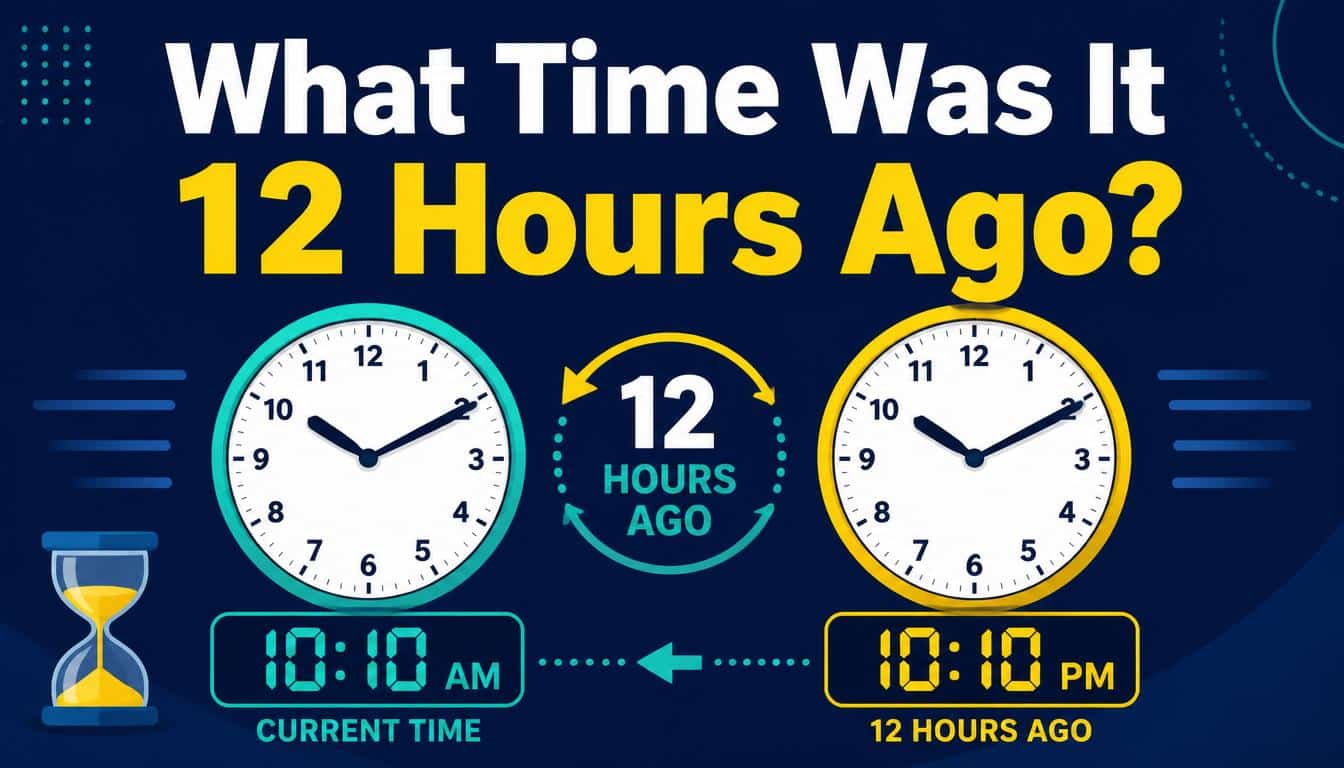
There is something oddly satisfying about looking at a clock and asking, “Wait, what time was it 12 hours ago?” It sounds like a tiny question, almost too small to bother with, yet time has a funny habit of crossing midnight and making simple answers feel less simple.
A few hours can quietly push us into a previous day, change AM to PM, or turn yesterday’s evening into today’s morning, and suddenly the answer needs a little thinking.
At its heart, the question is simply a time calculation: take the current time, move backward by 12 hours, and read the resulting past time.
The trick is remembering that the clock may change its date, day of week, or even the AM/PM side of the dial while you do it. Nothing mysterious, just clocks being clocks, I suppose.
| Time Reference | Time | Date | Day |
| 17 hours ago | 8:52 PM | September 29, 2026 | Tuesday |
| 16 hours ago | 9:52 PM | September 29, 2026 | Tuesday |
| 15 hours ago | 10:52 PM | September 29, 2026 | Tuesday |
| 14 hours ago | 11:52 PM | September 29, 2026 | Tuesday |
| 13 hours ago | 12:52 AM | September 30, 2026 | Wednesday |
| 12 hours ago | 1:52 AM | September 30, 2026 | Wednesday |
| Current time | 1:52 PM | September 30, 2026 | Wednesday |
| 12 hours from now | 1:52 AM | October 1, 2026 | Thursday |
What Time Was It 12 Hours Ago?
If the current time is 1:52 PM, then 12 hours ago it was 1:52 AM. The minutes stay exactly the same because we are subtracting a whole twelve-hour block. This is the easiest version of the calculation, and thankfully it doesn’t require a degree in time wizardry.
For example, at the moment represented by this article’s calculation, the local time is 1:52 PM on Wednesday, September 30, 2026, in a GMT+5 time zone. Subtracting 12 hours gives 1:52 AM on the same date, Wednesday, September 30, 2026. So the resulting time is 1:52 AM.
The important thing is that 12 hours does not automatically mean “yesterday.” If it is 2 PM now, twelve hours earlier was 2 AM today. But if it is 6 AM now, twelve hours earlier was 6 PM yesterday. The clock decides where the date boundary lands, not the number twelve by itself.
The Simple Rule for 12 Hours Ago
The basic method is wonderfully plain: Subtract 12 hours from the current clock time. If the answer would go below midnight, move the date backward by one day. That is the whole hours calculation, although midnight likes to make the process look more dramatic than it really is.
Suppose your clock time is 9:30 PM. Go back twelve hours and you arrive at 9:30 AM on the same day. The AM/PM calculation flips, but the date does not. Your breakfast time has simply appeared from the other side of the clock, which sounds poetic but is really just arithmetic.
Now imagine the current time is 7:15 AM. Subtract twelve hours and you get 7:15 PM on the previous day. Here, the AM/PM label changes and the calendar date changes too. This is where people often make a tiny mistake, especially when doing the calculation in their head.
What Time Was It 12 Hours Ago on a 12-Hour Clock?
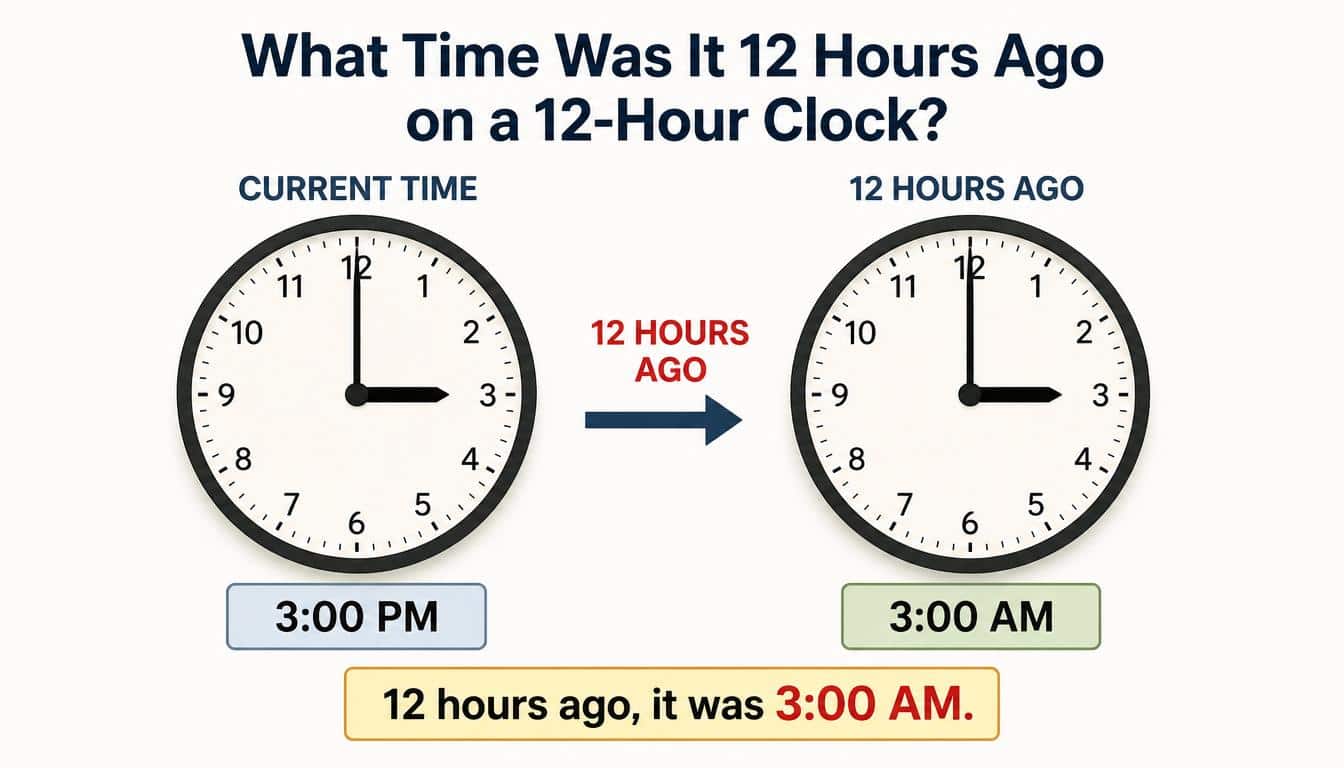
A 12-hour clock divides the day into two matching sections: AM and PM. Because each section contains twelve hours, moving backward exactly twelve hours takes you to the same clock number with the opposite AM/PM designation.
So, 1:57 PM becomes 1:57 AM, while 1:57 AM becomes 1:57 PM. The number on the clock stays put while the half of the day changes. It’s a strangely elegant little piece of time conversion.
Here are a few quick examples:
- 12:00 PM → 12:00 AM, twelve hours earlier.
- 1:57 PM → 1:57 AM, twelve hours earlier.
- 6:20 PM → 6:20 AM, twelve hours earlier.
- 9:45 AM → 9:45 PM on the previous day.
- 11:10 AM → 11:10 PM on the previous day.
- 12:30 AM → 12:30 PM on the previous day.
- 11:59 PM → 11:59 AM on the same day.
Notice how the minutes never change. That’s because time subtraction of a whole number of hours doesn’t alter the minute portion. If your clock says :57, the clock still says :57 after twelve hours, which is rather considerate of it.
A Real Example: Wednesday, September 30, 2026
Let’s make the calculation concrete. Imagine the current date and time is Wednesday, September 30, 2026, at 1:52 PM in GMT+5. We want to know the exact time twelve hours earlier.
Begin with 1:52 PM. Move backward one hour at a time, or simply recognize that twelve hours takes you to the opposite half of the 24-hour day. The answer is 1:52 AM, still on Wednesday, September 30, 2026.
That means the time difference between 1:52 AM and 1:52 PM is exactly twelve hours. It also means the elapsed time is twelve hours, or 720 minutes, which sounds much larger when written as a pile of numbers than it feels on an ordinary afternoon.
If the starting point were instead 1:57 PM, then the answer would be 1:57 AM. This is why a search for “what time was it 12 hours ago” can sometimes show a time such as 1:57 AM: the calculation depends entirely on the starting current time.
What Time Was It 12 Hours Ago in GMT+5?
A time zone matters whenever you want an exact real-world answer. In GMT+5, for example, the local clock is five hours ahead of Greenwich Mean Time. But the mathematical operation itself stays unchanged: take the local clock reading and subtract twelve hours.
If it is 3:00 PM in GMT+5, then twelve hours ago it was 3:00 AM in GMT+5. You do not subtract five hours again merely because GMT+5 appears in the question. The time zone tells you which clock you are using; it isn’t an extra part of the twelve-hour subtraction.
This distinction becomes useful when comparing messages, meetings, travel plans, or online events across countries.
A person in one time zone might say “twelve hours ago,” while another person sees a different local date. The underlying elapsed time can still be exactly twelve hours, even though their calendars don’t match.
12 Hours Ago: Morning, Afternoon, Evening, or Midnight?
One handy way to understand the calculation is to think in terms of the day’s natural sections. Morning time twelve hours ago generally becomes evening time, while afternoon can become early morning. The exact boundary depends on the starting clock time, naturally.
For example, 8:00 AM becomes 8:00 PM. That is morning becoming evening. Meanwhile, 8:00 PM becomes 8:00 AM, which is evening becoming morning. The clock number survives the journey while the description of the day changes around it.
The interesting cases sit near noon and midnight. Noon is 12:00 PM, while midnight is 12:00 AM. Confusing those two can turn an otherwise correct past time calculation into a rather impressive mess.
12 Hours Ago Calculator: How the Calculation Works
A 12 hours ago calculator does the same thing a person can do manually, only faster and with fewer opportunities for a sleepy mistake. It takes the starting time, performs time subtraction, and adjusts the date when the calculation crosses midnight.
The calculation can be represented simply as:
Current time − 12 hours = time 12 hours ago
If the current time is 10:40 PM:
10:40 PM − 12 hours = 10:40 AM
If the current time is 4:20 AM:
4:20 AM − 12 hours = 4:20 PM on the previous day
A useful hours ago calculator should therefore consider more than just the hour number. It should account for the AM/PM designation and the calendar date too. Otherwise, a technically neat answer can still be practically wrong.
12 Hours in Minutes, Seconds, and Milliseconds
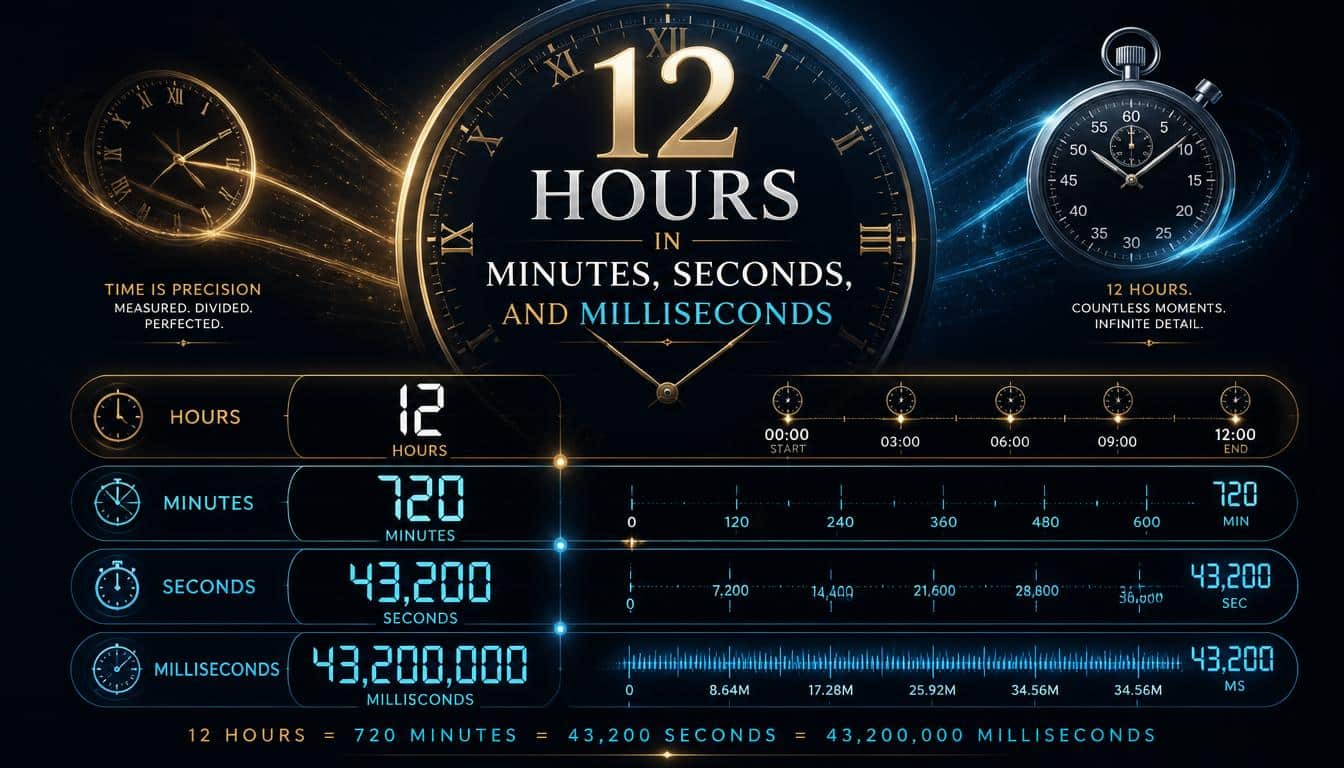
Sometimes the question is not really about a clock face. You may need a unit conversion because software, spreadsheets, logs, or technical systems measure elapsed time in smaller units.
Twelve hours contains:
- 12 hours
- 720 minutes
- 43,200 seconds
- 43,200,000 milliseconds
The conversions are straightforward. There are 60 minutes in an hour, so 12 × 60 gives 720 minutes. Multiply 720 by 60 and you get 43,200 seconds. Multiply that by 1,000 and the result is 43,200,000 milliseconds.
So when someone says “that happened 720 minutes ago,” they are describing the same twelve-hour interval. Likewise, 43,200 seconds ago and 43,200,000 milliseconds ago represent the same elapsed duration, just wearing different mathematical outfits.
What About 13, 14, 15, 16, or 17 Hours Ago?
The same method works when the question changes from twelve hours to another number. You simply subtract hours from the current time, while remembering that crossing midnight changes the date.
For a starting time of 1:52 PM, the calculations look like this:
- 12 hours ago: 1:52 AM, same date.
- 13 hours ago: 12:52 AM, same date.
- 14 hours ago: 11:52 PM, previous day.
- 15 hours ago: 10:52 PM, previous day.
- 16 hours ago: 9:52 PM, previous day.
- 17 hours ago: 8:52 PM, previous day.
This is where a time calculator becomes especially useful. Once you go beyond twelve hours, it becomes easier to accidentally shift the date incorrectly, particularly if you’re calculating several intervals quickly. A calculator doesn’t get distracted halfway through the arithmetic, which is one small advantage over humans.
What Is 12 Hours From Now?
The phrase 12 hours from now uses addition rather than subtraction. If the current time is 1:52 PM, adding twelve hours gives 1:52 AM on the next day.
That means “12 hours ago” and “12 hours from now” sit on opposite sides of the present moment. One looks backward into the past time, while the other looks forward into the future time.
For the same starting point of 1:52 PM on Wednesday, September 30, 2026:
- 12 hours ago → 1:52 AM, Wednesday, September 30.
- Current time → 1:52 PM, Wednesday, September 30.
- 12 hours from now → 1:52 AM, Thursday, October 1.
The duration is identical in both directions. Only the direction of travel changes, and suddenly the calendar gets involved on the future side too.
Why Date and Day of Week Matter
A correct answer to “what time was it?” may need more than an hour and minute. When a calculation crosses midnight, the date and day of week can change as well.
For example, if the current moment is Thursday at 6:00 AM, twelve hours earlier was Wednesday at 6:00 PM. Saying merely “6:00 PM” leaves out an important part of the answer. It tells you the clock time, but not which day that clock was showing it.
This matters for appointment records, messages, travel, work schedules, server logs, and reminders. A timestamp without its date or time zone can sometimes be like finding a key without knowing which door it belongs to.
How to Verify a 12-Hour Calculation
If you’re unsure about a result, there are several easy ways to perform validation. The first is to add twelve hours back to your answer. If you return to the original current time, the subtraction was correct.
For example, if you calculate that twelve hours before 7:25 AM was 7:25 PM yesterday, add twelve hours to 7:25 PM. You arrive at 7:25 AM today. That reverse check catches many errors, especially accidental date changes.
You can also use a time difference calculator, a phone’s clock application, a spreadsheet, or an hours from now calculator. For everyday questions, mental arithmetic is perfectly adequate, but tools become helpful when several time zones or dates are involved.
Common Mistakes When Calculating 12 Hours Ago
The most common error is forgetting that AM and PM switch after twelve hours. Someone sees 4:00 PM and subtracts twelve but accidentally writes 4:00 PM again. The clock number is right, but the half of the day is wrong, which is a sneaky little error.
Another common mistake is changing the date when you don’t need to. If it is 9:00 PM, twelve hours earlier is 9:00 AM on the same day. There is no reason to move to yesterday just because you performed subtraction.
A third mistake happens around midnight. If the current time is 5:00 AM, twelve hours earlier is 5:00 PM on the previous day. Here, the previous day calculation really is necessary. The safest habit is to ask yourself whether your backward movement crossed 12:00 AM.
A Quick Reference for 12 Hours Ago
Here is a compact reference you can keep in mind when doing a time conversion without a calculator:
- 12:00 AM → 12:00 PM yesterday.
- 1:00 AM → 1:00 PM yesterday.
- 2:00 AM → 2:00 PM yesterday.
- 6:00 AM → 6:00 PM yesterday.
- 9:00 AM → 9:00 PM yesterday.
- 12:00 PM → 12:00 AM today.
- 1:00 PM → 1:00 AM today.
- 6:00 PM → 6:00 AM today.
- 9:00 PM → 9:00 AM today.
- 11:00 PM → 11:00 AM today.
The minutes remain unchanged in each example. If the starting time is 6:37, for instance, the answer twelve hours earlier is also 6:37. Only the AM/PM designation and, when needed, the date will move.
The Fastest Mental Method
For most ordinary situations, you don’t really need an elaborate time calculator. Look at the hour, keep the minutes exactly as they are, and switch AM to PM or PM to AM. Then check whether the date needs to move backward.
If the current time is afternoon or evening, twelve hours earlier will usually fall earlier on the same date. If the current time is after midnight but before noon, the answer will normally belong to the previous date.
This method works because twelve hours is exactly half of a twenty-four-hour day. You’re essentially walking halfway around the clock face. Not very glamorous mathematics, perhaps, but remarkably useful.
Why “12 Hours Ago” Can Mean Different Calendar Dates
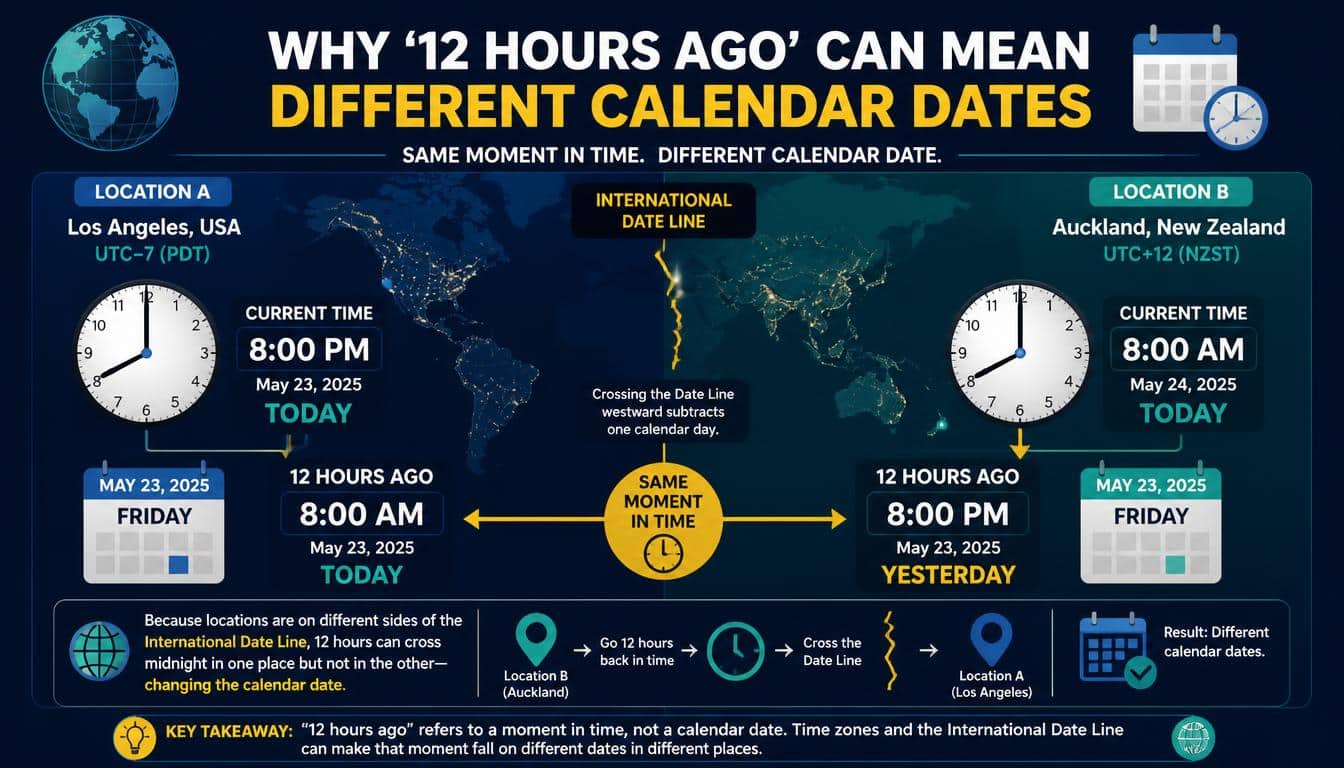
An elapsed duration and a calendar label are not the same thing. Twelve hours is always twelve hours, but the two endpoints can have different dates depending on where midnight appears between them.
For example, twelve hours from Wednesday at 8:00 AM is Wednesday at 8:00 PM. But twelve hours before Wednesday at 8:00 AM is Tuesday at 8:00 PM. Same duration, different calendar direction.
This distinction is especially important when interpreting phrases like “yesterday morning,” “last night,” or “twelve hours ago.” Human language often follows local habits rather than strict mathematical definitions, so the exact clock time and date are better evidence when precision matters.
When a Time Calculator Is Better Than Mental Math
Mental calculation is ideal for a simple question such as “what time was it 12 hours ago?” But a dedicated time calculator becomes more useful when you’re working with several dates, unusual offsets, or international schedules.
For example, you might need to calculate twelve hours ago in GMT+5, then compare it with a timestamp in another time zone. Or you may be checking whether a message sent 14 hours ago belongs to yesterday. These situations involve more than simple subtraction.
An Inch Calculator, by contrast, is designed for measurements such as inches rather than elapsed time, so it isn’t the appropriate tool for this particular job. It is a useful reminder that calculators can be specialized, and using the right one saves a surprising amount of confusion.
A Simple Formula You Can Reuse
The reusable formula is pleasantly short:
Past time = current time − elapsed time
For this particular question:
Time 12 hours ago = current time − 12 hours
If you’re working with a 24-hour clock, the arithmetic can become even cleaner. A time such as 13:52 means 1:52 PM. Subtract 12 and you get 01:52, or 1:52 AM. If the subtraction produces a negative value, add 24 and move the date back one day.
That approach is especially handy in programming, spreadsheets, databases, and technical logs because a 24-hour clock avoids the AM/PM ambiguity. The arithmetic becomes almost boring, which in time calculations is generally a good thing.
Frequently Asked Questions
What time was it 12 hours ago
12 hours ago means subtracting 12 hours from the current time. For example, if it is 1:57 PM now, 12 hours ago it was 1:57 AM.
12 hours ago
12 hours ago refers to the exact time that occurred half a day before the current time. It can be calculated by subtracting 12 hours from the current time.
What was 12 hours ago from now
To find what was 12 hours ago from now, simply subtract 12 hours from the current time. The result will show the exact time from 12 hours earlier.
12 hours ago from now
12 hours ago from now is the same time on the opposite AM/PM period. For example, 12 hours before 2:00 PM is 2:00 AM.
What time was 12 hours ago
The time 12 hours ago can be found by subtracting 12 hours from the current time. This calculation may also move the date to the previous day.
Read More: https://gracethemes.com/what-date-will-it-be-3-weeks-from-today/
Final Thoughts on Finding the Time 12 Hours Ago
The question “what time was it 12 hours ago?” has a wonderfully simple answer once you understand the structure behind it. Take the current time, subtract 12 hours, switch the AM/PM designation, and check whether the calculation crossed midnight.
For the example used here, Wednesday, September 30, 2026 at 1:52 PM in GMT+5 becomes 1:52 AM on Wednesday, September 30, 2026 when moving twelve hours into the past. The interval is 12 hours, 720 minutes, 43,200 seconds, or 43,200,000 milliseconds.
And perhaps that’s the nicest thing about a small question like this: time looks complicated mostly when we stare at all its moving pieces at once.
Break it into time difference, time subtraction, AM/PM conversion, and date adjustment, and the answer settles down quietly.
Twelve hours ago was simply another point on the same long line of time, sitting there patiently while we caught up with the clock.
If you want, I can also make this more SEO-focused, more human/blog-like, or more tightly optimized around “what time was it 12 hours ago” while keeping the same factual calculation.
