

What Time Was It 10 Hours Ago?
Sometimes a tiny question about the clock arrives at a surprisingly inconvenient moment: what time was it 10 hours ago?
Maybe you’re checking when a message was sent, working backward from an appointment, comparing two time zones, or simply wondering where the morning disappeared to.
Ten hours sounds simple enough, but once AM/PM calculation, midnight, and a previous day enter the room, things can get a little slippery.
If the current time is 2:54 PM on Saturday, September 19, 2026, in GMT+5, then going back 10 hours takes us to 4:54 AM on the same Saturday.
That is the basic idea behind this entire calculation: take the present clock time and subtract 10 hours.
If your actual current time is different, naturally, the resulting time will be different too, and that little detail is where many online answers get tangled.
| Time Difference | Time | Date |
| 10 hours ago | 4:54 AM | Saturday, September 19, 2026 |
| 11 hours ago | 3:54 AM | Saturday, September 19, 2026 |
| 12 hours ago | 2:54 AM | Saturday, September 19, 2026 |
| 13 hours ago | 1:54 AM | Saturday, September 19, 2026 |
| 14 hours ago | 12:54 AM | Saturday, September 19, 2026 |
| 15 hours ago | 11:54 PM | Friday, September 18, 2026 |
| Current time | 2:54 PM | Saturday, September 19, 2026 |
| 10 hours from now | 12:54 AM | Sunday, September 20, 2026 |
| 11 hours from now | 1:54 AM | Sunday, September 20, 2026 |
| 12 hours from now | 2:54 AM | Sunday, September 20, 2026 |
| 13 hours from now | 3:54 AM | Sunday, September 20, 2026 |
| 14 hours from now | 4:54 AM | Sunday, September 20, 2026 |
| 15 hours from now | 5:54 AM | Sunday, September 20, 2026 |
What Time Was It 10 Hours Ago From 2:54 PM?
Let’s make the calculation plain, without making the clock look like a university exam.
Starting with 2:54 PM, subtracting ten hours means moving backward across the afternoon and into the early morning. The minutes stay at 54 because we are subtracting whole hours only, which makes this particular time subtraction pleasantly tidy.
The calculation looks like this:
- Current time: 2:54 PM
- Time to subtract: 10 hours
- Calculation: 2:54 PM − 10 hours
- Resulting time: 4:54 AM
- Date: Saturday, September 19, 2026
So, if the current time is exactly 2:54 PM, then 10 hours ago was 4:54 AM. Easy enough, once the clock stops pretending its numbers are more mysterious than they really are.
This also means that the answer is still on the same day, because 2:54 PM is more than ten hours after midnight. Had we started with a time before 10:00 AM, however, the calculation would cross midnight and land on the previous day.
How to Calculate 10 Hours Ago
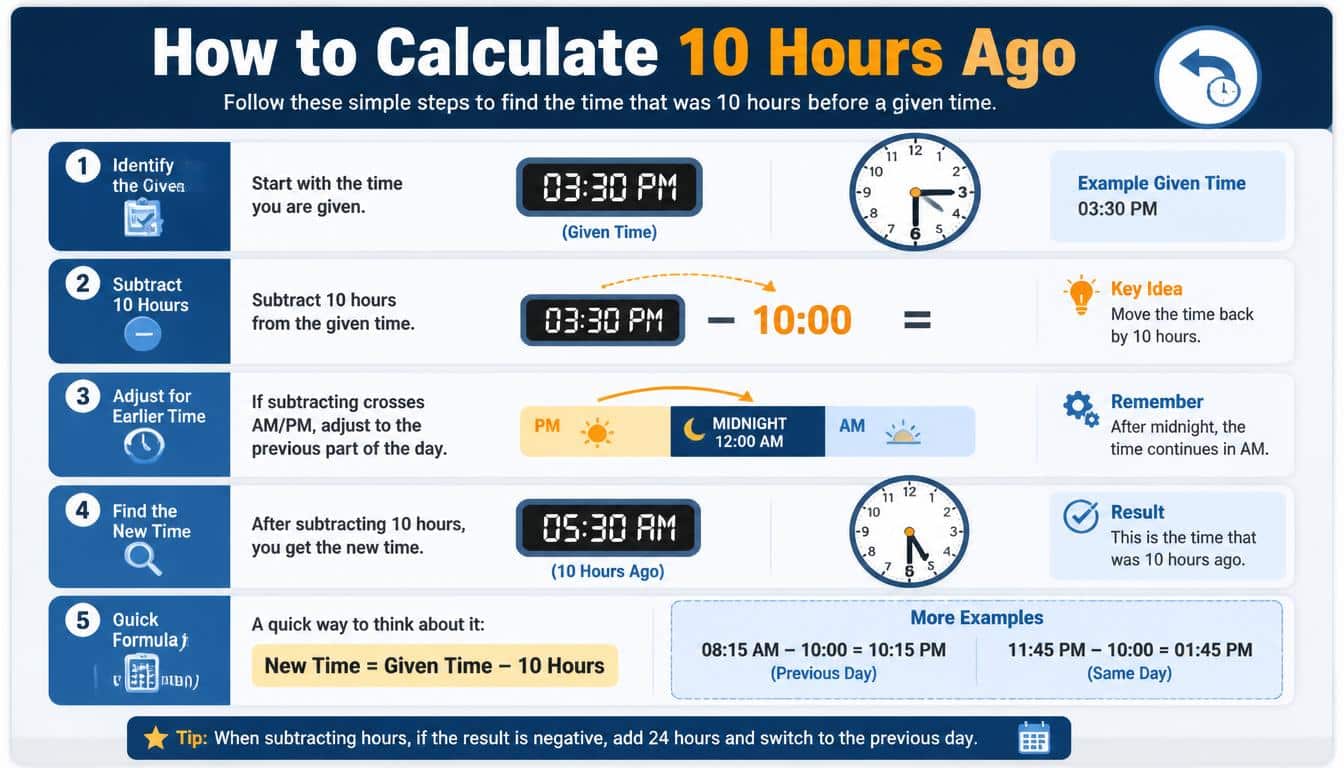
The simplest method for finding the time 10 hours ago is to subtract ten from the hour portion of the current time. Keep the minutes and seconds unchanged unless your starting time includes something unusual such as seconds that need separate adjustment.
For example, suppose your current time is 6:30 PM. Subtracting ten hours gives 8:30 AM. Nothing dramatic happens there, thankfully.
If your starting time is 7:15 AM, however, subtracting ten hours gives 9:15 PM on the previous day. The clock has crossed midnight, so the date must move backward as well. This is the part people often forget when doing a quick past time calculation in their heads.
A useful mental trick is to move backward in two stages. First subtract the hours until you reach midnight, then continue counting backward from midnight. It takes a few more seconds, but it saves the classic “same date, wrong date” mistake.
What Was the Time 10 Hours Ago Today?
If you are asking what was the time 10 hours ago today, the answer depends completely on your actual current time and time zone. “Ten hours ago” is not one universal clock reading sitting somewhere in the sky waiting for us to discover it.
For the supplied example, the current time is 2:54 PM in GMT+5. Ten hours earlier is 4:54 AM, also in GMT+5. Because the subtraction does not cross midnight, the date remains Saturday, September 19, 2026.
Here’s the same calculation in a compact form:
- 2:54 PM − 1 hour = 1:54 PM
- 2:54 PM − 5 hours = 9:54 AM
- 2:54 PM − 10 hours = 4:54 AM
The minutes remain 54 throughout, which is a handy clue. Whole-hour subtraction normally changes the hour but not the minute portion. Time math is odd like that, but at least it gives us one small kindness.
10 Hours Ago in the Morning, Afternoon, and Evening
The phrase 10 hours ago can produce very different results depending on when you ask the question. A ten-hour jump backward from evening usually lands in the morning, while a ten-hour jump backward from morning may land on the previous evening.
If it is 8:00 PM now, ten hours ago was 10:00 AM. That crosses no date boundary, so the calculation stays wonderfully boring.
If it is 5:00 AM now, ten hours ago was 7:00 PM on the previous day. Suddenly the date matters, and the innocent little calculation has become a date-and-time calculation.
That is why an hours ago calculator often asks for both the date and time rather than simply requesting an hour value. The clock needs a little context, otherwise it can give a technically neat answer that belongs to the wrong calendar day.
Understanding 10 Hours in Minutes, Seconds, and Milliseconds
Ten hours may feel like a single chunk of time, but mathematically it can be broken into smaller pieces. This becomes useful when you’re comparing timestamps, working with software, or checking elapsed hours between two events.
The basic conversions are:
- 10 hours in minutes = 600 minutes
- 10 hours in seconds = 36,000 seconds
- 10 hours in milliseconds = 36,000,000 milliseconds
The calculations are straightforward:
10 × 60 = 600 minutes
600 × 60 = 36,000 seconds
36,000 × 1,000 = 36,000,000 milliseconds
So if someone says an event happened 10 hours ago, they could equally say it happened 600 minutes ago or 36,000 seconds ago. The meaning doesn’t change; only the measuring stick does. Milliseconds, though, are probably a little dramatic for checking when you last had breakfast.
What Time Is 10 Hours From Now?
The same principle works in the opposite direction. Instead of subtracting ten hours, you simply add ten hours to the current time.
For example, if the current time is 2:54 PM, then 10 hours from now is 12:54 AM on the following day. Notice the date change this time: moving forward from the afternoon by ten hours takes us past midnight.
That gives us a useful contrast:
- 10 hours ago: 4:54 AM
- Current time: 2:54 PM
- 10 hours from now: 12:54 AM the next day
This little three-part comparison makes the concept much easier to understand. Past time moves backward, future time moves forward, and midnight is the doorway neither direction gets to ignore.
What About 11, 12, 13, 14, and 15 Hours Ago?
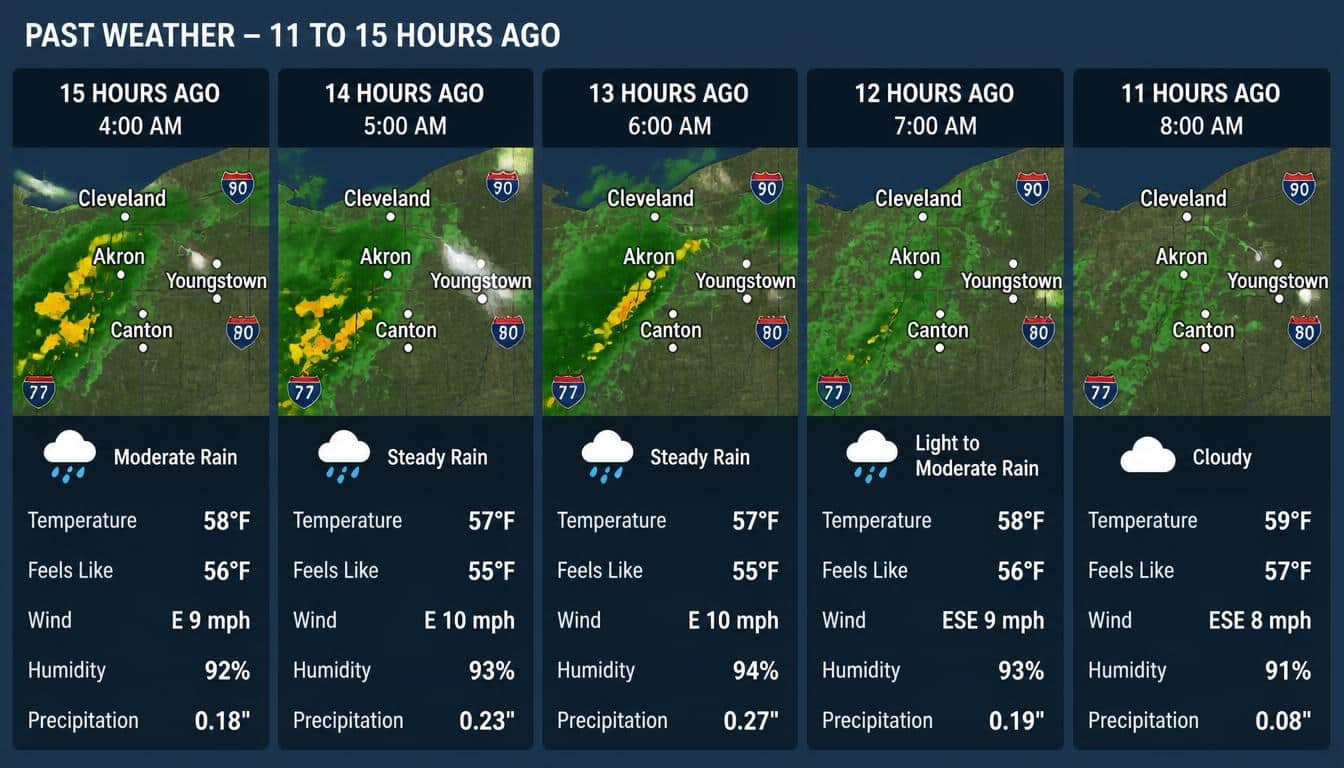
Once you understand 10 hours ago, the neighboring calculations are almost effortless. You simply continue subtracting one additional hour at a time from the same starting point.
Using 2:54 PM as the current time:
- 11 hours ago: 3:54 AM
- 12 hours ago: 2:54 AM
- 13 hours ago: 1:54 AM
- 14 hours ago: 12:54 AM
- 15 hours ago: 11:54 PM on Friday, September 18, 2026
The final calculation is where the date changes. At 14 hours ago, we are still just after midnight on Saturday. One more hour backward takes us into late Friday evening.
This is a good illustration of date rollover. The time itself may look perfectly ordinary, but the date attached to it has quietly changed behind the scenes.
Why AM and PM Can Cause Confusion
The 12-hour clock is friendly most of the time, but AM/PM conversion can create a few headaches. The especially troublesome points are 12:00 AM and 12:00 PM, because “12” behaves differently from the numbers around it.
In the 12-hour format, 12:00 AM means midnight, while 12:00 PM means noon. So if you’re calculating backward from 12:00 PM, ten hours earlier is 2:00 AM. If you’re calculating backward from 12:00 AM, ten hours earlier is 2:00 PM on the previous day.
The 24-hour clock removes some of this confusion. For example, 2:54 PM becomes 14:54, and ten hours earlier is 04:54. There is no AM or PM label to interpret, which is one reason technical systems often prefer 24-hour time.
Still, people naturally speak in AM and PM, so learning both formats is useful. Your phone may know exactly what it means; your brain might still occasionally ask for coffee.
How a Time Calculator Finds the Answer
A basic time calculator follows the same logic you can perform manually. It takes a starting date and time, applies the requested time difference, and adjusts the calendar whenever the calculation crosses midnight.
For a ten-hour subtraction, the process is essentially:
Starting time − 10 hours = resulting time
If the resulting hour becomes less than zero, the calculation rolls backward into the previous date. If you’re adding hours and the result passes 24:00, the date moves forward.
An online 10 hours ago calculator can be particularly useful when you need to perform many calculations or when seconds, dates, and time zones are involved.
It reduces mental arithmetic, though it still helps to understand what the calculator is doing. Otherwise, you end up trusting a tiny box on a webpage with your entire relationship to Thursday.
Does the Time Zone Change the Answer?
Yes, the time zone can change the clock reading, even though the duration itself remains ten hours.
For instance, GMT+5 means the local clock is five hours ahead of Greenwich Mean Time. If an event occurred ten hours earlier, you should calculate the ten-hour difference within the relevant time zone unless the question specifically asks you to convert between zones.
The duration remains fixed:
10 hours = 600 minutes = 36,000 seconds = 36,000,000 milliseconds.
What changes is the displayed clock time when you move between time zones. This distinction between elapsed time and local clock time is important, especially for international meetings, travel, remote work, and timestamped messages.
A Few Real-Life Examples of 10 Hours Ago
Imagine you received an email at 2:54 PM and want to know when it was sent relative to a ten-hour window. Ten hours earlier, the clock read 4:54 AM. That might explain why the sender’s message arrived while most people were still firmly asleep.
Or perhaps a friend says, “I was there ten hours ago,” and you want to check the claim against a timestamp. The calculation is the same: identify the reference time, subtract ten hours, and check whether the date crossed midnight.
Another common example is travel. If someone says their flight departed ten hours ago, the local departure time may not be enough to understand the event unless you also know the departure location and its time zone. Ten elapsed hours is universal; the clock on the wall is not.
Common Mistakes When Calculating 10 Hours Ago
One frequent mistake is subtracting ten from the minutes instead of the hours. If the time is 2:54 PM, you don’t calculate 2:44 PM. That would be ten minutes earlier, not ten hours earlier, and clocks are very particular about this distinction.
Another mistake is forgetting the date. If your answer moves through midnight, you need to label it as the previous day. A time such as 11:30 PM can be correct while the attached date is completely wrong, which is a sneaky little error.
People also sometimes confuse “ten hours ago” with “ten o’clock ago,” as if the clock were counting appointments rather than duration. The phrase refers to an elapsed period of 10 hours, not a particular clock number.
Finally, watch out for daylight-saving changes when working across time zones. In regions where daylight saving applies, a clock can shift while elapsed time continues normally. That is one situation where a simple manual calculation may need extra context.
A Simple Method You Can Remember
When you need to calculate 10 hours ago, remember three steps.
First, write down the exact current time. Second, subtract ten hours from the hour value. Third, check whether you crossed midnight and therefore need to change the date.
For 2:54 PM, the process is:
2:54 PM → subtract 10 hours → 4:54 AM
No minute adjustment is needed because the difference is exactly ten whole hours. If the calculation crosses midnight, simply attach the previous date.
For more complicated situations, a time calculator or hours ago calculator can handle the arithmetic quickly. But knowing the manual method means you can verify the result yourself, which is never a bad habit.
Frequently Asked Questions
10 hours ago
10 hours ago means the time that was exactly 10 hours before the current time. You can find it by subtracting 10 hours from the current time.
How long ago was 10 hours
10 hours ago refers to a point in time that occurred 10 hours before now. In other words, 10 hours have passed since that specific time.
10 hours ago from now is what time
To find the time 10 hours ago from now, simply subtract 10 hours from the current time. If the calculation crosses midnight, the date will change as well.
What time was 10 hours ago
The time 10 hours ago depends on your current time and time zone. Subtract 10 hours from the current time to determine the exact time.
Time 10 hours
“Time 10 hours” generally refers to a duration of 10 hours. This is equal to 600 minutes, 36,000 seconds, or 36,000,000 milliseconds.
Read More: https://gracethemes.com/what-date-is-32-weeks-from-today/
Final Thoughts on Finding the Time 10 Hours Ago
So, what time was it 10 hours ago? If the reference point is 2:54 PM on Saturday, September 19, 2026, in GMT+5, then the answer is 4:54 AM on Saturday, September 19, 2026.
The underlying rule is beautifully ordinary: subtract ten hours from the current time, keep the minutes and seconds unless your calculation requires otherwise, and adjust the date whenever midnight gets crossed. That’s the whole little engine beneath the answer.
Once you understand it, questions such as what was the time 10 hours ago, how to subtract 10 hours from the current time, and what time is 10 hours from now become variations of the same calculation.
Whether you’re checking a message, planning a schedule, comparing timestamps, or simply wondering where the last ten hours wandered off to, the clock can be worked backward without much fuss.
And perhaps that’s the nicest thing about time calculations: they make something that feels vague suddenly precise.
Ten hours is 600 minutes, 36,000 seconds, or 36,000,000 milliseconds but on an ordinary day, it’s simply a small journey backward across the clock face, one hour at a time.
