

What Time Is 16 Hours From Now?
There is something oddly satisfying about asking a clock a question that sounds simple but can become surprisingly slippery: what time is 16 hours from now?
You look at the clock, add some hours in your head, cross midnight, wonder whether the date changed, and suddenly a tiny piece of arithmetic has turned into a small puzzle.
It happens more often than people admit, specially when planning work, travel, medication reminders, online events, sleep schedules, or simply trying to figure out when tomorrow has properly arrived.
The good news is that 16 hours from now is not difficult to calculate once you know the starting time and timezone.
The trick is remembering that sixteen hours is longer than half a day but shorter than a full day, so the answer often lands on the following day.
And yes, the AM/PM part can sneak up on you a little, which is why writing the calculation down is sometimes better than trusting a sleepy brain.
For a reference calculation, suppose the current time is 9:52 PM GMT+5 on Tuesday, August 25, 2026. Add 16 hours, and the answer is 1:52 PM on Wednesday, August 26, 2026.
That is the neat little destination this article will unpack, including why the date changes and how you can perform the same time calculation yourself.
One small detail matters, though: if your actual clock says 9:51 PM rather than 9:52 PM, the result is 1:51 PM. Relative-time answers move with the clock, naturally.
So think of 9:52 PM as the fixed example used throughout, rather than a claim that every reader’s clock shows the same minute.
| Current Time | 16 Hours From Now | Day |
| 12:00 AM | 4:00 PM | Same day |
| 1:00 AM | 5:00 PM | Same day |
| 2:00 AM | 6:00 PM | Same day |
| 3:00 AM | 7:00 PM | Same day |
| 4:00 AM | 8:00 PM | Same day |
| 5:00 AM | 9:00 PM | Same day |
| 6:00 AM | 10:00 PM | Same day |
| 7:00 AM | 11:00 PM | Same day |
| 8:00 AM | 12:00 AM | Next day |
| 9:00 AM | 1:00 AM | Next day |
| 10:00 AM | 2:00 AM | Next day |
| 11:00 AM | 3:00 AM | Next day |
| 12:00 PM | 4:00 AM | Next day |
| 1:00 PM | 5:00 AM | Next day |
| 2:00 PM | 6:00 AM | Next day |
| 3:00 PM | 7:00 AM | Next day |
| 4:00 PM | 8:00 AM | Next day |
| 5:00 PM | 9:00 AM | Next day |
| 6:00 PM | 10:00 AM | Next day |
| 7:00 PM | 11:00 AM | Next day |
| 8:00 PM | 12:00 PM | Next day |
| 9:00 PM | 1:00 PM | Next day |
| 10:00 PM | 2:00 PM | Next day |
| 11:00 PM | 3:00 PM | Next day |
The Simple Answer: What Time Is 16 Hours From Now?
If the starting point is 9:52 PM GMT+5 on Tuesday, August 25, 2026, then 16 hours from now is 1:52 PM GMT+5 on Wednesday, August 26, 2026.
It sounds almost like the clock has taken a little overnight journey and returned in the afternoon, which is basically what happened.
The easiest mental method is to divide the calculation around midnight. From 9:52 PM to midnight is 2 hours and 8 minutes.
After midnight, you still have 13 hours and 52 minutes left. Add those to midnight and you arrive at 1:52 PM the next day. This method is handy when your starting time is late in the evening and ordinary addition gets messy.
Another way is even quicker. Add 12 hours first: 9:52 PM becomes 9:52 AM on Wednesday. Then add the remaining four hours.
That takes you to 1:52 PM. No complicated hours calculator is required, though a calculator is certainly useful if you are doing several such calculations in a row.
So, in the fixed example, the answer is:
- Starting time: 9:52 PM GMT+5, Tuesday, August 25, 2026
- Duration: 16 hours
- Future time: 1:52 PM GMT+5
- Future date: Wednesday, August 26, 2026
- Elapsed duration: 960 minutes
- Equivalent duration: 57,600 seconds
- Equivalent duration: 57,600,000 milliseconds
The numbers look more dramatic when written in seconds and milliseconds, somehow. Sixteen hours is still just sixteen hours, but 57,600 seconds makes it feel like a much bigger creature.
Why 16 Hours From Now Usually Lands on the Next Day
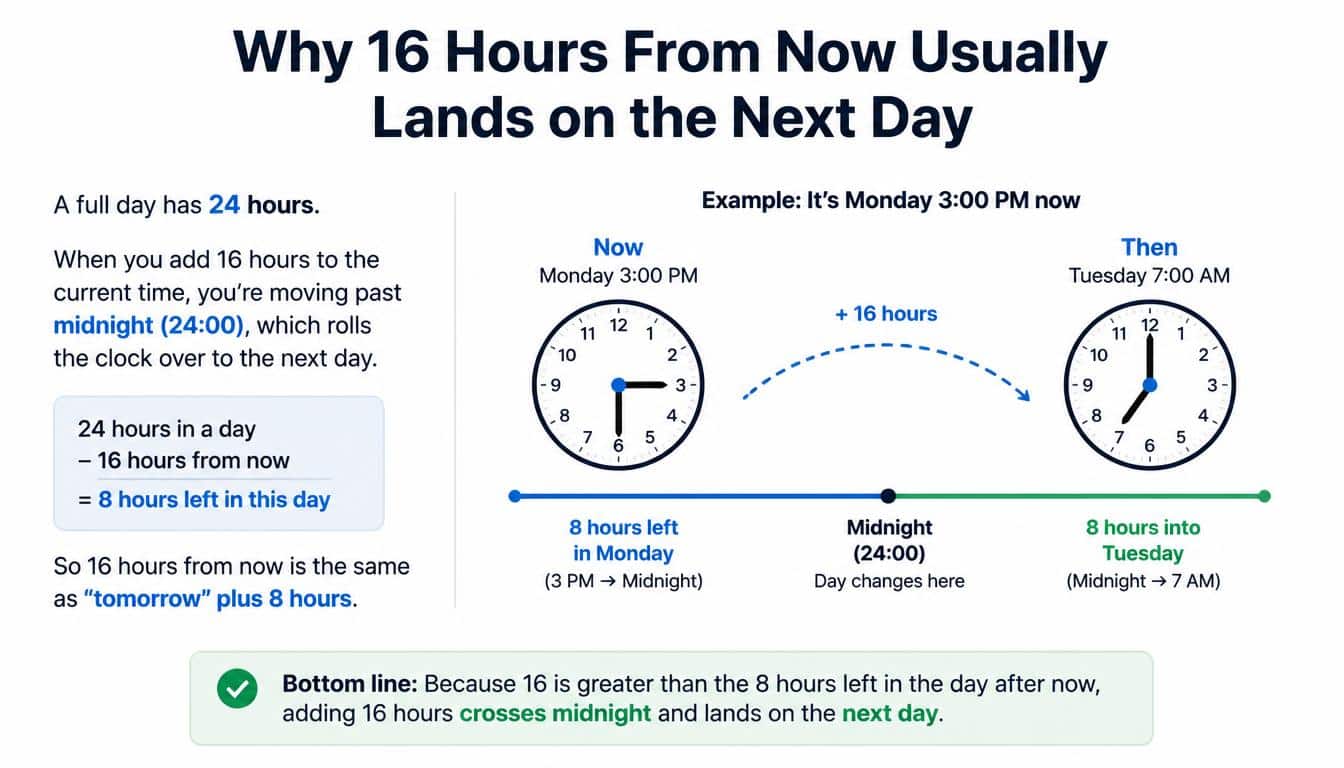
A full day contains 24 hours, while our example uses only 16. That means the calculation does not travel through an entire 24-hour cycle, but it does travel far enough to pass midnight. This is the important part people sometimes miss when doing a quick hour calculation.
Imagine the evening beginning at 9:52 PM. You have three hours and eight minutes until 1:00 AM, but you don’t actually need to think in that complicated direction.
Sixteen hours after 9:52 PM must be later than noon the next day because twelve hours gets you to 9:52 AM, with four more hours remaining. The answer therefore belongs to the afternoon, not the morning.
Crossing midnight also means the future date changes. Tuesday becomes Wednesday, even though only sixteen hours have passed.
This is why questions about time and date should not be answered by looking at the clock alone. The calendar matters too, quietly sitting beside the clock like the less glamorous member of the partnership.
How to Calculate 16 Hours From Now Manually
A reliable time calculation starts with identifying the exact starting point. Write down the hour, minute, AM or PM designation, date, and timezone if the calculation matters across regions.
Skipping the timezone can make an otherwise perfect calculation completely wrong for somebody elsewhere, which is a rather annoying way to lose an hour or more.
For the example, begin with 9:52 PM. Add 12 hours, which produces 9:52 AM on the next day. Then add four additional hours.
The result becomes 1:52 PM on Wednesday, August 26. This approach is particularly easy with a 12-hour clock, because twelve hours simply switches AM to PM or PM to AM while keeping the minutes unchanged.
You can also use the 24-hour format. In that system, 9:52 PM becomes 21:52. Add 16 hours and you get 37:52. Because a day ends at 24:00, subtract 24 hours, leaving 13:52.
That gives 1:52 PM when converted back into AM / PM notation. The 24-hour approach can feel less friendly at first, but it is very tidy once you get used to it.
The third method is to convert the duration into minutes. Sixteen hours equals 960 minutes, so you can add 960 minutes to the starting time.
This is useful for a scheduling spreadsheet or a programming task, though doing it manually for a single question is slightly like bringing a suitcase to carry one sock.
What Happens When You Cross Midnight?
Midnight is the little boundary that causes most of the confusion in 16 hours later calculations.
It is not merely “late night”; it marks the beginning of a new calendar day. So when your calculation passes 12:00 AM, the date must advance too.
With the example of 9:52 PM Tuesday, there are only 2 hours and 8 minutes before midnight. Once those minutes pass, it is Wednesday.
The remaining time from the original sixteen-hour duration continues into Wednesday afternoon. Nothing mysterious happened to the clock, really; the calendar simply turned its page.
This same principle works whether you begin at 10:15 PM, 11:40 PM, or 11:59 PM. Add enough hours to cross midnight, and you are calculating a following morning or later period on a new date. The precise resulting time depends on the starting hour, of course.
Understanding AM and PM After 16 Hours
AM/PM conversion becomes easier when you remember that the 12-hour clock has two twelve-hour halves. AM covers midnight through late morning, while PM covers noon through the evening. When you add twelve hours, the clock number remains the same but AM and PM switch.
For example, 9:52 PM plus 12 hours is 9:52 AM. Add another four hours and you reach 1:52 PM. Notice that the answer is not 13:52 PM; that would mix two different time formats together, which clocks generally don’t appreciate.
Noon deserves special attention because it is 12:00 PM, while midnight is 12:00 AM. That distinction feels needlessly sneaky until you’ve made the mistake once, and then you tend to remember it forever.
If your calculation reaches noon, pause for a second before deciding whether the label should be AM or PM.
How Long Is Sixteen Hours?
People sometimes ask not only what time will it be 16 hours from now, but also how much time sixteen hours actually represents. In ordinary terms, it is two-thirds of a 24-hour day, which is a surprisingly large slice of time.
In smaller units, the conversion is straightforward. Sixteen hours equals 960 minutes, because 16 × 60 = 960. It equals 57,600 seconds, because 960 × 60 = 57,600.
And it equals 57,600,000 milliseconds, because each second contains 1,000 milliseconds. Written out like this, sixteen hours suddenly looks very busy indeed.
These conversions are useful in different settings. Minutes are convenient for schedules, seconds can be useful for technical calculations, and milliseconds appear in computing and systems work.
For an everyday appointment, however, saying “tomorrow afternoon” is usually more helpful than announcing “51.6 million milliseconds from now.”
16 Hours From Now Versus 16 Hours Ago
A related question is what time was it 16 hours ago? The same arithmetic works in reverse. Instead of adding sixteen hours to the starting point, subtract sixteen hours.
This distinction matters when checking timestamps, reviewing a work log, or trying to remember when something happened the previous evening.
If the reference point is 9:52 PM Tuesday, subtracting twelve hours takes you to 9:52 AM Tuesday. Subtracting another four hours gives 5:52 AM Tuesday. So 16 hours ago from 9:52 PM Tuesday was 5:52 AM Tuesday.
It stays on the same calendar date in this particular example, which shows why adding and subtracting hours should never be assumed to change the date automatically.
The same principle applies to 17 hours ago, 18 hours ago, 19 hours ago, 20 hours ago, and 21 hours ago. Each additional hour simply moves the reference point farther backward. A good time calculator is useful when the numbers become awkward, but the underlying idea never changes.
What About 17, 18, 19, 20, and 21 Hours From Now?
Once you understand 16 hours from now, the nearby calculations are almost boringly easy. Starting from 9:52 PM GMT+5 on Tuesday, August 25, each extra hour pushes the result one hour later on Wednesday.
- 17 hours from now: 2:52 PM Wednesday
- 18 hours from now: 3:52 PM Wednesday
- 19 hours from now: 4:52 PM Wednesday
- 20 hours from now: 5:52 PM Wednesday
- 21 hours from now: 6:52 PM Wednesday
This little sequence is useful because it shows the pattern without requiring a separate mystery for every hour. Once the first calculation is correct, the next several are just gentle steps forward. Time is repetitive like that, thankfully.
Timezones Can Change the Answer You See
A calculation such as 16 hours from current time is only meaningful when the starting timezone is understood.
If someone says “16 hours from now” while sitting in GMT+5 and someone else interprets the same moment in another timezone, their displayed clock times may differ even though the actual elapsed duration is identical.
The duration itself never changes because of a timezone. Sixteen hours remains sixteen hours. What changes is the local representation of the starting and ending moments.
This is why travel plans, international meetings, remote work schedules, and online events should include a timezone whenever confusion could cause trouble.
For the example used here, GMT+5 is part of the reference. Starting at 9:52 PM GMT+5 and adding sixteen hours gives 1:52 PM GMT+5 the next day.
If you need the corresponding time somewhere else, first calculate the exact moment and then convert that moment into the destination timezone.
When an Hours From Now Calculator Is Useful
You can absolutely calculate a simple sixteen-hour duration by hand. Still, an hours from now calculator or time calculator becomes useful when minutes, dates, multiple timezones, or several durations are involved.
It removes the small mental gymnastics that can lead to silly errors, especially late at night when the brain has already announced closing time.
A date and time calculator can also help when the starting point is unusual, such as 11:47 PM, or when you need to calculate a series of future deadlines.
For example, adding 16 hours, then another 18 hours, then subtracting 7 hours manually is doable, but it isn’t exactly a thrilling use of anyone’s afternoon.
Many online calculation resources, including tools published by sites such as Inch Calculator, provide related time and duration calculations.
A time knowledge base can be handy when you want to understand the method rather than merely receive a single answer.
Still, it’s worth checking that the tool clearly identifies its reference time and timezone before relying on the result.
A Quick Reference for 16-Hour Calculations
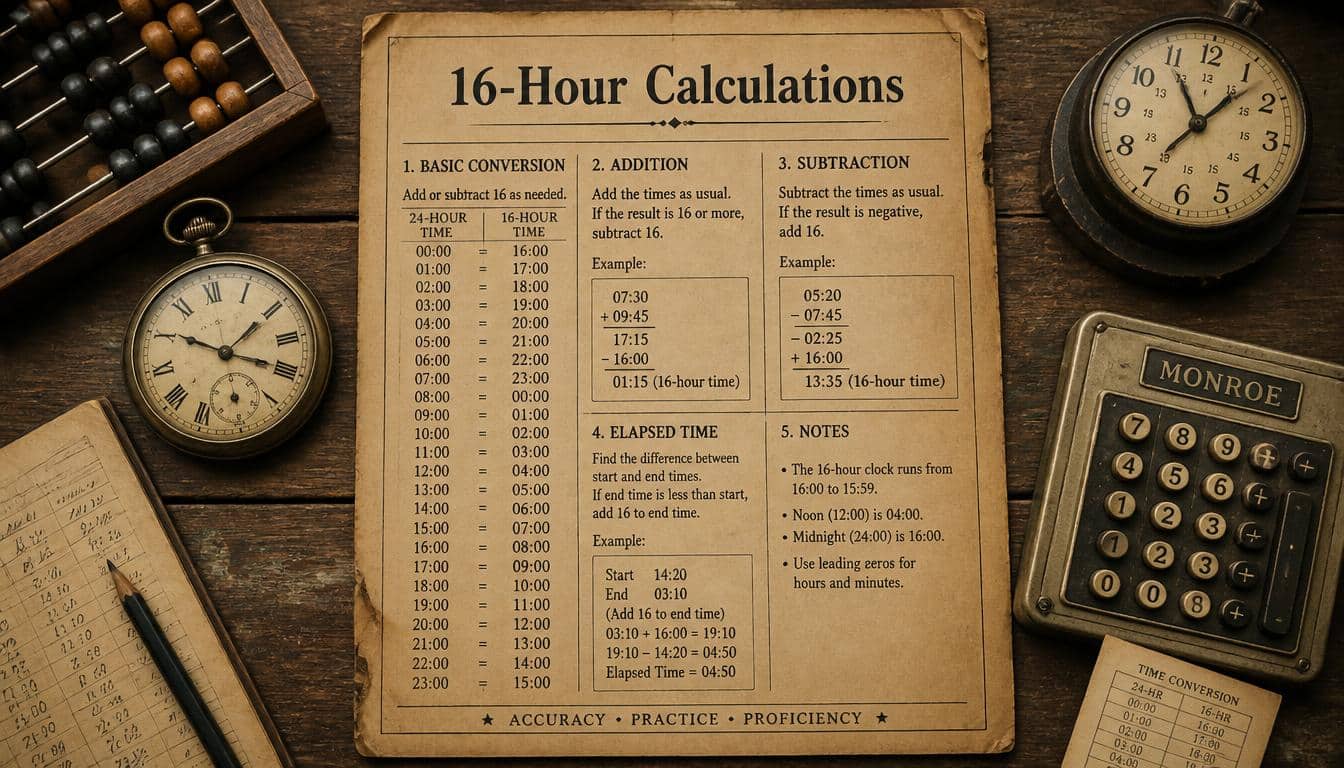
If you often search for calculate 16 hours from now, it helps to remember a few simple patterns. Starting in the evening usually means the result appears the next day, while starting early in the morning may produce an afternoon or evening result on the same date.
For instance, 6:00 AM plus sixteen hours is 10:00 PM on the same day. Noon plus sixteen hours is 4:00 AM the next day. 6:00 PM plus sixteen hours is 10:00 AM the following day. The number sixteen doesn’t change; only the starting point does.
This is also why copying somebody else’s answer to a “16 hours from now” search can be dangerous.
Their current time may not be your current time, and their timezone may not be yours. Relative time is wonderfully convenient and slightly unreliable when the reference point is missing.
Practical Uses for Knowing the Future Time
Knowing what time is 16 hours from now is useful in everyday situations that have nothing to do with mathematics homework.
Someone might be timing a fasting period, planning a shift, calculating a travel interval, checking when an online sale ends, or figuring out when a delayed task should be revisited.
It can also matter for international communication. A message sent at night in one country might reach someone during their afternoon.
If you know that sixteen hours separates two moments, you can anticipate the recipient’s local time more sensibly instead of assuming everybody lives according to your own wall clock.
For deadlines, it is smart to write both the time and date. “Due in sixteen hours” is temporary information; “due Wednesday, August 26 at 1:52 PM GMT+5” is much harder to misunderstand. Specificity wins here, even if it looks a little less elegant.
Common Mistakes When Adding Hours
One common mistake is forgetting that midnight changes the date. Another is accidentally adding sixteen to the clock number without converting between the AM and PM halves.
A third is ignoring the timezone when the calculation involves another country. These errors are small, but small errors are remarkably talented at causing large scheduling headaches.
Another mistake is treating 12:00 AM and 12:00 PM as if they were interchangeable. They aren’t. Midnight is 12:00 AM, while noon is 12:00 PM.
If you’re unsure, using 24-hour notation can make the calculation cleaner and reduce the chance of accidentally scheduling something at midnight instead of lunchtime.
Finally, remember that “from now” is a moving expression. If your clock says 9:51 PM now and you check again a minute later, the answer has moved by a minute too.
That sounds obvious, but it is the reason a fixed example such as 9:52 PM is more useful for explaining the method than pretending there is one permanent answer for everyone.
The Easiest Formula to Remember

For everyday use, the formula is beautifully uncomplicated: starting time + duration = future time. If the total passes midnight, advance the date. If it passes noon, check the AM/PM designation. If you’re working across regions, include the timezone.
For the example:
9:52 PM + 16 hours = 1:52 PM the next day.
Or, in 24-hour format:
21:52 + 16 hours = 13:52 the next day.
And in smaller units:
16 hours = 960 minutes = 57,600 seconds = 57,600,000 milliseconds.
There isn’t much more machinery hiding behind the curtain. The calculation is simple once the clock and calendar are treated as a pair, rather than as two unrelated things.
Frequently asked Questions
What time will it be in 16 hours
To find the time 16 hours from now, simply add 16 hours to your current time. The result may fall on the next day if the calculation passes midnight.
16 hours from now
16 hours from now means the exact time you will reach after adding sixteen hours to the current time. Remember to account for the date if the calculation crosses midnight.
16 hours from now is what time
The answer depends on your current time and timezone. Add 16 hours to your present time to find the exact future time and date.
What is 16 hours from now
16 hours from now is simply your current time plus sixteen hours. For example, if it is 9:52 PM now, it will be 1:52 PM the following day.
What time is it in 16 hours
In 16 hours, the clock will show a time that is sixteen hours ahead of the current time. If you start in the evening, the answer will usually be on the next day.
Read This Blog: https://gracethemes.com/how-many-days-until-may-1st/
Final Answer: 16 Hours From Now
So, if the reference time is 9:52 PM GMT+5 on Tuesday, August 25, 2026, then 16 hours from now is 1:52 PM GMT+5 on Wednesday, August 26, 2026. The calculation crosses midnight, moves into the following day, and ends in the afternoon.
If your actual current time is different, simply substitute your exact starting time. For example, if your clock currently reads 9:51 PM, the result is 1:51 PM the following day.
Relative time belongs to the exact moment you ask the question, which is why even one minute can matter.
The most useful habit is to include the full current time and date, along with the timezone when necessary.
Once you do that, questions about 16 hours later, 16 hours after, or even 17–21 hours ago become much less mysterious. A clock is just counting; we are the ones who occasionally make it dramatic.
Whether you are planning tomorrow’s meeting, checking a deadline, arranging a long journey, or simply satisfying that little itch to know what time will it be 16 hours from now, the method stays wonderfully steady.
Add the hours, watch for midnight, respect the date, and check the timezone. Thats really it and sometimes the simplest answer is the one that lets the rest of the day feel a bit more organized.
