

What Date Is 2 Weeks From Today? Calculate the Date Easily
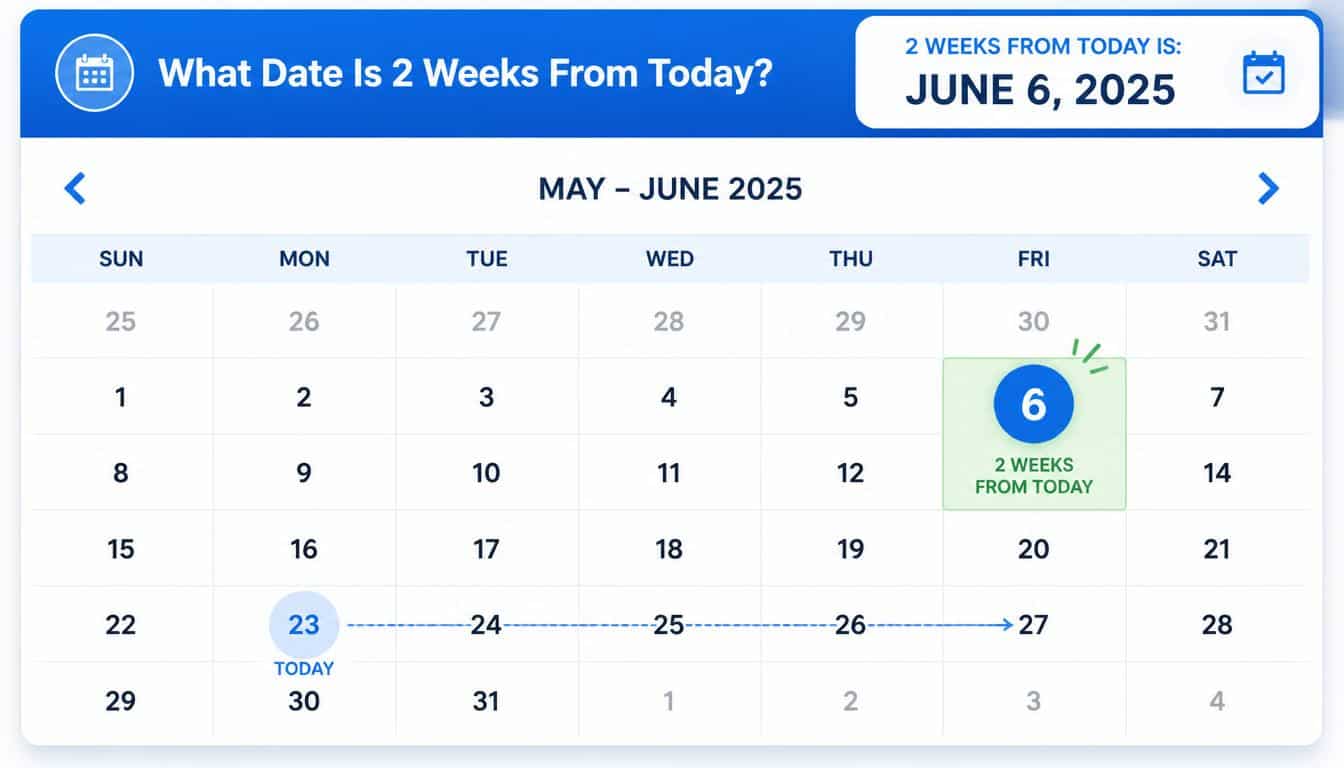
Sometimes a date is hiding in plain sight, but somehow it still feels like a tiny puzzle. You know today’s date, you know you need to move forward by two weeks, and yet the calendar makes you pause for a second. Is it really that simple? Yes, mostly and for Today: August 28, 2026, the answer is September 11, 2026.
That means the date 2 weeks from today is Friday, September 11, 2026. The calculation is not complicated, but understanding how the days, weeks,
and calendar dates connect can make future date questions much easier to solve, even when you don’t have a date calculator sitting nearby.
A two-week period contains 14 days, which gives us a wonderfully reliable shortcut: simply add 14 days to the starting date.
From August 28, moving forward fourteen days lands exactly on September 11. No calendar gymnastics required, thankfully.
If you’re checking a deadline, planning an appointment, counting down to an event, or simply wondering what date is 2 weeks from today,
this guide walks through the calculation, explains the related time durations, and shows a few easy ways to calculate future and past dates without getting your weeks all tangled up.
| Starting Date | 2 Weeks From Today | Day |
| August 28, 2026 | September 11, 2026 | Friday |
What Date Is 2 Weeks From Today?
Starting with August 28, 2026, we can perform a simple two-week date calculation.
Two weeks equals 14 days, so:
August 28, 2026 + 14 days = September 11, 2026
Therefore, the answer to “What date is 2 weeks from today?” is:
September 11, 2026
And because August 28, 2026 is a Friday, fourteen days later is also a Friday. This is one of the handy little things about adding a complete number of weeks: the weekday stays exactly the same.
So the full result is Friday September 11 2026.
For someone using a date calculator, the process is essentially the same. Enter the starting date, choose a future calculation, add two weeks, and the calculator produces the target date.
But knowing the manual method is useful too, particularly when you’re away from your phone or trying to understand how the result was produced.
How Do You Calculate 2 Weeks From Today?

The easiest method is to convert weeks into days first.
One week = 7 days.
Two weeks = 7 + 7 = 14 days.
Now take the current date, which here is August 28, 2026, and count forward 14 days.
The first seven days take you from August 28 to September 4. The next seven days take you from September 4 to September 11. So the date in 2 weeks is September 11.
You can think of it like moving two complete squares of seven days across a calendar.
It sounds almost too simple, but this method avoids a common mistake where people accidentally count the starting day as day one and end up one day short. Calendars can be sneaky like that.
Another useful rule is that adding one week preserves the weekday. Therefore:
- August 28, 2026 → September 4, 2026
- September 4, 2026 → September 11, 2026
Both movements are exactly seven days, making the final date two weeks after the original.
So if you’re trying to calculate date 2 weeks from now, remember the tiny formula:
Starting date + 14 days = date two weeks from today.
September 11, 2026 Is the Target Date
The target date for this calculation is September 11, 2026, which falls on a Friday.
The calculation can be expressed several ways:
Starting date: August 28, 2026
Duration: 2 weeks
Duration in days: 14 days
Target date: September 11, 2026
Day of week: Friday
This also means that September 11th is the upcoming date when counting two full weeks forward from August 28.
For people searching phrases such as “what is the date 2 weeks from now”, “what day is it in 2 weeks”, or “when is 2 weeks from today”, these are all asking essentially the same calendar question. The wording changes, but the calculation doesn’t.
The answer remains Friday, September 11, 2026.
Two Weeks Is More Than Just 14 Calendar Squares
A week-based calculation becomes even more interesting when the duration is converted into smaller units.
Two weeks contain:
- 2 weeks
- 14 days
- 336 hours
- 20,160 minutes
- 1,209,600 seconds
The mathematics is straightforward.
Two weeks × 7 days = 14 days.
14 days × 24 hours = 336 hours.
336 hours × 60 minutes = 20,160 minutes.
20,160 minutes × 60 seconds = 1,209,600 seconds.
So if somebody asks, “How many hours are in 2 weeks?” the answer is 336 hours. If they ask how many minutes, it is 20,160 minutes.
And yes, there are 1,209,600 seconds ticking away during those same two weeks, which suddenly makes fourteen days feel rather dramatic.
This is why a time duration calculator and a date calculator aren’t always doing the exact same job. A duration calculator measures an amount of elapsed time, while date arithmetic determines where that duration lands on a calendar.
August 28, 2026 to September 11, 2026

The calendar calculation crosses from August into September, which can make the arithmetic appear slightly harder than it really is.
August has 31 days. Starting on August 28, there are only a few days remaining in that month before we enter September.
Counting forward gives:
- August 29 — 1 day
- August 30 — 2 days
- August 31 — 3 days
- September 1 — 4 days
- September 2 — 5 days
- September 3 — 6 days
- September 4 — 7 days
- September 5 — 8 days
- September 6 — 9 days
- September 7 — 10 days
- September 8 — 11 days
- September 9 — 12 days
- September 10 — 13 days
- September 11 — 14 days
That puts us neatly at September 11, 2026.
Notice that the starting date itself isn’t counted as one day elapsed. We’re measuring the distance after August 28, not treating August 28 as the first completed day. This distinction is small, but it matters alot in date calculations.
Date Comparison: Two Weeks Forward
A useful way to understand the pattern is to compare several starting dates with the dates exactly two weeks later.
| Starting Date | Date 2 Weeks Later |
| August 24, 2026 | September 7, 2026 |
| August 25, 2026 | September 8, 2026 |
| August 26, 2026 | September 9, 2026 |
| August 27, 2026 | September 10, 2026 |
| August 28, 2026 | September 11, 2026 |
| August 29, 2026 | September 12, 2026 |
| August 30, 2026 | September 13, 2026 |
| August 31, 2026 | September 14, 2026 |
| September 1, 2026 | September 15, 2026 |
The pattern is almost pleasingly mechanical. Move the starting date forward by one day, and the date two weeks later also moves forward by one day. Once you see that pattern, adding weeks to a date becomes much less intimidating.
What Day Will It Be Two Weeks From Today?
The answer is Friday.
August 28, 2026 is a Friday. Since a week contains exactly seven days, adding two weeks means adding fourteen days. Fourteen is divisible by seven, so the weekday does not change.
That gives:
Friday, August 28, 2026 → Friday, September 11, 2026
This is useful when planning recurring meetings, appointments, classes, celebrations, or deadlines. If something happens on a Friday and you need to schedule it two weeks later, you already know the second event will also land on Friday.
The same principle works for any weekday. Monday plus two weeks is Monday. Wednesday plus two weeks is Wednesday. Sunday plus two weeks is Sunday. The calendar has its little rules, and this one is thankfully a friendly one.
What Is 14 Days From Today?
Because two weeks equals fourteen days, 14 days from today produces exactly the same result.
Starting from August 28, 2026:
August 28 + 14 days = September 11, 2026
Therefore, the answers to these questions are identical:
- What is 14 days from today?
- What is the date 14 days from now?
- What date is two weeks from now?
- What is the date in 2 weeks?
- When is 2 weeks from today?
All point to September 11, 2026.
The terminology changes depending on what somebody types into a search engine, but underneath it all is the same bit of date arithmetic.
What Date Was 2 Weeks Ago?
Going backward is simply the reverse calculation.
If August 28, 2026 is today, then two weeks ago was 14 days earlier.
August 28, 2026 − 14 days = August 14, 2026
So the date 2 weeks ago was August 14, 2026.
This is a good example of why relative dates can sometimes confuse people. “Two weeks ago” and “two weeks from today” sound almost like mirror images, because they are. One moves backward through the calendar, while the other moves forward.
You can use the same approach for 3 weeks ago, 4 weeks ago, 5 weeks ago, or 6 weeks ago. Just multiply the number of weeks by seven and subtract the resulting number of days from the starting date.
What About 3, 4, 5, or 6 Weeks From Today?
Once the two-week calculation is clear, longer periods become very easy.
Starting from August 28, 2026:
- 3 weeks from today = September 18, 2026
- 4 weeks from today = September 25, 2026
- 5 weeks from today = October 2, 2026
- 6 weeks from today = October 9, 2026
Each additional week simply moves the answer seven days further into the future.
Going backward works in exactly the same fashion:
- 3 weeks ago = August 7, 2026
- 4 weeks ago = July 31, 2026
- 5 weeks ago = July 24, 2026
- 6 weeks ago = July 17, 2026
This is essentially a simple weeks calculator that you can perform in your head. You don’t need sophisticated software unless you’re dealing with more complicated rules involving business days, time zones, holidays, or exact timestamps.
Why Date Calculations Sometimes Go Wrong
Most basic date calculations aren’t difficult. The mistakes usually happen because people use slightly different meanings of “from today,” or because they count the starting day incorrectly.
For example, if someone says “14 days from August 28,” they generally mean that fourteen complete days pass after August 28. That lands on September 11.
Another source of confusion is the difference between calendar days and business days. Fourteen calendar days includes weekends. Fourteen business days does not, so that calculation would produce a different result.
Time zones can matter too when a calculation includes an exact time rather than only a date. A date-only question such as this one is much cleaner because we’re simply comparing calendar dates, not trying to calculate the exact moment 336 hours after a timestamp.
In other words, don’t let a simple calendar question wear a fancy mathematical hat. Most of the time, the solution is simply count seven, then seven again.
How to Use a Date Calculator
A date calculator is useful when you want to calculate a future date without manually counting.
The basic process is usually:
- Enter the starting date.
- Choose whether you’re moving forward or backward.
- Select weeks, days, or another unit.
- Enter the amount, such as 2 weeks.
- Read the resulting future date or past date.
For this example, the input would effectively be:
Starting date: August 28, 2026
Add: 2 weeks
Result: September 11, 2026
A future date calculator is especially useful when you’re calculating several dates at once. It reduces the risk of overlooking a month boundary, a leap day, or an unusual calendar situation.
Still, knowing how to calculate a date yourself is worth having in your mental toolbox. Your brain is allowed to do calendar work too, it won’t complain.
September 2026 Calendar Thinking
The calculation ends in September 2026, so it’s useful to see how the target date fits into the month.
The first day of September 2026 is a Tuesday, while September 11 is a Friday. The target therefore falls during the second full week of the month.
For someone planning an upcoming date, this can make the result more meaningful than a bare number. Instead of remembering only “14 days,” you can remember Friday, September 11, 2026 a specific day that you can actually put into a calendar.
This is one reason calendar-based thinking is often easier than thinking in raw durations. “Two weeks” is abstract. “Friday, September 11” is a real appointment, a real deadline, a real little square waiting for something to happen.
A Simple Formula for Future Dates
If you frequently need to calculate future dates, there is a very simple formula:
Future date = Starting date + number of weeks × 7 days
For two weeks:
August 28, 2026 + (2 × 7) = September 11, 2026
For four weeks:
August 28, 2026 + (4 × 7) = September 25, 2026
For six weeks:
August 28, 2026 + (6 × 7) = October 9, 2026
This method is especially handy when you’re trying to count forward on a calendar. First convert weeks into days, then move forward by that number of days. Simple, dependable, and not nearly as scary as the phrase “calendar calculation” makes it sound.
Counting Down to September 11
If you’re keeping a countdown to September 11, then August 28 marks exactly two weeks before the target date.
That gives us a clean duration of:
2 weeks = 14 days = 336 hours = 20,160 minutes = 1,209,600 seconds
Of course, the exact number of hours, minutes, and seconds between two real-world moments can depend on the precise starting and ending times and time-zone rules.
But when we’re talking about a straightforward date interval of two calendar weeks, these are the standard duration conversions.
The countdown feels different depending on which unit you choose. Fourteen days sounds short. Three hundred thirty-six hours sounds longer.
More than one million seconds sounds like you’ve suddenly got an enormous amount of time. It’s the exact same stretch of calendar, just wearing different clothes.
Practical Ways to Remember the Calculation
If you don’t have a calculator available, there are several easy tricks. First, remember that two weeks always means fourteen days. That alone solves most basic questions.
Second, if the date is near the end of a month, break the calculation into two pieces. Starting August 28, move to September 4 for the first week, then September 11 for the second.
Third, check the weekday. If the starting date is Friday and you’ve added a complete two weeks, the answer should also be Friday. This gives you a quick sanity check.
Finally, if you’re uncertain, use a calendar and physically move forward two rows of seven days. Sometimes the old-fashioned method wins, and there is no shame in letting a paper calendar do a little work.
Why Relative Dates Are Useful
Expressions such as today’s date, two weeks from today, 2 weeks ago, and date in 2 weeks are examples of relative dates. Their meaning depends on the starting point.
If today changes, the answer changes too.
For example, “two weeks from today” on August 28 is September 11. Ask the same question tomorrow, August 29, and the answer becomes September 12.
This is why systems that store deadlines, appointments, reminders, and events often convert relative dates into exact calendar dates.
“Two weeks from today” is convenient for conversation, but September 11, 2026 is much clearer when everyone needs to know exactly when something happens.
Relative date language is human and flexible. Exact dates are better for records. Both have their place.
Frequently Asked Questions
What day will it be in 2 weeks
In two weeks, it will be Friday, September 11, 2026. That is exactly 14 days from today, August 28, 2026.
What is 2 weeks from today
Two weeks from today is Friday, September 11, 2026. Two weeks equals 14 days, so counting forward 14 days from August 28 gives September 11.
What is two weeks from today
The date two weeks from today is Friday, September 11, 2026. This is calculated by adding 14 days to today’s date, August 28, 2026.
Two weeks from now
Two weeks from now will be Friday, September 11, 2026. It is 14 days after August 28, 2026.
2 weeks from today
2 weeks from today is Friday, September 11, 2026. Since two weeks contains 14 days, simply add 14 days to August 28, 2026.
Read This Blog: https://gracethemes.com/what-date-is-5-weeks-from-today/
Final Answer: What Date Is 2 Weeks From Today?
So, let’s bring the whole calculation back to the simple question.
Today: August 28, 2026
Add: 2 weeks
Equivalent: 14 days
Target date: September 11, 2026
Day: Friday
Therefore, the date 2 weeks from today is Friday, September 11, 2026.
The same answer can be described as September 11th, September 11 2026, or Friday September 11 2026. Whatever wording you prefer, the calendar lands in the same place.
The key idea is wonderfully uncomplicated: two weeks equals fourteen days, and adding fourteen days to August 28 takes us to September 11.
Once you understand that small piece of date calculation, questions about weeks from today, days from now, future dates, and past dates become much easier to handle.
If you’re planning something for the future, write down the exact target date rather than relying only on a phrase like “in two weeks.” Calendars are much happier when we give them definite instructions.
And if you ever forget the method, don’t worry. Start with the original date, convert weeks into days, count forward or backward, and check the weekday.
That’s really all there is to it a tiny bit of arithmetic, a calendar, and fourteen patient little days waiting in between.
If you’d like, I can also turn this into a more SEO-aggressive 2,000–2,500 word version, with a meta title, meta description, FAQ section, featured-snippet answers, and stronger keyword placement.
