

Top Device Retrieval Services for Remote Companies: 7 Laptop Return Experts Compared
Departing employees often promise to “mail the laptop tomorrow.” Three months later, IT is still chasing a $1,500 MacBook. Gartner says enterprises retrieve barely 50 % of issued gear, leaving ghost assets. Remote work cements the risk: Gallup’s 2026 Hybrid Work Indicator shows 27 % of remote-capable staff are fully off-site and 52 % split their week, so three quarters finish miles from an IT closet. Retrieval specialists tilt the odds. Services such as Allwhere now hit 90 %+ on-time returns—proof that smart logistics beat shipping labels. This guide breaks down seven leaders so the next laptop never turns into a $1,500 desk ornament.
Why remote device retrieval matters in 2026
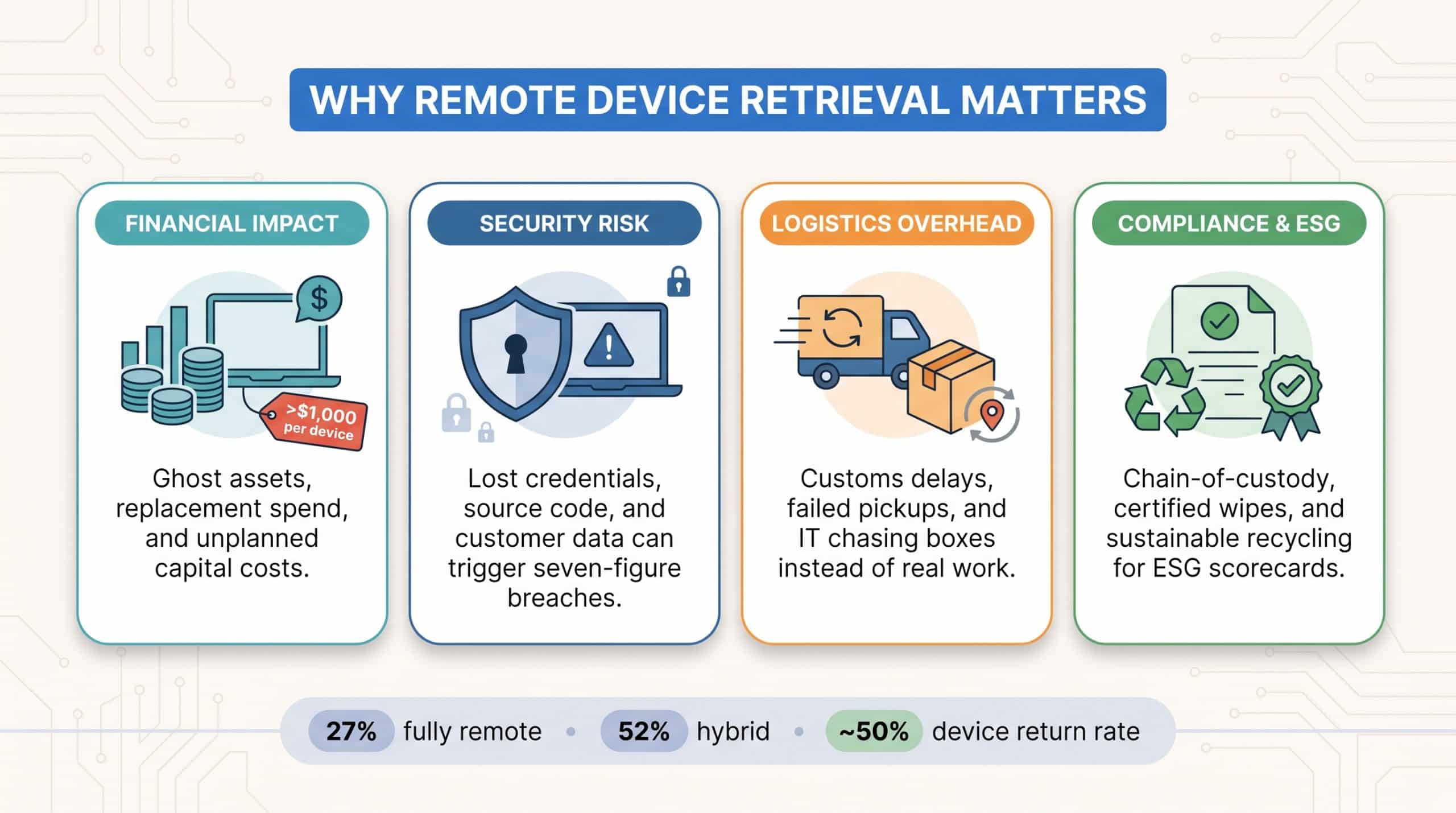
Remote work is no longer a pandemic footnote. Gallup’s latest Hybrid Work Indicator shows the United States settling into a durable mix: roughly 27 percent of remote-capable employees are now fully off-site, and another 52 percent split time between home and office.
That means three quarters of knowledge workers finish their last day far from an IT closet.
Every laptop that doesn’t make its way home dents budgets twice.
First, the hardware cost: an average corporate notebook still runs well over a grand.
Second, the risk: an unmanaged machine holds credentials, source code, and customer data that can trigger a seven-figure breach.
The scale of the problem is sobering. Gartner analysts put the industry’s “return rate” at barely 50 percent; half of off-boarded devices simply vanish.
Multiply that by routine turnover or a sudden layoff wave, and you’re staring at a stack of ghost assets and unplanned capital spend.
Logistics headaches add insult to injury.
Cross-border pickups get trapped in customs.
Courier tags pile up on empty doorsteps.
Internal teams burn hours playing shipping clerk, follow-up bot, and forensic accountant just to confirm where a box went.
Compliance raises the stakes.
Auditors now expect a clean chain of custody and documented wipes.
ESG scorecards ask what happened to the lithium and aluminum after you retired that MacBook.
Miss either requirement, and you invite fines—or at least uncomfortable board questions.
Bottom line: device retrieval is no longer a nice-to-have ops task; it’s a security, financial, and reputational imperative.
The next section lays out the hard criteria we used to separate marketing claims from real-world performance.
What to look for in a device retrieval service
Choosing a retrieval partner isn’t about who ships the prettiest cardboard box.
You need proof they bring gear home quickly, securely, and without draining the IT budget.
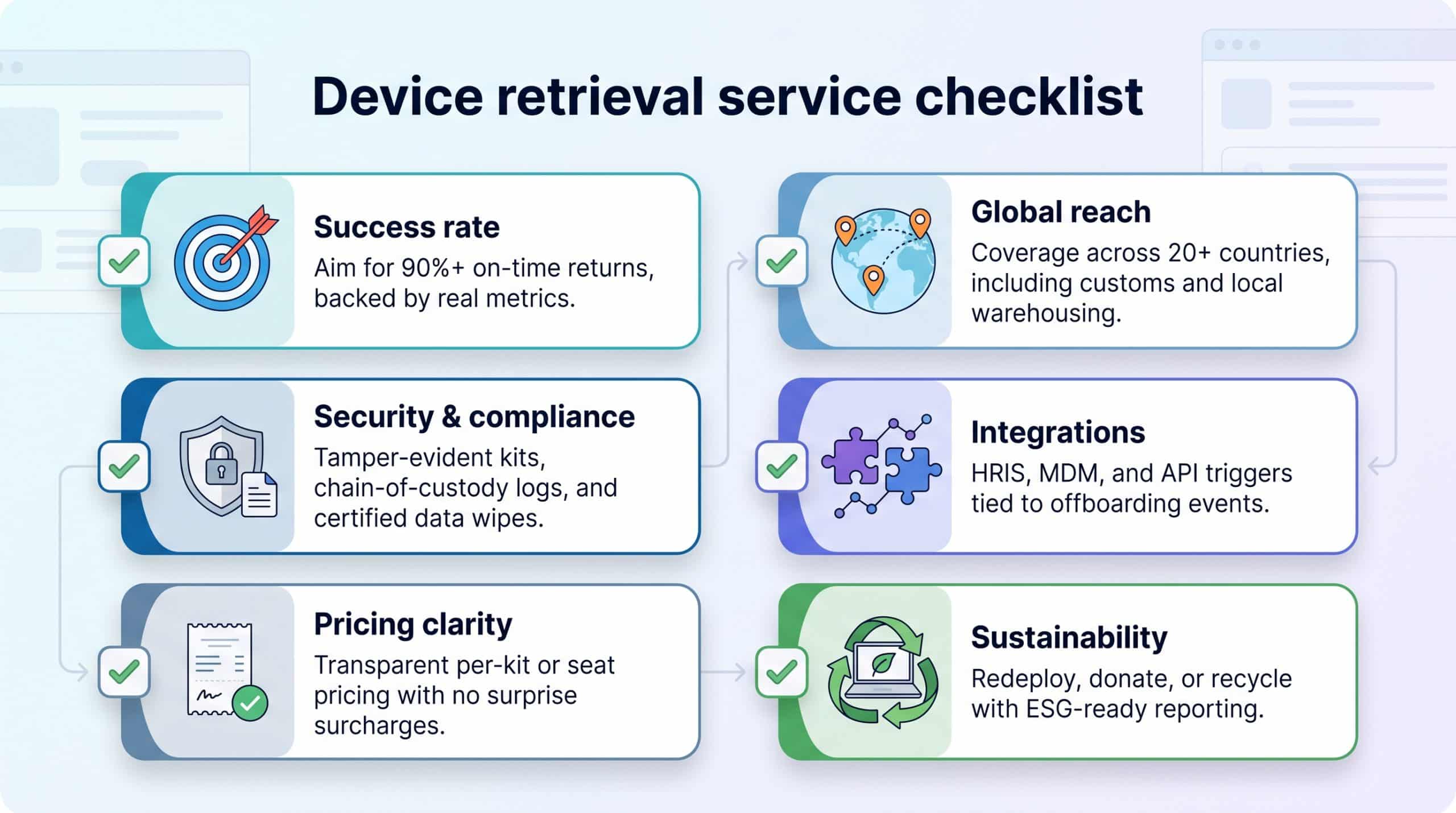
Start with the success rate. Anything below the low-90s means you still gamble with lost assets. Leading vendors publish hard numbers (Allwhere lists a 91 percent on-time record), so ask for evidence early.
Reach comes next. Remote teams sprawl across continents, so a service that stalls at the border is a non-starter. Look for a network covering at least two dozen countries, handling customs forms, and maintaining local warehouses for fast turnarounds.
Security is table stakes. Tamper-evident kits, chain-of-custody logs, and certified wipes protect your data and satisfy auditors. If a provider won’t share ISO or SOC reports, walk away.
Integration matters more than you think. When the HRIS flags an exit, the retrieval flow should trigger right away. APIs and off-the-shelf connectors spare IT from chasing spreadsheets.
Price transparency seals the deal. Clear per-device or seat-based fees beat surprise surcharges for “special handling.” Extra credit if the service offers eco-friendly recycling or refurbishment, as sustainability now ranks beside cost on board agendas.
Keep these filters in mind and the shortlist will build itself.
Next, we’ll stack the seven front-runners side by side so you can see who checks which boxes.
The seven leaders, side by side
Now that we know what matters, let’s see how the top contenders measure up.
The snapshot below distills dozens of data points into a single view.
Scan it, spot the outliers, then keep reading; detailed reviews follow in the next sections.
| Service | Return rate | Countries covered | Security / compliance* | Workflow integrations | Pricing model | Sustainability perks |
| Allwhere | 91 % on-time | 48 | Tamper-evident kits, NIST wipe option | Workday, open API | Pay-per-kit from ≈ $99 | Redeploy or certified recycle |
| GroWrk | “High 90s” (client case studies) | 150+ | SOC 2; local customs handling | HRIS & MDM connectors | Seat-based subscription | Refurbish / resale revenue share |
| Firstbase | 97 % (platform SLA) | 150+ | Chain-of-custody, SOC 2 | Deep HR stack | Flat monthly per employee | ITAD built-in |
| Workwize | 100 % claimed | 100+ | ISO 27001, wipe certificates | HRIS sync, API | SaaS license + per use | Local warehouses cut CO2 |
| Deel Equip | 96 % global recovery rate | 130+ | Carbon-neutral secure kits | Native in Deel HR | Add-on pricing | Tree planted per return |
| Retriever | ~90 % | US / EU core | Tracking + disposal add-on | Self-serve portal | Per-kit ≈ $120 | Optional recycle storage |
| Wisetek (ReturnTek) | 95 %+ (enterprise SLA) | NA / EMEA / APAC hubs | ISO 27001, R2, onsite pickup | Custom enterprise links | Contract volume-based | Detailed ESG reports |
*Security column lists the highest-value proof each vendor offers (certifications, chain-of-custody docs, or wipe standards).
A few headline insights jump off the page:
- Allwhere, Workwize, and GroWrk lead on global reach, making them safe bets for truly distributed teams.
- Workwize’s perfect-score marketing claim looks impressive, but remember it comes from the vendor’s own data. Treat it as a flag to investigate, not gospel.
- Wisetek is the compliance heavyweight. If auditors keep you up at night, its documentation can save hours in front of the board.
Use the table as a quick filter.
In the next section, we’ll dive into the strengths, quirks, and ideal use cases for each service, starting with the all-rounder that tops our ranking.
1. Allwhere: the all-in-one workhorse
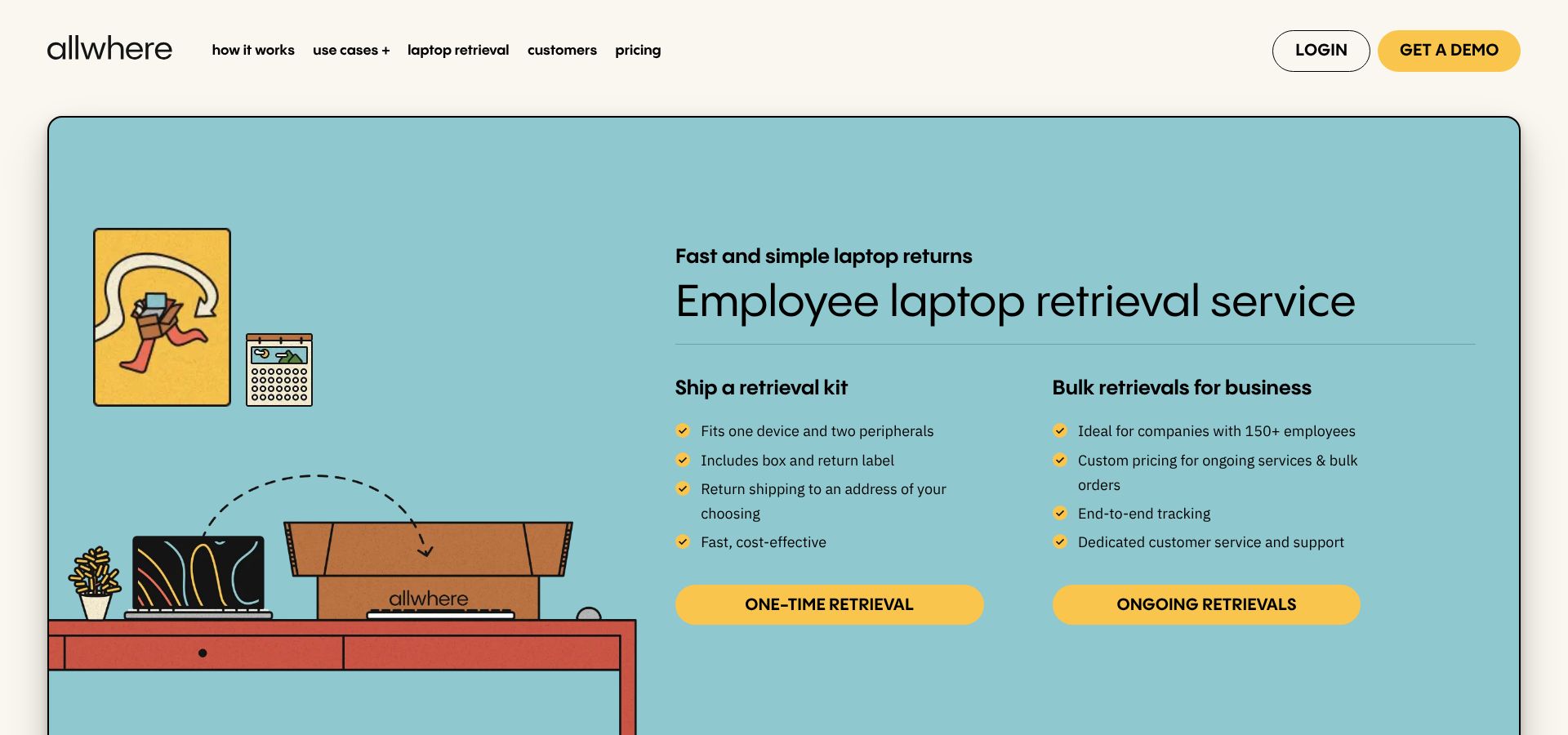
Allwhere employee laptop retrieval service and dashboard screenshot
Allwhere tops our list for one simple reason: it covers every stage of the return, not just the shipping label.
When you mark an employee as “leaving” in Workday, Allwhere’s API fires automatically.
Within 24 hours a padded kit lands on the doorstep, complete with tape, prepaid label, and step-by-step instructions.
Friendly nudges reach the user’s inbox and phone until tracking shows the box in transit.
That follow-through pays off.
Allwhere reports a 91 percent on-time retrieval rate, nearly doubling the industry’s do-it-yourself average, and its survey of IT pros—where 64 percent confessed to losing a device in transit—is published in the company’s comprehensive ITAM best practices guide.
Geography seldom trips the service up.
With operations across 48 countries, Allwhere handles customs paperwork and even stores returned devices locally, so you avoid long-haul freight back to HQ.
Need that MacBook redeployed to a new hire in Berlin? A few clicks send it from the nearest warehouse.
Security ticks every compliance box.
Kits are tamper-evident, chain-of-custody updates hit your dashboard in real time, and you can order a NIST-level data wipe plus a certificate of destruction once the machine arrives.
Pricing stays clear: pay per kit (starting around $99 domestically) with no platform subscription required.
That makes Allwhere attractive whether you offboard five people a quarter or fifty in a single layoff.
Sustainability isn’t an afterthought.
You can refurbish and redeploy devices, donate them, or route them into certified recycling, all tracked for ESG reporting.
Bottom line: if you want a retrieval partner that plugs into existing HR workflows, works across borders, and backs every step with verifiable results, Allwhere is a safe first call.
2. GroWrk: global reach on autopilot
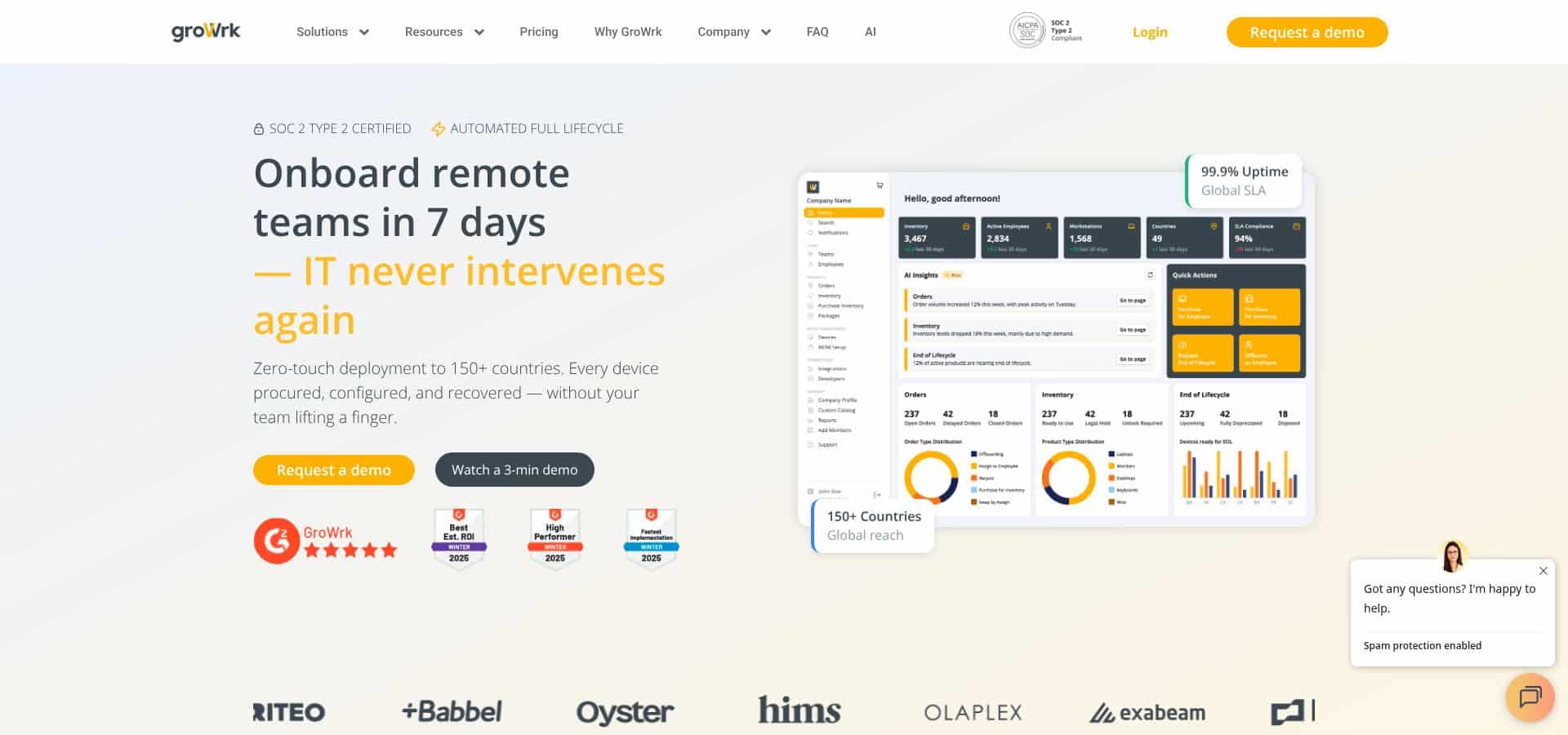
GroWrk global IT asset retrieval platform homepage screenshot
If your headcount spans three continents, GroWrk can feel almost unfair.
The platform pairs a 150-country logistics network with a tidy dashboard that automates every step of offboarding.
Flag an exit and the system pings local partners to dispatch a return kit from the nearest depot, often inside the same country, so packages clear customs quickly and arrive days, not weeks, later.
GroWrk lives up to the “autopilot” label.
Integrations with BambooHR, Okta, and popular MDM tools mean IT never has to copy addresses or chase tracking codes.
Status updates flow into Slack or email, and admins can see, in one glance, who still owes a laptop.
Clients praise the follow-through.
Case studies cite return rates in the mid-90s, which matches the platform’s persistent reminder cadence: gentle emails escalate to texts, then phone calls if a box still sits unopened.
Security checks the right boxes: SOC 2 reports, tamper-evident packaging, and optional data-wipe coordination with certified ITAD partners.
For bulk projects, such as merger-driven layoffs, GroWrk can even stage an on-site collection to scoop up dozens of devices in a single day.
Pricing is subscription-based, bundled into its broader device-lifecycle suite.
That means no surprise invoices, but it also means GroWrk works best if you plan to use the platform for deployment and break-fix as well.
Sustainability adds a final perk.
Returned gear can be refurbished locally and redeployed, reducing carbon miles while recapturing hardware value.
Choose GroWrk when geography is your biggest headache and you want the offboarding workflow to run itself.
3. Firstbase: flat-rate simplicity from hire to retire
Firstbase treats equipment like a subscription, not a sporadic chore.
Sign up, pay a predictable monthly fee per employee, and the platform handles everything: procurement, deployment, support, and, crucially, the return kit when someone leaves.
Because retrieval sits inside the contract, you never wonder whether the next pickup will cost extra or slip through the cracks.
Automation earns its keep.
An exit event in your HRIS triggers a return ticket instantly.
Firstbase prints the label, schedules the courier, and tracks the box so IT can focus on higher-value work.
The results speak loudly.
Customers report near-doubling of retrieval rates after switching, lifting performance from the industry average of 50 % to 97 %, thanks to those zero-touch workflows and persistent follow-ups.
Coverage spans more than 150 countries through partner depots, ensuring remote staff from São Paulo to Singapore see the same two-day kit arrival most U.S. employees enjoy.
If a device lingers, Firstbase keeps nudging until it lands safely in inventory.
Security fundamentals stay solid: tamper-evident packaging, SOC 2 compliance, and optional NIST 800-88 wipes.
Returned hardware moves into refurbishment, resale, or certified recycling, letting finance recoup value while sustainability teams log a win.
The trade-off is flexibility.
If you only need the occasional retrieval, a per-kit service will be cheaper.
But for companies that want a full device-as-a-service model, Firstbase removes both friction and financial guesswork.
4. Workwize: automation with a 100 % track record
Workwize treats hardware logistics like a software problem: automate everything, miss nothing.
The moment HR marks an exit, the platform spins up a retrieval workflow, with no manual tickets or address chasing.
A kit ships from the nearest regional warehouse (the company stocks Europe, North America, and APAC), so most employees receive packaging within forty-eight hours.
Workwize claims a 100 % return rate since launch.
Ambitious, yes, but fast kits and steady reminders leave little room for procrastination.
Local warehousing is the key advantage.
Because devices travel domestically on the return leg, you avoid cross-border delays and cut both shipping cost and carbon emissions.
Once received, Workwize wipes the machine, grades its condition, and either stores it for the next hire or resells it, sharing up to forty-five percent of residual value with you.
Integrations run deep.
Out-of-the-box connectors link Workwize to Workday, BambooHR, and ServiceNow, while an open API lets developers sync data into custom dashboards.
Security stays tight: ISO 27001 certification, tamper-evident packaging, and downloadable wipe certificates satisfy even demanding auditors.
Pricing is hybrid: a SaaS platform fee plus per-activity charges.
That means higher upfront commitment than pay-per-kit rivals, but at scale the savings on redeployment credits and avoided hardware purchases can outweigh the subscription.
If you want a hands-off system that turns offboarding into a simple workflow, while extracting every last dollar (and gram of CO₂) from returned gear, Workwize belongs on your shortlist.
5. Deel Equip: returns built into your HR stack
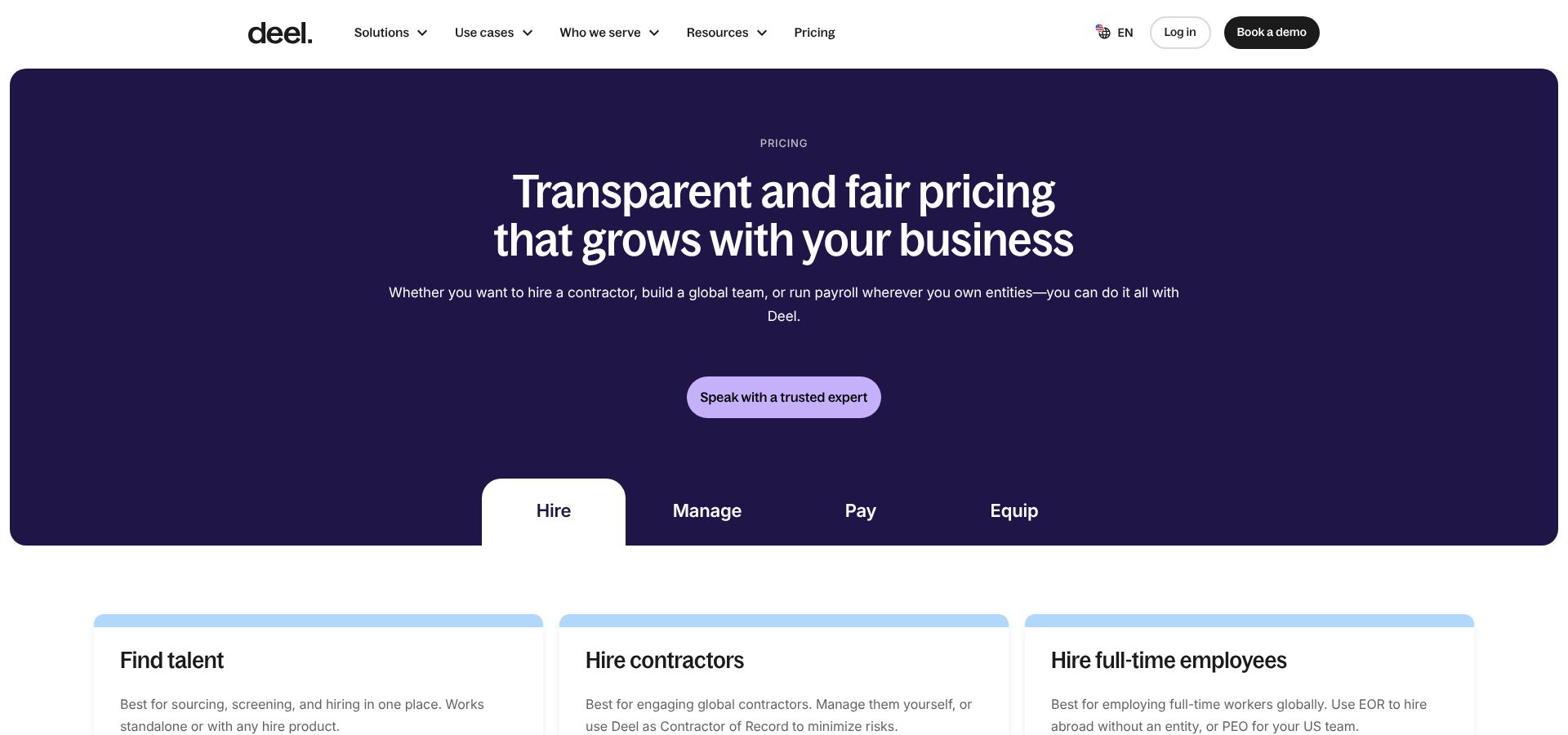
Deel IT and device lifecycle management pricing screenshot highlighting equipment recovery
If your payroll and compliance already run on Deel, adding the Equip module feels almost instant.
The flow is simple.
HR ends an employment contract in Deel, clicks “collect equipment,” and a carbon-neutral kit heads out the same day.
Because the request lives inside the same dashboard that manages offboarding documents and final pay, nothing slips through the cracks.
Equip keeps its sustainability promise.
Each shipment is offset, and the team plants a tree for every successful return, a plus for ESG reports.
Returned laptops travel the shortest path, usually a domestic courier to the nearest Deel warehouse, where technicians wipe drives and prepare the hardware for its next tour.
Coverage matches Deel’s payroll footprint, spanning more than 130 countries.
Customs paperwork is pre-filled, so devices cross borders without surprise duties or hold-ups.
Security meets finance and health-tech standards: sealed packaging, tracking at every hand-off, and wipe certificates available in the portal.
Need proof for auditors? Two clicks.
Pricing appears as an add-on to your existing Deel bill, keeping procurement simple.
If you’re not already a Deel customer, the platform can feel heavy.
For teams already deep in the Deel ecosystem, Equip makes equipment retrieval just another checkbox on the offboarding list: fast, green, and fully documented.
6. Retriever: pay-as-you-go ease for one-off returns
Sometimes you don’t need an end-to-end platform.
You just need a laptop back, quickly and with minimal paperwork.
That’s Retriever’s focus.
Ordering takes about two minutes.
Enter the ex-employee’s address, pick the device type, and a shock-absorbing box ships the same day.
Tape and a prepaid label are inside, so the user can’t blame missing supplies.
Persistence drives results.
Automated reminder emails escalate to texts, then live-agent calls if the box gathers dust.
That follow-up pushes return rates to roughly 90 percent, impressive for a service with zero subscription lock-in.
Coverage centers on the United States, Canada, and Europe, ideal for transatlantic teams but less suited to far-flung APAC sites.
International pickups outside core regions are possible, just slower and pricier.
Security basics stay solid: tamper-evident tape, real-time tracking, and an optional add-on for certified data destruction once the laptop arrives.
Need storage? Retriever can shelf the device until you decide whether to redeploy or recycle.
Costs stay predictable: about $120 per kit domestically, with volume discounts at ten devices or more.
No platform fees, no minimums—pay only when you need it.
Choose Retriever when offboardings are sporadic, budgets are tight, and simplicity outranks deep integrations.
7. Wisetek ReturnTek: enterprise chain of custody without compromises
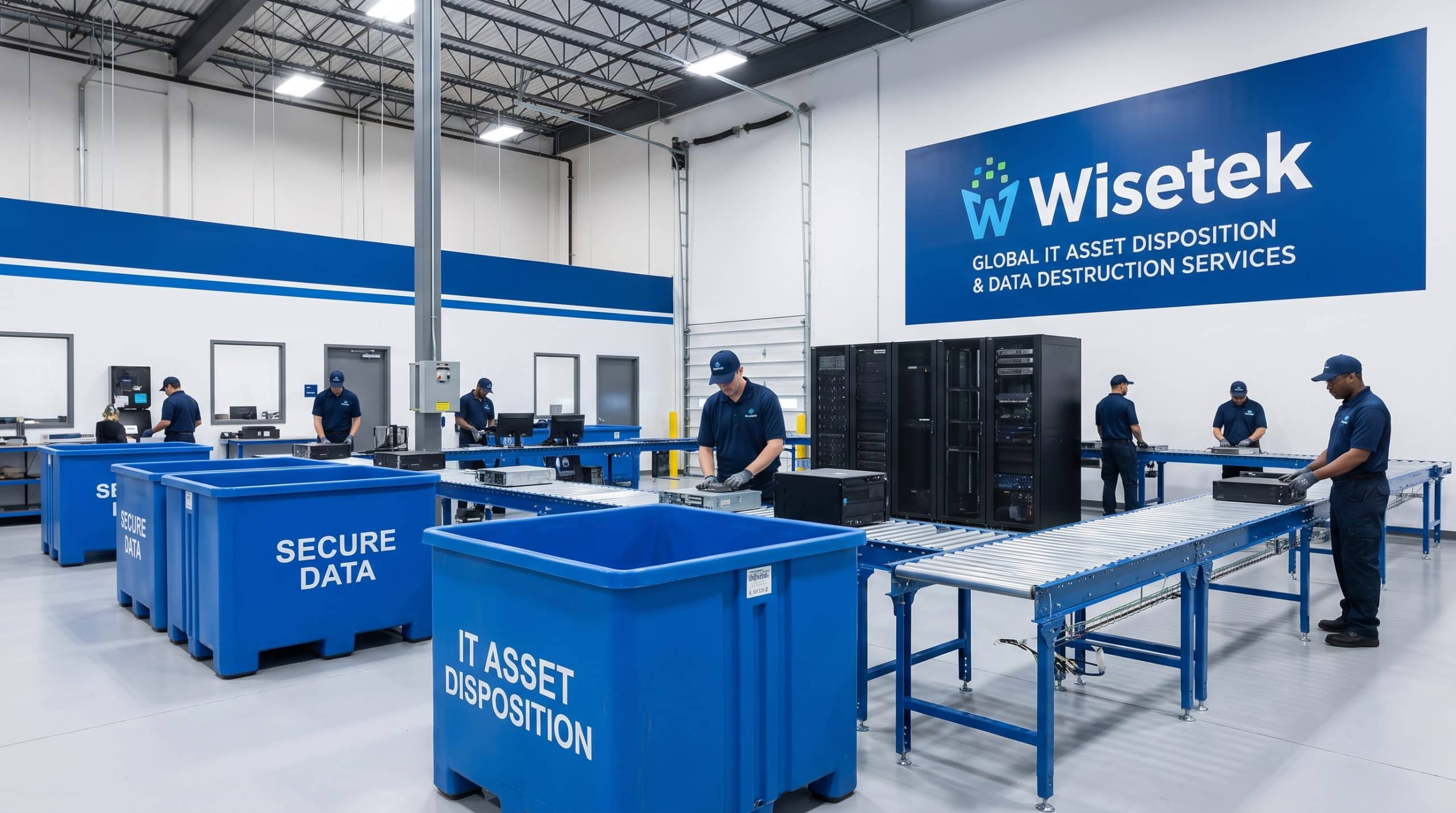
Wisetek IT asset disposition and ReturnTek enterprise chain-of-custody services screenshot
When auditors drive your timetable, you need a retrieval partner that speaks their language.
Wisetek’s ReturnTek service was built for that scenario.
Everything starts with documentation.
Before a single box leaves the warehouse, you receive a project plan outlining serial numbers, pickup windows, and disposal methods, ready for an ISO or SOC review.
On collection day, uniformed technicians arrive with lock-sealed flight cases and bar-code scanners.
Each laptop is photographed, tagged, and logged in a chain-of-custody record that updates in real time.
Large projects (shutting down a 300-seat office, for example) finish in hours, not weeks.
Coverage is global.
ReturnTek runs secure hubs in North America, EMEA, and APAC, and can stage temporary depots near client sites to avoid customs delays.
For high-security hardware, the team can even shred drives on-site so data never leaves the building.
Data protection remains strict.
Devices move through an R2-certified wipe and destruction workflow, and you receive tamper-proof certificates stamped with technician ID, timestamp, and wipe method.
Cost lands at the premium end, with contract pricing based on volume or project scope, yet enterprises often recoup spend through risk reduction and the ability to prove compliance at the click of a PDF.
Choose ReturnTek when board-level governance and zero-gap auditing outweigh every other factor.
It is excessive for casual, one-off returns but a lifesaver when a missed laptop could trigger a regulatory headline.
