
Top Companies Offering Ad-to-Landing Page Personalization Services in 2026
You’ve nailed your ad creative. The copy is sharp, the targeting is precise, and your click-through rate looks great on paper. But somewhere between the click and the conversion, you’re losing people and fast.
The culprit? A disconnect between what your ad promises and what your landing page delivers.
In 2026, the most competitive growth teams aren’t just optimizing ads in isolation. They’re closing the loop between the ad experience and the post-click experience through ad-to-landing page personalization matching landing page content dynamically to the specific ad a visitor just clicked.
This guide breaks down what this strategy actually looks like in practice, why it’s become a non-negotiable for PPC performance, and which companies are leading the space.
Why Ad-to-Landing Page Personalization Has Become the Standard
Every ad tells a story. When someone clicks it, they arrive at your landing page expecting that story to continue. If it doesn’t, if they see a generic headline instead of the offer they clicked on they bounce. That disconnect doesn’t just hurt conversion rates. It wastes your ad spend.
Post-click personalization is the practice of tailoring the landing page experience based on who clicked and what they clicked on. This means swapping headlines, CTAs, visuals, and even entire sections of a page depending on the ad source, keyword, audience segment, or campaign.
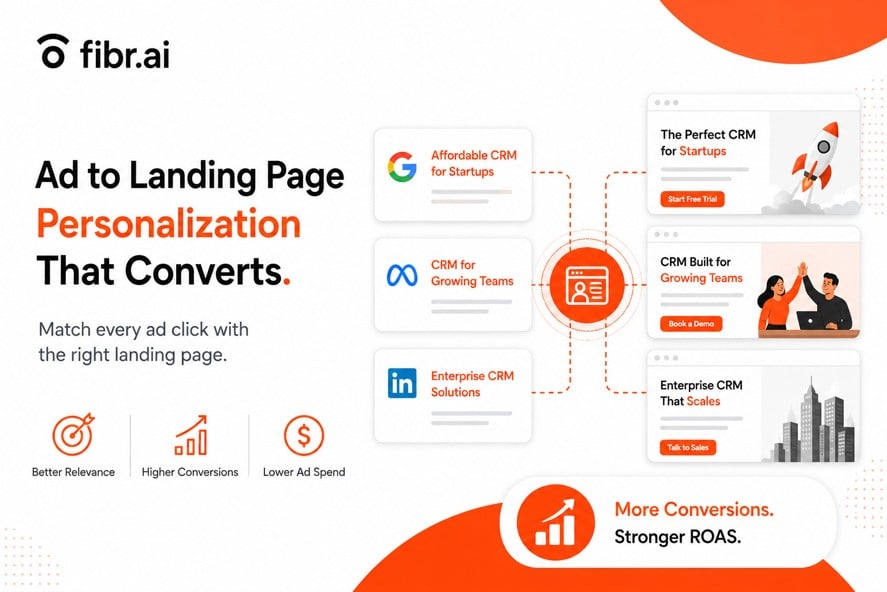
Done right, it creates continuity. A visitor who clicked a Google Search ad for “affordable CRM for startups” lands on a page that speaks directly to startup pain points — not a generic product overview built for enterprise buyers.
The numbers back this up. Personalized landing pages consistently outperform static ones in conversion rate optimization benchmarks. And with PPC costs continuing to rise, the pressure to squeeze more value from every click has never been higher.
What to Look for in an Ad-to-Landing Page Personalization Platform
Before exploring the companies in this space, it’s worth understanding what separates a capable tool from a transformative one.
-
Dynamic Content Swapping at Scale
True dynamic landing pages go beyond basic A/B testing. They pull in signals, UTM parameters, audience data, referral source, geolocation and use them to serve the right message to the right visitor automatically. The best platforms do this without requiring a developer for every variation.
-
AI-Powered Personalization
The shift toward AI landing page personalization has changed the game significantly. Rather than marketers manually building dozens of landing page variants, AI can now generate and test personalization rules at scale identifying what resonates with each audience segment and continuously optimizing based on performance data.
-
Audience-Level Segmentation
PPC landing page optimization isn’t just about keywords. It’s about understanding intent. Visitors from a branded search campaign are in a different mindset than those from a cold display ad. The best tools let you segment by campaign type, audience list, device, or even CRM data and personalize accordingly.
-
No-Code Flexibility
Speed matters in performance marketing. Platforms that require engineering resources for every page change slow teams down and kill momentum. The best solutions allow marketers to build, test, and launch personalized landing pages independently.
-
Fibr AI
Among the newer entrants making serious noise in this space, Fibr AI has emerged as a purpose-built platform for ad-to-landing page personalization at scale. What makes Fibr stand out is its focus on closing the message match gap, the specific disconnect between ad copy and landing page content that costs businesses conversion.
Fibr allows marketers to create hundreds of personalized landing page variants from a single base page, dynamically updating headlines, subheadings, CTAs, and imagery based on the ad a visitor clicked. Whether you’re running campaigns across Google Ads, Meta, or LinkedIn, Fibr ensures your landing page always speaks the language of the ad that brought the visitor there.
Its AI-driven approach means personalization scales without proportional effort. Instead of building 50 page variants by hand, teams can define the rules and let Fibr handle the execution automatically, serving the most relevant content to each visitor.
Fibr is particularly well-suited for performance marketing teams that are tired of leaving conversion gains on the table due to generic landing pages. If you want to understand how AI is reshaping post-click experiences, the Fibr blog is worth bookmarking.
-
Unbounce
Unbounce has long been a staple in the landing page optimization world. Their Smart Traffic feature uses AI to automatically route visitors to the landing page variant most likely to convert, based on visitor attributes. For teams already invested in the Unbounce ecosystem, it remains a solid option for dynamic landing pages and conversion rate optimization.
-
Instapage
Instapage positions itself as a post-click optimization platform, with features like AdMap, a visual tool that connects your ads directly to corresponding landing pages. It’s designed for larger teams managing high-volume PPC campaigns who need alignment between ad groups and landing experiences. Their personalization features allow for audience-level targeting with dynamic text replacement.
-
Optimizely
Optimizely brings enterprise-grade experimentation and personalization to the table. It’s built for organizations that want deep integration between their CMS, CRM, and experimentation layer. Their personalization engine allows teams to build rules based on behavioral data, audience segments, and campaign source making it a strong fit for sophisticated digital experience programs.
-
VWO (Visual Website Optimizer)
VWO offers robust A/B testing combined with behavioral targeting that extends to landing pages. Its personalization capabilities allow marketers to serve different content based on traffic source, campaign, or visitor behavior, a practical solution for teams that want personalization without a full platform overhaul.
Top Companies Offering Ad-to-Landing Page Personalization in 2026
The Real Opportunity: Connecting Ad Intent to Page Experience
The companies above each solve part of the problem. But the fundamental shift happening in 2026 is a deeper one: the best-performing growth teams are no longer treating ads and landing pages as separate disciplines.
Landing page personalization is now a full-funnel strategy. That means mapping every ad variation to a corresponding page experience, using AI to scale that mapping across campaigns, and continuously optimizing based on what’s actually driving conversions, not just clicks.
For teams running performance campaigns at scale, the gap between ad and landing page is one of the highest-leverage optimization opportunities available. And platforms like Fibr are making it more accessible than ever to close that gap without needing a full engineering team.
Conclusion
Ad-to-landing page personalization isn’t a nice-to-have in 2026; it’s a core pillar of conversion rate optimization for any team serious about PPC performance. The companies in this space are giving marketers the tools to deliver relevant, consistent experiences from first click to final conversion.
If you’re evaluating solutions for your team, start by auditing the message match between your current ads and landing pages. The gap you find there is your opportunity.
To explore how AI-powered personalization is changing the way performance marketers work, visit Fibr’s website or dive into their blog for practical insights on scaling post-click experiences.
