
The Most Useful Beta Review May Be the Refund
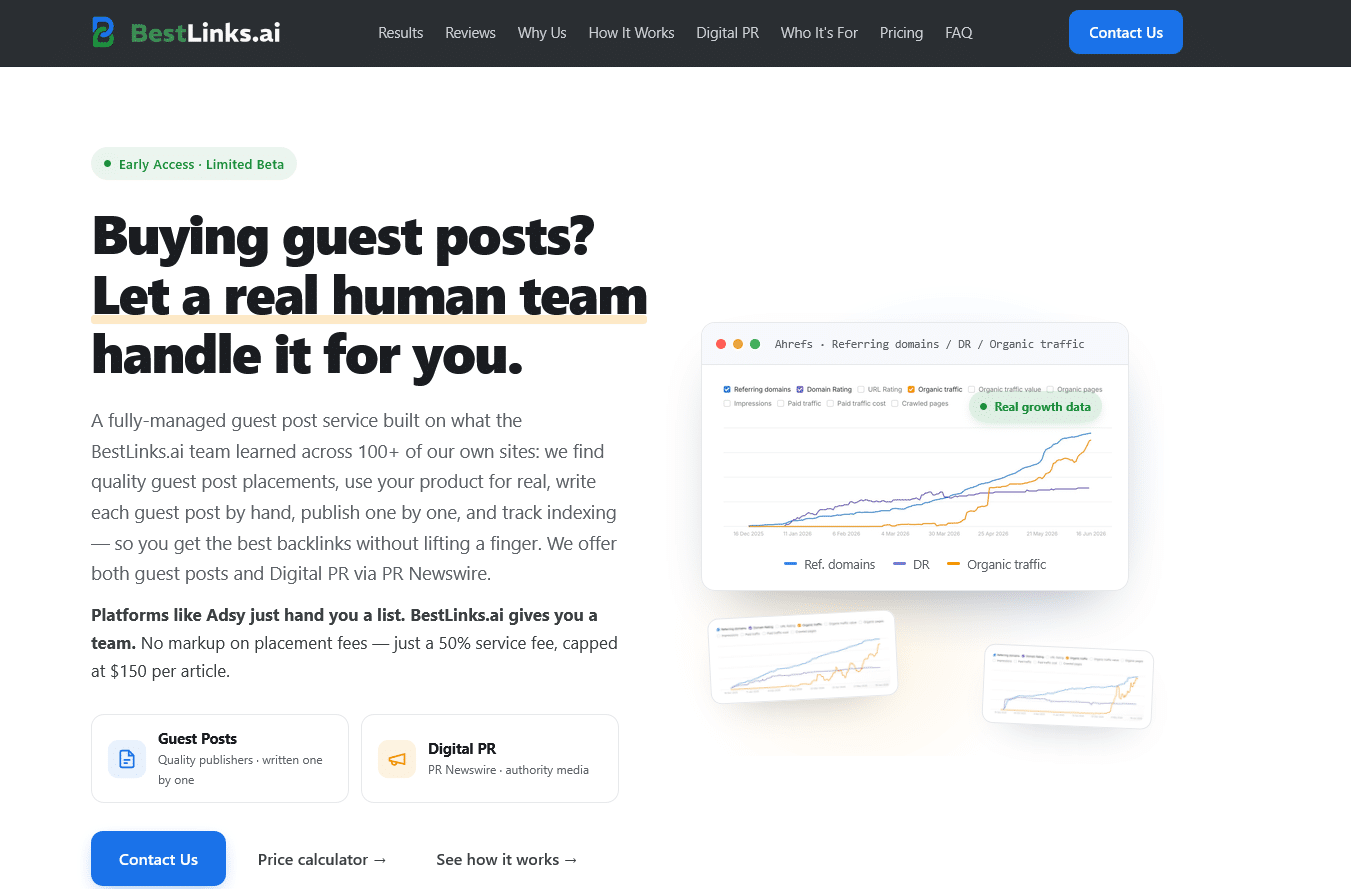
Early customer pages usually remove the awkward cases. That makes them pleasant to read and weak for buying decisions. The beta record for BestLinks AI does something more useful: it accounts for all thirteen purchasers, including the customer who was refunded because the required articles were not in English.
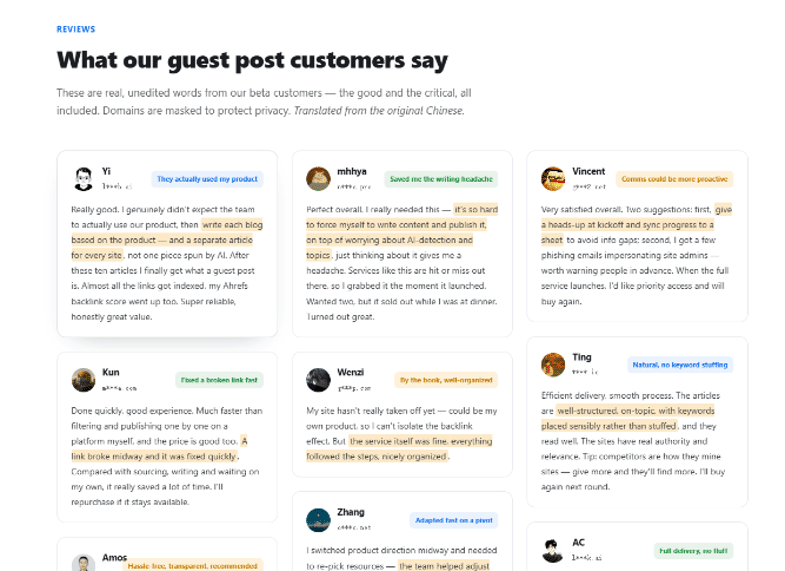
The numbers are plain. Thirteen customers bought during the early beta. Two saved the service for later. One received a refund after needing non-English articles. The remaining ten used the service, and their reviews are presented as unedited words translated from Chinese, with domains masked for privacy. This small record cannot prove universal results. It can show how the service reports fit, use, and mismatch.
A Complete Denominator Changes How Reviews Read
Ten positive or critical reviews mean more when the reader knows how they relate to the full buyer group. Without the denominator, ten reviews could come from ten users, fifty users, or a carefully selected portion of a much larger cohort. Here, the buyer can see which people used the service and which did not.
The two customers saving it for later are not failures or successes. They bought access but had not yet produced evidence about delivery. Keeping them in the count prevents a common mistake: treating payment as proof of use. It also shows that early access can be purchased before a campaign is ready to move.
Placed beside the full denominator, those two deferred purchases also expose timing as part of fit. A site may believe in backlinks and still lack approved pages, a stable product message, or staff to review candidates. Buying before those inputs exist can leave money idle and send the campaign through rework when the brief changes.
The refunded customer is different. That case identifies a hard fit boundary. The service currently writes English articles only, and the customer needed another language. Returning the money is more informative than forcing delivery and later presenting an apologetic review about unusable work.
The Refund Reveals A Production Boundary
Language support affects more than translation. A guest article must fit a publisher’s editorial voice, explain the product accurately, and place a link inside natural prose. Producing that work in another language requires editorial competence in that language and access to suitable publishers. A literal translation after the fact would not preserve those conditions.
That is why the refund belongs in service evaluation. It shows that BestLinks AI recognized a mismatch before converting it into weak output. The discarded sale protects both sides: the buyer does not pay for articles it cannot use, and the service does not pretend that English production automatically extends to every market.
The case should not be stretched into a broad claim about customer care. One refund does not prove how every disagreement will be handled. It gives a concrete example of one published boundary being enforced when it mattered.
A buyer can use the case as an intake check. Put the required publishing languages, markets, and target pages into the first message. If the service cannot support one of them, discovering that before site research protects both teams from discarded work.
Ten Reviews Can Show Process Evidence
A small review set is most valuable when readers look for operational detail rather than adjectives. “Great service” says little. A comment that mentions understanding what a guest post is after ten articles points to a clearer result: the customer saw enough of the process to recognize how tailored placements differ from generic link buying.
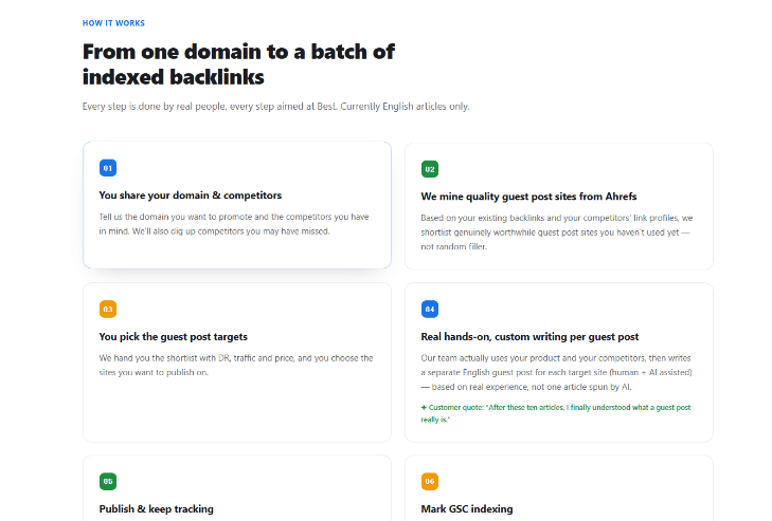
Other useful signals would include whether the shortlist was understandable, whether articles were written separately, whether publication status stayed visible, and whether problems were followed through. Those details connect to observable stages. They are harder to fake with a single impressive outcome claim.
BestLinks AI says the reviews include both good and critical language without editing. That choice can help a buyer inspect friction, but it does not replace direct questions. Translation may also smooth or alter tone even when meaning is preserved. The safest reading is to treat each review as one account of the process, not as a measured performance result.
Review order matters too. Do not read praise first and search for proof later. Start with a stage of service and ask whether any reviewer describes it. For writing, look for signs that articles differed by publisher. For delivery, look for publication and follow-up detail. Missing evidence should stay missing rather than being filled by enthusiasm.
Review Language Needs Four Separate Filters
A buyer can read the BestLinks AI beta record through four filters:
- Fit: Did the customer need English guest articles and have a site ready to promote?
- Use: Did the customer actually proceed, or merely reserve the service?
- Process: Does the review describe selection, writing, publication, or follow-up?
- Outcome: Is the claim directly observable, or does it imply an SEO result affected by many other factors?
Separate Specific Evidence From A General Mood
This prevents ten comments from collapsing into one average mood. A review may be strong on process and silent on search performance. Another may praise communication without revealing publication quality. Both can be useful if they are not asked to prove more than they contain.
It also exposes unreadable praise. If a review has no task, no stage, and no consequence, the buyer cannot connect it to the service being purchased. That comment may still be sincere, but it should carry less weight than a specific account of what happened.
Trace Criticism To Its Operational Owner
The same discipline applies to criticism. A complaint about waiting may reveal poor communication, or it may reflect a publisher delay outside direct control. The buyer needs the stage, who owned the next action, and how the issue ended. Without those details, the review identifies friction but not its cause.
Early Beta Numbers Cannot Prove SEO Results
Thirteen purchasers are too few to support broad claims about ranking lifts, traffic growth, or the expected return of every campaign. The ten users may differ in site age, content quality, keyword competition, and budget. Two deferred buyers further reduce the amount of delivery evidence in the cohort.
The service itself separates its Ahrefs examples from a guarantee and notes that SEO depends on many factors. The beta reviews should be read with the same restraint. They can describe how the team worked. They cannot isolate the effect of a backlink from content, technical health, brand demand, or changes elsewhere in search.
A buyer who needs stronger proof should ask for evidence suited to the decision: sample shortlist fields, article quality, publication records, maintenance handling, and clear pricing. Those checks reduce operational uncertainty even when a reliable traffic forecast remains impossible.
This approach has a cost, but it is small compared with buying from an average star rating. A review pass can take one focused hour and prevent a later batch from being sent back because the service language, article language, or approval workflow never matched the buyer’s needs.
The Buyer Should Ask About Mismatch First
The most revealing sales question is often not “What result did your happiest customer get?” It is “Who did you refund, decline, or advise to wait?” That question tests whether the provider has a real boundary around fit.
Verify Language And Business Readiness Before Payment
For this service, one boundary is English-only writing. Another appears in its guidance that sites already earning money are better candidates, while very early sites with tight budgets may be better served by manual, free backlink work. These limits narrow the market, but they also reduce the chance of selling a costly process to a buyer who cannot use it well.
A buyer should still verify current needs before paying: language, target domain, competitors, content readiness, and the ability to review candidate sites. If any of those inputs is missing, early access can turn into another purchase saved for later.
Turn Vague Readiness Into A Real Brief
That intake should be factual rather than optimistic. “We may enter Europe” is not the same as needing English placements now. “We have competitors” is not the same as naming businesses with comparable buyers. When placed in a real brief, vague readiness becomes visible before it creates a queue.
A Refund Can Be Better Evidence Than Praise
This is a small public beta record, not a statistically complete performance study. BestLinks AI makes it useful through the accounting: thirteen bought, two deferred use, one mismatch was refunded, and ten proceeded to reviews.
The refund deserves attention because it proves less and reveals more. It does not promise rankings or universal satisfaction. It shows one moment when the service recognized that its production model could not meet the requested language and did not force the work through.
For a careful buyer, that kind of boundary is part of quality. A provider that can explain whom it cannot serve is easier to evaluate than one whose review page contains only people who were apparently perfect fits from the beginning.
The missing fit is often more actionable than another broad promise of satisfaction.
It tells the buyer what to verify before research, writing, and publisher coordination begin.
