

Kilowatt Conversion Calculator
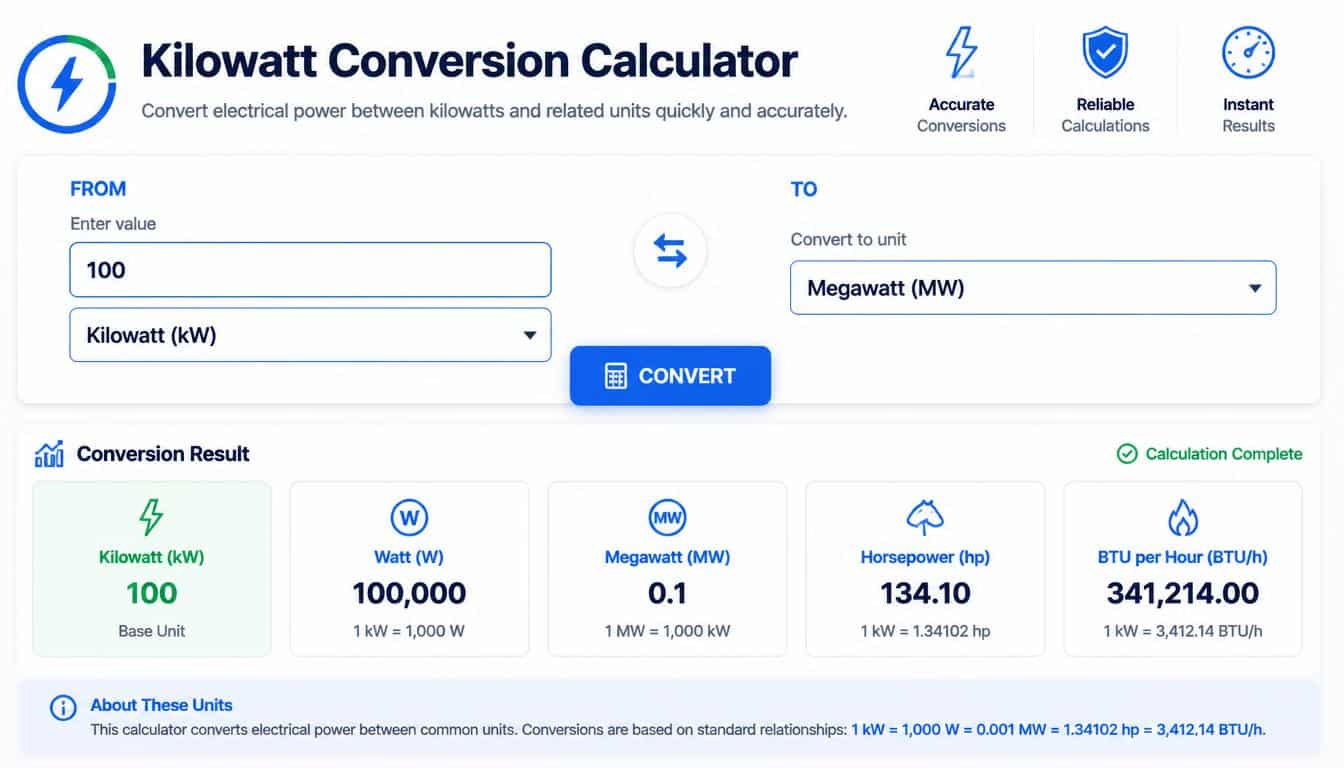
A number written as 5 kW can look perfectly ordinary until you need to know what it means in watts, horsepower, BTU per hour, or megawatts. Suddenly, a simple little number has several different faces.
That’s where a kilowatt conversion calculator becomes useful, because power measurements have a habit of becoming confusing just when you need an answer quickly.
Whether you’re checking an appliance rating, comparing electrical equipment, working through an engineering calculation, or simply trying to understand your electricity usage,
kilowatt conversion turns one power measurement into another equivalent value. No mysterious arithmetic is required, thankfully.
A kilowatt is a unit of power, and its basic relationship is wonderfully straightforward: 1 kW = 1,000 W.
Since one watt is one joule per second, one kilowatt is also 1,000 joules per second. From there, you can convert kilowatts into a range of other power units using established conversion factors.
What Is a Kilowatt?
A kilowatt, abbreviated as kW, is a metric or SI-related unit used to express power. Power describes the rate at which energy is transferred, produced, or consumed.
In electrical applications, kilowatts are especially common because household and industrial equipment can require considerably more than a single watt.
The word itself gives away part of the story. The kilo prefix means 1,000, so one kilowatt contains one thousand watts. In other words, 1 kilowatt equals 1,000 watts, or 1 kW = 1,000 W. It really is one of those rare formulas that doesn’t try to make your afternoon difficult.
Power can also be expressed in terms of energy rate. Because a watt is equal to a joule per second, 1 kW = 1,000 J/s.
This distinction matters when you’re thinking about electrical power versus energy consumption. Power tells you how quickly energy is being used, while energy tells you how much has been used over a period.
For example, a heater rated at 2 kW has a power rating of 2,000 watts. That does not automatically mean it consumes 2,000 watt-hours every hour under every operating condition, though.
Actual energy consumption depends on how long the equipment operates and whether its power demand changes.
How a Kilowatt Conversion Calculator Works
A kilowatt conversion calculator takes an input value in kilowatts and applies the appropriate conversion factor for the unit you’ve selected. The basic idea is almost comically simple:
Converted value = kilowatts × conversion factor
Suppose you want to convert 7 kW into watts. The conversion factor is 1,000 watts per kilowatt:
7 kW × 1,000 = 7,000 W
So, 7 kilowatts is equivalent to 7,000 watts.
For another example, converting 4 kW to megawatts uses the factor 0.001:
4 kW × 0.001 = 0.004 MW
A good power conversion calculator simply performs these calculations for you, reducing the chance of misplaced zeros. And yes, misplaced zeros are remarkably talented at ruining an otherwise sensible calculation.
The same principle works for horsepower, BTU per hour, microwatts, milliwatts, and other recognized units. You enter the input value, choose the desired unit, and the calculator returns the equivalent measurement.
Kilowatt Conversion Calculator: kW to Watts
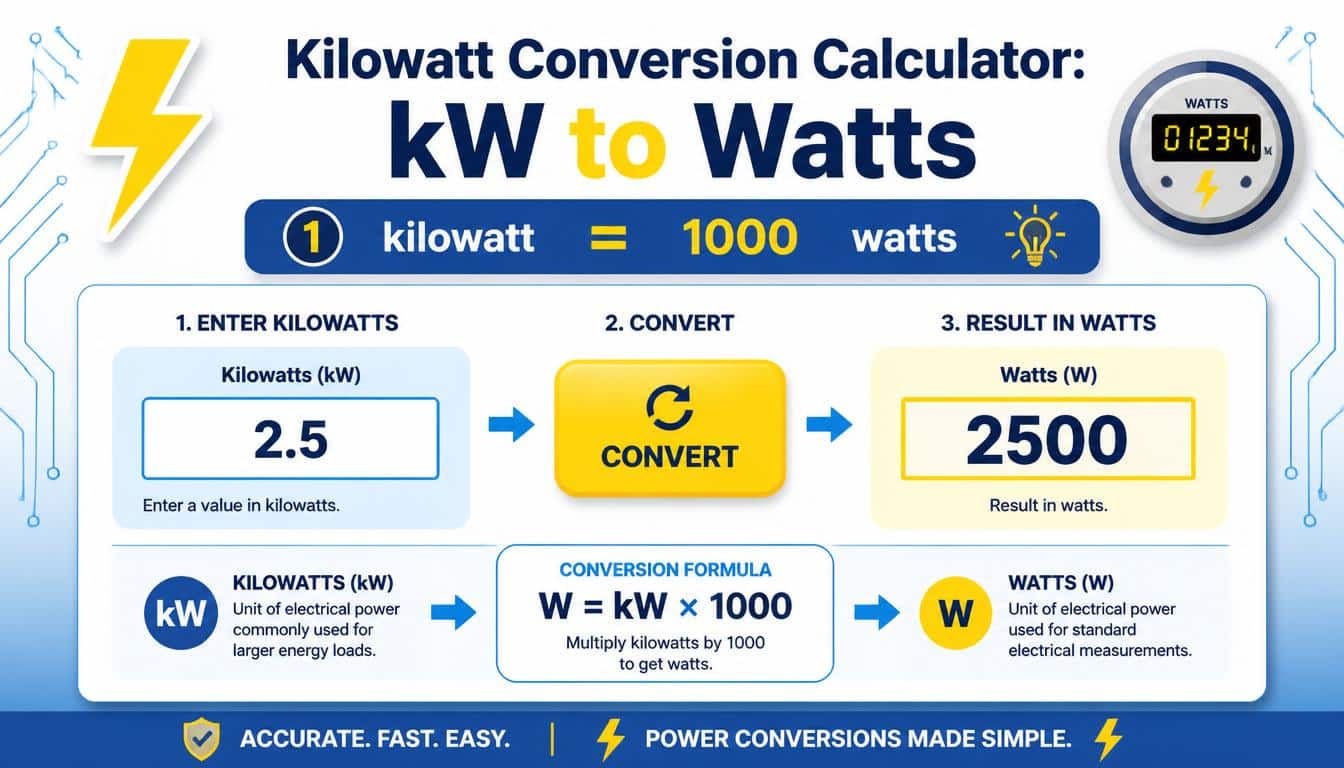
The most common kilowatt conversion is probably kilowatt to watt conversion. This is because watts are the smaller unit and are frequently used for individual electronic components, lighting products, small appliances, and technical specifications.
The relationship is:
1 kW = 1,000 W
To convert kW to W, multiply the kilowatt value by 1,000.
Examples:
- 5 kW = 500 W
- 1 kW = 1,000 W
- 5 kW = 1,500 W
- 2 kW = 2,000 W
- 5 kW = 5,000 W
- 10 kW = 10,000 W
- 25 kW = 25,000 W
This is a straightforward unit conversion, but it becomes especially useful when comparing equipment whose specifications are written in different units.
A device rated at 1.2 kW, for instance, has a power rating of 1,200 watts. Seeing both numbers can make product specifications much easier to compare.
Kilowatt Conversion Calculator: kW to Horsepower
Another common request is kilowatt to horsepower conversion, particularly when discussing motors, engines, pumps, compressors, and mechanical equipment.
For mechanical horsepower, a commonly used approximation is:
1 kW ≈ 1.341022 hp
Therefore:
kW × 1.341022 = horsepower
For example:
- 1 kW ≈ 1.341 hp
- 5 kW ≈ 6.705 hp
- 10 kW ≈ 13.410 hp
- 20 kW ≈ 26.820 hp
- 50 kW ≈ 67.051 hp
The word “horsepower” can be slightly slippery because different definitions of horsepower exist, including mechanical horsepower and metric horsepower.
A kilowatt converter should therefore identify which horsepower convention it uses if precision matters.
For casual comparisons, the 1.341022 figure is generally convenient. For formal engineering work, use the definition required by the relevant standard or specification instead of assuming every form of horsepower is identical.
Kilowatt Conversion Calculator: kW to Megawatts
When power values become large, writing thousands or millions of watts becomes rather clumsy. This is where the megawatt becomes useful.
The relationship is:
1 kW = 0.001 MW
And therefore:
1 MW = 1,000 kW
To convert kilowatts to megawatts, divide by 1,000, or multiply by 0.001.
Examples:
- 100 kW = 0.1 MW
- 500 kW = 0.5 MW
- 1,000 kW = 1 MW
- 2,500 kW = 2.5 MW
- 10,000 kW = 10 MW
Large generators, power stations, industrial facilities, and utility-scale electrical systems are commonly discussed using megawatts. A power measurement of 25 MW, for instance, represents 25,000 kW.
Kilowatts to Milliwatts and Microwatts
Going in the opposite direction can produce some impressively large numbers. A milliwatt, abbreviated mW, is one-thousandth of a watt, while a microwatt, abbreviated µW, is one-millionth of a watt.
Because:
1 kW = 1,000 W
and:
1 W = 1,000 mW
we get:
1 kW = 1,000,000 mW
Similarly:
1 W = 1,000,000 µW
so:
1 kW = 1,000,000,000 µW
That means:
- 1 kW = 1,000,000 mW
- 1 kW = 1,000,000,000 µW
- 001 kW = 1,000 mW
- 000001 kW = 1,000 µW
These conversions can be useful in electronics, instrumentation, communications, sensors, and other technical fields where very small levels of power output are measured.
Kilowatts to BTU per Hour
Thermal systems often use BTU per hour, written as Btu/h, rather than watts or kilowatts. This can make international specifications feel like they’re speaking two completely different languages, but a conversion connects them.
A commonly used conversion is:
1 kW ≈ 3,412 Btu/h
So:
- 1 kW ≈ 3,412 Btu/h
- 2 kW ≈ 6,824 Btu/h
- 5 kW ≈ 17,060 Btu/h
- 10 kW ≈ 34,120 Btu/h
This conversion appears frequently in heating, cooling, HVAC, and thermal equipment specifications.
It is important to remember that BTU per hour is a rate of energy transfer, just as watts and kilowatts describe a rate. It should not be confused with a total amount of energy. The little “per hour” part is doing important work there, even if it looks harmless.
Kilowatts to Kilocalories per Hour
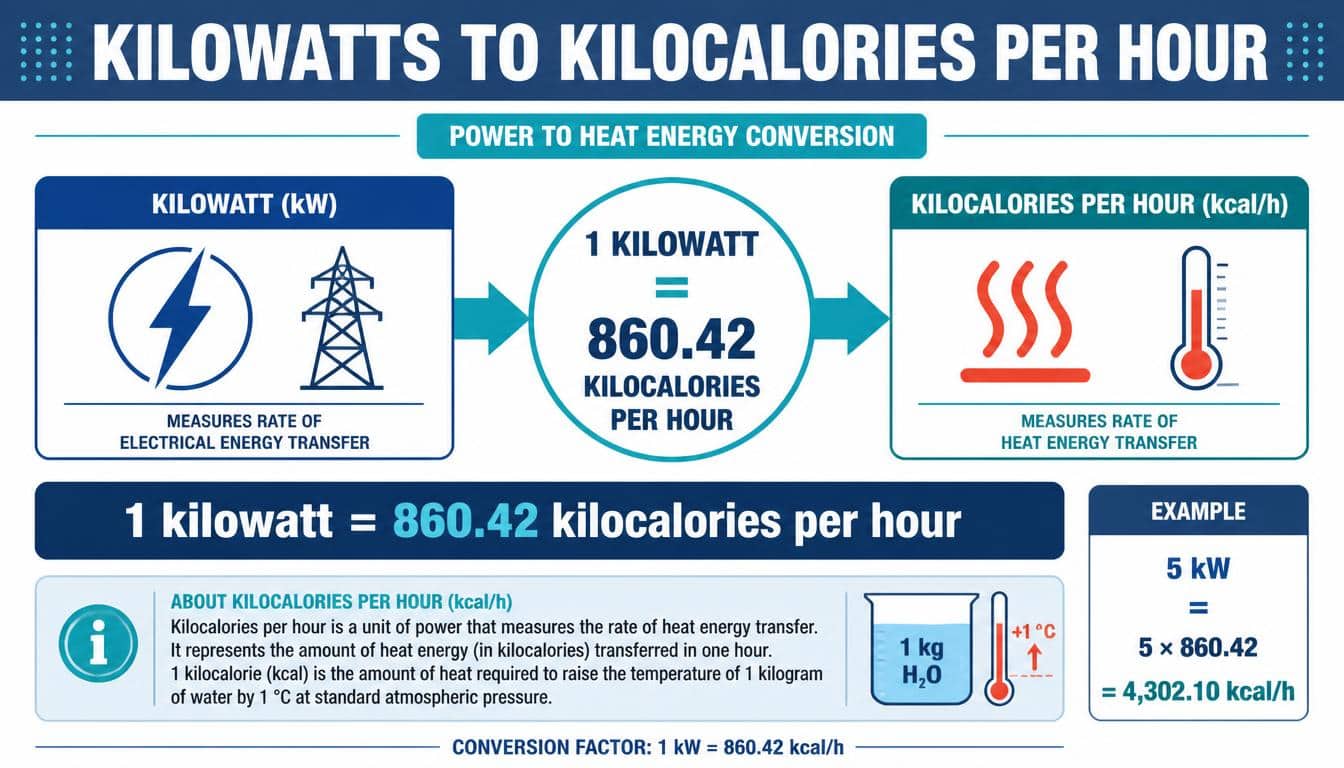
Another thermal conversion uses kilocalories per hour, abbreviated kcal/h. A commonly used approximate relationship is:
1 kW ≈ 860.420815 kcal/h
Using that factor:
- 1 kW ≈ 860.42 kcal/h
- 2 kW ≈ 1,720.84 kcal/h
- 5 kW ≈ 4,302.10 kcal/h
- 10 kW ≈ 8,604.21 kcal/h
The exact value used by a calculator may vary slightly depending on the definition and rounding convention. For everyday calculations, the approximate factor is generally enough; for scientific or engineering work, the selected standard should be stated.
Kilowatts, Amperes, and Electrical Calculations
People sometimes search for kilowatts to amperes conversion, but this isn’t a simple fixed conversion like kW to watts. The relationship between power and current depends on other electrical quantities, especially voltage and, for AC systems, power factor and phase configuration.
For a simple DC circuit, the relationship is:
Power (W) = Voltage (V) × Current (A)
Therefore:
Current (A) = Power (W) ÷ Voltage (V)
For example, a 2 kW load operating at 200 volts would draw:
2,000 W ÷ 200 V = 10 A
But an AC installation may require additional information. A calculator that converts kilowatts to amperes should therefore ask for the appropriate voltage and electrical configuration rather than pretending there is one universal conversion factor.
The same caution applies to kilowatts to kilovolt-amperes and kilowatts to volt-amperes. In AC systems, real power, apparent power, and power factor are related but are not interchangeable measurements.
Kilowatts vs. Kilowatt-Hours
One of the most common sources of confusion is the difference between kilowatt and kilowatt-hour.
A kilowatt measures power. A kilowatt-hour measures energy.
Think of power as the rate and energy as the accumulated amount. A 3 kW appliance operating continuously for 2 hours would use:
3 kW × 2 h = 6 kWh
The appliance’s power rating is 3 kW, while its energy consumption for those two hours is 6 kWh.
This distinction is particularly important when reading electricity bills. Utility charges commonly involve kilowatt-hours, not simply the kilowatt rating printed on an appliance. A higher-power device may consume more energy in a short period, while a lower-power device running for much longer can also accumulate significant consumption.
Quick Kilowatt Conversion Table
A conversion table is handy when you need common values without reaching for a calculator every single time.
| Kilowatts | Watts | Megawatts | Horsepower | Approx. Btu/h |
| 0.1 kW | 100 W | 0.0001 MW | 0.134 hp | 341 Btu/h |
| 0.5 kW | 500 W | 0.0005 MW | 0.671 hp | 1,706 Btu/h |
| 1 kW | 1,000 W | 0.001 MW | 1.341 hp | 3,412 Btu/h |
| 2 kW | 2,000 W | 0.002 MW | 2.682 hp | 6,824 Btu/h |
| 5 kW | 5,000 W | 0.005 MW | 6.705 hp | 17,060 Btu/h |
| 10 kW | 10,000 W | 0.01 MW | 13.410 hp | 34,120 Btu/h |
| 50 kW | 50,000 W | 0.05 MW | 67.051 hp | 170,600 Btu/h |
| 100 kW | 100,000 W | 0.1 MW | 134.102 hp | 341,200 Btu/h |
The values shown for horsepower and thermal units are approximate. A professional electrical calculator or engineering application may display more decimal places when greater precision is needed.
Common Kilowatt Conversion Factors
Keeping a few basic conversion factors nearby makes many calculations almost effortless.
- 1 kW = 1,000 W
- 1 kW = 1,000 J/s
- 1 kW = 0.001 MW
- 1 kW ≈ 1.341022 hp
- 1 kW ≈ 3,412 Btu/h
- 1 kW ≈ 860.420815 kcal/h
- 1 kW = 1,000,000 mW
- 1 kW = 1,000,000,000 µW
The SI system makes the metric conversions particularly tidy because they follow powers of ten. The less tidy-looking values, such as horsepower and BTU per hour, come from different measurement traditions.
SI Units and the Metric System
The kilowatt fits naturally into the SI units framework. The watt is the SI derived unit for power, named after engineer James Watt. A watt represents one joule per second.
The prefixes make larger and smaller quantities easier to express. Kilo represents 10³, while mega represents 10⁶, milli represents 10⁻³, and micro represents 10⁻⁶.
That gives us a neat progression:
µW → mW → W → kW → MW
Each step represents a change of three orders of magnitude. Once you see that pattern, SI power conversion becomes considerably less intimidating.
Organizations such as the National Institute of Standards and Technology (NIST) provide references and guidance concerning measurement units and their use. For precise technical work, consulting recognized standards is sensible, especially when a conversion involves definitions that can vary between industries or measurement systems.
How to Use a Power Conversion Calculator Correctly
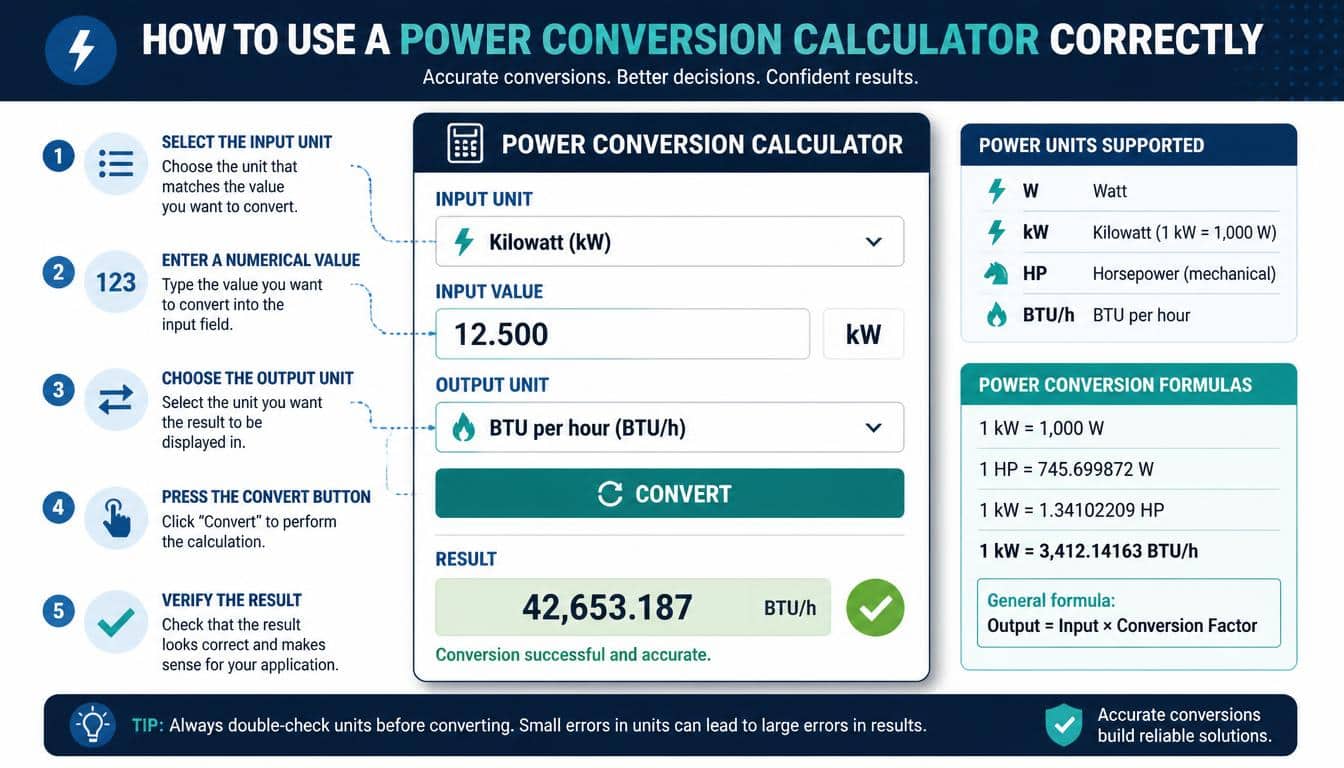
Using a power converter is easy, but getting a meaningful answer still depends on entering the right information.
Start by identifying the original measurement. If the specification says 7.5 kW, your input is 7.5 and your starting unit is kilowatts.
Next, select the unit you need. That might be watts, horsepower, megawatts, BTU/h, or another supported power unit.
Finally, check the result against the expected scale. If you convert 5 kW to watts and receive 5 W, something has gone sideways. The correct result is 5,000 W.
For technical work, also check whether the calculator is using mechanical horsepower, metric horsepower, a particular BTU definition, or another convention. Small definitional differences can matter when precision is important.
Read More: https://gracethemes.com/what-date-is-26-weeks-from-today/
Conclusion When Manual Conversion Is Better
A kilowatt calculator is convenient, but knowing the basic formulas is still worthwhile. It lets you check calculator results and understand what the number actually represents.
For example, remembering 1 kW = 1,000 W is enough to solve many everyday conversions instantly.
Likewise, knowing that 1 MW equals 1,000 kW gives you a quick mental route between smaller and larger electrical power measurements.
Manual conversion is especially useful in classrooms, workshops, engineering notes, equipment comparisons, and situations where internet access isn’t available. Your calculator might be clever, but it can’t help much if
