
How Small Teams Are Creating Visual Content Without Design Resources
For years, professional visual content was largely a function of organizational scale. Companies with dedicated creative teams, in-house designers, and substantial marketing budgets could consistently produce polished graphics, presentation decks, branded assets, and campaign visuals. Smaller organizations often faced a different reality. They might have strong ideas, deep expertise, and compelling products, yet still struggle to communicate those advantages visually because creating professional assets required resources they simply did not have.
That dynamic is beginning to change.
The shift is not merely technological. It reflects a broader transformation in how visual communication is created, distributed, and integrated into everyday work. Across small businesses, agencies, consulting firms, creator-led businesses, and independent publishers, visual content is becoming less dependent on specialized design capacity and more dependent on workflow. Organizations are increasingly discovering that the challenge is not generating ideas. The challenge is moving those ideas efficiently from concept to communication.
The demand for visual content continues to expand. Blog posts require featured imagery. Marketing campaigns require social graphics, presentation materials, landing-page assets, and promotional visuals. Internal communications increasingly rely on visual summaries rather than text-heavy documents. Even organizations with relatively modest digital footprints now operate in environments where visual communication influences credibility, engagement, and audience attention.
The result is a growing tension. Expectations around content quality continue to rise, while many teams remain resource constrained. For smaller organizations, every new communication initiative often competes with limited time, limited budgets, and limited creative capacity. The question is no longer whether visual content matters. The question is how teams can create it consistently without building an expensive creative operation around every project.
Why Visual Content Has Become a Business Requirement
Visual communication is no longer confined to branding and advertising.
Customers encounter visuals throughout their journey with an organization. Employees consume information through presentations, dashboards, training materials, and knowledge bases. Prospects evaluate companies through websites, social channels, and marketing campaigns. Stakeholders increasingly expect information to be communicated through formats that are easy to understand and easy to share.
As a result, visual content has become a business requirement rather than a marketing luxury.
A consultant presenting research findings, a blogger publishing industry analysis, a startup launching a product update, and an agency preparing client recommendations all face the same reality: information competes for attention. The ability to communicate visually often determines whether information is absorbed, ignored, or forgotten.
This is particularly challenging for smaller teams because visual communication traditionally required specialized expertise. Organizations either hired designers, outsourced work, or accepted slower production timelines. In many cases, visual creation became the bottleneck that delayed campaigns, presentations, content launches, and internal initiatives.
The bottleneck was rarely creativity.
More often, it was production capacity.
The Shift Toward AI-Assisted Visual Workflows
What is changing today is not simply the availability of AI tools. It is the emergence of integrated workflows that connect ideation, content development, visual creation, and presentation into a more seamless process.
Historically, visual production often sat at the end of a project. Content was created first. Design happened later. Presentation development came after that. Every stage involved a separate handoff.
Smaller teams often struggled because every handoff required time, coordination, and resources.
Today, those boundaries are becoming less rigid.
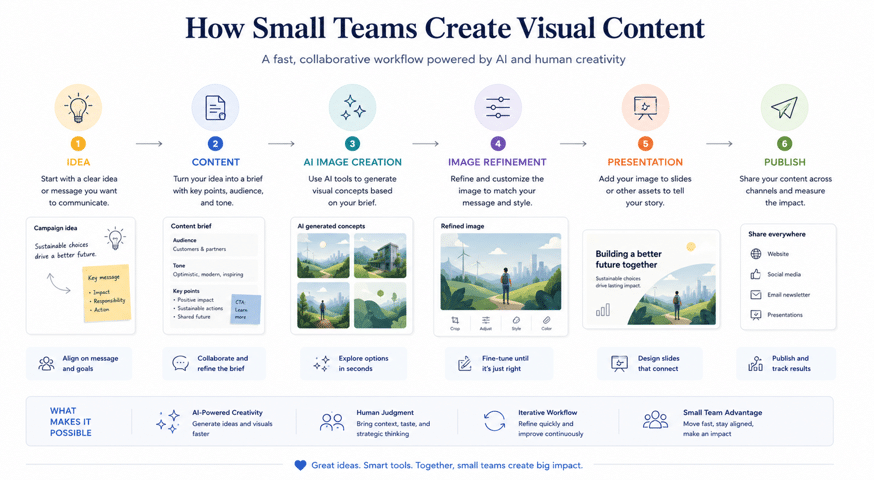
Many organizations are beginning with ideas, moving directly into content development, generating supporting visuals, refining those assets, and preparing presentation materials within a connected workflow. The result is not simply faster production. It is a reduction in the friction that previously existed between different stages of communication.
This shift is particularly valuable for organizations that operate without dedicated design departments because it allows communication workflows to move forward without waiting for specialized resources at every stage.
Marketing Teams Are Expanding Their Creative Capacity
Marketing teams provide one of the clearest examples of how visual workflows are evolving.
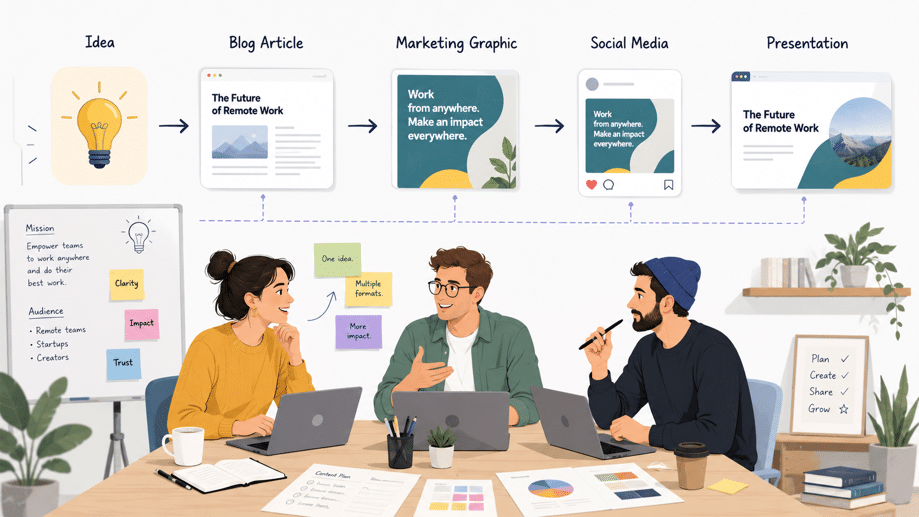
Modern campaigns rarely consist of a single asset. A blog post often leads to social content, promotional graphics, presentation materials, email visuals, and landing-page assets. The challenge is not simply creating content. It is maintaining a consistent visual presence across multiple channels while working within realistic resource constraints.
This is one reason many teams increasingly use an AI image generator to create campaign concepts, blog illustrations, social graphics, and supporting visuals that align with existing content strategies. The significance is not simply that images can be created more quickly. It is that visual creation becomes part of the same workflow as content development, allowing marketers to move more efficiently from concept to execution.
The impact is particularly noticeable in smaller organizations where one person may be responsible for content strategy, campaign management, publishing, and reporting. The ability to create supporting visual assets without waiting for external design resources allows teams to maintain momentum while preserving communication quality.
Bloggers and Content Creators Are Building Richer Experiences
Independent creators face many of the same challenges as small businesses.
Most bloggers, newsletter operators, educators, and content creators do not have access to dedicated design teams. Yet audience expectations continue to rise. Long-form content increasingly competes with visually rich media formats, making presentation an important part of the overall experience.
A modern article often benefits from:
- Featured imagery
- Supporting illustrations
- Social media assets
- Visual summaries
- Presentation-style breakdowns
Historically, creating these materials required significant effort or additional budget.
Today, creators increasingly have access to workflows that allow them to build visual assets alongside their written content. The result is a more cohesive publishing process where visuals are treated as part of communication rather than an afterthought added later.
Refinement Matters as Much as Creation
Creating an image is rarely the final step.
Visual assets frequently require refinement before they are ready for publication. Images may need cleanup, subject isolation, resizing, formatting, or adjustments that help them fit specific communication channels.
This is why many teams now incorporate image refinement into their workflow when preparing visuals for websites, presentations, social content, and marketing materials. Whether it involves isolating subjects, cleaning up distracting elements, or preparing graphics for different formats, the refinement stage has become just as important as image creation itself. Many organizations also use Quillbot and its Background Remover as part of this process to simplify image preparation before publication. The value is not simply in removing a background. It is in reducing the amount of manual work required to transform a draft visual into a finished communication asset.
The broader trend is worth noting.
Organizations are increasingly treating visual workflows as a sequence of connected stages rather than isolated tasks. Creation, refinement, adaptation, and distribution all contribute to the final outcome. Teams that streamline those stages often gain more value than teams that focus exclusively on generation.
Presentations Are Becoming the Final Communication Layer
One of the most interesting developments is the growing connection between content creation and presentation development.
Organizations use presentations to communicate research, train employees, share strategies, present results, and support decision-making. In many environments, presentations serve as the bridge between information and action.
Historically, presentation development often required rebuilding information that already existed elsewhere. Reports would become slides. Blog posts would become presentations. Research findings would need to be reformatted for different audiences.
Today, many teams are increasingly using an AI presentation maker to transform ideas, reports, campaign concepts, and written content into presentation-ready formats that support communication, training, and stakeholder engagement. The significance of this shift is not simply efficiency. It reflects a broader movement toward integrated communication workflows where information can move more naturally between formats.
For small teams, this can eliminate substantial amounts of repetitive work while making it easier to communicate ideas consistently across different audiences.
Why Smaller Teams Benefit the Most
Large organizations will continue to invest in creative departments and specialized design talent.
The more interesting story may be what happens to smaller organizations.
Historically, smaller teams often faced a difficult choice between quality and speed. Producing professional visual communication required either significant internal effort or external resources that many organizations could not justify.
AI-assisted workflows are helping reduce those constraints.
A startup can create marketing visuals without building a dedicated creative team. A consultant can transform research into professional presentations more efficiently. A blogger can support long-form content with custom imagery. A small business can improve its communication without dramatically increasing production costs.
The competitive advantage increasingly comes from workflow efficiency rather than organizational size.
Organizations that can move effectively from ideas to communication gain the ability to operate at a level that previously required substantially greater resources.
The Future of Visual Content Creation
The future of visual communication is unlikely to be defined by individual tools.
Instead, it will be shaped by workflows that connect ideas, content, visuals, and presentations into a cohesive system. The most successful organizations are not necessarily the ones creating the most content. They are the ones reducing the friction between expertise and communication.
For smaller teams, that shift has significant implications.
It means that strong ideas can travel further. Communication can become more visual. Content can be adapted more efficiently across formats. Teams can spend less time managing production constraints and more time focusing on the value they deliver.
In many ways, the most significant impact of AI on visual content creation may not be the images themselves.
It may be the ability to help smaller teams communicate with a level of clarity, consistency, and professionalism that was once available only to organizations with far greater creative resources.
Why Visual Communication Is Becoming More Important
If presentations remain one of the most important communication formats in business, visuals have become one of the most important elements within those presentations.
Business audiences process more information than ever before. Executives review dozens of reports every week. Sales teams present to prospects with increasingly limited attention spans. Internal communications compete with an endless stream of meetings, emails, dashboards, and notifications. In that environment, visuals do more than make presentations attractive—they help people understand information more quickly.
This explains why modern presentations have evolved well beyond bullet points and charts.
Consulting firms now rely heavily on conceptual diagrams that simplify strategic recommendations. Marketing teams communicate campaign performance through visual storytelling rather than spreadsheets. Product organizations increasingly illustrate customer journeys instead of describing them through text. Trainers and educators use visual examples to improve comprehension and retention.
The role of visuals is expanding because the volume of information continues to increase while the amount of attention available to absorb that information does not.
That shift has created a new challenge for organizations that do not have dedicated creative teams.
The expectation for visual communication has become universal, but the resources required to produce that communication have not grown at the same pace.
AI Is Making Visual Creation Part of the Same Workflow
Historically, visual production was often treated as an entirely separate discipline.
Once a presentation outline had been completed, the next step usually involved sourcing imagery, creating diagrams, developing illustrations, or requesting support from a design team. Each additional step introduced more coordination, longer timelines, and additional revisions.
Many organizations are now moving away from that fragmented process.
Visual development is increasingly becoming part of the same workflow that begins with research and ends with presentation delivery. Rather than waiting until the final stages of a project to think about imagery, professionals are creating visual assets alongside the narrative itself.
This is where an AI image generator is increasingly becoming part of professional communication workflows. Teams use it to develop concept illustrations, presentation graphics, blog visuals, campaign imagery, and supporting assets that reinforce the story being communicated rather than simply decorating the slides.
The important change is not that visuals can be produced more quickly.
The important change is that visual thinking becomes integrated into communication itself.
Ideas, written content, supporting imagery, and presentations increasingly evolve together rather than as separate deliverables.
Consulting Teams Are Rethinking Presentation Development
Few industries rely on presentations more heavily than consulting.
Every client engagement involves translating large amounts of research into recommendations that executives can understand and act upon. Consultants rarely struggle to generate information. Their challenge is organizing that information into narratives that reduce complexity without oversimplifying the underlying issues.
This has traditionally required substantial manual effort.
Research is gathered.
Insights are synthesized.
Storylines are developed.
Slides are designed.
Graphics are produced.
Every stage depends on the previous one.
AI-assisted workflows are beginning to reduce the friction between those stages. Consultants increasingly use conversational ideation to structure thinking, visual generation to reinforce strategic recommendations, and presentation-building tools to transform complex analysis into communication that clients can absorb more efficiently.
Importantly, the role of the consultant does not diminish.
If anything, it becomes more valuable.
As routine production becomes easier, greater emphasis shifts toward judgment, interpretation, and strategic thinking—the areas where professional expertise continues to matter most.
Marketing, Sales, and Startups Are Experiencing Similar Changes
Marketing teams are facing comparable pressures.
Campaigns no longer exist as single pieces of content. A product launch may require presentations, social media assets, sales enablement material, landing pages, internal communication, and executive updates. Maintaining consistency across these formats has traditionally required significant coordination between writers, marketers, and designers.
Sales organizations encounter a similar challenge.
Presentations rarely remain static. They evolve continuously as customer conversations change, products develop, and market conditions shift. The ability to adapt messaging quickly often becomes a competitive advantage.
For startup founders, presentation development carries even greater importance.
Investor pitches, customer presentations, hiring conversations, partnership discussions, and product demonstrations all depend on communicating ideas clearly under significant time pressure. Once that pitch lands and a raise is on the table, business valuation firms are typically the next call — appraising the company’s worth based on market comparables, growth trajectory, and the story just presented. Few early-stage companies have dedicated presentation specialists or creative teams.
Integrated AI workflows allow these organizations to spend less time rebuilding information across different formats and more time refining the ideas they want to communicate.
The presentation increasingly becomes the final expression of an already connected communication process rather than an isolated creative project.
Educators and Trainers Are Applying the Same Principles
The same evolution is taking place beyond traditional business environments.
Educators, trainers, and learning professionals regularly transform complex subjects into structured learning experiences. Their success depends not only on the accuracy of the information they present but also on how effectively learners understand and retain it.
Presentations often serve as the framework around which that learning experience is built.
AI-assisted communication workflows are helping these professionals organize educational material, develop clearer presentation structures, and produce supporting visual assets that improve comprehension without dramatically increasing preparation time.
The underlying objective remains remarkably consistent across industries.
Whether someone is presenting research, teaching a course, pitching investors, or explaining quarterly performance, the goal is ultimately the same:
Help people understand information well enough to act on it.
The Future of AI-Assisted Communication
The broader evolution taking place is not simply about presentation software.
It is about communication itself.
For many years, organizations treated research, writing, design, and presentation development as separate disciplines supported by different tools and different teams. AI is gradually reducing the distance between those activities by connecting them into more cohesive workflows that begin with ideas and end with communication.
That evolution changes how professionals spend their time.
Less effort is devoted to rebuilding information across multiple formats.
More effort can be invested in improving clarity, strengthening arguments, refining narratives, and tailoring communication for specific audiences.
The organizations that benefit most from AI may not be those that create presentations the fastest.
They may be the ones that create presentations people understand most easily.
As business communication continues to evolve, the competitive advantage will not come from producing more slides or generating more content.
It will come from building communication workflows that allow ideas to move efficiently from research to insight, from insight to presentation, and from presentation to action.
That may ultimately become the most significant contribution AI makes to professional communication—not replacing expertise, but allowing expertise to be communicated more clearly, more consistently, and with far less friction than was previously possible.
