

Hours from Now Calculator – Calculate Future Time Easily and Accurately
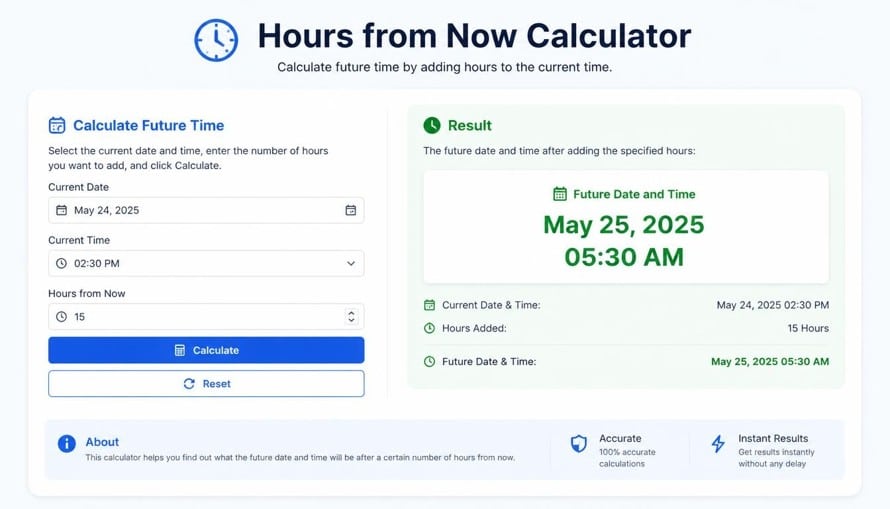
Time has a funny way of slipping through our fingers. One minute, you’re planning a meeting for later in the afternoon, and before you know it, you’re wondering whether you still have enough time to get ready.
Perhaps you need to know what time it will be five hours from now, or maybe you’re counting down to a flight, an important appointment, a project deadline, or simply the moment when your favourite show begins.
That’s where an Hours from Now Calculator becomes surprisingly useful. Instead of staring at the clock, counting hours on your fingers, or repeatedly checking your phone, you can calculate a future time in just a few seconds.
This simple yet practical time calculator helps you add hours and minutes to the current time, find an exact future date, and understand how much time remains before an upcoming event. It’s especially handy when calculations cross midnight or extend into another day.
Whether you’re a student organising study sessions, a professional managing deadlines, a traveller planning a journey, or someone who just wants to know what time it will be later, understanding how this calculator works can make everyday planning a little less chaotic.
What Is an Hours from Now Calculator?
An Hours from Now Calculator is an online time calculation tool that tells you the exact time and date after adding a particular number of hours and minutes to a starting time.
For example, suppose your current time is 3:30 PM and you want to know what time it will be seven hours later. Rather than manually counting forward, the calculator performs the calculation and gives you 10:30 PM.
Simple enough, right?
But its usefulness goes beyond adding a few hours. A good Hours from Now Calculator can also handle longer durations, calculate future dates, and display results in either 12-hour AM/PM or 24-hour time format.
Here are some common things you can calculate:
- What time will it be 5 hours from now?
- What time will it be 10 hours from now?
- What time will it be 24 hours from now?
- What date will it be 48 hours from now?
- What time will it be after 3 hours and 45 minutes?
- How many hours are left until a particular event?
- What will the future time be if you start from a specific initial time?
Think of it as a small digital assistant that takes care of the clock arithmetic while you focus on the things that actually matter.
How Does the Hours from Now Calculator Work?
Using an online time calculator is generally straightforward. You don’t need advanced mathematical knowledge or any special technical skills.
Most calculators allow you to enter a starting time, specify the number of hours and minutes, and receive the calculated result.
Here’s how the process usually works:
1. Choose your starting time
The initial time is your reference point. It can be the current local time or a different time that you enter manually.
2. Enter the number of hours
Type the number of hours you want to add. It could be 2, 5, 12, 24, or even 100 hours.
3. Enter additional minutes
If your calculation includes minutes, enter them separately. For example, you might want to calculate 4 hours and 35 minutes from now.
4. Select your preferred time format
Depending on the calculator, you may choose between a 12-hour AM/PM display and a 24-hour clock.
5. Calculate the future time
Press the Calculate button, and the tool displays the expected future time and, where supported, its corresponding calendar date.
The result gives you a clear picture of when your selected duration will end. No mental gymnastics required.
Why Use an Hours from Now Calculator?
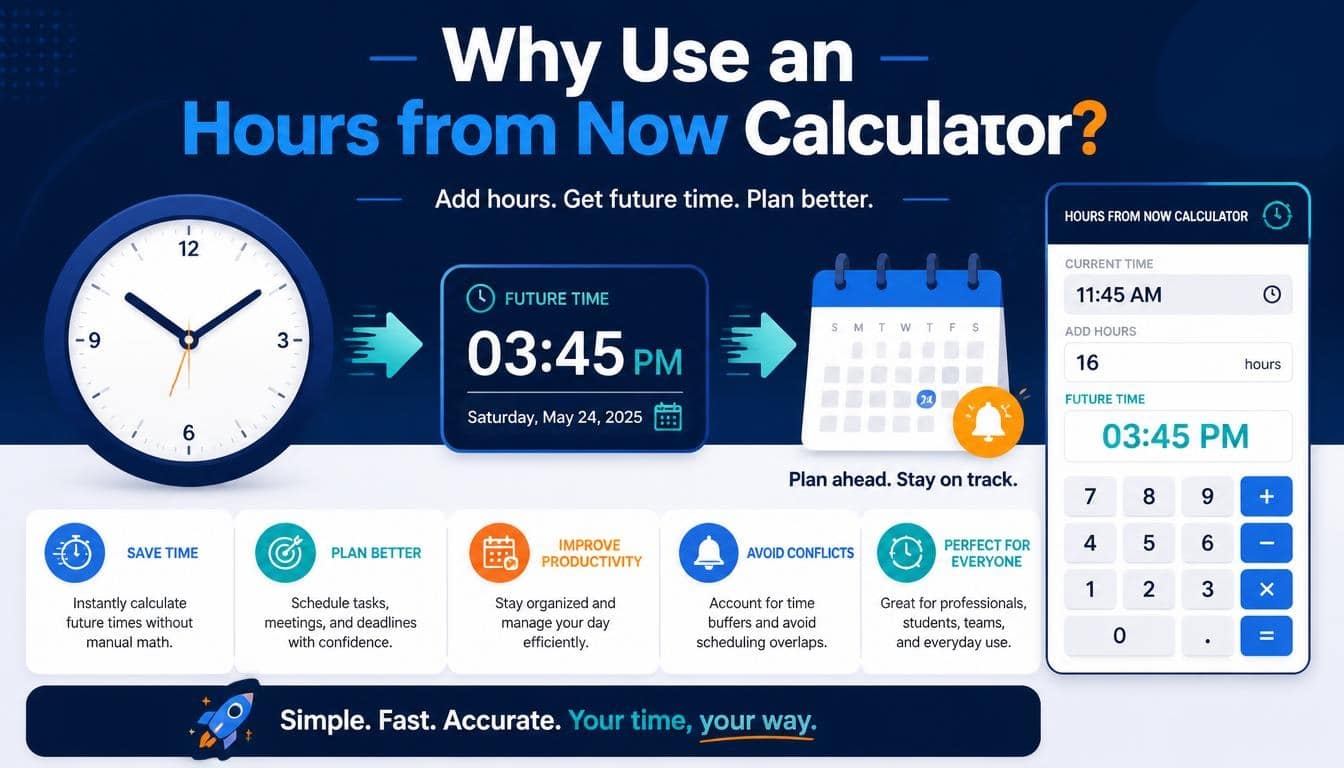
We often underestimate how useful accurate time calculations can be. A few hours may seem easy to calculate, but once minutes, midnight, and multiple calendar days enter the picture, mistakes become surprisingly common.
An Hours from Now Calculator removes much of that confusion.
Here are some practical reasons to use one.
Save Time on Everyday Calculations
Imagine it’s 11:45 AM and you have a task that should take 6 hours and 25 minutes. You could count forward manually, but there’s always a chance of losing track.
A time calculator provides the result immediately, making everyday planning quicker.
Avoid Confusion Around Midnight
This is one of the most helpful features.
Suppose it’s 9:30 PM and you want to add 7 hours. The answer isn’t simply a later time on the same calendar day. Your calculation crosses midnight and reaches 4:30 AM the following day.
The calculator handles this date transition automatically.
Plan Meetings and Appointments
Professionals often work with deadlines spread across different time zones and schedules. Calculating the exact time after a specific duration helps reduce scheduling confusion.
Manage Study and Work Sessions
Students can calculate the end of a study session, while employees can estimate when a particular work period will finish.
Keep Track of Important Events
From travel departures to online meetings and special occasions, knowing the exact future time helps you prepare without constantly checking the clock.
Calculate Time From Now: Practical Examples
Sometimes, the easiest way to understand a calculator is to see it in action. The following examples show how adding hours to the current time produces different results.
For consistency, these examples use a starting time of 6:00 PM on November 19, 2026.
| Time added | Calculated future time |
| 1 hour | 7:00 PM, November 19 |
| 2 hours | 8:00 PM, November 19 |
| 3 hours | 9:00 PM, November 19 |
| 5 hours | 11:00 PM, November 19 |
| 6 hours | 12:00 AM, November 20 |
| 8 hours | 2:00 AM, November 20 |
| 10 hours | 4:00 AM, November 20 |
| 12 hours | 6:00 AM, November 20 |
| 24 hours | 6:00 PM, November 20 |
| 48 hours | 6:00 PM, November 21 |
Notice how the date changes once the calculation passes midnight. That’s an important detail, particularly when planning overnight activities.
What Time Will It Be 5 Hours From Now?
If your starting time is 2:00 PM, adding five hours gives you 7:00 PM on the same day.
This calculation is useful for estimating when you’ll finish an afternoon activity or when an evening appointment will begin.
What Time Will It Be 10 Hours From Now?
Suppose it’s 8:00 PM. Adding ten hours takes you to 6:00 AM the following day.
This is a common calculation for overnight shifts, travel schedules, and sleep planning.
What Time Will It Be 24 Hours From Now?
Adding 24 hours means moving forward by exactly one full day.
If it’s 4:15 PM on Thursday, the result will be 4:15 PM on Friday, assuming the same local time zone and no unusual clock changes.
What Time Will It Be 48 Hours From Now?
Forty-eight hours represent two complete days.
For example, if it’s 10:30 AM on November 19, the result will be 10:30 AM on November 21.
These examples demonstrate how an hours and minutes calculator can make longer time calculations much easier to understand.
How to Calculate Hours From Now Manually
Although an online calculator is convenient, learning the basic method is useful when you don’t have access to one.
The principle is simple: add the requested duration to your initial time.
Future time = Initial time + Time duration
Let’s break it down with an example.
Suppose your initial time is 4:20 PM and you want to add 3 hours and 50 minutes.
- Starting time: 4:20 PM
- Additional hours: 3 hours
- Additional minutes: 50 minutes
- Time after adding hours: 7:20 PM
- Time after adding minutes: 8:10 PM
Your calculated future time is 8:10 PM.
Understanding the 60-Minute Rule
A clock has 60 minutes in every hour. Whenever your minute calculation reaches or exceeds 60, convert the extra minutes into an additional hour.
For example:
45 minutes + 30 minutes = 75 minutes.
Since 75 minutes equal 1 hour and 15 minutes, you carry one hour into the hour calculation and keep 15 minutes.
Understanding the 24-Hour Rule
A standard clock repeats its time every 24 hours.
If your calculation goes beyond 11:59 PM, the calendar date advances to the next day.
For longer calculations, divide the total duration into complete days and remaining hours.
For example:
50 hours = 2 days + 2 hours.
This makes it easier to calculate a future date and time without getting lost in a long sequence of clock movements.
Hours From Now Calculator for Different Time Formats
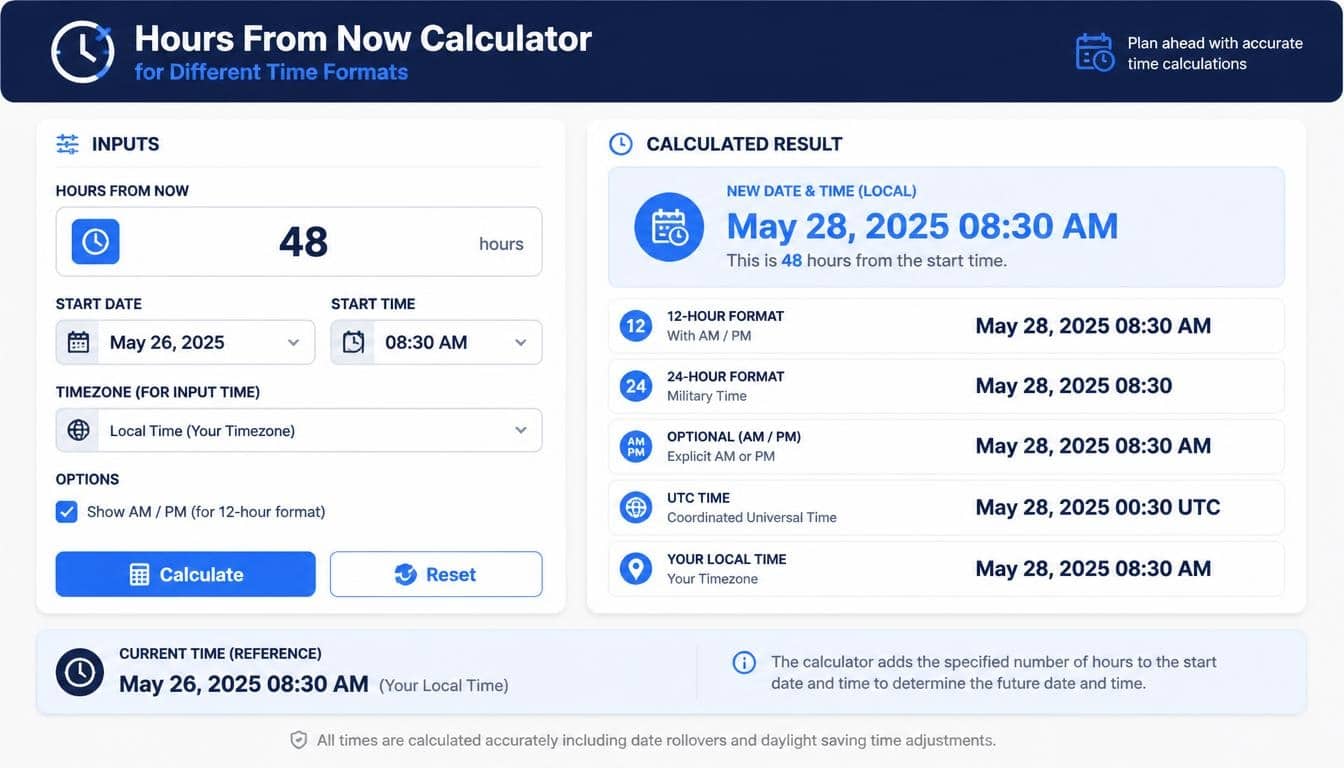
Time can be displayed in different formats depending on your location, workplace, or personal preference.
A reliable time calculator should make it easy to understand the result regardless of the format you’re accustomed to.
12-Hour AM/PM Format
The 12-hour clock divides the day into two periods:
- AM represents the period from midnight until just before noon.
- PM represents the period from noon until just before midnight.
For example, 18:30 in the 24-hour format becomes 6:30 PM in the 12-hour format.
This format is commonly used in everyday conversations, appointment reminders, and informal schedules.
24-Hour Format
The 24-hour clock represents the entire day using numbers from 00:00 through 23:59.
For example:
| 24-hour time | 12-hour time |
| 06:00 | 6:00 AM |
| 09:30 | 9:30 AM |
| 12:00 | 12:00 PM |
| 14:15 | 2:15 PM |
| 18:45 | 6:45 PM |
| 21:00 | 9:00 PM |
| 23:30 | 11:30 PM |
This format is particularly useful in aviation, healthcare, transport, and other industries where misunderstandings about AM and PM could create problems.
HH:MM:SS Time Display
Some digital clocks and specialised calculators also show hours, minutes, and seconds.
For example, 02:15:30 represents 2 hours, 15 minutes, and 30 seconds in a duration display.
This level of detail is helpful when working with countdowns, precise schedules, and technical time measurements.
Hours From Now Calculator for Long Durations
Not every time calculation involves just two or three hours. Sometimes you need to calculate a future date several days away.
A good Hours from Now Calculator should handle these longer durations without requiring you to perform separate calculations.
Consider the following examples, assuming a starting time of 9:00 AM on November 19, 2026.
| Duration | Future date and time |
| 24 hours | November 20, 9:00 AM |
| 36 hours | November 20, 9:00 PM |
| 48 hours | November 21, 9:00 AM |
| 72 hours | November 22, 9:00 AM |
| 96 hours | November 23, 9:00 AM |
| 120 hours | November 24, 9:00 AM |
| 168 hours | November 26, 9:00 AM |
These examples are particularly useful for people managing multi-day projects, travel itineraries, and extended countdowns.
Converting Hours Into Days
When a duration becomes quite large, converting hours into days makes the result easier to understand.
There are 24 hours in a standard day.
For example:
- 24 hours = 1 day
- 48 hours = 2 days
- 72 hours = 3 days
- 96 hours = 4 days
- 120 hours = 5 days
- 240 hours = 10 days
For an uneven duration, divide the number of hours by 24 and keep the remainder.
For instance, 55 hours equals 2 days and 7 hours.
This is where an Hours to Days Converter can be useful alongside a future time calculator.
Hours From Now Calculator for Work, Travel, and Daily Planning
Time calculations become much more meaningful when connected to real situations. Here are a few examples of how different people can use this tool.
For Employees and Remote Workers
Suppose your working day begins at 8:30 AM and you have a scheduled eight-hour shift.
Adding eight hours gives you 4:30 PM, before accounting for unpaid breaks or other workplace arrangements.
For remote workers collaborating internationally, the ability to calculate time differences and future meeting times can be especially useful.
For Students
A student who begins studying at 5:15 PM and plans to study for 3 hours and 30 minutes can calculate an ending time of 8:45 PM.
This makes it easier to create a realistic study schedule and avoid letting one subject consume the entire evening.
For Travellers
Travel plans often involve departure times, arrival estimates, airport transfers, and waiting periods.
If a flight is expected to depart at 11:20 PM and the journey lasts 7 hours and 40 minutes, the calculated arrival time is 7:00 AM the next day, assuming the times are in the same time zone.
For international flights, remember that local time zones must also be considered. A simple hours-from-now calculation doesn’t automatically account for a destination’s different time zone.
For Parents and Families
Families often plan activities around school schedules, meals, appointments, and bedtime routines.
Calculating a future time can help coordinate responsibilities without repeatedly checking the clock.
For Event Organisers
Weddings, conferences, online events, and community gatherings require careful scheduling.
An accurate time calculation helps organisers determine when preparations should begin and when particular activities are expected to finish.
Countdown Calculations: From Everyday Events to Space Missions
Countdowns are another interesting application of time calculation.
You’ve probably heard the famous expression “T-minus” during space mission broadcasts. It refers to the time remaining before a scheduled event, such as a rocket launch.
NASA and other space organisations use carefully managed countdown procedures to coordinate complex launch preparations.
Imagine a hypothetical space shuttle countdown beginning at T-minus 5 hours.
Each passing hour brings the launch closer:
- T-minus 5 hours: Initial countdown period.
- T-minus 4 hours: Preparations continue.
- T-minus 3 hours: Additional checks take place.
- T-minus 2 hours: Final preparations move forward.
- T-minus 1 hour: The countdown approaches its final stages.
- T-minus zero: The scheduled launch moment arrives.
An ordinary countdown calculator can help estimate the time remaining before an event, although actual spaceflight countdowns involve specialised procedures, holds, and schedule adjustments.
The same principle applies to everyday activities. You can calculate how many hours remain until a birthday celebration, a flight departure, an online class, or an important deadline.
Hours Ago Calculator: Finding a Time in the Past
While an Hours from Now Calculator moves forward, an Hours Ago Calculator works in the opposite direction.
Instead of adding hours to the current time, it subtracts them.
For example, if your current time is 6:00 PM:
- 1 hour ago was 5:00 PM.
- 2 hours ago was 4:00 PM.
- 5 hours ago was 1:00 PM.
- 8 hours ago was 10:00 AM.
- 12 hours ago was 6:00 AM.
- 24 hours ago was 6:00 PM on the previous day.
This feature is helpful when reviewing past activities, checking when a message was received, estimating the start of an event, or working out when a particular task began.
A complete time calculator may provide both future and past calculations, allowing you to move in either direction from your initial time.
Common Mistakes to Avoid When Calculating Future Time
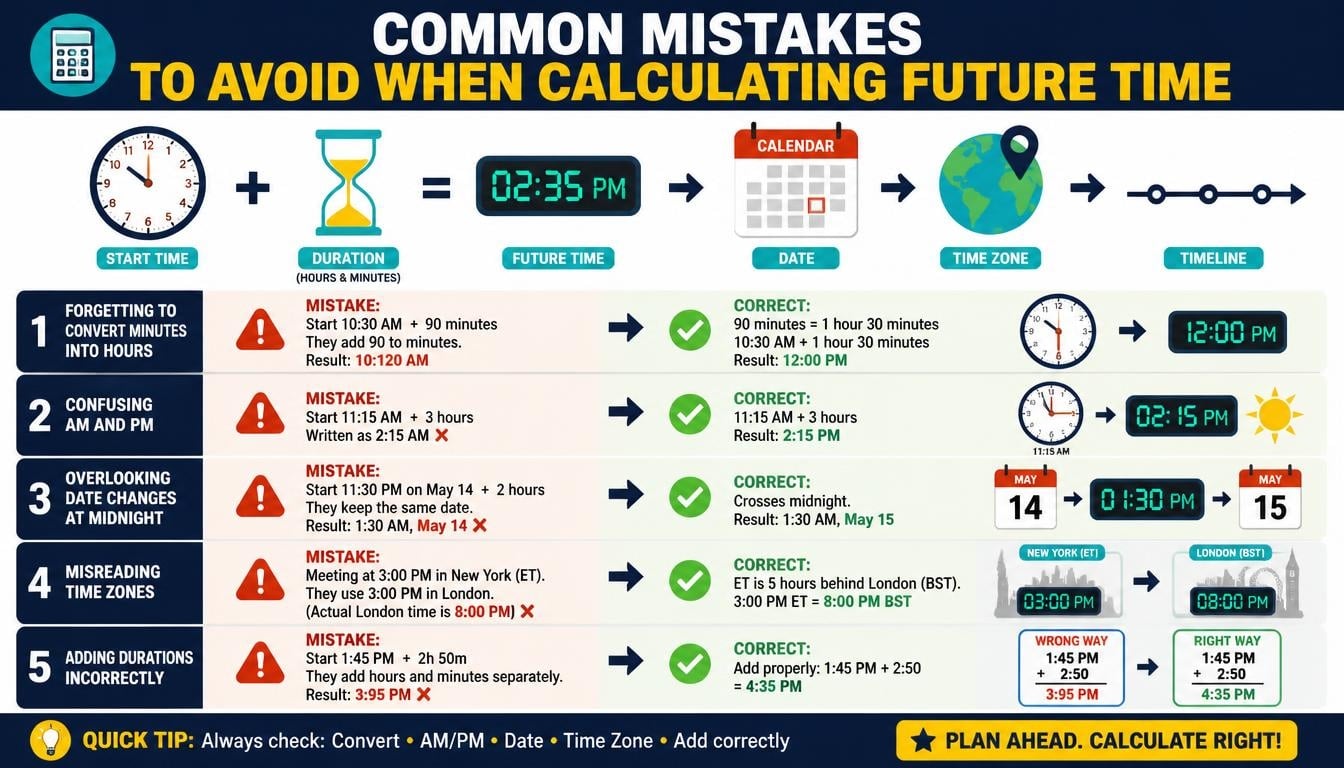
Even simple time calculations can produce incorrect results when certain details are overlooked.
Here are some common mistakes worth avoiding.
Forgetting about midnight: Adding several hours to an evening time may move the result into the next calendar day.
Confusing AM and PM: 12:00 AM means midnight, while 12:00 PM means noon. Mixing them up can shift a schedule by 12 hours.
Ignoring minutes: Adding 2 hours and 45 minutes is not the same as adding just 2 hours.
Forgetting the starting time: Make sure you know whether the calculator is using the current time or a manually entered initial time.
Ignoring time zones: If you’re calculating the time of an international meeting or flight, account for the destination’s local time.
Overlooking daylight saving changes: In regions that observe daylight saving time, local clock calculations can behave differently when a duration crosses a clock adjustment.
Assuming every day has exactly the same local-clock duration: A standard day is 24 hours, but daylight saving transitions can make a local calendar day 23 or 25 hours.
Being aware of these details makes your calculations more dependable.
NLP, Semantic Entities, and LSI Keyword Extraction for Time Calculators
A useful time calculator page should communicate its purpose clearly to both visitors and search engines.
This is where NLP, Semantic Entities, and LSI Keyword Extraction become relevant from an SEO perspective.
Natural Language Processing (NLP) helps search systems understand the meaning and relationships between words. For a page about calculating future time, relevant terms include current time, initial time, hours later, future date, and time duration.
Semantic Entities provide additional context by connecting related concepts. For example, an Hours from Now Calculator naturally relates to a Time Calculator, Hours Ago Calculator, Countdown Calculator, Digital Clock, and Time Conversion.
Similarly, LSI Keyword Extraction is often used as an SEO term for identifying related phrases that support a page’s central subject. Although modern search engines use more sophisticated semantic systems than simple keyword matching, related terminology still helps create useful, comprehensive content.
Some relevant keyword variations include:
- Time from now calculator
- Calculate time from now
- Add hours to current time
- Current time plus hours
- Future time calculator
- Calculate hours ahead
- Hours and minutes calculator
- Hours from now with date
- Calculate future date and time
- Time remaining calculator
- 24-hour time calculator
- AM PM time calculator
- Hours to minutes converter
- Hours to seconds converter
- Hours to days converter
The goal isn’t to squeeze every phrase into every paragraph. Instead, use relevant language naturally so readers can understand the subject without encountering repetitive or awkward sentences.
How to Get More Accurate Results From an Online Time Calculator

A few small habits can improve your experience with any online time calculation tool.
- Check your local time: Confirm that your device clock displays the correct time and time zone.
- Enter the correct duration: Double-check the hours and minutes before calculating.
- Use a manual starting time when needed: This is particularly important when calculating from a scheduled appointment rather than the present moment.
- Choose a suitable format: Use AM/PM for everyday reading or the 24-hour format for professional schedules.
- Check the calendar date: When calculations cross midnight, verify that the displayed date has changed correctly.
- Review long-duration results: For calculations extending across multiple days or time zones, confirm the relevant calendar and clock assumptions.
A little attention at the beginning can prevent a surprising amount of confusion later.
Frequently Asked Questions About Hours From Now Calculator
What is an Hours from Now Calculator?
An Hours from Now Calculator is a time calculation tool that adds a specified number of hours and minutes to a starting time. It displays the resulting future time and may also show the corresponding date.
How do I calculate time from now?
Enter your current time or another starting time, add the number of hours and minutes you want, and calculate the result. You can also perform the calculation manually by adding the duration to the starting time.
What time will it be 5 hours from now?
The answer depends on your current local time. For example, if it is 2:00 PM, five hours from now will be 7:00 PM on the same day.
What time will it be 10 hours from now?
If your current time is 8:00 AM, adding ten hours gives you 6:00 PM on the same day. If the starting time is 8:00 PM, the result will be 6:00 AM the following day.
What time will it be 24 hours from now?
Twenty-four hours from now is generally the same clock time on the following calendar day. For example, 3:45 PM on Thursday becomes 3:45 PM on Friday.
Can I add minutes as well as hours?
Yes. Most hours-from-now calculators allow you to enter both hours and minutes. For instance, you can calculate the exact time after 2 hours and 35 minutes.
Can I calculate more than 24 hours from now?
Absolutely. You can calculate durations of 48, 72, 100, or even several hundred hours. The calculator converts the additional time into complete days and remaining hours where supported.
Does the calculator automatically change the date?
A calculator that supports date calculations should update the calendar date whenever the added duration passes midnight. This is especially useful for overnight and multi-day calculations.
What is the difference between an Hours from Now Calculator and an Hours Ago Calculator?
An Hours from Now Calculator adds time to a starting point to find a future result. An Hours Ago Calculator subtracts time to determine a past time.
Can I use a 24-hour time format?
Yes, provided the calculator supports that option. For example, 17:30 in the 24-hour format is equivalent to 5:30 PM in the 12-hour format.
Is an online time calculator accurate?
It can provide accurate arithmetic when the starting time, duration, and time-zone assumptions are correct. However, daylight saving changes and international time-zone differences may require additional consideration.
Can I calculate the future date as well as the time?
Yes. A date-enabled Hours from Now Calculator can display both the future clock time and the corresponding calendar date, which is particularly useful for durations longer than 24 hours.
How to Make Time Calculations Part of Better Daily Planning
Knowing how to calculate time from now is a small skill, but it can make everyday organisation feel considerably easier.
Before starting a long task, calculate when you expect to finish. When scheduling a meeting, work out the exact time rather than estimating. When planning a journey, consider both the duration and the local time at your destination.
You can also use a countdown calculation to create reminders for important events. Instead of wondering how much time is left, you’ll have a clearer idea of what needs to happen and when.
One practical habit is to add a small buffer to important schedules. If a journey takes two hours, for example, don’t automatically assume you’ll arrive exactly two hours after leaving. Traffic, waiting periods, and unexpected delays can all affect the actual result.
The calculator gives you the mathematical answer; good planning helps you make that answer useful.
Read More: https://gracethemes.com/how-many-days-until-may-21-2028/
Conclusion: Make Every Hour Count
Time doesn’t wait for anyone, and that’s probably why keeping track of it matters so much. Whether you’re organising a busy workday,
planning a trip, preparing for an important event, or simply curious about what time it will be a few hours from now, having a reliable way to calculate future time makes life a little simpler.
An Hours from Now Calculator takes an everyday question and turns it into an instant, understandable answer.
From adding a few minutes to calculating several days ahead, it removes unnecessary mental effort and helps you plan with greater confidence.
Remember, accurate time calculation isn’t only about knowing what the clock will say later. It’s about making better use of the hours you have right now.
So the next time you catch yourself wondering, “What time will it be in five hours?”, let a time calculator do the counting.
And if you have a favourite trick for managing deadlines, schedules, or countdowns, share your experience in the comments. Someone else might find it just as useful.
After all, every hour has somewhere to take us. The trick is knowing when we’ll get there.
