

Dog Pregnancy Calculator: Estimate Your Dog’s Due Date and Prepare for Puppies
Waiting for puppies to arrive is a curious mixture of excitement, tenderness, and a little bit of nervous pacing around the house.
One day, your dog is chasing her favourite toy as usual, and before long, you are wondering whether her appetite has changed, whether her belly looks different, and, most importantly, when those tiny paws might finally appear.
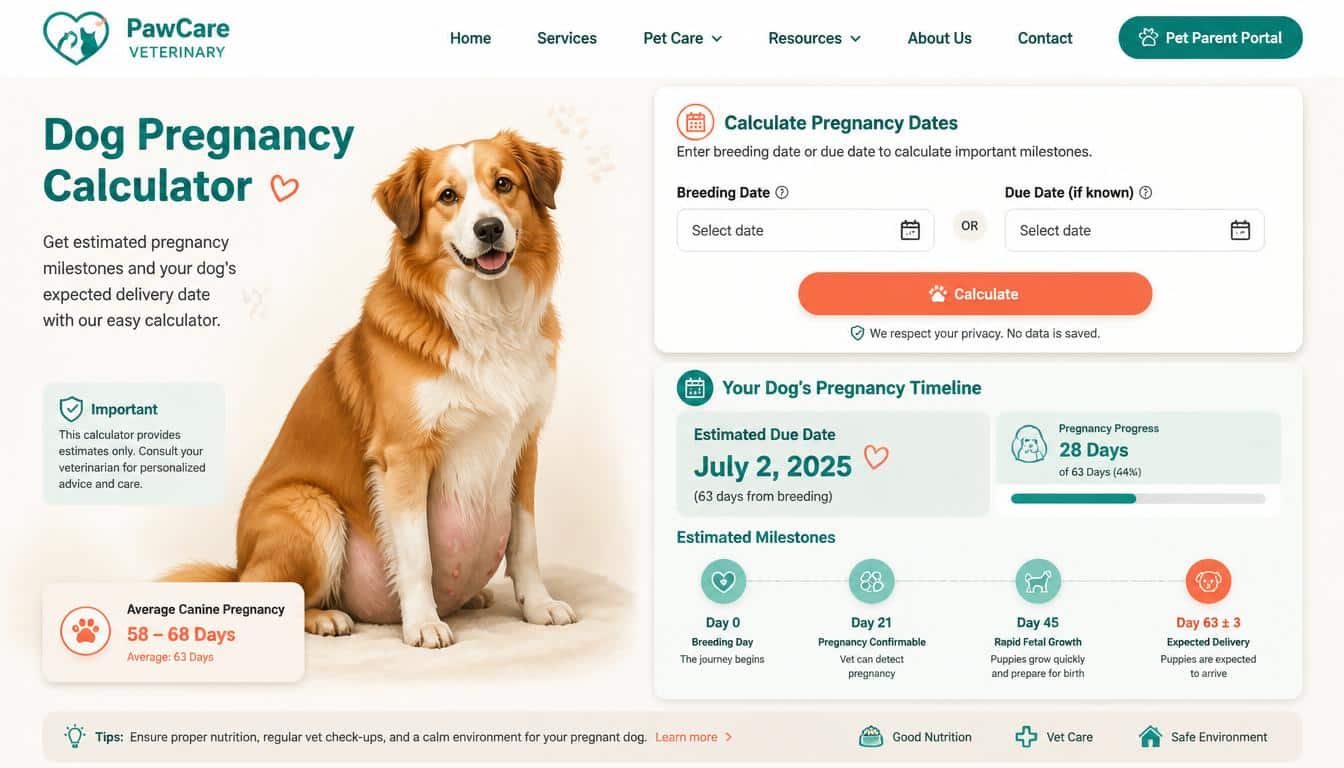
A Dog Pregnancy Calculator can help make this waiting period a little less mysterious. By entering your dog’s mating date, you can estimate her expected delivery date, understand the likely pregnancy timeline, and begin preparing for the arrival of her litter. It isn’t a crystal ball, of course, but it gives you a sensible starting point.
Dogs generally remain pregnant for around 63 days, although the actual timing can vary. If you are caring for a pregnant dog for the first time, or you have been through puppy season before and still find yourself counting the days, understanding canine gestation can make the whole experience less stressful.
Let’s look at how a dog pregnancy due date is calculated, what happens during each stage, and how you can help your dog stay comfortable and healthy until her puppies arrive.
What Is a Dog Pregnancy Calculator?
A Dog Pregnancy Calculator is a simple date-estimation tool that predicts when a pregnant dog may give birth. Most calculators use the mating date as their starting point and add an average gestation period of approximately 63 days.
For example, if your dog mated on October 12, 2026, her estimated due date would be December 14, 2026. That date is useful for planning veterinary appointments and preparing a safe place for delivery, though it does not guarantee that labour will begin on that exact day.
Canine pregnancy is a little more complicated than counting nine weeks on a calendar. The date of mating does not always match the date of fertilisation, and sperm can survive inside the female reproductive tract for several days. This is why two dogs with apparently similar mating dates may give birth at different times.
A calculator offers a helpful estimate, not a medical diagnosis. Your veterinarian can use examinations and appropriate diagnostic tests to assess the pregnancy and help you understand the likely delivery window.
Dog Pregnancy Calculator: Calculate Your Dog’s Due Date
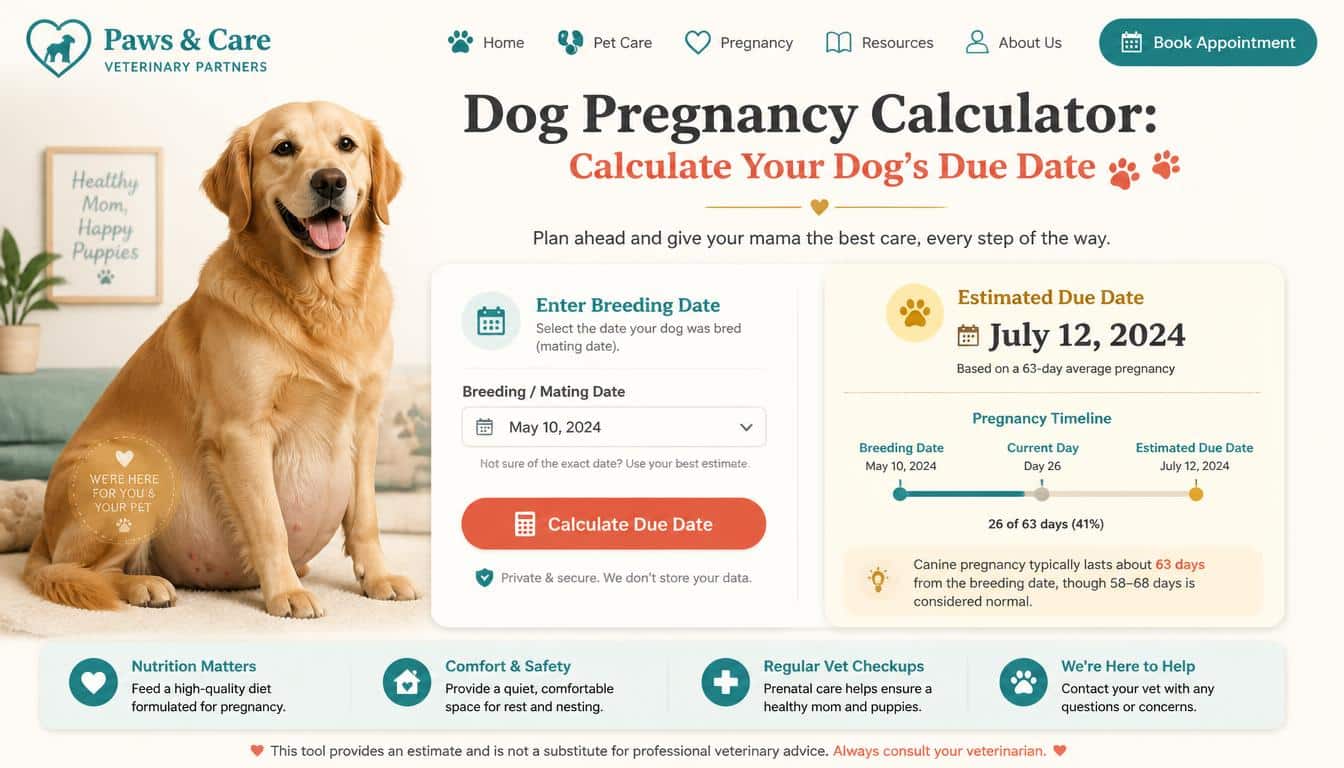
The easiest way to estimate a dog’s delivery date is to start with the date she mated. The following example shows how a typical Dog Pregnancy Calculator Due Date estimate works.
Example calculation
- Dog mating date: October 12, 2026
- Average gestation period: 63 days
- Estimated due date: December 14, 2026
- Approximate 57-day date: December 8, 2026
- Approximate 65-day date: December 16, 2026
These dates are estimates based on adding the stated number of days to the mating date. They should not be treated as guaranteed birth dates or as a substitute for veterinary guidance.
For practical planning, keep the estimated date visible on your calendar, but allow some flexibility. Your dog may deliver earlier or later than the average, and a veterinarian can help determine whether the pregnancy is progressing normally.
Dog Due Date Calculator: How to Use the Estimate
If you are using a Dog Due Date Calculator, follow these simple steps:
- Record the mating date as accurately as possible.
- Add 63 days to establish the average estimated delivery date.
- Use a broader window to prepare for possible variation in the pregnancy length.
- Arrange veterinary care to confirm the pregnancy and monitor your dog’s health.
- Prepare the whelping area before the estimated delivery period, rather than waiting until the last minute.
If the mating date is uncertain, or your dog mated more than once over several days, the calculation becomes less precise. Tell your veterinarian the dates you know, even if they are only approximate, because that information can help guide further assessment.
Understanding the Dog Gestation Period
The Dog Gestation Period is the time between conception and birth. Canine pregnancy is commonly described as lasting about 63 days, or roughly nine weeks, but the timing depends on how pregnancy is measured.
When calculated from ovulation, canine gestation is much more consistent, at approximately 63 days. When calculated from mating, the apparent duration can vary considerably because mating and ovulation may not occur on the same day.
This distinction matters when interpreting a calculator result. A date that looks slightly early or late on your calendar may reflect uncertainty about fertilisation timing rather than a problem with the pregnancy itself.
For many owners, the most useful approach is to combine a date estimate with veterinary monitoring. That way, you are not relying on a single number while waiting for your dog’s puppies to arrive.
Dog Pregnancy Timeline: What Happens Week by Week?
A Dog Pregnancy Timeline gives you a general picture of the changes that may occur as the puppies develop. Every dog is different, and visible changes do not always appear according to a perfect weekly schedule.
Week 1: Mating and the Beginning
The first week usually starts with mating. Fertilisation may happen later, so you might not notice any changes in your dog just yet. She may behave and eat exactly as she did before, which is perfectly possible during the early days.
Continue her normal, balanced routine and avoid giving medications or supplements without veterinary advice. There is no need to dramatically increase her food simply because mating has occurred; her nutritional needs will change as the pregnancy progresses.
Week 2: Early Development
During the second week, early embryos continue developing and moving towards the uterus. Most dogs still look completely normal, and their owners may find it difficult to believe that anything is happening at all.
Keep exercise gentle and familiar, provide fresh water, and watch for unusual symptoms. A quiet dog is not necessarily pregnant, just as an energetic dog is not necessarily carrying an empty litter.
Week 3: Early Pregnancy Changes
Some dogs begin to show subtle changes in appetite, affection, or energy during the third week. Others show very little, which is why behaviour alone cannot reliably confirm pregnancy.
A veterinarian may recommend a relaxin hormone test at an appropriate time, often from around 25 days after ovulation or breeding-related timing advised by the clinic. If an early test is negative but pregnancy remains possible, your veterinarian may recommend repeating it.
Week 4: Veterinary Confirmation
By around day 25 to 30, an ultrasound may help confirm pregnancy and assess the developing puppies. The exact timing depends on the dog’s reproductive dates, the equipment used, and the experience of the veterinary professional.
An ultrasound can provide valuable information, although it is not always the best method for counting every puppy. Your veterinarian can explain what the examination reveals and whether any follow-up is needed.
Weeks 5 and 6: Growing Puppies
As pregnancy progresses, your dog’s abdomen may become more noticeable, particularly if she is carrying several puppies. Her nutritional requirements also begin to rise, and she may prefer smaller, more frequent meals as her abdomen expands.
This is a good time to discuss an appropriate growth-formulated or puppy food with your veterinarian. The aim is to meet the needs of both the mother and her developing puppies without encouraging excessive weight gain.
Week 7: Preparing for Birth
By the seventh week, the delivery period is getting closer. You may notice more obvious physical changes, and your dog might start seeking a quieter place to rest.
Introduce a clean, comfortable whelping box in a familiar indoor area. Let her investigate it at her own pace, because a space she already trusts is more likely to feel reassuring when labour approaches.
Week 8: The Final Stretch
During the eighth week, preparation becomes especially important. Keep the environment calm, have your veterinarian’s contact information ready, and make sure you know where to seek emergency care if necessary.
An X-ray may be useful from approximately day 45 onwards, with later pregnancy often providing clearer views of the puppies’ skeletons. Your veterinarian can advise on timing and whether imaging would help estimate litter size.
Week 9: Watching for Labour
As the expected delivery date approaches, your dog may become restless, pant, dig at bedding, or refuse food during early labour. Some dogs seek attention, while others prefer a little privacy; neither behaviour alone tells you exactly when a puppy will be born.
Keep observing without hovering over her constantly. If she seems distressed, has abnormal discharge, experiences prolonged straining without delivering a puppy, or develops other worrying signs, contact a veterinarian promptly.
How Long Are Dogs Pregnant?
One of the most common questions from dog owners is, “How many days is a dog pregnant?” The short answer is approximately 63 days, although the answer depends on the date used to measure the pregnancy.
When ovulation is known, pregnancy typically lasts close to 63 days. When only the mating date is available, a rough range of 57 to 65 days is often used for planning, but it should not be interpreted as a guarantee that every birth within that window is normal.
The Dog Pregnancy Length can also be influenced by uncertainty in the breeding dates and differences in individual reproductive timing. Breed size, litter characteristics, and the mother’s health may affect how a pregnancy needs to be monitored, so personalised veterinary advice is valuable.
If you are wondering, “When will my dog give birth?”, think of the calculator date as the centre of a planning window. It tells you when to be prepared, not the exact hour when the first puppy will appear.
Dog Pregnancy Signs: How to Recognise a Possible Pregnancy
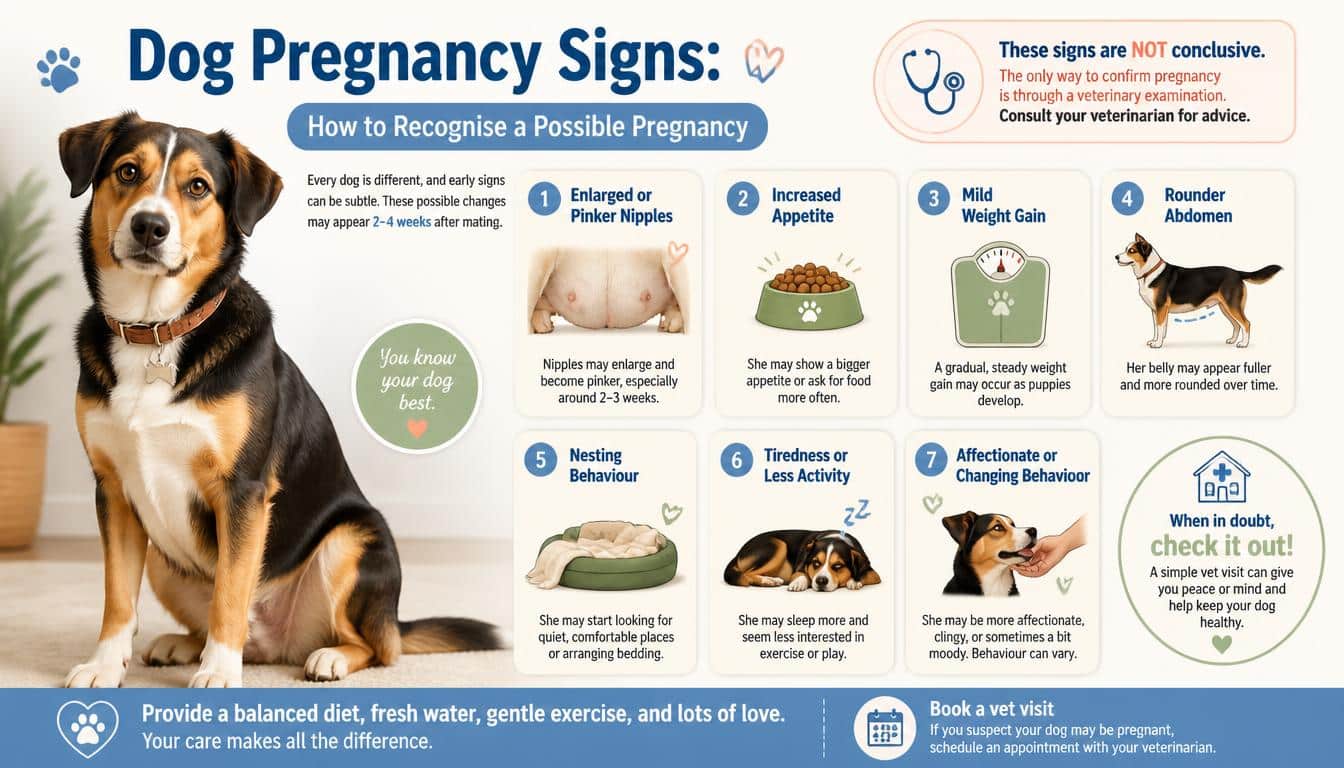
Physical and behavioural changes can provide clues, but they cannot confirm pregnancy on their own. Some signs appear gradually, and others may be caused by hormonal changes unrelated to a true pregnancy.
Common Dog Pregnancy Signs include:
- Enlarged or more noticeable nipples.
- Changes in appetite, including temporary loss of interest in food.
- Gradual weight gain and abdominal enlargement.
- Increased tiredness or a change in usual activity levels.
- More affectionate, clingy, or occasionally irritable behaviour.
- Nesting behaviour as the expected delivery date approaches.
- Changes in mammary tissue as the body prepares for nursing.
Not every pregnant dog will display all these signs. Some show obvious changes, while others remain surprisingly ordinary until later in pregnancy.
False pregnancy can also cause signs such as nesting, mammary enlargement, and changes in behaviour. If your dog appears pregnant but has not been confirmed as carrying puppies, a veterinary examination can help distinguish between pregnancy and other causes.
How Veterinarians Confirm Dog Pregnancy
A calculator can estimate dates, but only appropriate veterinary assessment can help establish whether your dog is actually pregnant. Choosing the right test also depends on how long it has been since ovulation or mating.
Relaxin Hormone Testing
Relaxin is a hormone associated with pregnancy in dogs. A veterinarian may use a blood test to detect it once it is present at a detectable level, commonly from around 25 days after ovulation.
Testing too early may produce a negative result even when pregnancy is developing. Your veterinarian can advise whether a repeat test is appropriate if the first result does not match the available breeding history.
Ultrasound Examination
Ultrasound can often detect pregnancy at approximately 25 to 30 days, depending on timing and clinical circumstances. It helps assess pregnancy and fetal development, but it may not provide an exact puppy count.
This is often reassuring for owners who want confirmation before making extensive birth preparations. It also gives the veterinary team an opportunity to discuss the mother’s health and any concerns that need attention.
X-rays in Later Pregnancy
X-rays can show the mineralised skeletons of developing puppies, usually becoming useful from around day 45 and often more informative later in pregnancy. A veterinarian may recommend an X-ray to help estimate litter size and support delivery planning.
Knowing the likely number of puppies can be useful when labour begins, because it helps you recognise when delivery may be complete. However, an X-ray estimate still needs to be interpreted alongside the mother’s condition and the progress of labour.
Abdominal Palpation
An experienced veterinarian may sometimes feel changes associated with pregnancy through abdominal palpation during an appropriate stage. This method has limitations and is not something owners should attempt at home.
Pressing or squeezing the abdomen to look for puppies can cause discomfort or injury. Leave pregnancy assessment to a trained professional, even if you are curious about what is happening inside your dog’s growing belly.
Writing
Dog Pregnancy Care: Keeping the Mother Healthy
Good Dog Pregnancy Care is about steady, sensible routines rather than making every day feel like a medical emergency. Your dog needs suitable nutrition, comfortable rest, regular observation, and veterinary support throughout pregnancy.
Small changes matter, but you don’t have to interpret every yawn or skipped meal as a warning sign. Learn your dog’s usual habits, then contact your veterinarian if you notice changes that are persistent, severe, or unusual for her.
Feeding a Pregnant Dog
A balanced diet is essential for a healthy pregnancy. During the early weeks, many dogs can continue eating their usual complete and balanced adult food if their body condition and health are appropriate.
As pregnancy progresses, energy needs increase. Your veterinarian may recommend a suitable growth or puppy food that meets recognised nutritional standards, such as applicable AAFCO nutrient profiles. The right choice depends on the dog’s size, condition, and individual needs.
Avoid suddenly increasing portions by a large amount. Smaller, more frequent meals may become easier to manage in late pregnancy, when the growing puppies take up more space in the abdomen.
Vitamins and Supplements
More supplements do not automatically mean healthier puppies. Excessive calcium supplementation, for example, can interfere with normal calcium regulation and increase the risk of problems around birth and lactation.
Speak with your veterinarian before adding vitamins, minerals, or other products to your dog’s diet. A complete diet formulated for her needs is usually a better starting point than a cupboard full of supplements.
Exercise and Rest
Most healthy pregnant dogs benefit from regular, gentle activity. Short walks, comfortable movement around the home, and familiar low-impact activities can help maintain fitness without placing unnecessary strain on the mother.
Avoid strenuous exercise, rough play, overheating, and activities that could cause injury. The appropriate level of activity can change as pregnancy advances, so ask your veterinarian what is suitable for your dog.
Veterinary Checkups and Preventive Care
Arrange prenatal veterinary appointments to confirm pregnancy, discuss nutrition, and establish a plan for delivery. Tell the clinic about any medicines, supplements, previous pregnancies, or health conditions your dog has experienced.
Parasite prevention, vaccinations, and medications need individual consideration during pregnancy. Don’t start or stop treatments without professional advice, because a product that is safe for one dog may not be appropriate for another.
Preparing for Your Dog’s Whelping Date
The word whelping simply means giving birth to puppies. Preparing for your dog’s Dog Whelping Date gives you time to organise the environment, collect essential supplies, and understand when professional help may be needed.
You don’t need a complicated nursery worthy of a magazine photograph. A clean, safe, quiet place where the mother can rest comfortably is much more important.
Set Up a Comfortable Whelping Box
Prepare a whelping box in a quiet indoor area about a week before the estimated delivery date, or earlier if your dog needs time to get comfortable with it.
Choose a box that allows the mother to lie down and stretch out while helping keep newborn puppies safely contained. Use clean, washable bedding and ensure the area can be kept warm without overheating the mother.
Introduce the space gradually. Some dogs happily settle into their box straight away, while others inspect it as if you’ve installed a suspicious piece of furniture in their favourite room.
Prepare Essential Supplies
Keep useful supplies together so you are not searching for them in the middle of the night.
- Clean towels and spare washable bedding.
- A digital thermometer for monitoring the environment or the mother when advised.
- A suitable, safe heat source for newborn puppies, arranged to prevent burns and overheating.
- A notebook for recording puppy births and observations.
- Your veterinarian’s regular and emergency contact details.
- A reliable way to transport the mother and puppies if veterinary care is required.
Do not attempt medical procedures or administer medication during labour unless a veterinarian has instructed you to do so.
Recognise Signs of Labour
Restlessness, nesting, panting, trembling, and reduced appetite can occur during the early stages of labour. Some dogs become unusually attached to their owners, while others want to be left in peace.
A fall in rectal temperature may occur before labour, but temperature readings alone cannot reliably predict the exact time of delivery. If your veterinarian has recommended monitoring temperature, ask how to take and interpret the readings correctly.
Contact your veterinarian urgently if your dog has strong, persistent straining without producing a puppy, appears severely weak or distressed, has heavy bleeding, or develops foul-smelling discharge. Green or dark discharge before the first puppy, especially if delivery does not follow promptly, also warrants immediate veterinary advice. Do not wait for a calculator’s estimated date to pass if something seems wrong.
What Can Affect a Dog Pregnancy Due Date?
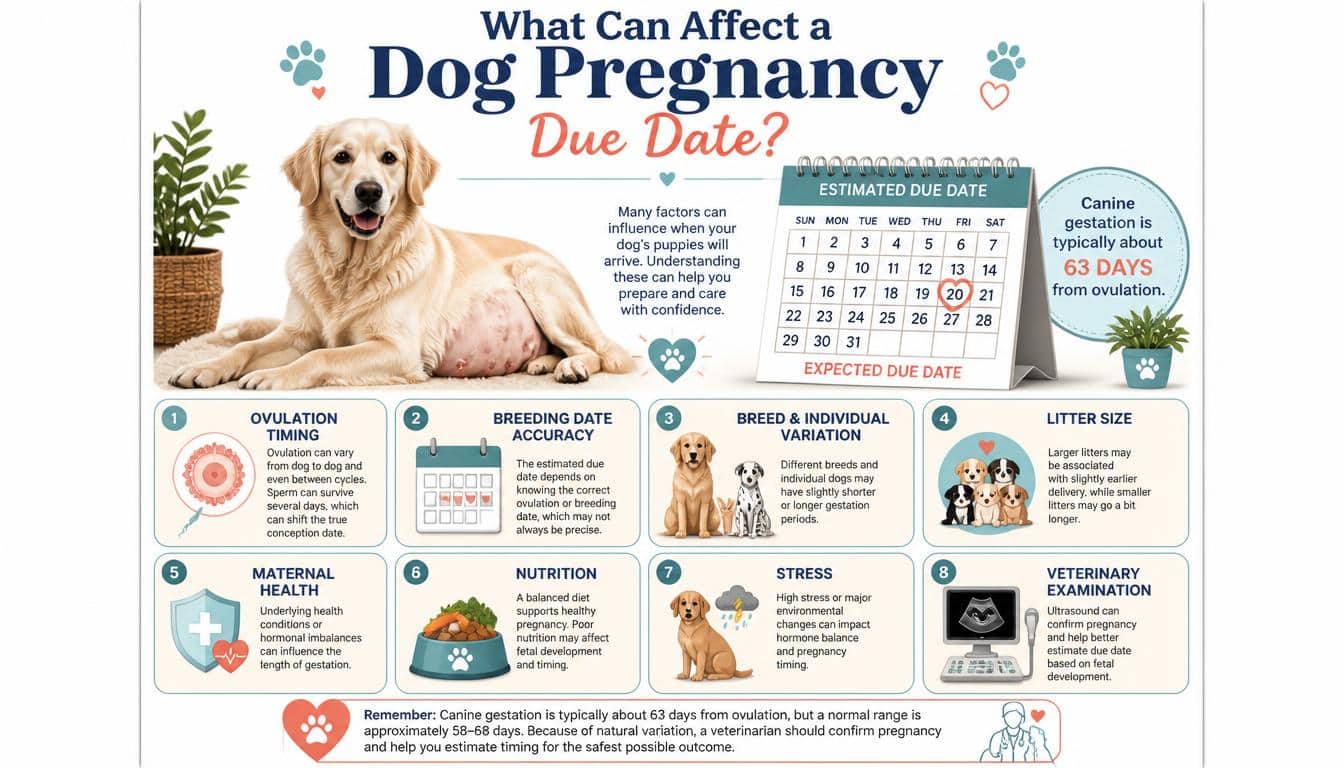
Even a carefully recorded mating date cannot tell the whole story. Several factors can influence how accurately you can estimate the expected puppy delivery date.
Uncertain mating dates: If your dog was with a male on several occasions, the exact breeding date may be unclear. This creates a wider estimation window.
Ovulation timing: Mating does not necessarily occur on the day of ovulation, which is one of the main reasons a mating-based estimate can be imprecise.
Individual reproductive differences: Dogs vary in their reproductive timing, and the course of an individual pregnancy needs to be assessed in context.
Litter and maternal factors: Litter size and the mother’s physical condition may influence veterinary planning and the care needed during pregnancy and birth, although neither provides a reliable standalone due-date prediction.
If the estimated date approaches and your dog has not delivered, speak with your veterinarian rather than assuming she simply needs a few more days. Likewise, signs of labour or illness before the expected date should be assessed on their own merits.
Frequently Asked Questions About a Dog Pregnancy Calculator
How accurate is a Dog Pregnancy Calculator?
A Dog Pregnancy Calculator is useful for estimating a delivery window when the mating date is known. It is less precise when ovulation and fertilisation dates are unknown, so the result should guide preparation rather than replace veterinary assessment.
Can I calculate a dog’s due date without knowing the mating date?
It may still be possible to estimate the pregnancy stage using veterinary examination and diagnostic testing. However, without a reliable breeding date, a calculator cannot provide a meaningful date estimate by itself.
When can an ultrasound detect dog pregnancy?
Ultrasound may detect pregnancy from approximately 25 to 30 days, depending on timing and clinical circumstances. Your veterinarian can recommend the best appointment date based on the information available.
When can an X-ray show puppies?
X-rays may begin to show mineralised puppy skeletons from around day 45. Later imaging is often more useful for estimating the number of puppies, but your veterinarian should determine the appropriate timing.
Should I change my dog’s food immediately after mating?
Not necessarily. During early pregnancy, many dogs can continue their usual complete and balanced diet. Increased nutritional needs generally become more important later, and your veterinarian can help you plan the transition.
Can a pregnant dog still go for walks?
In many uncomplicated pregnancies, gentle walks and familiar activities remain appropriate. Avoid strenuous exercise and ask your veterinarian for individual guidance, especially if your dog has health problems or develops pregnancy complications.
What if my dog goes past her estimated due date?
First, remember that a mating-based estimate is not exact. Contact your veterinarian if the expected date passes without delivery, particularly if the mating dates are reliable or your dog shows concerning signs. Do not use the calendar alone to decide whether it is safe to wait.
How to Make the Most of Your Dog Pregnancy Calendar
A Dog Pregnancy Calendar becomes more useful when you treat it as a record of your dog’s progress rather than simply a countdown to birth.
Record the mating date, veterinary appointments, test results, changes in appetite, and any advice you receive about nutrition or exercise. These notes can help you explain changes clearly when you speak with your veterinarian.
You can also keep a short daily observation log during the final weeks. Note whether your dog is eating normally, resting comfortably, and behaving as expected. Avoid trying to diagnose problems from the notes alone; their purpose is to help you recognise changes and communicate them accurately.
If you use other pet-care tools, a dog weight calculator or dog calorie calculator may help you organise relevant measurements, provided the results are interpreted appropriately. A dog age calculator or dog water intake calculator may be useful for other aspects of routine care, but none of these tools can confirm pregnancy or predict labour.
Frequently aSked Questions
Dog gestation calculator
A dog gestation calculator estimates your dog’s pregnancy duration and expected delivery date using the mating date. Dogs are pregnant for about 63 days on average, although the actual timing may vary.
Dog due date calendar
A dog due date calendar helps you track your dog’s pregnancy week by week and prepare for the arrival of her puppies. Mark the estimated due date and schedule veterinary checkups to monitor her health.
Calculate dog due date
To calculate your dog’s due date, add approximately 63 days to the mating date. This gives you an estimated delivery date, not a guaranteed birth date, so consult your veterinarian for guidance.
Shih tzu pregnancy calculator
A Shih Tzu pregnancy calculator estimates when your Shih Tzu may give birth based on her mating date. Like other dogs, Shih Tzus typically have a gestation period of around 63 days, and veterinary monitoring is important throughout pregnancy.
Canine due date calculator
A canine due date calculator helps estimate when a pregnant dog is likely to deliver her puppies. Enter the known mating date to calculate an approximate due date and plan appropriate prenatal care.
Read More: https://gracethemes.com/what-date-is-9-months-from-today/
Final Thoughts: Every Day Brings You Closer to Meeting the Puppies
A Dog Pregnancy Calculator gives you a useful starting point when you are counting down to the arrival of a new litter. By estimating the due date, understanding the gestation period, and preparing for whelping, you can replace some of the uncertainty with a clear, practical plan.
Remember that the estimated date is only one part of the picture. Good nutrition, gentle exercise, veterinary checkups, and a calm delivery environment all contribute to supporting the mother and her puppies.
And when the big day finally arrives, the calendar will probably be the last thing on your mind. You’ll be watching a tiny puppy take its first breath, listening for those first little squeaks, and wondering how something so small can fill an entire room with happiness.
Prepare carefully, ask your veterinarian questions whenever you’re unsure, and give your dog the patience and comfort she deserves. The countdown is important, but helping her through the journey safely is what truly makes the difference.
