

Cubic Yard Calculator: Calculate Cubic Yards, Material Quantity, and Cost
There is a funny little moment that happens during almost every landscaping or construction project: someone looks at a pile of gravel, soil, mulch, dirt, or concrete and says, “Okay, but how much of this do we actually need?”
It sounds simple, until the measuring tape comes out and everybody starts speaking in feet, inches, yards and fractions like they are decoding a treasure map.
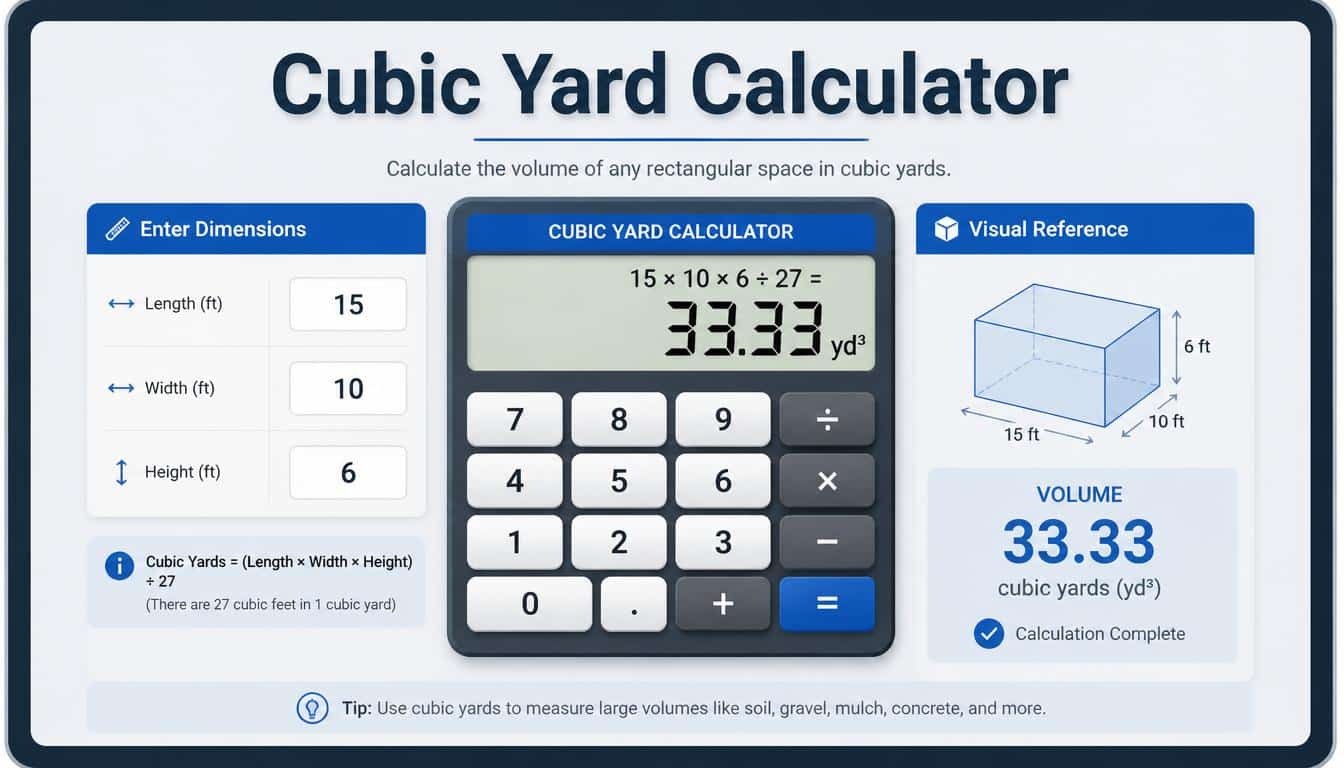
That is exactly where a Cubic Yard Calculator becomes useful. Instead of guessing how much material belongs in a flower bed, driveway, excavation area, or concrete project, you can turn ordinary length, width, and depth measurements into volume in cubic yards.
It makes the buying decision much less mysterious, and yes, it can also help prevent ordering a mountain of mulch when you only needed a hill.
A cubic yard is a unit of volume commonly used for bulk materials. Once you understand the basic cubic yard formula, calculating yardage becomes surprisingly straightforward, even if math has never been your favorite weekend activity.
| Item | Formula / Value |
| Cubic Yard Formula | Length × Width × Depth ÷ 27 |
| 1 Cubic Yard | 27 cubic feet |
| 1 Cubic Yard | 46,656 cubic inches |
| 1 Yard | 3 feet |
| 1 Foot | 12 inches |
| Inches to Feet | Inches ÷ 12 |
| Cubic Feet to Yards | Cubic Feet ÷ 27 |
| Material Cost | Cubic Yards × Price per Yard |
| Rectangular Area | L × W × D |
| Cylinder | π × Radius² × Height ÷ 27 |
| Common Materials | Gravel, Soil, Mulch, Concrete, Dirt, Fill |
| Best Use | Estimate material quantity and cost |
What Is a Cubic Yard?
A cubic yard is a three-dimensional measurement representing a space that is 1 yard long, 1 yard wide, and 1 yard high. Since one yard equals 3 feet, one cubic yard measures 3 ft × 3 ft × 3 ft, which equals 27 cubic feet.
In other words, 1 cubic yard = 27 cubic feet. This relationship is the little bridge between measurements taken in feet and the amount of bulk material you need to order.
A cubic yard is also equal to 46,656 cubic inches and approximately 0.764555 cubic meters. Those conversions look rather dramatic on paper, but the important thing for most landscaping and construction work is simply remembering the 27-cubic-foot relationship.
Materials such as gravel, soil, mulch, dirt, fill, and concrete are often sold by the cubic yard. The supplier may quote a price per yard, so knowing your cubic yardage can turn a vague project estimate into an actual shopping list.
How Does a Cubic Yard Calculator Work?
A cubic yardage calculator takes the dimensions of your project and converts them into a volume measurement. For a simple rectangular area, you normally need three measurements: length, width, and depth.
If your measurements are already in feet, the basic calculation is:
Cubic yards = Length × Width × Depth ÷ 27
For example, imagine a garden area that is 12 feet long, 14 feet wide, and 9 inches deep. Because the depth is measured in inches, first convert 9 inches into feet.
9 inches ÷ 12 = 0.75 feet.
Then calculate the volume:
12 × 14 × 0.75 = 126 cubic feet.
Finally:
126 ÷ 27 = 4.67 cubic yards.
So the project requires approximately 4.67 cubic yards of material before allowing for waste, settling, compaction, or ordering practices. It is a pretty small calculation, really, but it saves a surprising amount of guesswork.
Cubic Yard Calculator Formula for Rectangular Areas
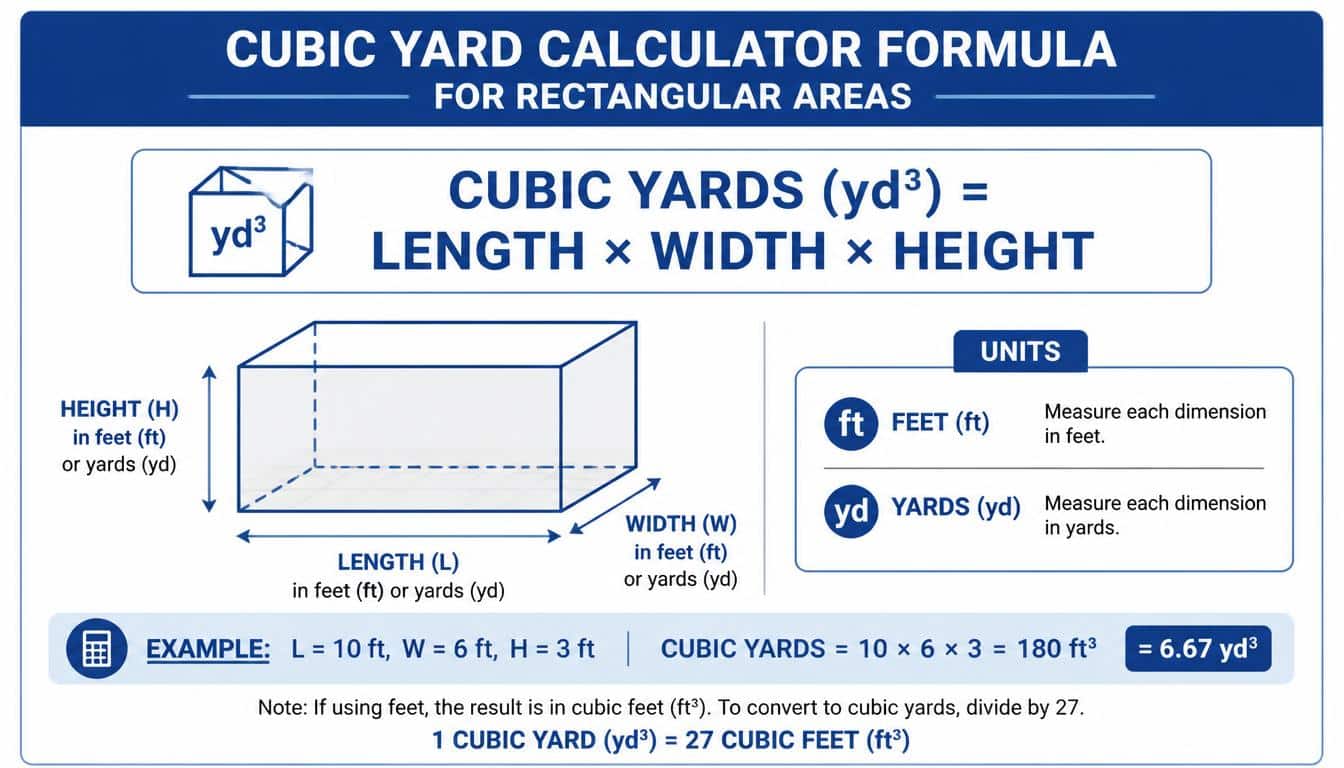
Most household landscaping projects have a rectangular prism or rectangular cuboid shape, even when the garden itself looks a little wonky around the edges.
The standard cubic yards formula is:
Cubic yards = Length × Width × Height ÷ 27
For landscaping, “height” is often the depth of material. If you are spreading mulch, soil, or gravel over the ground, depth tells the calculator how thick that layer will be.
Suppose a driveway section measures 20 feet by 10 feet, and you want 4 inches of gravel. Convert the depth first:
4 ÷ 12 = 0.3333 feet.
Then:
20 × 10 × 0.3333 = 66.66 cubic feet.
66.66 ÷ 27 = approximately 2.47 cubic yards.
That means your estimated gravel yardage is about 2.47 cubic yards. Depending on how the supplier sells material, you may need to purchase 2.5 yards, 3 yards, or another available quantity.
How to Calculate Cubic Yards From Feet
If your length, width, and depth are all given in feet, things get wonderfully boring. And boring is good when calculating materials.
Multiply the three dimensions together to find cubic feet, then divide by 27 to convert the result into cubic yards.
For instance:
15 ft × 8 ft × 0.5 ft = 60 cubic feet.
60 ÷ 27 = 2.22 cubic yards.
The key thing is that all dimensions need to use the same unit before multiplication. Mixing feet and inches without converting them first can create a very confident-looking answer that is completely wrong, which is a sneaky little problem.
How to Calculate Cubic Yards From Inches
Sometimes the project dimensions are measured in inches, especially for smaller construction jobs or detailed measurements. You can still use a cubic measurement calculator, but convert the measurements consistently.
There are 12 inches in 1 foot. So, divide an inch measurement by 12 to turn it into feet.
For example, a material depth of 6 inches equals:
6 ÷ 12 = 0.5 feet.
If an area is 10 feet long and 16 feet wide with a 2-inch material depth, the calculation becomes:
10 × 16 × (2 ÷ 12) = 26.67 cubic feet.
Then:
26.67 ÷ 27 = approximately 0.99 cubic yards.
That is almost exactly one cubic yard. A convenient result, for once the measuring gods have smiled.
Calculating Cubic Yards for Landscaping
A landscaping calculator is particularly useful when planning beds, pathways, lawns, driveways, and other outdoor spaces. The most common materials include mulch, soil, gravel, and decorative stone.
For mulch, measure the length and width of the bed and decide how deep you want the layer. For soil, the same process works, although soil may settle after installation. Gravel calculations also use the same basic volume approach, but the final amount can depend on the type and application.
For example, a 9-foot × 12-foot garden bed with a 3-inch layer of mulch needs:
9 × 12 × 0.25 = 27 cubic feet.
27 ÷ 27 = 1 cubic yard.
So that garden bed needs roughly one cubic yard of mulch. This is the kind of quick material quantity calculation that makes a supplier conversation much easier.
Gravel, Soil, Mulch, and Dirt Yardage
Different materials can require different practical considerations even when the mathematical volume is identical. A gravel calculator, soil calculator, or mulch calculator can therefore be useful for estimating how much bulk material to purchase.
A 2-cubic-yard volume is still 2 cubic yards whether it contains mulch or gravel, but the weight can be dramatically different. That matters if you are transporting the material yourself or checking the capacity of a truck.
Soil yardage may also need extra allowance because loose soil can compact after spreading. Mulch can settle too, while gravel may spread differently depending on stone size and the condition of the surface beneath it.
The volume calculation gives you the starting point. Real-world material behavior is where the slightly messier part begins.
How to Calculate Concrete Yardage
Concrete is another major application for a cubic yard calculator. Contractors and homeowners often need to know the volume of a slab, footing, walkway, patio, or other concrete project before ordering.
For a rectangular slab, use:
Length × Width × Thickness ÷ 27 = cubic yards
Suppose a patio is 12 feet long, 12 feet wide, and 4 inches thick.
Four inches equals 0.3333 feet.
12 × 12 × 0.3333 = about 48 cubic feet.
48 ÷ 27 = approximately 1.78 cubic yards.
Concrete ordering deserves particular care because running short during a pour can be a rather unpleasant surprise. It is often sensible to discuss the calculated amount and an appropriate allowance with the concrete supplier rather than relying on a razor-thin estimate.
Cubic Yard Calculation for a Cylinder
Not every project is a rectangle. Some spaces are round, such as circular planting areas, round foundations, posts, tanks, or other cylindrical structures.
For a cylinder, the volume formula is:
Volume = π × radius² × height
If the measurements are in feet, divide the resulting cubic feet by 27 to get cubic yards.
The radius is half the diameter. So if the diameter is 10 feet, the radius is 5 feet.
A cylinder that is 10 feet across and 1 foot deep would therefore have a volume of:
π × 5² × 1
Using π as approximately 3.14159265359 gives about 78.54 cubic feet.
Then:
78.54 ÷ 27 = approximately 2.91 cubic yards.
For circular spaces, measuring the diameter carefully is important because a small error there affects the calculated radius and therefore the final volume more significantly than you might expect.
How Much Area Does a Cubic Yard Cover?
There is no single answer to “how much does a cubic yard cover?” because coverage depends entirely on the depth of material.
One cubic yard equals 27 cubic feet. If you spread it 1 foot deep, it covers 27 square feet. If you spread that same cubic yard thinner, it covers a much larger area.
At a depth of 6 inches, or 0.5 feet:
27 ÷ 0.5 = 54 square feet.
At a depth of 3 inches, or 0.25 feet:
27 ÷ 0.25 = 108 square feet.
This is why an area and depth calculator is often more useful for landscaping than simply asking how many yards a project covers. Thickness changes everything, quietly sitting there like the boss of the calculation.
How Much Material Do I Need?
To determine how many cubic yards you need, measure the complete area that will receive material and calculate its volume. If the area has an unusual shape, divide it into smaller rectangles or other manageable geometric areas.
For example, an L-shaped garden can be split into two rectangular sections. Calculate the yardage for each section, then add the results together.
This approach is often more accurate than trying to force an irregular space into one oversized rectangle. The latter can leave you ordering material for empty air, which is impressive but not especially useful.
You should also consider waste, settling, compaction, and installation conditions. The appropriate allowance varies by project and material, so a local material supplier or contractor can help determine whether your calculated quantity should be increased.
Estimating Material Cost
Once you know your cubic yardage, estimating the price is straightforward.
Material cost = Cubic yardage × Price per cubic yard
If your project requires 4 cubic yards and the supplier charges $45 per cubic yard:
4 × $45 = $180.
That gives you an estimated material cost before delivery fees, taxes, minimum-order charges, or other supplier-specific costs.
If your calculation produces 4.67 cubic yards, don’t automatically assume that every supplier will sell exactly 4.67 yards.
Some suppliers may sell fractional quantities, while others may have minimums or preferred ordering increments. Asking about a partial yard can sometimes save money and sometimes create a delivery headache, so it is worth checking first.
Cubic Feet to Cubic Yards Conversion
The most important conversion in this entire topic is simple:
1 cubic yard = 27 cubic feet
Therefore:
Cubic yards = Cubic feet ÷ 27
And:
Cubic feet = Cubic yards × 27
For example, 81 cubic feet equals:
81 ÷ 27 = 3 cubic yards.
Likewise, 5 cubic yards equals:
5 × 27 = 135 cubic feet.
Remember that this is a conversion between volumes, not ordinary length measurements. You cannot convert 27 feet into one cubic yard; the word “cubic” changes the whole game.
Common Mistakes When Calculating Cubic Yardage
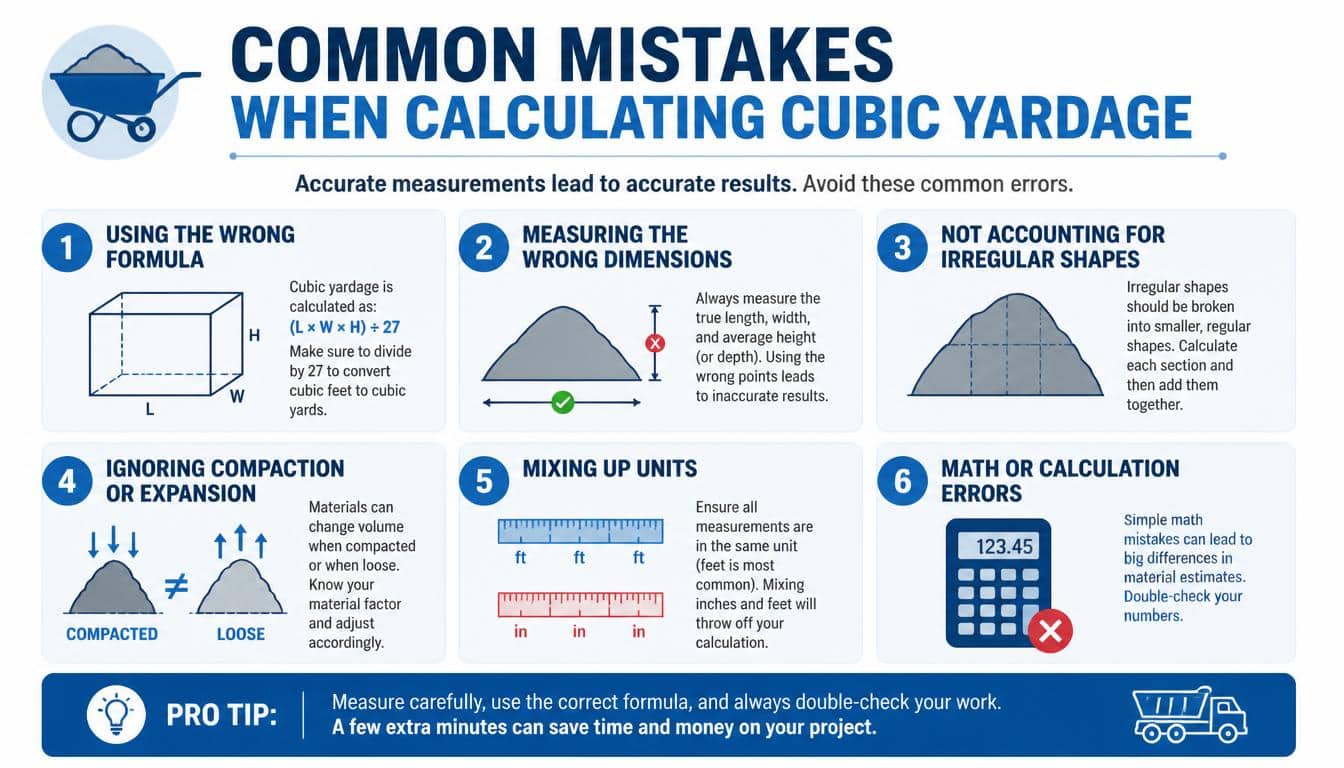
One of the biggest mistakes is forgetting to convert inches into feet. A depth of 6 inches is not 6 feet, thankfully, or your garden would require a heroic quantity of mulch.
Another common error is using square feet as though they were cubic feet. Area measures two dimensions, while volume measures three. You need length, width, and depth or height to calculate cubic yardage.
People also sometimes divide by 3 instead of 27 when converting cubic feet to cubic yards. One yard equals 3 feet, but one cubic yard equals 3 × 3 × 3 feet, which is 27 cubic feet.
Finally, rounding too early can affect the final answer. Keep several decimal places during the calculation, then round the finished result according to the quantity your supplier actually sells.
Truck Bed and Material Capacity
If you plan to pick up material yourself, knowing the cubic yardage of a truck bed can be helpful, but volume is only part of the story. Weight capacity matters just as much, and different materials have very different densities.
For example, a truck may physically have enough space for a certain volume of mulch, but that does not automatically mean it can safely carry the same volume of wet soil or gravel.
A commonly discussed example is a 6-foot truck bed, such as a 2022 Toyota Tacoma 6-foot truck bed, whose usable volume depends on the bed’s actual dimensions and the height to which material is loaded.
Always check the vehicle’s payload rating and the supplier’s loading guidance rather than relying only on cubic-yard volume.
Tips for Getting a More Accurate Cubic Yard Estimate
Measure each section carefully, particularly when the project has several different depths. A few inches can make a surprisingly noticeable difference across a large area.
Use the same measurement system throughout the calculation. If you start in feet, convert inches into feet before multiplying. Mixing units is where many otherwise sensible calculations wander off into the weeds.
For irregular spaces, divide the project into simple shapes. Calculate each section separately and add the volumes together. This is often the easiest method for real gardens and construction areas.
Keep the calculated result separate from the amount you actually order. Your cubic yard calculation tells you the theoretical volume, while your final order quantity should account for practical factors such as settling, compaction, waste, and supplier policies.
And when the material is heavy, check weight limits as well as volume. A cubic yard is a volume measurement; it does not tell you how many pounds or tons are sitting inside it.
Quick Cubic Yard Reference
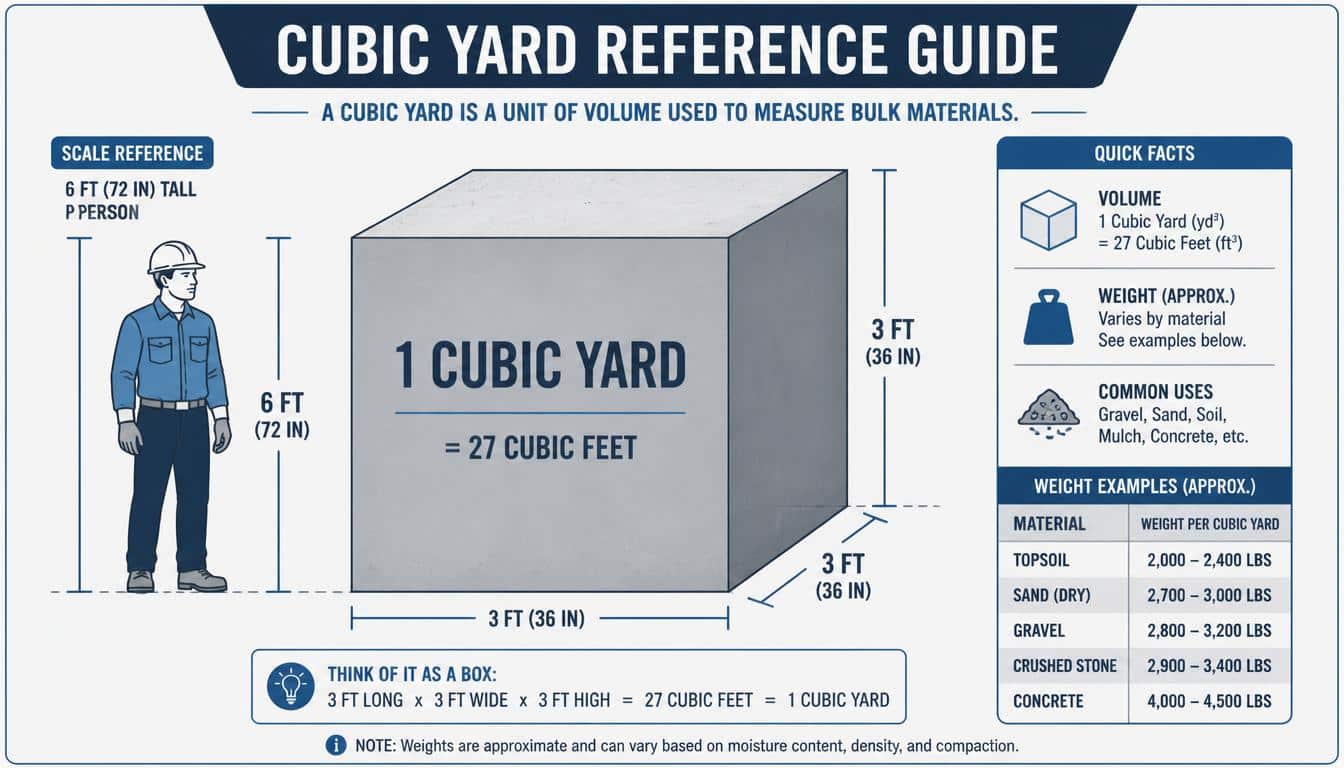
Here are a few useful conversions to keep nearby when working on a project:
- 1 cubic yard = 27 cubic feet
- 1 cubic yard = 46,656 cubic inches
- 1 cubic yard ≈ 0.764555 cubic meters
- 1 yard = 3 feet
- 1 foot = 12 inches
- 3 feet × 3 feet × 3 feet = 1 cubic yard
- 36 inches × 36 inches × 36 inches = 1 cubic yard
- Cubic yards from feet = L × W × D ÷ 27
- Material cost = cubic yardage × price per cubic yard
These simple relationships cover a surprisingly large percentage of everyday landscaping projects and basic construction calculations.
Frequently Asked Questions About Cubic Yard Calculations
How do I calculate cubic yards?
Multiply the length, width, and depth in feet to find cubic feet, then divide that result by 27. The answer is your approximate volume in cubic yards.
How many cubic feet are in a cubic yard?
There are 27 cubic feet in one cubic yard. This comes from multiplying 3 feet by 3 feet by 3 feet.
How many cubic yards do I need for landscaping?
Measure the length and width of the area, determine the desired material depth, convert the depth to feet, and use the cubic-yard formula. The result tells you the estimated material yardage.
How many cubic yards of gravel do I need?
Multiply the gravel area’s length, width, and depth in feet, then divide by 27. For irregular areas, break the space into smaller shapes and add their volumes together.
How much does a cubic yard cost?
The cubic yard cost depends on the material, location, supplier, delivery distance, and market prices. Multiply the number of cubic yards by the supplier’s current price per yard to estimate the material cost.
Can I calculate cubic yards from inches?
Yes. Convert the inch measurements into feet first by dividing each measurement by 12, then apply the standard formula. This keeps the units consistent and avoids a very common calculation mistake.
How much does one cubic yard cover?
Coverage depends on depth. One cubic yard contains 27 cubic feet, so spreading it at 3 inches deep covers approximately 108 square feet, while spreading it at 6 inches deep covers about 54 square feet.
Can a cubic yard calculator estimate concrete?
Yes. For a rectangular slab or similar structure, enter the length, width, and thickness, making sure the dimensions use consistent units. For complicated concrete shapes, divide the structure into simpler geometric sections.
Yardage calc
A yardage calculator helps you determine how much material you need based on the length, width, and depth of an area. It is useful for estimating landscaping and construction materials.
Cyd calculator
A CYD calculator determines the volume of a space in cubic yards. Enter the dimensions of the area to quickly calculate the required cubic yardage.
Yards of dirt calculator
A yards of dirt calculator helps estimate the amount of dirt needed for a specific area and depth. It gives the result in cubic yards for easier ordering.
Dirt yardage calculator
A dirt yardage calculator calculates the cubic yards of dirt required for landscaping, grading, or filling projects. Simply enter the area’s dimensions and depth.
Dirt yard calculator
A dirt yard calculator helps you determine how many cubic yards of dirt you need for your project. It can also help estimate the amount of material to order.
Read More: https://gracethemes.com/what-date-is-14-weeks-from-today/
Making the Calculation Work for Your Project
The real strength of a Cubic Yard Calculator is not that it performs difficult mathematics. The math itself is quite modest. Its value is that it turns physical dimensions into a useful purchasing number, connecting the space you need to fill with the amount of material a supplier can actually sell you.
Whether you’re calculating gravel yardage for a driveway, mulch yardage for flower beds, soil yardage for raised planting areas, or concrete volume for a patio, the same underlying idea keeps appearing:
dimensions become volume, volume becomes cubic yards, and cubic yards become an order quantity and estimated cost.
Before placing an order, measure twice, check your units, and review the result with your supplier when the project is large or the material is particularly heavy.
A calculator can give you the number; experience and careful measuring help make sure that number behaves itself in the real world.
A good cubic yard calculation should leave you feeling less like you’re guessing and more like you’re actually in control of the project.
Once length, width, depth, volume, and the 27-cubic-foot conversion click into place, the whole subject becomes much less intimidating and your next pile of gravel suddenly looks a lot more measurable.
