

Can Prompts Alone Make AI Writing Sound Human? What the Research Shows
In a 2025 study at UC San Diego, people chatted with a human and an AI side by side for five minutes, then guessed which was which. When GPT-4.5 was given a carefully written persona prompt, judges picked it as the human 73% of the time. Without that prompt, the same model won just 36% of the time.
One prompt doubled the result. So it’s tempting to conclude that the right instructions can make any AI text pass as human. Type “write like a person, vary your sentences, avoid clichés” and you’re done, right?
Not quite. The research tells a more mixed story, and it’s worth understanding before you spend an hour tweaking prompts.
Why Everyone Is Trying to Prompt Their Way to Human
ChatGPT alone had more than 900 million weekly active users as of March 2026, according to OpenAI. That’s a staggering volume of AI-assisted writing, and most of it shares the same polished, slightly flat voice.
At the same time, people are uneasy about telling the difference. A Pew Research Center survey of 5,023 US adults, published in September 2025, found 53% weren’t confident they could tell whether something was made by AI, while 76% said being able to tell was extremely or very important. So writers want their AI-assisted drafts to sound natural, and readers want to know what they’re reading. Prompting looks like the cheapest fix. The alternatives take more effort: editing by hand, or running drafts through a dedicated rewriting model such as phrasly ultra, which aims for natural phrasing while keeping your meaning. So it’s fair to ask how far prompts get you on their own.
What a Good Prompt Can Actually Do
Prompts are powerful. The UC San Diego study, by Cameron Jones and Benjamin Bergen, shows it clearly.
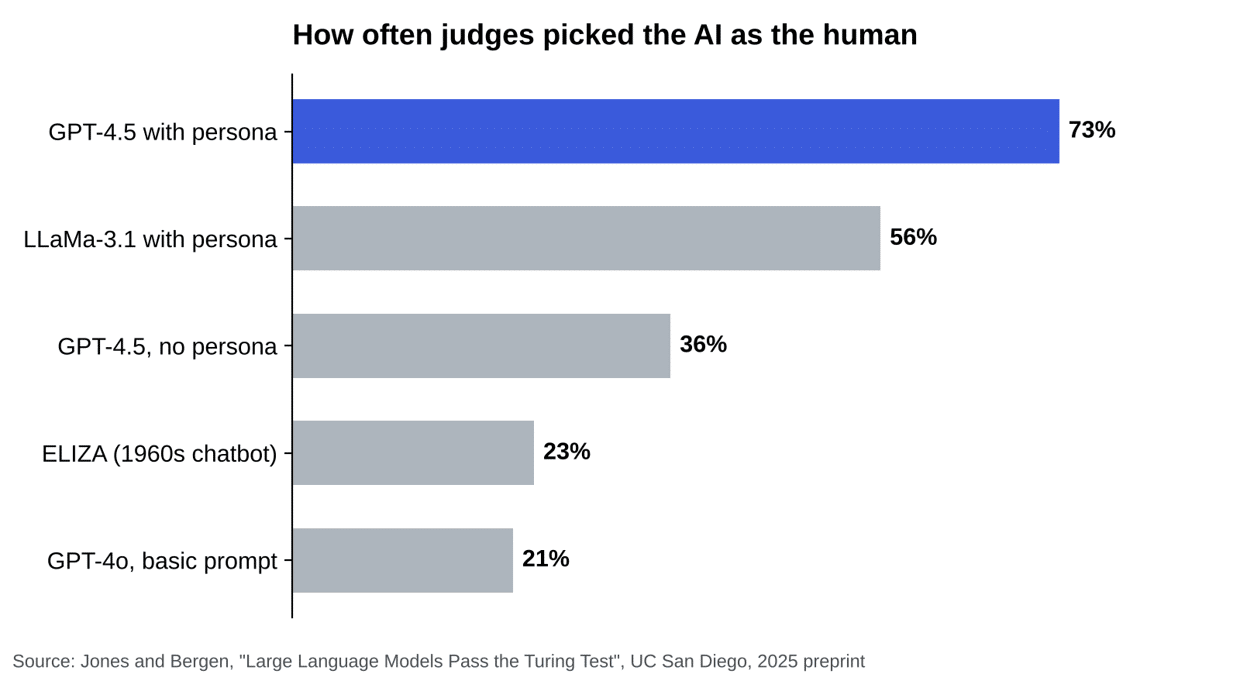
Share of conversations where judges picked the AI as the human, by model and prompt (Jones and Bergen, UC San Diego, 2025 preprint).
The persona prompt told the model to adopt a specific character: a young person who’s into internet culture, a bit casual and not trying too hard. That shift in voice changed how people perceived it. A plain GPT-4o setup scored 21%, actually below ELIZA, a chatbot from the 1960s, at 23%.
One caveat matters. This was live chat, not a 1,500-word article. Short, casual replies are easier to make convincingly human than long, structured writing.
Prompts Can Even Fool Detectors
A 2024 study by Ning Lu and colleagues introduced a prompting method called SICO. Using just 40 human-written examples to guide the model’s style, it helped GPT-3.5 evade six AI detectors, cutting their accuracy score (AUC) by 0.5 on average. That’s a huge drop. It’s also older work on an older model, and detectors have changed since.
Where Prompting Runs Out of Road
Here’s the other side.
Models Have a Default Voice That Fights Back
A 2025 study by Kendro, Maloney and Jarvis compared ChatGPT writing with human writing on lexical diversity, the range of words and structures used. ChatGPT text differed significantly from human text, and a classifier told them apart with 95.8% accuracy. One finding stands out: newer models produced less human-like text than older ones.
A March 2026 preprint on AI-assisted essays found something similar. Essays written with AI help lost most of the natural variation in how ideas were linked, though the researchers found that more specific prompting reversed some of that. Their conclusion was that sameness isn’t built into AI, it comes from how people use it. Good prompts help. Lazy prompts produce lazy-sounding text.
Expert Readers Still Catch It
A 2025 ACL paper by Jenna Russell, Marzena Karpinska and Mohit Iyyer tested people who use ChatGPT heavily for writing. A majority vote of five such experts misclassified just 1 of 300 articles, even when the AI text had been paraphrased or prompted with a detailed guide on avoiding AI tells. Regular readers may struggle. Experienced ones notice word choice, structure and those too-neat conclusions.
Results Swing Wildly
In a hands-on 2026 test, marketer Lilach Bullock prompted ChatGPT through two rounds of humanising instructions. Originality.ai’s AI score dropped from 94% to 61% to 22%. Then she re-scanned the exact same text 15 minutes later and got 38%. Same words, different verdict. Prompting can move the number, but you can’t count on where it lands.
Generic “Sound Human” Prompts Barely Work
A recent test of two custom GPTs built for rewriting AI text ran the same 280-word ChatGPT draft through both. Each still scored 100% AI on GPTZero and changed surprisingly little. Wrapping a “be more human” instruction in a custom GPT doesn’t give the model a new voice.
How to Write Prompts That Actually Help
If prompting alone isn’t magic, it’s still the cheapest first step. These approaches work better than “make it sound human.”
Give It Your Writing, Not Adjectives
Paste two or three paragraphs you’ve written and ask the model to match the voice. Examples beat descriptions every time. That’s essentially what the SICO researchers did with their 40 samples.
Feed It Real Material
Give the model your notes, interview quotes, data or a voice memo transcript. Text built from specific source material sounds less generic because it is less generic.
Set Concrete Rules
Instead of “vary sentences,” try: “Mix sentences of 4 to 30 words. No paragraph longer than four sentences. Don’t use ‘moreover,’ ‘delve,’ ‘crucial’ or ‘in today’s world.’ Use contractions.”
Assign a Specific Persona
The Jones and Bergen result shows persona matters. “A plain-spoken operations manager explaining this to a new hire” will sound more human than “a professional writer.”
Ask for a Point of View
Models default to balance. Tell it which side to take and why, then edit the argument so it’s really yours.
Prompt, Then Edit
Even the best prompt gives you a draft, not a finished piece. The research points to a three-layer approach:
- Prompt well to get a better starting draft.
- Rework the phrasing where it still sounds stiff. For long drafts, a dedicated rewriting model like the one mentioned earlier can handle this pass. Its published pass rates come from the company’s own benchmark, so judge it on your own text.
- Edit by hand to add specifics, opinions and anything only you would know.
That last step is the one no tool skips. And if you’re writing in a setting with AI rules, such as school, a publication or a client contract, follow them and disclose where expected.
Better Inputs, Still Your Output
Can prompts alone make AI writing sound human? Sometimes, briefly, in short bursts. The Turing test study proves a persona can transform how a model comes across. But longer writing exposes a model’s default habits, expert readers still pick up on them, and detector scores bounce around even on unchanged text.
Prompting is a strong opening move, not the whole game. Use it to get a sharper first draft, then shape that draft with your own examples, your own opinions and your own rhythm. The most human thing in any piece of writing is still the person who decided what it should say.
