
The 7 Best Shopify Mobile App Builders for Brands in 2026
For the right Shopify brand, a mobile app can be one of their most valuable revenue channels.
An app gives your best customers a faster, more convenient way to shop. It keeps your brand visible on their phone and lets you reach them directly through push notifications, without having to pay every time you send a message.
Through history, to get all these benefits, a brand had to have deep pockets and development resources. Today, not so much.
A Shopify mobile app builder is a platform that lets Shopify brands launch their own mobile apps, without hiring developers or a development agency. They give every Shopify brand an app development team, giving access to the best retention channel in ecommerce, for a price starting from just a few hundred dollars per month.
The category is broad, and choosing the right platform to power your brand’s app can be a challenge. But that’s what we’re going to help with, below.
The Best Shopify Mobile App Builders At A Glance
Here’s a quick look at seven Shopify mobile app builders that brands are using to build high-quality native mobile apps:
| Mobile app builder | Best for | Starting price | Approach |
| MobiLoud | Established brands that want to retain their complete existing storefront | $1,499/month, plus setup | Builds the app directly from the existing website |
| Tapcart | Shopify brands focused on app merchandising and optimization | $500/month | Block-based Shopify app builder |
| Shopney | Small and mid-market brands wanting a straightforward no-code platform | $149/month | Theme and block-based builder |
| Superfans.io | Brands focused on loyalty, exclusivity and VIP experiences | Custom pricing | Retention-focused drag-and-drop builder |
| Plobal Apps | Brands prioritizing push campaigns and personalization | $199/month | Drag-and-drop native app builder |
| Apptile | Brands interested in live commerce and flexible visual merchandising | $249/month | Tile-based no-code builder |
| Appmaker | Brands wanting more design control and developer extensibility | Around $1,000/month | Customizable block-based platform |
Why Your Shopify Store Should Have a Mobile App
The first step is to validate why (or if) your brand should have a mobile app in the first place.
A mobile app may not be essential for every Shopify brand.
For an early-stage store still trying to establish consistent traffic and product-market fit, the more urgent focus is acquiring more customers and getting over a certain growth plateau.
But for any business with consistent revenue and a natural path to repeat purchases, having a mobile app is quickly becoming essential.
An app gives customers an easier way to come back, browse, and buy again from you. Less friction = more repeat purchases.
It also gives your brand a permanent place on their home screen, and push notifications, which are like a free version of SMS, that land on the customer’s lock screen, already opened.
Through a mobile app, you can provide exclusive experiences for your best customers:
- Early access to promos and new products
- Exclusive discounts for VIPs
- Store experiences built for returning customers specifically
- A hub for your loyalty program, easy access to subscription management, in-app community features
All these are features that drive meaningful increases in repeat customer revenue.
Of course, if you don’t have the product line to justify customers making multiple purchases, all that doesn’t matter. And a mobile app might not be the best fit.
But for any growing brand in categories such as fashion, beauty, grocery, F&B, supplements, hobbies, automotive, sports and outdoors, and much more – a mobile app is now a core brand asset.
The Very Best Shopify Mobile App Builders for Today’s Brands
Now, let’s dive deeper into the core topic: the best mobile app builders to help you create a high-quality mobile app for your Shopify brand.
1. MobiLoud
Best for established brands that want to retain their complete existing storefront
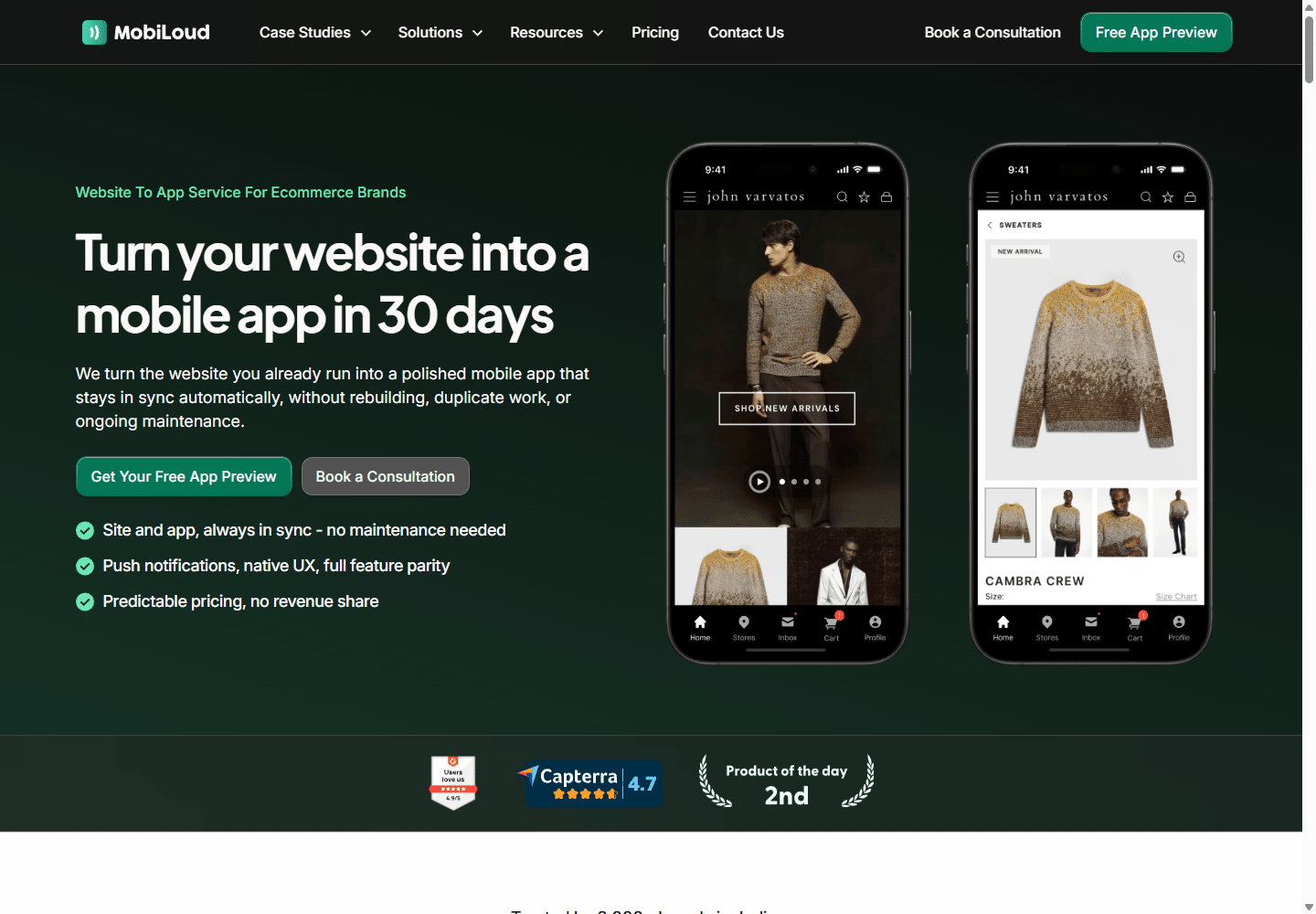
MobiLoud is a different kind of mobile app builder.
Instead of asking you to rebuild your Shopify store using a selection of native templates and blocks, MobiLoud builds native iOS and Android apps directly from your existing website.
It then adds a native layer on top, including tab navigation, push notifications, deep linking, app-only screens and other mobile-specific functionality.
The important difference is that your existing site is the foundation of the app.
This means that everything that works on your website can continue to work inside the app, including your entire tech stack; Shopify apps, custom design, third-party vendor tools, checkout, custom code and bespoke functionality.
The app runs off the live version of your site, so changes made to the website are reflected in the app automatically. Your team doesn’t have to maintain a separate app storefront or reproduce every website update in another editor.
This makes MobiLoud particularly relevant for established brands with customized stores or complex technology stacks.
A conventional Shopify app builder may support many popular ecommerce integrations, but it still needs a native integration for each individual tool. MobiLoud avoids much of that problem because the app continues to use the existing storefront and its existing integrations.
MobiLoud is also a fully managed service rather than primarily a piece of self-service software. Its team handles the design, configuration, testing, app-store submission and ongoing technical maintenance.
Notable features
- Full support for your existing Shopify storefront, custom code and third-party tools
- Native tab navigation and app-only screens
- Push notifications and deep linking
- App-store submission and ongoing updates handled by MobiLoud
- Support for Shopify, Shopify Plus, as well as headless builds on Shopify Hydrogen or custom frameworks
- No need to manage a second storefront
Best suited to
MobiLoud is best suited to established ecommerce brands, generally from around $5 million in annual online revenue through enterprise level.
It is an especially strong fit for brands in fashion, beauty, grocery and supplements, where stores frequently depend on subscriptions, loyalty programs, reviews, product personalization, bundles, search tools and other third-party functionality.
Pricing
MobiLoud’s Business plan starts at $1,499 per month. A separate setup fee covers design, configuration, analytics, push notification setup, quality assurance and submission to the Apple App Store and Google Play. Enterprise pricing is available for larger or more complex deployments.
What to consider
MobiLoud costs more than an entry-level DIY builder and is designed for brands that already have meaningful ecommerce scale.
The higher price reflects a different type of service. Rather than giving your team a tool and leaving it to build and operate the app, MobiLoud delivers and maintains the app on your behalf.
It therefore makes the most sense when preserving the existing customer experience and reducing internal workload matter more than finding the lowest monthly subscription.
2. Tapcart
Best for Shopify-native merchandising and app optimization
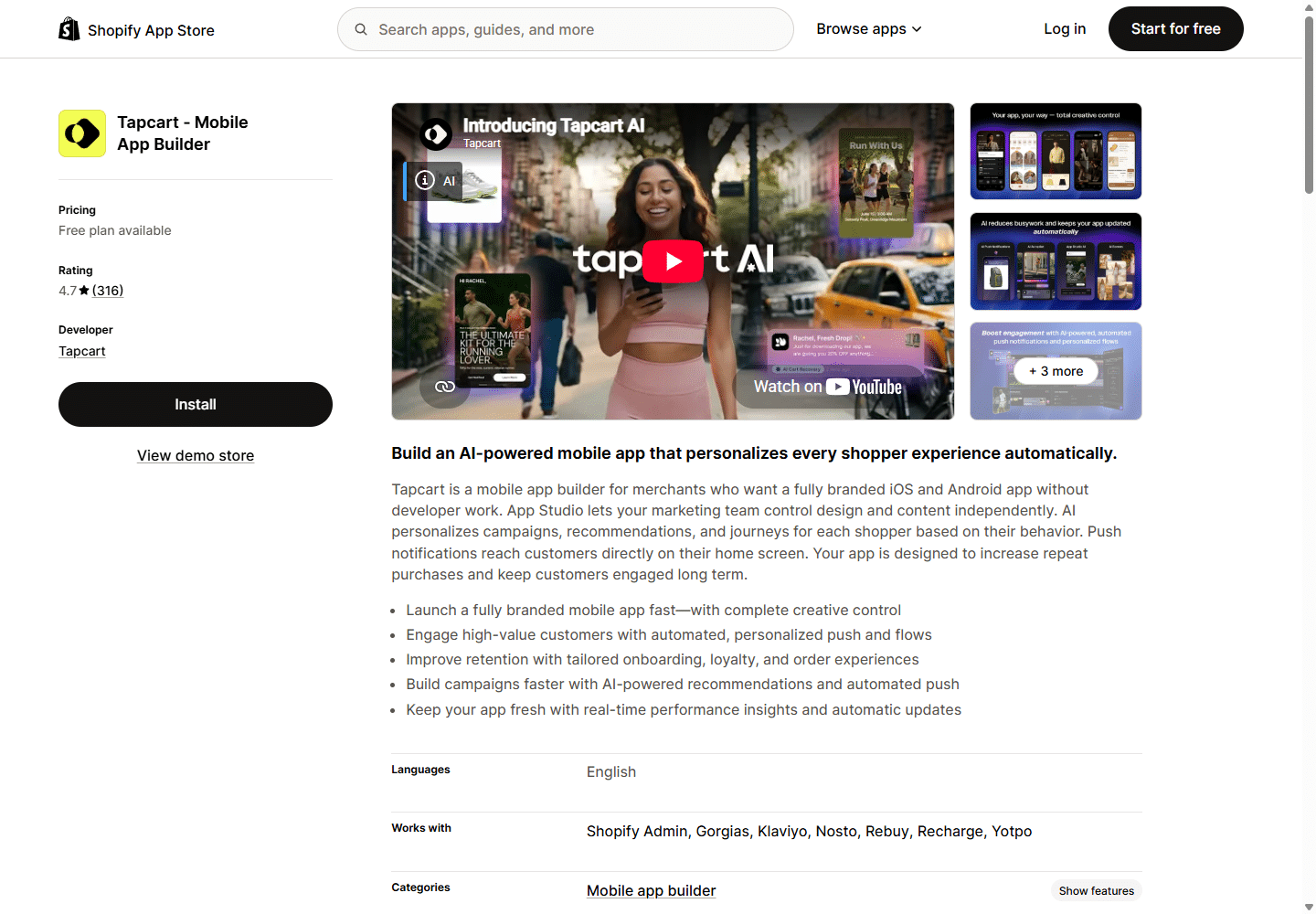
Tapcart is one of the most established mobile app platforms built specifically for Shopify.
It lets brands create native iOS and Android shopping apps using a block-based visual editor. Products, collections, customer details, inventory and checkout data run from Shopify, while the app experience is managed through Tapcart.
In recent years, Tapcart has expanded beyond basic app creation into merchandising, personalization and optimization. It has a complex editor to let brands create app-specific layouts, landing pages and campaigns, and AI tools to expand that even further.
This makes Tapcart a good option for brands that intend to operate their app as an active merchandising channel; not so much if you want your app to be a low-maintenance channel.
Notable features
- Block-based app editor
- App-specific product and collection merchandising
- Push notifications and in-app campaigns
- Customer segmentation and personalized content
- App analytics and optimization tools
- Capture Kit for driving app downloads
- Integrations with popular Shopify tools
Best suited to
Tapcart is best suited to established Shopify brands that want a mature, Shopify-specific platform and have a team available to merchandise and optimize the app.
It is a particularly logical choice when the app is expected to have its own campaigns, layouts and content strategy rather than simply matching the existing website.
Pricing
Tapcart’s plans currently start at $500 per month, up to a starting point of $2,850/month for their Enterprise plan. Available features vary by tier, and larger brands may receive customized commercial terms.
What to consider
Tapcart creates a separate app storefront using its own blocks and supported integrations.
That gives your team significant control over the app experience, but it also means the app needs to be managed separately from the website.
Brands with heavily customized storefronts should audit their existing Shopify stack carefully and confirm that every important customer journey can be reproduced inside the app.
3. Shopney
Best for a straightforward no-code app-building experience
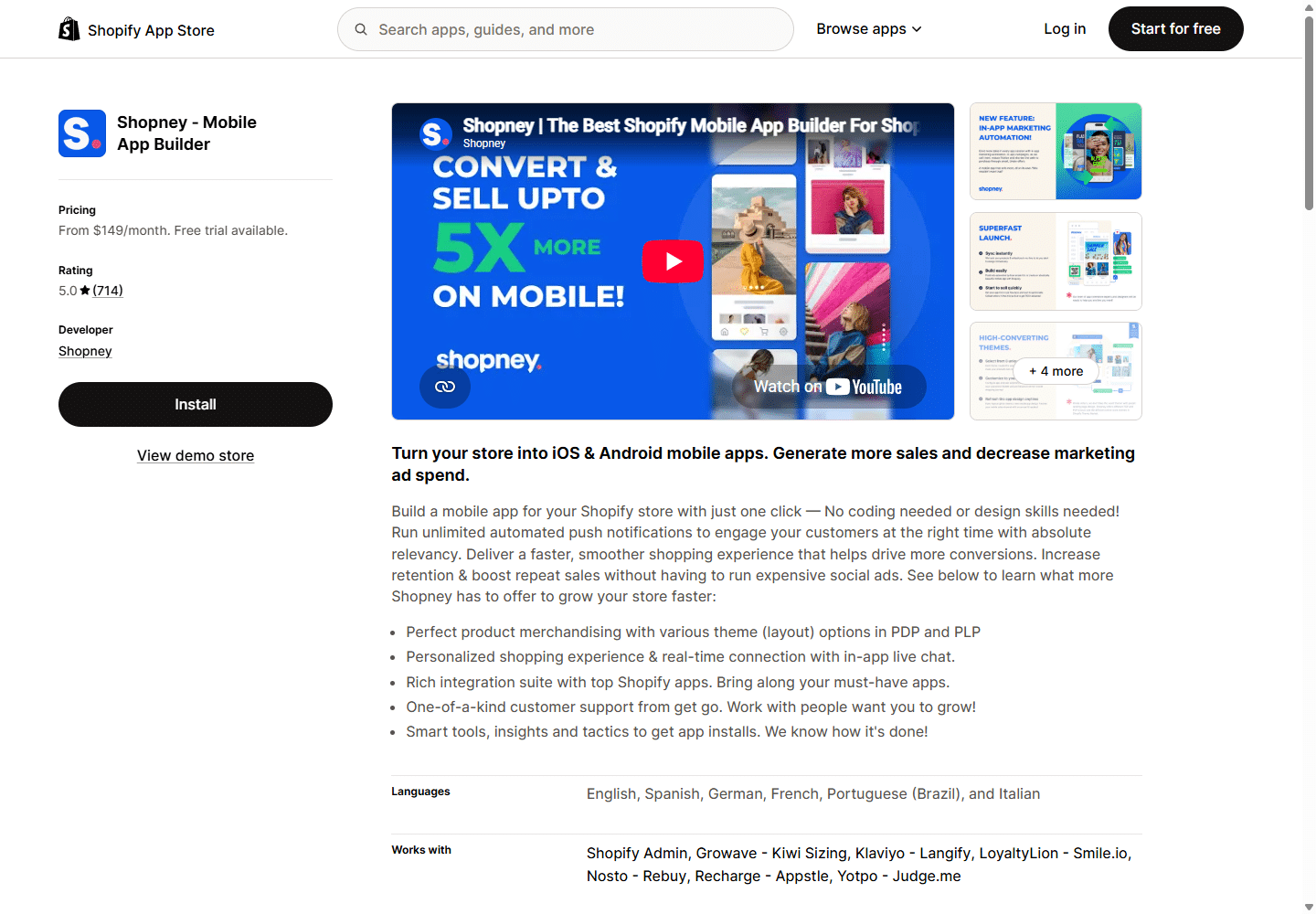
Shopney is a no-code Shopify mobile app builder aimed at brands that want to launch without hiring mobile developers.
It provides a selection of themes and configurable design elements that merchants can use to assemble an iOS and Android app.
The platform follows a conventional mobile app builder model. You choose a theme, customize the app’s layout and branding, connect the integrations you require, and manage the resulting app through Shopney’s dashboard.
The platform also offers multi-language and multi-currency capabilities, making it relevant for stores selling across multiple markets. Shopney advertises flat subscription pricing without commissions on app sales.
Notable features
- Multiple mobile app themes
- Drag-and-drop design controls
- Unlimited push notifications on supported plans
- In-app chat
- Multi-language and multi-currency support
- Barcode scanning
- Live-selling and augmented-reality features on selected tiers
- No commission on app sales
Best suited to
Shopney is a strong option for small and mid-market Shopify brands that want a conventional no-code builder with relatively transparent pricing.
It is particularly suitable for stores whose customer journey can be represented effectively using standard ecommerce layouts and supported Shopify integrations.
Pricing
Shopney’s plans currently start at $149 per month, with higher tiers available for brands that need additional themes, integrations, support and enterprise functionality.
What to consider
As with most drag-and-drop builders, the main consideration is whether Shopney can reproduce the important parts of your existing storefront.
A standard product catalog and checkout may be straightforward. Custom product configurators, unusual account functionality, bespoke landing pages or less common Shopify apps may require additional investigation.
4. Superfans.io
Best for loyalty, exclusivity and VIP customer experiences
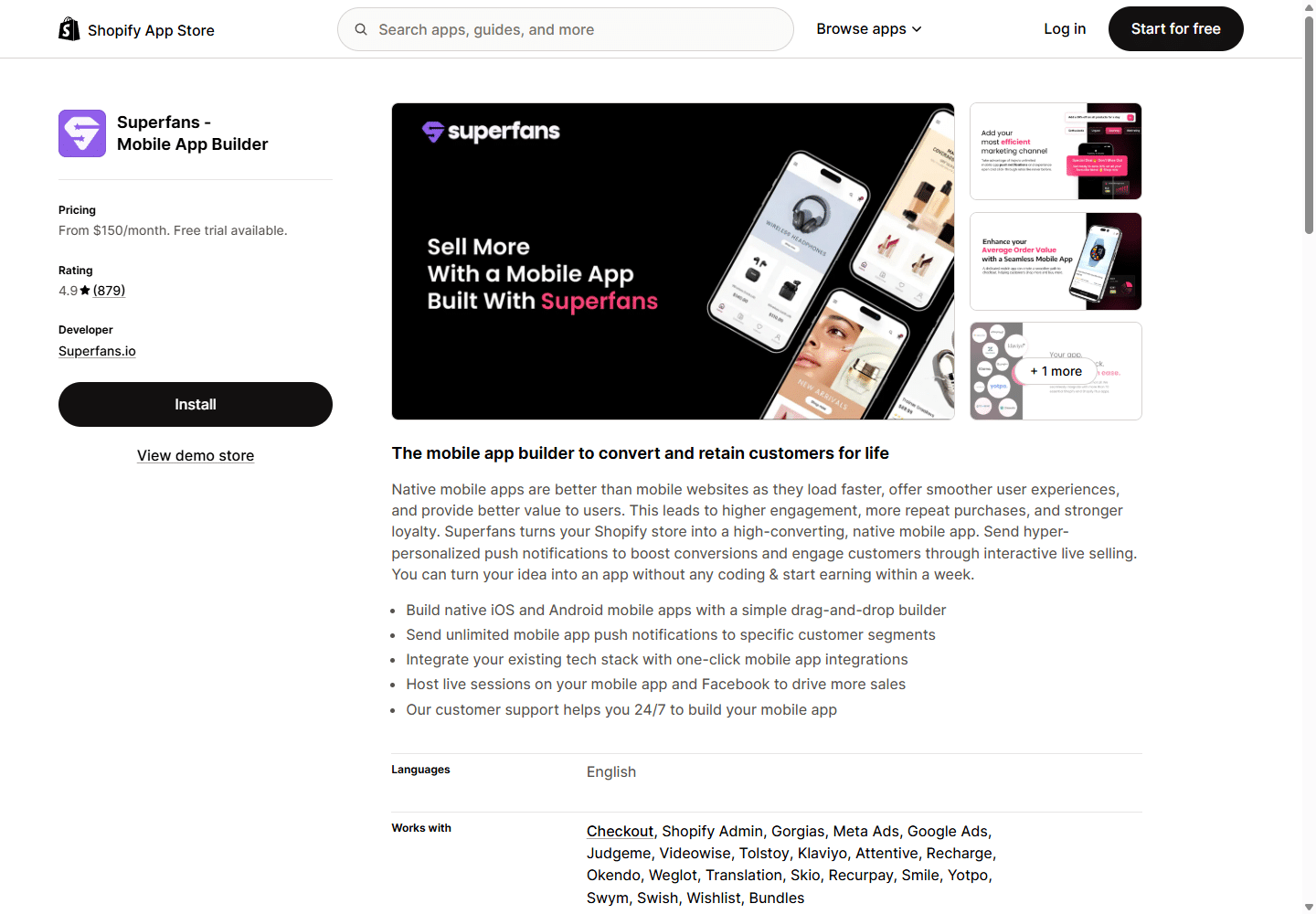
Superfans.io is the new name for the platform previously known as Vajro.
Its current positioning focuses heavily on retention and on helping brands create a dedicated experience for their most valuable customers.
The core idea is that an app should offer more than another way to access the same product catalog. Brands can use it to provide early access, exclusive products, app-only discounts, personalized attention and other VIP benefits.
That makes Superfans particularly interesting for brands with strong communities, frequent product drops or customers who buy repeatedly.
The platform still provides the functionality expected from a Shopify mobile app builder, including drag-and-drop design, push notifications, integrations and synchronized ecommerce data.
Superfans currently advertises more than 70 integrations, support for 18 languages and 82 currencies, and 24-hour customer support. It also allows brands to create custom blocks by connecting its SDK with Claude.
Notable features
- App-exclusive products and discounts
- Early access and VIP shopping experiences
- Push-powered customer journeys
- Gift-with-purchase functionality
- Live selling
- More than 70 integrations
- Support for multiple languages and currencies
- SDK access for custom app blocks
Best suited to
Superfans is best suited to Shopify brands that see their app primarily as a customer loyalty and retention channel.
It is especially relevant for brands with product drops, highly engaged communities, loyalty programs or a meaningful base of high-value repeat buyers.
Pricing
Superfans currently asks brands to book a demonstration and select a plan based on their requirements. Its website offers a 30-day trial during which merchants can build, publish and promote their app.
Because pricing may vary according to brand size and requirements, confirm the complete subscription, integration and support costs directly with the company.
What to consider
The strongest case for Superfans comes when a brand already has an identifiable group of loyal customers to serve.
An app cannot create customer loyalty by itself. Brands still need enough repeat demand, product interest and promotional reach to persuade customers to download and continue using it.
5. Plobal Apps
Best for push campaigns and app personalization
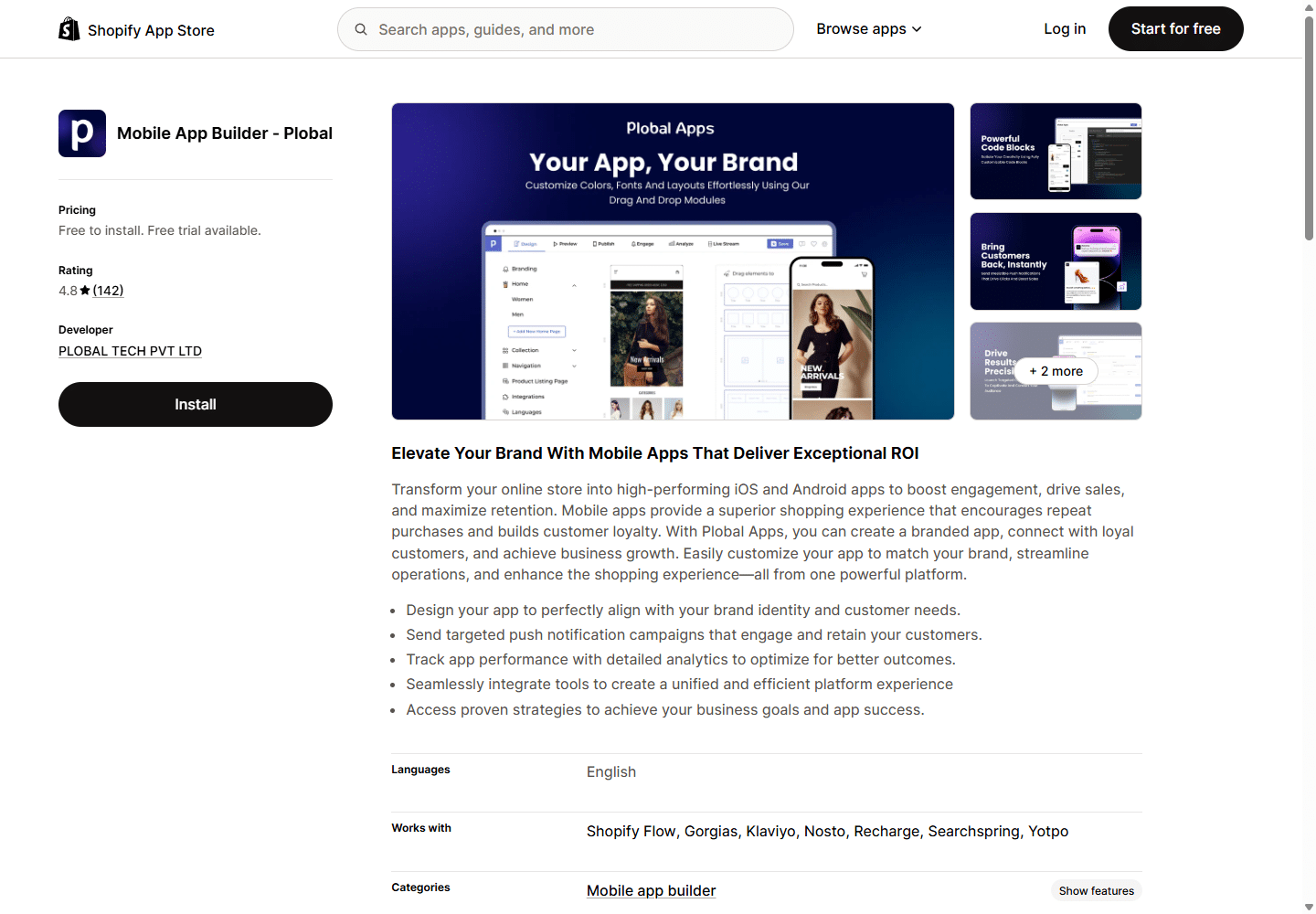
Plobal Apps is a long-running Shopify mobile app builder that lets merchants create native iOS and Android apps using a drag-and-drop interface.
Its entry plan covers the core requirements for launching an ecommerce app, including native apps, push notifications, standard integrations, real-time analytics and customer support.
Higher plans add more advanced retention and personalization features.
These include abandoned-browse campaigns, segmented push notifications, product filters, Apple Pay, custom fonts, multiple page setups and personalized app content.
That progression makes Plobal a practical option for brands that want to begin with a relatively standard app and add more sophisticated marketing functionality as the channel grows.
Notable features
- Native iOS and Android apps
- Drag-and-drop app builder
- Unlimited push notifications
- Real-time analytics
- Abandoned-browse campaigns
- Segmented notifications
- App personalization on higher plans
- Apple Pay support
- Advanced integrations on the Enterprise plan
Best suited to
Plobal is best suited to small and mid-market Shopify brands that place particular importance on push notifications, automated campaigns and personalized app experiences.
Its tiered structure also makes it possible to begin with the basic platform and move into more advanced functionality later.
Pricing
Plobal’s standard plan starts at $199 per month and includes native iOS and Android apps, four standard integrations and unlimited push notifications.
Its Essential plan costs $499 per month and adds features including abandoned-browse campaigns, user segmentation and Apple Pay.
The Enterprise plan costs $1,199 per month and includes a 1% fee on total in-app sales. It adds unlimited advanced integrations, personalization, multiple pages and priority support.
What to consider
Plobal’s Enterprise revenue share can become a material cost as app sales grow.
A brand generating $100,000 per month through the app would pay $1,000 per month in revenue share before the platform subscription and any other costs.
Brands should model this against expected app revenue rather than comparing only the headline monthly fee.
6. Apptile
Best for live commerce and flexible visual merchandising
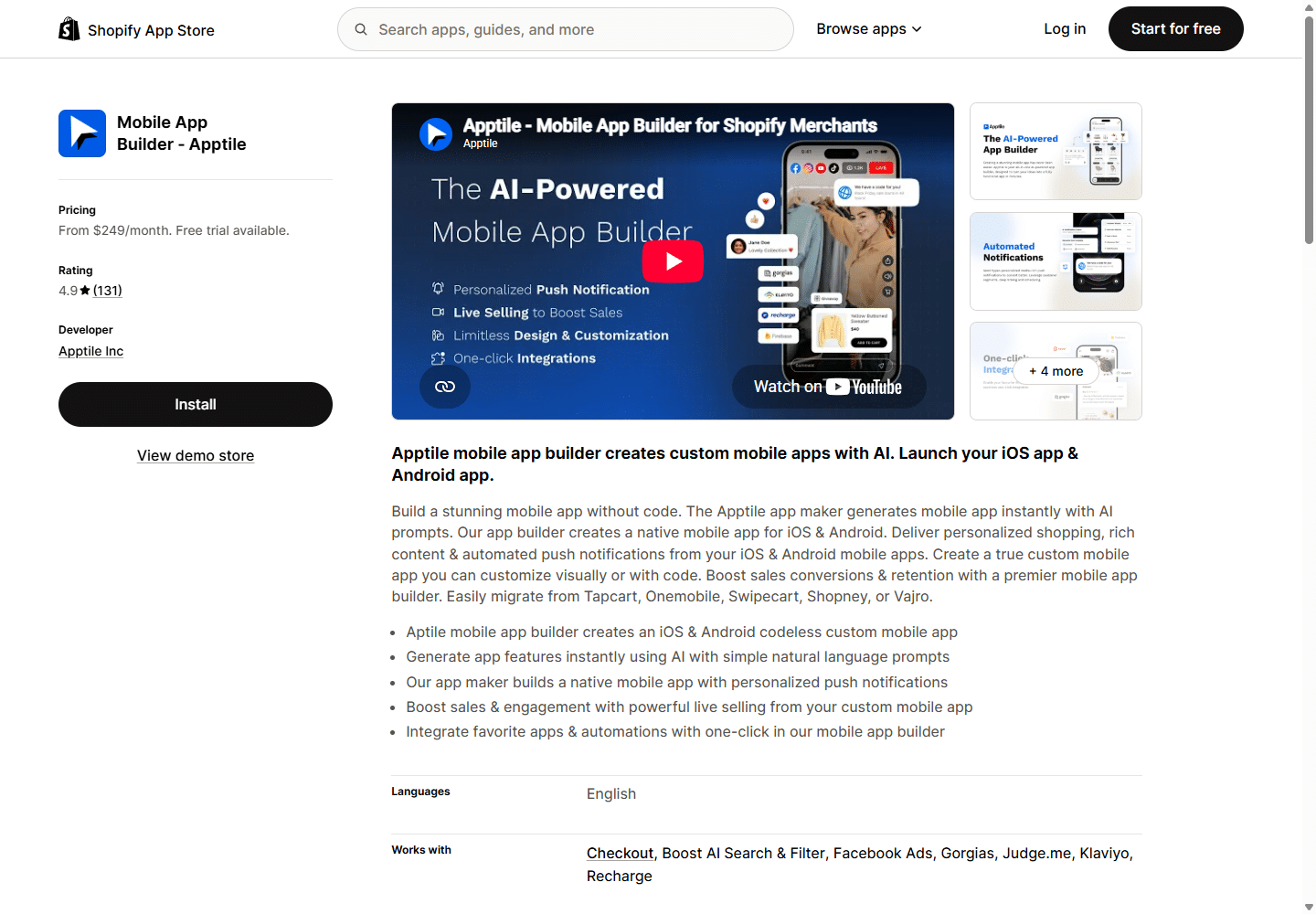
Apptile is a design-focused no-code app builder for Shopify.
Its visual system is based on configurable “tiles.” Brands can choose from a large library of prebuilt components, arrange them into app screens and customize the resulting experience.
The platform is notable for combining standard ecommerce functionality with more interactive forms of merchandising.
Its Pro plan includes live video selling, multistreaming, shoppable feeds and unlimited push notifications. The Plus plan adds custom product and cart pages, AI-powered video clips, polling, preorders, waitlists and automated notifications.
Apptile also provides more technical flexibility at the enterprise level through custom tiles, custom themes, a visual development editor, an SDK, a command-line interface and a developer sandbox.
Notable features
- More than 300 design tiles
- Live video selling
- Streaming to Facebook, Instagram, TikTok and YouTube
- AI-assisted push notification copy
- Custom product and cart pages
- AI Pop Clips and shoppable video
- Preorders and waitlists
- Tile SDK and developer tools on enterprise plans
Best suited to
Apptile is particularly well suited to visually driven brands and those interested in live commerce, product launches or interactive merchandising.
Fashion, beauty and lifestyle brands may find its video, content and design features especially useful.
Pricing
Apptile’s Pro plan costs $249 per month and includes more than 300 design tiles, unlimited standard integrations, unlimited push notifications and live video selling.
The Plus plan costs $499 per month and adds custom product and cart pages, advanced analytics, premium integrations, video clips, preorders and automated notifications.
Enterprise pricing is customized. Live-selling plans include 50,000 viewer minutes per month, after which additional usage fees apply.
What to consider
Some of Apptile’s most distinctive features are concentrated on its higher plans.
Before choosing it, determine which features are central to your app strategy and which are simply attractive additions. A brand that does not plan to use live video or interactive content may be better served by a simpler platform.
7. Appmaker
Best for customization and developer extensibility
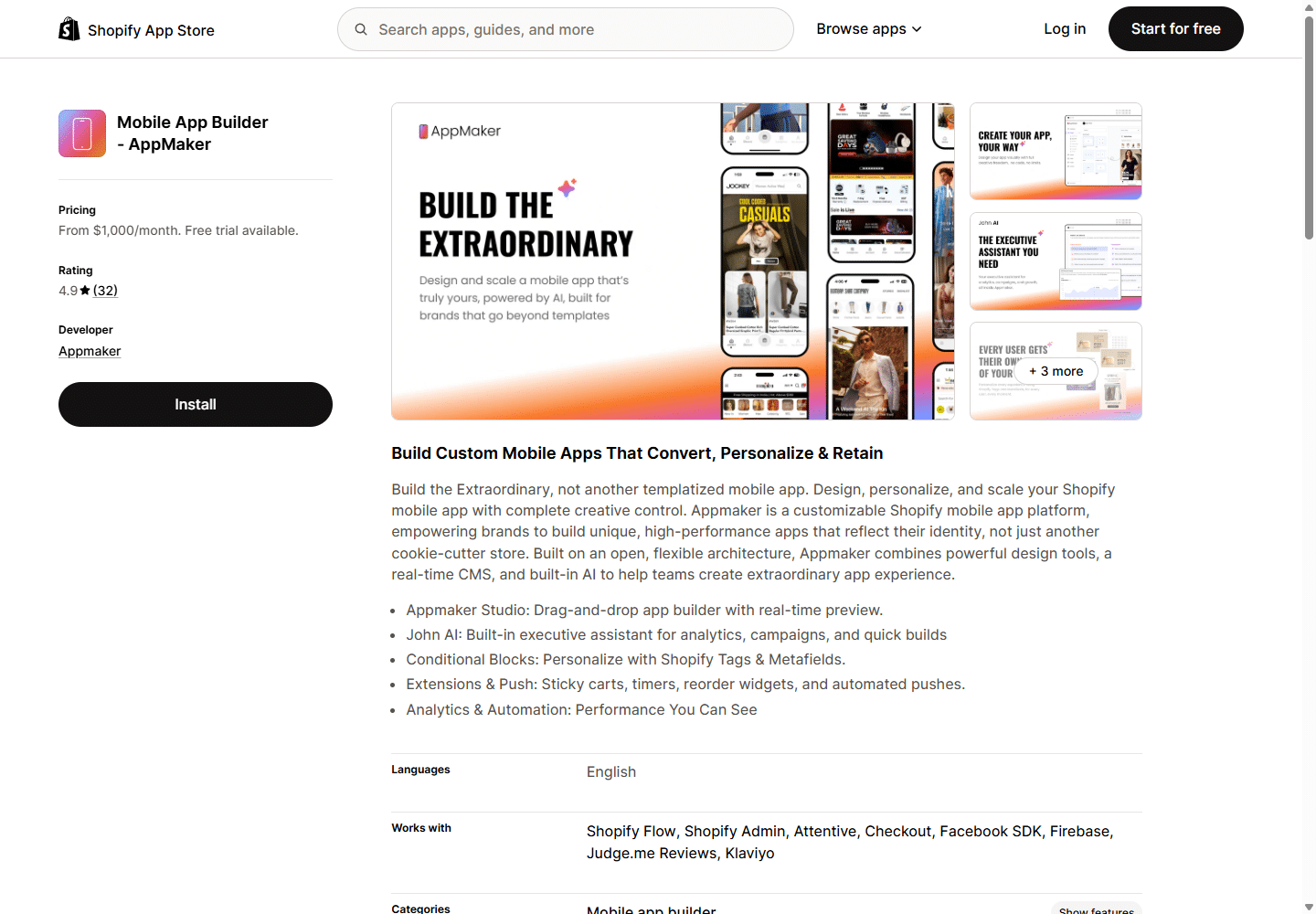
Appmaker is a customizable Shopify mobile app platform aimed at brands that want more control than a standard template-based builder provides.
It combines a visual content management system with a more open architecture, allowing brands to create custom layouts and extend the app through additional components and integrations.
Products, customer information, inventory and orders remain connected to Shopify, while app-specific layouts and content are managed through Appmaker.
The platform supports more than 160 integrations and positions itself around creative flexibility, personalization and scalability.
Appmaker’s real-time CMS lets teams update app content without submitting a new version to the app stores for every merchandising change.
It also provides built-in AI tools intended to help teams generate layouts and app components more quickly.
Notable features
- Real-time app CMS
- Flexible layout and design controls
- More than 160 integrations
- Conditional content using Shopify data
- Built-in AI design tools
- Custom components and integrations
- Developer access on advanced plans
Best suited to
Appmaker is best suited to larger Shopify brands that want greater design flexibility and expect to extend the app beyond standard no-code components.
It may be especially relevant when a brand has access to internal developers or an agency that can take advantage of its more technical capabilities.
Pricing
The Shopify App Store currently lists Appmaker from approximately $1,000 per month.
Its enterprise offering starts at $2,000 per month and includes a 1% fee on in-app sales. Custom solutioning or one-time development work may be priced separately.
What to consider
Appmaker is positioned considerably above entry-level mobile app builders.
The subscription, revenue share and potential development costs mean that brands should have a clear reason for choosing its customization capabilities. Otherwise, they may be paying for technical flexibility they do not use.
How To Choose The Right Shopify Mobile App Builder
So which of the platforms named above is the right choice for your store?
There’s no single “best” answer for every brand. But there are a few questions you can ask to get to one that works best for your brand, in particular.
Here are five specific questions to ask yourself, when reviewing a tool:
- Does it support our full tech stack? The tools that power your loyalty program, subscriptions, custom pages; are they compatible with the app builder too?
- How much work do we need to do? Are you looking at having to build a whole new storefront? Do you have the bandwidth for something like this?
- How much work is it to maintain? Once you launch, how much day-to-day will it take to keep your app running?
- What’s the full cost – everything included? Look at the subscription cost, as well as the cost of the time you spend managing it, and any extras like revenue share, and consider the long-term cost of ownership.
- Does it align with our goals? Think about the goal for your app. Do you want to launch a high-touch sales channel or an extension of your web store? How does the app builder align with that?
Every platform will claim they’re the best. The one that answers each of these questions in the way you want is the actual best Shopify mobile app builder for your store.
That could be MobiLoud, it could be Tapcart, or it could be a niche tool that fits better alongside how your business operates.
Whatever it is, there are fewer barriers than ever stopping you from launching a real, native mobile app for your brand, and getting a new, powerful, direct line to your customer’s phone.
