
5 Best AI Tools for Creating Shopify Product Pages From a Product URL in 2027
Creating a Shopify product page from an existing listing can involve several repetitive tasks: collecting product information, preparing descriptions, organizing images, selecting a layout, and publishing the finished page.
AI tools can simplify this process, but not every platform that accepts a product URL produces the same result.
Some generate individual Shopify product pages. Others build entire storefronts around imported products, while design-focused builders use URLs as visual references.
For merchants comparing AI product page tools in 2027, understanding these differences is essential.
Which AI Tools Can Create Shopify Pages From URLs?
| Tool | URL Workflow | Starting Paid Price |
| PagePilot | Product URL to editable product page | $39/month |
| Atlas AI | Product URL to pages or storefront layouts | $39/month |
| DropMagic | Product-driven storefront generation | $79/month |
| GemPages | Visual reference to editable layout | $29/month |
| Instant | Website reference to Shopify design | $39/month |
1. PagePilot — Best for Frequent Product URL-to-Page Generation
PagePilot focuses on turning existing ecommerce product listings into editable Shopify product pages.
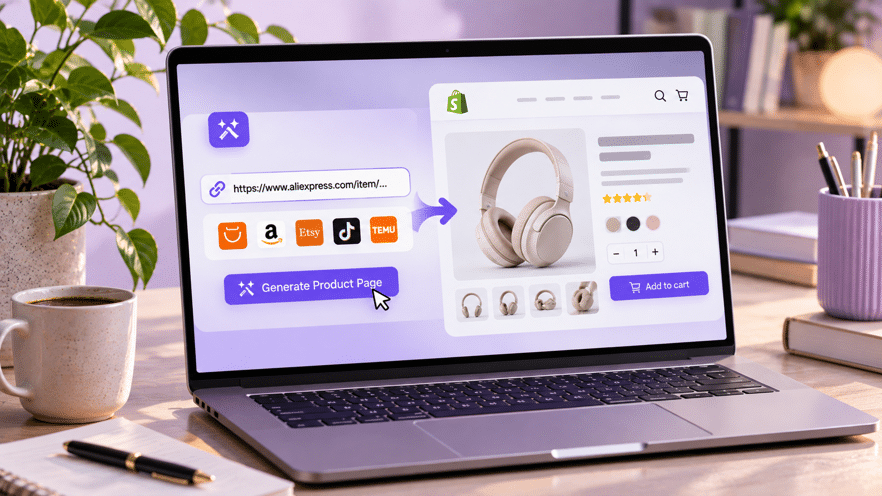
Merchants can paste a supported product URL, choose a template, and generate a page with AI-assisted descriptions, images, and product-focused sections.
Supported sources include Shopify stores and marketplaces such as AliExpress, Amazon, Etsy, and TikTok Shop.
Once the page is generated, merchants can edit its text, imagery, and layout through a visual editor before publishing it to Shopify.
PagePilot also offers product angle suggestions, AI text and image editing, more than 35 customizable conversion-oriented sections and blocks, and multilingual content support.
This makes the platform particularly useful for stores that frequently introduce new products.
A merchant testing several home organization products, for example, could generate individual pages, adjust their messaging, and publish them to the same Shopify storefront.
The AI Shopify product page builder provides a repeatable workflow from product link to editable Shopify page.
Pricing: Lite costs $39/month and includes 10 product or homepage generations and 50 AI images. Starter costs $59/month and includes unlimited page generation, 200 AI images, and three connected Shopify stores.
Best for: Shopify merchants who regularly generate individual product pages from existing product URLs.
Consideration: The Lite plan includes 10 page generations per month, so merchants testing a larger number of products may need to upgrade to Starter for unlimited generation.
2. Atlas AI — Best for Product Pages and Broader Storefront Creation
Atlas is a direct competitor in product URL-based generation.
Merchants can provide product links or select products from their existing Shopify catalog to generate pages and storefront layouts.
Atlas supports product pages alongside broader store creation workflows, making it relevant to merchants who want to prepare several connected pages rather than one isolated listing.
The platform also provides ecommerce features such as bundles and cart upsells.
For example, a merchant launching a small collection of related fitness accessories could use Atlas to prepare product pages and supporting storefront content.
Pricing: The Base plan starts at $39/month. Additional usage or capabilities may affect the total subscription cost.
Best for: Merchants who want product URL importing alongside broader Shopify storefront creation.
Consideration: Atlas builds within a Shopify theme, and merchants should review the plan’s publishing and usage allowances before subscribing.
3. DropMagic — Best for Product-Driven Dropshipping Store Launches
DropMagic approaches product URL generation from a storefront perspective.
Rather than concentrating only on individual product pages, it uses product information to help create a branded Shopify store.
The platform supports AI-assisted product messaging, storefront layouts, and audience-specific positioning.
For example, a merchant launching a travel accessories business could prepare a storefront around a selected product and tailor the messaging to its intended audience.
This makes DropMagic more relevant to a new business launch than a merchant who simply wants to add one product page to an established store.
Pricing: Free store generation and preview are available. The Pro plan costs $79/month and is required for Shopify publishing.
Best for: Dropshippers who want to create a new Shopify storefront around an existing product.
Consideration: Merchants needing only individual product pages may find the complete-store workflow more extensive than necessary.
4. GemPages — Best for Recreating Product Page Layouts
GemPages serves a different purpose from product URL importers.
Its GemAI Image-to-Layout functionality helps merchants turn visual references into editable page layouts.
A merchant might want to recreate the general structure of a product page, including its image arrangement, benefits section, and purchase information.
GemPages can assist with that design process through its visual editor.
It also supports product pages, landing pages, and sales funnels.
However, using a reference to recreate a layout is different from importing a supplier’s product information and generating the entire page.
Pricing: Free plan with one published page. Build costs $29/month, Optimize $59/month, and Enterprise $199/month.
Best for: Merchants who want to recreate or customize the visual structure of Shopify product pages.
Consideration: GemPages is primarily a page design and customization platform, not a dedicated product URL importer.
5. Instant — Best for Design-Led Shopify Page Creation
Instant supports AI-assisted Shopify design using prompts, screenshots, website URLs, and Figma references.
Merchants can provide a visual reference and use its AI Agent to create an editable layout.
This makes Instant particularly useful for brands that already have a specific design direction.
Its reusable sections and templates also help merchants maintain consistency across multiple pages.
For example, a fashion retailer could create several product layouts that share the same visual identity.
Pricing: Starter costs $39/month and includes unlimited landing pages, 10 Shopify theme sections, three product or collection templates, and 1,000 AI credits. A free Developer plan is available for development stores.
Best for: Merchants who want to create Shopify layouts from design references.
Consideration: Instant’s URL workflow is design-oriented rather than a dedicated supplier product import process.
Product URL Import vs. Design Reference
These tools support three distinct workflows.
Product information import: PagePilot and Atlas use product information to help generate Shopify pages.
Product-driven store generation: Atlas and DropMagic support broader storefront creation based on selected products.
Design-reference generation: GemPages and Instant help merchants recreate or adapt visual layouts.
A merchant adding 20 products to an existing store may prefer a repeatable product page generator.
Someone launching a new store around a single product may benefit more from complete storefront creation.
A designer working from a screenshot or Figma file has a different requirement altogether.
Can You Reuse Images and Descriptions From Another Website?
The ability to import product information does not automatically provide permission to reuse third-party content commercially.
This matters when importing products from Amazon, Etsy, AliExpress, or other marketplaces.
Product photographs, graphics, and original descriptions may be protected by copyright or subject to supplier licensing restrictions.
Merchants should obtain authorized product images where possible, prepare original descriptions, and verify factual specifications.
AI rewriting or image editing does not automatically resolve intellectual property concerns.
The safest approach is to treat imported information as a starting point, not proof that every asset can be reused.
How to Choose the Right Tool
| Requirement | Tools to Compare |
| Generate individual product pages frequently | PagePilot, Atlas |
| Create a store around imported products | Atlas, DropMagic |
| Recreate a page’s visual layout | GemPages, Instant |
| Work from screenshots or design references | Instant, GemPages |
| Streamline product page publishing | PagePilot |
Merchants should also compare supported source websites, subscription limits, editing flexibility, and the rights associated with imported content.
Frequently Asked Questions
Can AI create a Shopify product page from an AliExpress URL?
Yes. PagePilot and Atlas support product URL-based workflows that can use AliExpress listings. Merchants should confirm source compatibility and review the generated content before publishing.
Does a URL-to-page tool automatically copy another website’s design?
Not necessarily. Product import tools use listing information, while design-reference builders focus on page appearance. These are different capabilities.
Can AI create a complete Shopify store from a product link?
Some tools, including Atlas and DropMagic, support product-driven storefront generation. Other platforms focus on individual pages.
Are supplier product images free to reuse?
Not automatically. Commercial usage rights depend on the image’s ownership and applicable licensing or supplier terms.
Final Thoughts
AI tools can reduce the manual work involved in creating Shopify pages, but their workflows are not interchangeable.
PagePilot is particularly relevant for repeated product URL-to-page generation. Atlas supports product pages and broader storefront creation, while DropMagic focuses on launching product-driven stores.
GemPages and Instant are better suited to design-reference workflows.
Choosing the right tool starts with identifying whether the goal is to import product information, generate a storefront, or customize a visual layout.
