

Best AI Tools for Character Consistency in Microdrama and Series
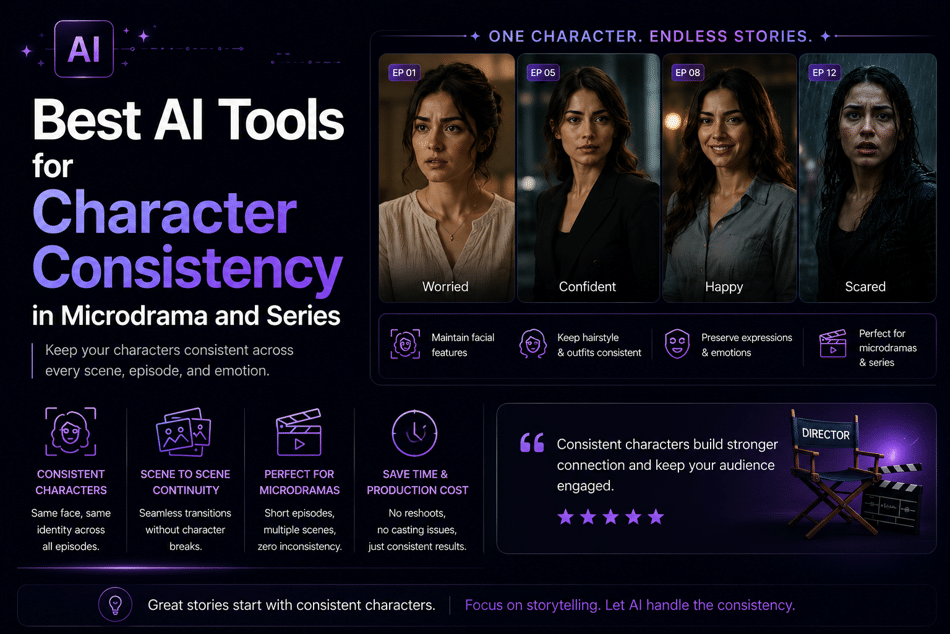
A single inconsistent frame breaks the illusion for a viewer faster than a rough camera move or a stiff line of dialogue ever could, and in a microdrama or episodic series, that inconsistency has to survive not just one scene, but dozens of episodes shot over weeks or months.
Single-clip character consistency is close to a solved problem across the leading AI video tools in 2026. What’s still genuinely hard is holding one character’s identity across an entire season, and handling scenes where two characters physically interact within the same shot.
This list covers tools specifically suited to that longer-horizon problem, season-long consistency and multi-character scenes, rather than general single-clip character quality.
How We Evaluated These Tools
Four things mattered most for series and microdrama work specifically: whether identity survives across many separate episodes and sessions, not just one clip; how the tool handles multi-character scenes and physical interaction; how much setup time a persistent identity requires; and whether the workflow supports the fast turnaround a serialized format demands.
The Tools at a Glance
| Tool | Best for | Identity method | Episode turnaround |
| Invideo Agent | Full-series consistency, including multi-character scenes | Locked multi-angle reference sheet | Fast, reference reused automatically |
| HeyGen | Persistent presenter identity across a season | Trained avatar model | Setup once, then fast |
| LTX Studio (Elements) | Reusable character and location assets in one project | Saved, tagged reference assets | Fast within a project |
| Crreo AI | Purpose-built, all-in-one microdrama workflow | In-app character setup | Fast, phone-friendly |
| OpenArt AI | Accessible character consistency for solo creators | Reference images | Fast |
Pricing and exact feature specs shift quickly in this category, confirm current details on each provider’s site before publishing.
Invideo Agent: Best for Full-Series Consistency, Including Multi-Character Scenes
Invideo Agent locks a character’s identity through a multi-angle reference sheet, front, three-quarter, profile, and back, plus face close-ups, generated at high resolution, so the same reference carries across every episode in a series without re-uploading or re-describing the character each time. This character consistency system also catches its own drift: if a shot comes back with the wrong face, wardrobe, or room, the agent flags what failed and regenerates that shot until it matches, rather than leaving continuity checks to a human reviewer.
For the harder case, two characters in physical contact, where identity can blur at the point of contact, a hand-drawn sketch of the physical configuration gets fed in as a visual reference alongside the character sheets, giving the agent spatial information a text prompt alone can’t convey.
Best for: Series and microdrama productions that need one or more recurring characters to hold up across many episodes, including scenes with direct physical interaction between characters.
Where it falls short: The reference-sheet workflow is a genuine production step rather than a one-click toggle, asking more setup time upfront than tools built purely for single-image or single-clip consistency.
Pricing: Plans start at $17/month, scaling to $900/month for the highest tier, credit-based across all plans.
HeyGen: Best for a Persistent Presenter Identity Across a Season
HeyGen is built around a persistent avatar identity, a spokesperson or recurring on-screen presence that stays visually and vocally consistent across many separate videos, rather than being re-cast for every new piece of content.
Its localization tools let that same persistent character speak multiple languages while remaining visually identical, which is useful for a series distributed across international audiences without recasting for each market.
Best for: Productions built around a consistent recurring presenter or spokesperson-style character who needs to appear the same way across an entire season, potentially in multiple languages.
Where it falls short: Built around the presenter/avatar format specifically, not suited to narrative scenes with multiple interacting characters or complex blocking, where identity needs to hold up beyond a single fixed on-screen presence.
LTX Studio (Elements): Best for Reusable Assets Within One Project
LTX Studio’s Elements feature treats characters, objects, and locations as reusable assets that get saved once and dropped into unlimited future shots within the same project, tagged and called up by creators as needed rather than re-described from scratch.
This fits naturally with episodic work, since a season’s recurring characters and locations become a standing library within the project rather than a per-episode setup task.
Best for: Teams producing a series within a single ongoing project who want characters, props, and locations to function as a shared, reusable library.
Where it falls short: More focused on video generation broadly than on precise, fine-grained consistency control for the hardest cases, like multi-character contact scenes.
Crreo AI: Best for a Purpose-Built Microdrama Workflow
Crreo is built specifically for the microdrama format, it segments a script into scenes aligned with narrative pacing, handles character consistency, dialogue, 9:16 export, voiceover, and music inside one workflow, and exports platform-ready vertical episodes with auto-generated thumbnails.
Its integrated approach keeps character setup, voice, music, and subtitles inside one timeline, which removes the export-import overhead of stitching together a multi-tool stack, a meaningful advantage for a solo creator publishing daily or weekly.
Best for: Solo creators or small teams publishing frequent, short vertical episodes who want one integrated workflow rather than assembling separate tools for each production step.
Where it falls short: Edits are largely scene-level (reorder, regenerate, swap a shot) rather than frame-level, which suits fast serialized publishing but offers less granular control than a dedicated previz-and-shot-planning workflow.
OpenArt AI: Best for Accessible Consistency From a Few Reference Photos
OpenArt Characters lets creators build a consistent AI character from a single image or a small set of reference photos, rather than requiring a large training dataset, a lower-friction entry point for solo creators, marketers, and illustrators.
Best for: Solo creators and small teams who want a reliable, reusable “character ID” without a heavier training or reference-sheet process.
Where it falls short: Reference-based consistency from a small photo set generally holds up less reliably across extreme angle changes or very high shot counts than a trained-identity approach.
Which One Should You Use?
Full-series consistency, including multi-character physical interaction: Invideo Agent.
A persistent presenter or spokesperson identity across a season, in multiple languages: HeyGen.
Reusable character and location assets inside one ongoing project: LTX Studio’s Elements.
A single, integrated, phone-friendly microdrama workflow: Crreo AI.
The lowest-friction entry point for solo creators: OpenArt AI.
Common Mistakes When Choosing a Character Consistency Tool for a Series
- Assuming single-clip consistency guarantees season-long consistency. A tool that holds a face steady within one clip doesn’t guarantee it holds up across dozens of episodes shot over weeks or months.
- Ignoring multi-character interaction until it breaks mid-season. Two well-locked characters can still blur into each other the moment they physically interact, as of mid-2026, this remains a weak point across every current platform.
- Choosing a heavier trained-identity workflow for a fast-turnaround, low-budget series. Training time is worth it for genuine season-long reuse, but it can slow down a daily or weekly publishing cadence if not planned for.
- Scattering assets across five disconnected tools. Running character references, voice, music, and editing through separate unconnected apps is where solo producers tend to stall, references get pasted wrong, and per-episode assembly turns into hours of export-import work.
- Underestimating setup time for a multi-episode series. A reference-sheet or trained-identity workflow asks for real upfront time, budget for it once, rather than treating it as a per-episode task.
FAQ
Is character consistency across an entire series harder than within a single clip?
Yes. Holding a character steady within one clip is close to solved across leading tools in 2026. Holding that same identity across dozens of separate episodes, sessions, and shots, without drift accumulating over time, remains the harder, less-solved problem.
Do trained-identity tools work better than reference-image tools for a season-long series?
Trained-identity approaches tend to hold up better across a high shot count or extreme angle changes since the identity is baked into a model rather than re-read from an image each time. Reference-image and reference-sheet tools are generally faster to set up but can drift more over a long-running season if not locked carefully.
Can any current tool fully solve multi-character physical interaction?
Not reliably, as of mid-2026, two characters interacting in the same shot still produce identity blurring across most platforms. Some tools, including invideo Agent, address this with a supplementary technique (a hand-drawn configuration sketch) rather than claiming it’s fully solved by reference sheets alone.
What’s the biggest workflow risk for a solo creator producing a microdrama series?
Scattering character, voice, music, and editing across separate disconnected tools. All-in-one workflows built for the format, or an agent that keeps character references in persistent project memory, remove most of the export-import overhead that causes solo producers to stall mid-season.
